Travel Kits for Employees and Executives: What to Include for Work Trips
Travel Kits for Employees and Executives: What to Include for Work Trips
There is a particular kind of corporate gift that gets used within hours of being received. It is not the desk accessory that sits in a drawer, and it is not the hamper that is eaten and forgotten. It is the travel kit handed to an employee the day before a work trip — opened on the flight, used in the hotel, and still in the bag on the next trip, and the one after that.
A travel kit works because it solves a real, immediate problem. Anyone who travels for work knows the small frictions: the charging cable left at home, the toiletries that leaked in the bag, the neck that aches after a red-eye, the passport buried at the bottom of a backpack at check-in. A well-assembled kit removes those frictions in advance, and the employee notices — not in the abstract way people notice a generic gift, but in the concrete way of finding the right thing in the bag at exactly the moment it is needed. That is a rare quality in a corporate gift, and it is the reason travel kits have become one of the most practical items in a corporate gifting programme.
But a travel kit is also easy to get wrong. Fill it with cheap, single-use items and it becomes clutter that gets thrown away at the hotel. Fill it with items the traveller already owns three of and it becomes a polite burden. Brand it too loudly and a senior executive will leave the whole kit at home rather than carry your logo through an airport. The difference between a kit that travels and a kit that gets discarded is entirely in the choosing — what goes in, what stays out, how it is matched to the traveller, and how it is packed, branded and delivered. This guide gives HR, procurement, admin and executive teams the complete framework: the core essentials, the executive upgrades, the trip types that change the contents, the branding and budget decisions, and the ordering and delivery mistakes that ruin an otherwise good kit.
The gifts for field sales teams guide on this site covers lightweight, durable gifts for people who are always on the move, and a travel kit is the natural companion to that thinking — this article is the deep companion that goes item by item, so a buyer can build a kit with confidence instead of guessing.
Why Travel Kits Work as Corporate Gifts
Most corporate gifts are evaluated on the day they are received. A travel kit is evaluated over months, on every trip the recipient takes. That is the first reason it works: the cost per use falls with every journey. A kit that is used on ten trips has delivered ten moments of usefulness for one purchase price, and very few gifts in the usual corporate price bands can claim that.
The second reason is fit. A travel kit is one of the few gifts that suits almost every kind of employee. It does not assume anything about the recipient’s size, diet, hobbies or lifestyle — the traps that catch so many other gifts. A sales executive, a consultant, a CXO and a conference speaker all travel, and all of them face the same small frictions. The contents change by seniority and trip type, but the idea itself is universal, which makes it one of the easiest items to standardise across a large, diverse workforce.
Third, travel kits fit almost every gifting occasion. They work as welcome-kit items for new joiners who will travel, as pre-trip gifts before a conference or an offsite, as recognition gifts for field teams, as executive gifts for CXOs and board members, and as festive-season gifts for the frequent travellers in the organisation. They also photograph well: a neatly packed kit in an open gift box is one of the most shareable images in a gifting programme, and that unboxing moment is part of the gift’s value.
There is also a human argument. Travel for work is tiring in ways that are easy to underestimate — early flights, late check-ins, unfamiliar hotels, long days with clients. A company that sends an employee on a trip with a thoughtful kit is saying something specific: we know this trip costs you something, and we prepared for it. That message lands differently from a generic gift, because it is tied to a real experience the recipient is about to have. The quarterly and annual award gifts framework on this site shows how recognition gifting works best as a system rather than a one-off gesture — and a travel kit fits that system well as a repeatable item for a team that travels often, rather than a single expensive statement piece.
None of this makes travel kits the right choice for every programme. A team that never travels does not need one. But for any organisation with people on the road — and in India, that is a large share of corporate teams — a travel kit deserves a proper evaluation, which is what the rest of this guide does.
The Core Travel Kit: What Every Kit Should Include
A good travel kit is built in layers. The core layer is the same for almost every traveller, and it is the layer that should be decided first. Everything after that is an upgrade or a specialisation. The core items below are chosen on three tests: the traveller will use it on almost every trip, it survives being carried and repacked, and it is genuinely better than the version the traveller would buy for themselves at the airport.
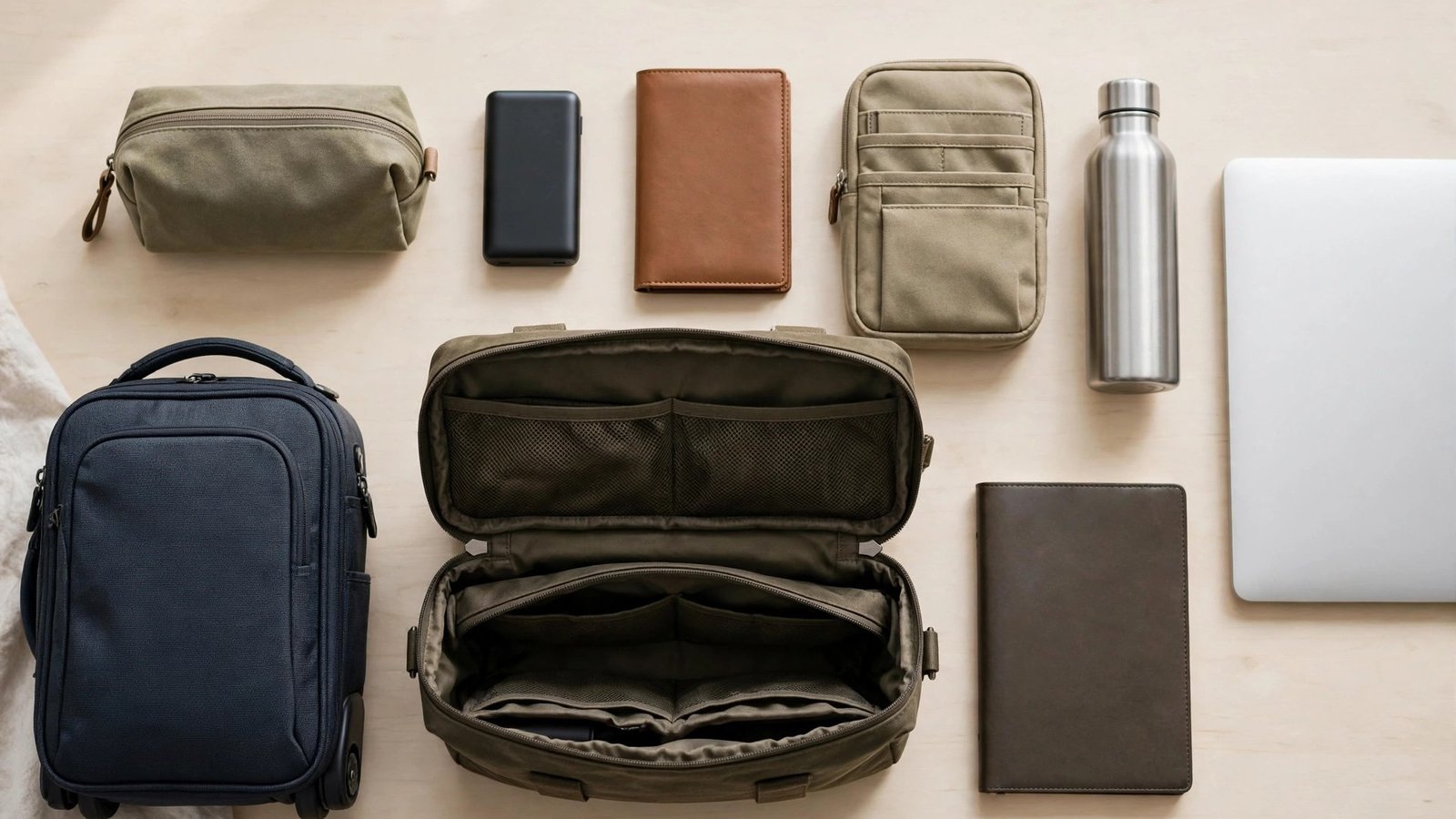
A quality toiletry pouch. This is the heart of the kit, and it is where cheap kits fail first. A good pouch is water-resistant, opens flat so contents are visible, has a hook or a handle, and keeps liquids contained when a bottle leaks. It should be sized for cabin baggage, not for a holiday suitcase. If the pouch is flimsy, the whole kit feels flimsy, because the pouch is the item the recipient touches most.
Travel-size toiletries, chosen with care. The toiletries in a kit should be genuinely useful, not decorative miniatures of products nobody uses. A solid, practical set is a moisturiser, a lip balm, a hand sanitiser and a small sunscreen — items that get used on a flight and in a hotel. Avoid strongly scented products, because scent is personal and a wrong choice makes the whole kit unwelcome. Avoid anything that looks like a free sample; the toiletries should feel like a considered selection, not a clearance bundle.
A power bank and a charging cable. A power bank is the single most used item in most travel kits, which is why it deserves its own buying decision rather than being treated as a filler. The power bank corporate gifts guide on this site covers capacity, safety certification and what to avoid in detail — the short version is that a 10,000 mAh bank with a certified cell and a proper cable is the right size for a work trip, it must carry BIS certification, and it must be carried in hand luggage, never in checked baggage, under airline rules. Pair it with a short, braided multi-tip cable rather than a long, tangled one; a cable that works with the recipient’s phone is useful, and a cable that does not is clutter.
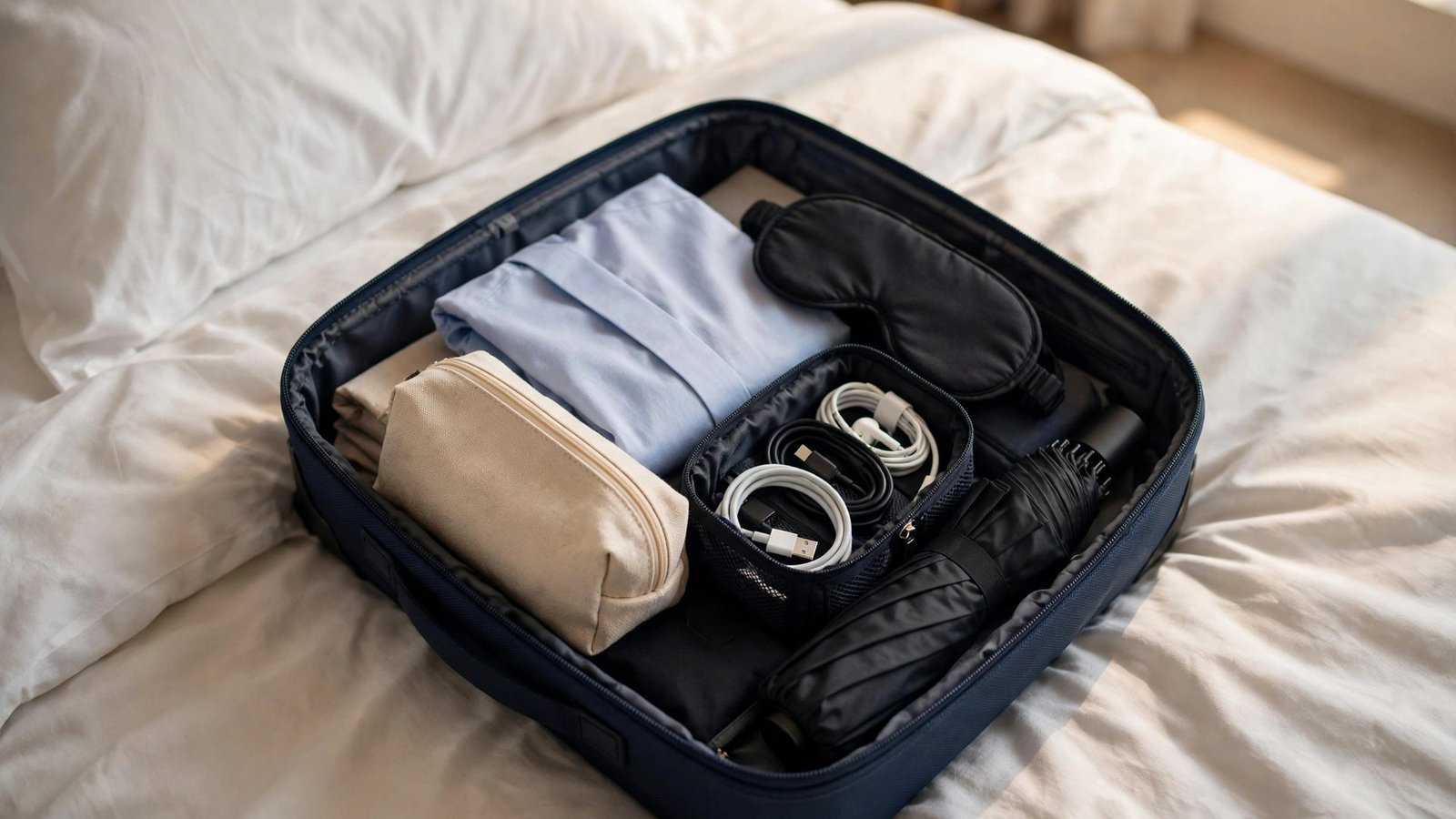
A cable organiser or tech pouch. Cables, adapters and earphones are the items that tangle, get lost and get left behind. A small, flat organiser with elastic loops or zip pockets solves that, and it is one of the cheapest items in the kit with the highest daily usefulness. It also keeps the kit looking organised after the first trip, which matters: a kit that stays tidy gets reused, and a kit that becomes a tangled mess gets abandoned.
A passport holder and a luggage tag. These two items do two jobs at once. Practically, they keep documents and bags identifiable and protected. Symbolically, they are the items that carry the brand most naturally — a debossed logo on a leather passport holder looks premium, while the same logo printed large on a bag looks like advertising. Choose a holder with space for a boarding pass and a card or two, and a tag that is sturdy enough to survive baggage handling rather than a thin card that tears on the first trip.
A sleep mask and earplugs. These are small, cheap and genuinely appreciated by anyone who has taken an early flight or slept in a hotel next to a lift. A contoured sleep mask that does not press on the eyes is worth the small extra cost over a flat one, and soft silicone earplugs beat foam ones for comfort on a long flight. They are also the items that make the kit feel thoughtful rather than transactional — someone thought about the recipient sleeping, not just about the recipient working.
A reusable steel bottle. A steel bottle is the practical, sustainable choice for a traveller, and it fits the kit well because it is used on the trip and then used again at the office. The steel bottles corporate gifting guide on this site covers grades, insulation and branding methods in detail — the short version for a travel kit is to choose a 500–750 ml bottle in 304-grade steel, with a leak-proof lid that survives being thrown into a bag, and a finish that takes engraving well. A bottle that leaks will ruin the whole kit’s reputation, so this is an item to test with a sample before ordering in bulk.
That is the core: seven items, each chosen because it will be used on almost every trip. A kit built on this core is already a good gift. Everything that follows is about making it better for a particular traveller or a particular kind of trip — not about adding items for the sake of a longer list.
Executive Travel Kits: What Changes at the Top
An executive travel kit is not a bigger version of the standard kit. It is a different product, built on different assumptions: the recipient travels more often, has higher expectations, already owns good versions of the basics, and will notice quality — or its absence — immediately. Giving a CXO the same kit as a new joiner is not generous; it is a signal that nobody thought about the recipient. The executive kit should feel like it was chosen by someone who understands how a senior leader actually travels.
The first change is material. Leather instead of synthetic, metal instead of plastic, fabric that feels substantial. A leather passport holder and a leather luggage tag, a pouch in a quality fabric with a solid zip, a bottle with a matte finish rather than a glossy one. The difference is not the logo; it is the hand-feel. An executive who carries good luggage will not carry a kit that looks cheap next to it, and the kit will stay at home if it does.
The second change is the contents. An executive kit drops the items a frequent traveller already has in abundance — another basic power bank, another generic cable — and adds the items that solve senior-traveller problems. A compact travel adapter that covers multiple countries is one. A quality noise-cancelling earphone set, or a premium sleep kit with a proper eye mask and a travel pillow that actually supports the neck, is another. A leather document organiser that holds a passport, boarding pass, cards and a pen in one place is a third. A small, elegant notebook and a good pen — the kind of pen that belongs in the premium pen sets guide on this site — completes it. The principle is simple: fewer items, each one better.
The third change is branding. On an executive kit, branding should be quiet. A small debossed logo on the passport holder, an engraved mark on the bottle, a subtle tone on the pouch. Nothing large, nothing printed in bright colour, nothing that turns a personal item into a billboard. The gifts for investors and board members guide on this site makes the same point about premium gifting etiquette: at senior levels, restraint is the brand. If the recipient would be embarrassed to use the item in front of a client, the branding has failed, however good the item is.
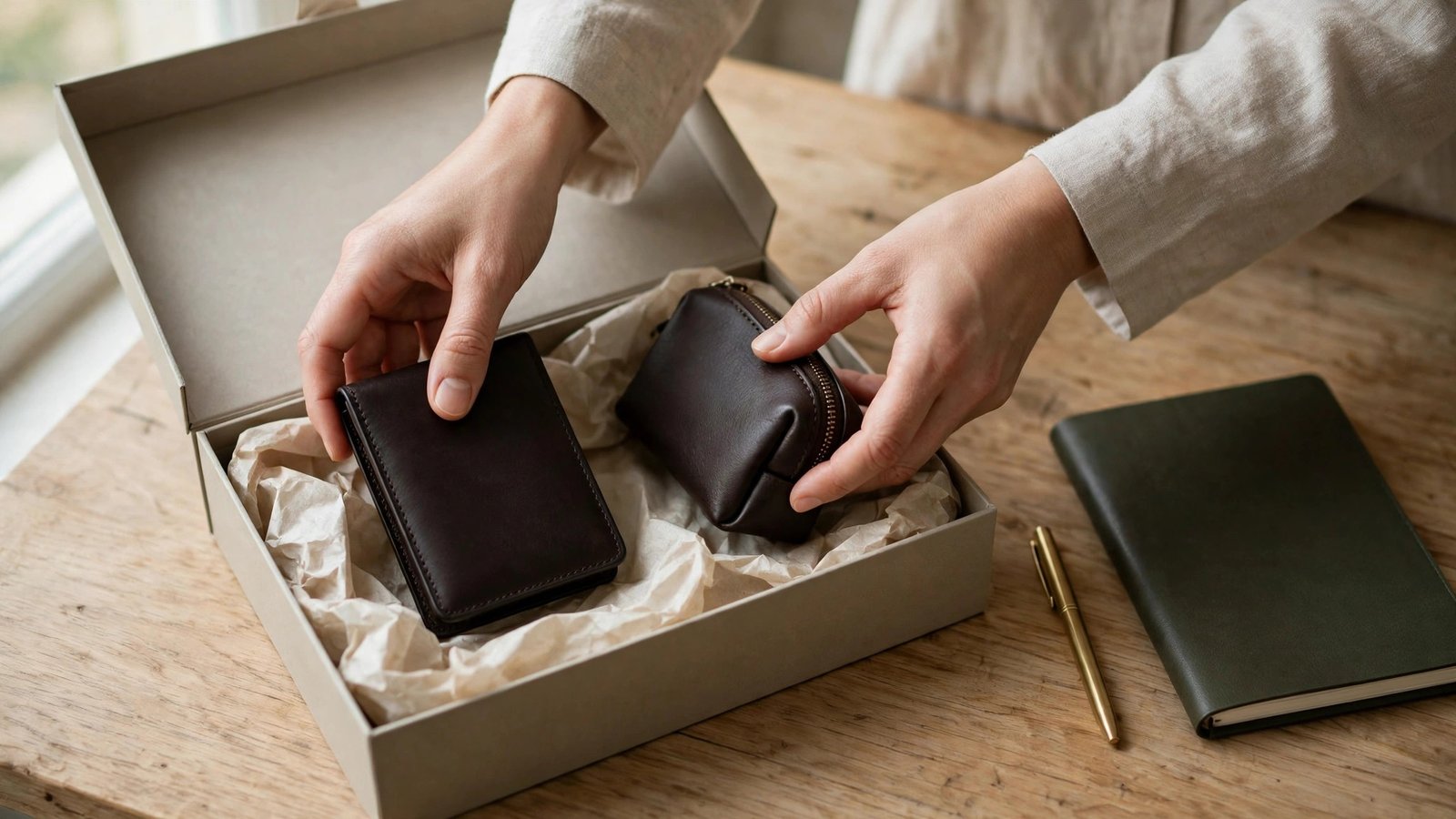
The fourth change is the presentation. An executive kit should arrive in a proper box — rigid, lined, with the items arranged rather than thrown in. The box itself is part of the gift, because it is the first thing the recipient sees, and it sets the expectation for everything inside. A kit that arrives in a flimsy courier bag tells the recipient that the contents were an afterthought, even when they were not.
Finally, the executive kit should be personal. A luggage tag with the recipient’s initials, a note that mentions the trip they are about to take, a kit that arrives before the journey rather than after it — these small touches are what separate an executive gift from a bulk order. They cost little, and they are the difference between a gift that is remembered and a gift that is filed away.
Matching the Kit to the Trip: Domestic, International, Conference and Offsite
A kit that is right for a two-day domestic trip is wrong for a two-week international assignment, and a kit built for a conference is wrong for a field visit. The trip type should decide the contents, not the other way around. The four trip types below cover most corporate travel, and each one changes the kit in a specific way.
Domestic overnight trips. This is the most common corporate trip in India — a flight to another city, one night in a hotel, a day of meetings, and home. The kit for this trip is the core kit, kept light: toiletry pouch, power bank and cable, passport holder and luggage tag, sleep mask, steel bottle. Weight matters more than completeness, because the traveller is carrying a cabin bag and does not want bulk. A heavy kit for a one-night trip is a kit that gets left behind next time.
International trips. International travel adds three things: documents, adapters and time zones. The kit should include a multi-country travel adapter, a document organiser that holds a passport, visa pages, boarding passes and travel insurance details, and a small kit for the long flight — a better sleep mask, earplugs, a moisturiser and lip balm for cabin air, and a pen for immigration forms. The power bank matters more here, because a dead phone in a foreign airport is a real problem, and the cable should cover the recipient’s devices. Check the airline rules for the destination too: power banks belong in hand luggage everywhere, and the DGCA rules that apply to Indian carriers are mirrored by most international airlines, so the kit should be packed with that in mind. The corporate gifts for IT and SaaS companies guide covers remote and hybrid team gifting in detail, and the same logic applies here: a kit that only works for the domestic half of a team’s travel is a kit that reminds the international traveller they were an afterthought.
Conferences and events. A conference kit is a working kit, not a leisure kit. The traveller needs a notebook and pen for sessions, a power bank and cable for a phone that is being used all day, a bottle for a long day on a conference floor, and a bag or organiser that carries business cards, badges and handouts. The speaker and guest gifts guide on this site covers event gifting etiquette in detail, and the same thinking applies: a conference kit should help the recipient do their job at the event, not just look good in a photograph. If the company is also exhibiting, the kit can include a branded item that works at the booth — but it should be an item the recipient would genuinely use, not a piece of event swag.
Offsites and team trips. An offsite kit is a shared-experience kit. It can be lighter on individual items and heavier on the things that make a group trip work: a good bottle, a small game or a pack of cards for the evening, a shared snack or two, and a kit that is identical for every member of the team, so nobody feels singled out. The board games and team games guide on this site covers game gifting in detail, and a compact card game is one of the best items to include in an offsite kit — it travels well, it is played in groups, and it turns an evening in a resort into a shared memory. The key decision for an offsite kit is consistency: every kit the same, delivered at the same time, so the kit becomes part of the event rather than a personal favour.
What to Leave Out: The Items That Ruin a Travel Kit
A travel kit is judged as much by what is missing as by what is included. The items below appear in many supplier catalogues, and they are the reason so many travel kits end up in hotel bins. Leaving them out is not a saving; it is a quality decision.
Cheap, single-use toiletries. A sachet of shampoo, a tiny soap that falls apart, a razor that nobody would choose — these items tell the recipient that the kit was assembled to a price rather than to a standard. If a toiletry is not good enough to use at home, it is not good enough to put in a gift. Either choose a proper travel-size product from a decent brand, or leave the category out entirely and spend the money on a better pouch.
Low-quality tech. A power bank without certification, a cable that charges slowly or breaks after a week, an adapter that does not fit properly — these are not just useless, they are actively harmful. A faulty power bank is a safety risk, and a cable that fails on a trip is worse than no cable at all, because the recipient trusted it. The power bank corporate gifts guide on this site covers the certification and safety checks in detail, and the rule is simple: if a tech item cannot be verified, do not include it. One good power bank beats three cheap gadgets.
Items the traveller already owns. Most frequent travellers already have a toiletry bag, a cable, a bottle and a sleep mask. The kit’s job is not to duplicate those items, but to replace the worst one with a better one, or to add the item they do not have. Before finalising the contents, ask a few frequent travellers in the organisation what they actually carry and what they wish they had. That conversation is worth more than any catalogue, and it is the fastest way to avoid the “another one of these” reaction.
Oversized or heavy items. A travel kit is carried in a cabin bag. Anything that adds weight without adding use is a liability: a large umbrella, a heavy book, a bulky gadget. The test is simple — would the recipient choose to carry this item on a flight? If the honest answer is no, it does not belong in the kit, however impressive it looks in a photograph.
Food that travels badly. Snacks can work in a kit, but only if they survive a flight and a hotel room. Chocolate melts, anything crumbly makes a mess, and anything strongly scented will annoy the recipient’s seat neighbour. If food is included, choose sealed, dry, robust items — nuts, a granola bar, a small pack of dry fruit — and keep them separate from the rest of the kit. The dry fruit hamper comparison in the programme’s upcoming topics covers festive food gifting in detail, and the same principle applies here: food in a travel kit must survive the journey.
Anything that cannot go through security. This is the mistake that turns a gift into an embarrassment. Liquids over 100 ml, sharp objects, aerosols and anything that looks suspicious in a scanner will be confiscated at security, and the recipient will remember the kit for the item that was taken away rather than the items that survived. Every liquid in the kit must be travel-size, every item must be cabin-safe, and the kit should be designed so the recipient does not have to repack it at the airport. This is a detail worth checking with the supplier before ordering, not after.
Budget Tiers: What a Travel Kit Costs in India
A travel kit’s cost is best understood in tiers, because the tier decides the quality of every item in it. The figures below are planning bands for budgeting discussions with a supplier — they are not a price list, and real prices depend on the supplier, the order size, the branding method and the materials chosen. The minimum order quantity guide on this site explains how order size changes the per-unit cost in detail, and the same logic applies here: a kit ordered for 500 people costs less per unit than the same kit ordered for 25.
The practical tier (roughly ₹750–₹1,500 per kit). This is the tier for regular employee travel — field teams, new joiners who will travel, conference attendees. The kit at this tier is the core kit: a decent pouch, travel toiletries, a certified power bank and cable, a cable organiser, a luggage tag, a sleep mask and a bottle. The quality is solid and honest, the branding is simple, and the kit is built to be used, not admired. This is the tier where most organisations should start, because it delivers the best value per rupee and it is the easiest tier to standardise across a large team.
The premium tier (roughly ₹1,500–₹3,000 per kit). This is the tier for senior managers, frequent travellers and client-facing teams. The pouch is better, the power bank is faster, the bottle is a better grade of steel, the sleep kit is contoured rather than flat, and a leather passport holder and a document organiser replace the basic versions. The presentation improves too — a proper box, tissue, a note. The difference between this tier and the practical tier is not the number of items; it is the quality of each one, and a frequent traveller will notice the difference immediately.
The executive tier (roughly ₹3,000 and above per kit). This is the tier for CXOs, board members, key clients and anyone whose kit will be judged against the luggage they already own. Leather goods, a premium sleep kit, a multi-country adapter, a quality notebook and pen, and packaging that feels like a gift rather than a delivery. At this tier, personalisation matters more than quantity — initials on a tag, a note about the trip, a kit that arrives before the journey. The gifts for investors and board members guide on this site covers the etiquette of premium gifting in detail, and the executive travel kit follows the same rules: fewer items, each one better, branding kept quiet.
Whatever the tier, two budgeting rules apply. First, budget for the box and the delivery as well as the contents — a kit that arrives damaged or late costs more in reputation than it saved in packaging. Second, budget for a sample. Ordering 500 kits without seeing one first is a gamble, and the sample approval checklist on this site exists precisely because a sample is the cheapest insurance in corporate gifting. Check the pouch zip, the bottle seal, the power bank certification, the print quality and the weight of the finished kit before approving production.
Branding a Travel Kit Without Ruining It
Branding is where most travel kits go wrong, because the temptation is to put the logo everywhere. A travel kit is a personal item — it is carried through airports, used in hotels, and seen by clients and colleagues. A logo that is too loud turns a useful gift into an advertisement the recipient did not agree to carry. The branding rules below keep the brand visible without making it intrusive.
Choose the right items to brand. The passport holder, the luggage tag, the pouch and the bottle are the natural branding surfaces. They are the items the recipient uses in public, and a subtle mark on them is seen often. The power bank, the cable and the sleep mask are poor branding surfaces — they are either hidden or too small, and a logo on them adds nothing.
Choose the right method. Debossing on leather, engraving on metal, and a tone-on-tone print on fabric all look premium. A large, bright screen print on a pouch looks like merchandise. The engraving versus printing versus embossing comparison in this programme covers the methods in detail, and the short version for a travel kit is to match the method to the material: engrave metal, deboss leather, print fabric quietly.
Keep it small and in one place. One logo on the pouch, one on the tag, one on the bottle — that is enough. A logo on every item in the kit is not branding; it is clutter, and it makes the kit feel like a promotional giveaway rather than a gift. The branded versus unbranded comparison in this programme makes the same point: a logo helps when it signals quality, and it hurts when it signals advertising. A travel kit should signal quality.
Use the logo file properly. A logo that is supplied as a low-resolution image will print badly, whatever the method. The logo file formats guide on this site explains what a vendor actually needs — a vector file for printing and engraving, a high-resolution file for anything else — and the rule applies directly to travel kits: supply the right file, approve the proof, and check the sample before production. A blurred logo on a leather tag is worse than no logo at all.
Ordering, Packing and Delivery: Getting the Kit to the Traveller in Time
A travel kit is a time-sensitive gift in a way most corporate gifts are not. A hamper that arrives a week late is still a hamper. A travel kit that arrives after the trip is a box of items the recipient no longer needs, and it is a visible failure of planning. The ordering and delivery process deserves as much attention as the contents.
Start with the trip calendar, not the catalogue. The first question is not what goes in the kit, but who is travelling, when, and where. A conference in three weeks, a client visit next Tuesday, an offsite next month — each one is a deadline, and the kit must be ordered, produced, branded and delivered before it. The lead-time guide on this site explains how far in advance corporate gifts should be ordered, and travel kits follow the same logic with one addition: the delivery must reach the traveller, not just the office. A kit that sits in a storeroom while the traveller is at the airport is a kit that failed.
Order the sample first. The sample approval checklist on this site lists the checks to run before production — the pouch zip, the bottle seal, the power bank certification, the print quality, the weight and the contents against the plan. For a travel kit, add one more check: pack the kit into a cabin bag and carry it. If it is too heavy, too bulky or awkward to pack, the contents need to change before the bulk order, not after.
Pack for the journey, not the photograph. A kit should arrive in a box that protects it, but it should also be packed in a way that the recipient can transfer it to their bag without repacking everything. Items in individual pouches, cables in an organiser, liquids in a sealed bag — the kit should be usable the moment it is opened. The address collection guide on this site covers the process of collecting employee addresses for gift delivery, and the same care applies here: confirm the delivery address and the date with the traveller, not just with their manager, because the traveller is the one who needs the kit.
Plan for the return. A good travel kit is reused, which means it should be built to survive being repacked. A pouch that holds its shape, a cable organiser that still closes after the third trip, a bottle that does not dent — these are the qualities that decide whether the kit is a one-trip gift or a permanent part of the traveller’s bag. When the next trip comes, the recipient will reach for the kit again, and the company will be remembered again. That is the return on a travel kit, and it is the reason the kit is worth doing properly.
Common Mistakes That Ruin Travel Kits
Most travel kit failures are not failures of budget. They are failures of judgement, and they are easy to avoid once they are named.
Buying a kit, not building one. A ready-made kit from a catalogue is convenient, but it is built for nobody in particular. It contains items the supplier wants to sell, not items the traveller needs. Building the kit — choosing each item against the traveller and the trip — takes more time, but it is the difference between a kit that is used and a kit that is stored. The pre-curated gift sets guide on this site covers the difference between ready-made sets and custom kits, and the same thinking applies: a pre-curated set is a starting point, not a finished answer.
Ignoring the traveller. A kit for a frequent flyer is not a kit for a first-time traveller. A kit for a field sales executive is not a kit for a CXO. Ordering one kit for everyone is the fastest way to make the kit feel impersonal. Ask the frequent travellers what they carry, check the trip type, and match the kit to the person — or at least to the group they belong to.
Over-branding. A logo on every item, a bright print on the pouch, a tagline on the box — the kit becomes an advertisement, and the recipient leaves it at home. Keep the branding quiet, small and on the right items, and the kit will travel.
Skipping the sample. A sample is the cheapest insurance in corporate gifting, and skipping it is the most expensive mistake. A pouch that tears, a bottle that leaks, a power bank that is not certified — all of these are discovered in a sample, and all of them are expensive to discover in a bulk order. The sample approval checklist exists for this reason, and a travel kit is exactly the kind of gift that needs it.
Forgetting the delivery. A kit that arrives after the trip is a failure, however good its contents. Plan the delivery around the traveller’s departure, confirm the address with the traveller, and build in a buffer for production delays. The corporate gift order playbook on this site covers what to do when an order goes wrong — damage, delay and wrong branding — and the best use of that playbook is to avoid needing it, by ordering early and checking the sample.
Including items that cannot fly. Liquids over 100 ml, sharp objects and uncertified power banks will be confiscated at security. Every item in the kit must be cabin-safe, and the kit should be designed so the recipient does not have to repack it at the airport.
FAQs
What should be included in a corporate travel kit for employees?
The core kit is a quality toiletry pouch, travel-size toiletries, a BIS-certified power bank with a charging cable, a cable organiser, a passport holder and luggage tag, a sleep mask with earplugs, and a reusable steel bottle. Those seven items cover almost every work trip. Everything else — adapters, document organisers, premium sleep kits — is an upgrade matched to the traveller and the trip type.
How much does a corporate travel kit cost in India?
As a planning band, a practical employee kit runs roughly ₹750–₹1,500, a premium kit for senior managers and frequent travellers roughly ₹1,500–₹3,000, and an executive kit roughly ₹3,000 and above. These are budgeting bands for supplier discussions, not a price list — real prices depend on the supplier, order size, branding method and materials. Always confirm the final per-unit cost, including the box and delivery, with your supplier.
Can a power bank be included in a corporate travel kit?
Yes — and it is usually the most-used item in the kit. Choose a 10,000 mAh bank with a certified cell and BIS certification (IS 13252), and make sure the recipient knows it must be carried in hand luggage, never in checked baggage, under DGCA and airline rules. A power bank without certification should not be included at all.
How do travel kits for executives differ from employee kits?
Executive kits use better materials (leather instead of synthetic, metal instead of plastic), fewer but higher-quality items, quiet branding (a small debossed logo, an engraved mark), proper rigid-box presentation, and a personal touch such as initials on a luggage tag or a note about the trip. The principle is fewer items, each one better.
What should not go in a corporate travel kit?
Cheap single-use toiletries, uncertified tech, items the traveller already owns three of, oversized or heavy items, food that melts or crumbles, and anything that cannot pass airport security — liquids over 100 ml, sharp objects and aerosols. Every item must be cabin-safe, or it will be confiscated and the kit will be remembered for the wrong reason.
How far in advance should we order travel kits?
Work backwards from the traveller’s departure date, not from the order date. Allow time for a sample, production, branding and delivery to the traveller — not just to the office. For a conference or offsite, order as soon as the travel list is confirmed; a kit that arrives after the trip is a failure, however good its contents.
Are travel kits a good corporate gift for employees who rarely travel?
No — a travel kit only makes sense for people who actually travel for work. For a team that rarely leaves the office, the same budget is better spent on a desk kit, a wellness kit or a festive hamper. A travel kit’s value comes from being used on trips; without trips, it is just a box of items.
Conclusion
A travel kit programme is easy to measure, because the evidence is visible. Ask the frequent travellers whether they used the kit, what they used most, what they did not use, and what they wish had been in it. That conversation, held after a few trips, is worth more than any survey, and it tells you exactly what to change in the next order.
Watch for the signs of a kit that works: the pouch in the traveller’s bag on the next trip, the bottle on their desk, the power bank in their hand at the airport. Watch for the signs of a kit that does not: the kit still sealed in its box a month later, the items given away, the pouch in a drawer. The difference between the two is rarely the budget. It is the choosing — the contents, the quality, the branding and the delivery — and that is entirely within the buyer’s control.
A travel kit is one of the most useful gifts a company can give to people who travel for work, because it is used at the exact moment it is needed, and it keeps being used long after the trip is over. Built well, it is a small piece of planning that says the company thought about the journey, not just the gift. Built badly, it is a box of items that gets left behind. The framework in this guide — the core kit, the executive upgrade, the trip matching, the budget tiers, the branding rules and the delivery plan — is the difference between the two, and it is the framework to use before the next order is placed.
H. Natural CTA
If your team travels for work — sales teams on the road, consultants flying out to clients, executives heading to conferences — a travel kit is one of the few gifts that gets used on the very next trip, and on every trip after it. Start with the core kit in this guide, match the upgrades to the traveller and the trip, order a sample before the bulk run, and get the kit to the traveller before they leave. Arrow Gifter can help you build a travel kit around your team, your trips and your budget — talk to us about the travellers you have in mind, and we will put together a kit that actually travels with them.
1 Comment