Premium Pen Sets for Clients: Choosing by Seniority, Budget and Occasion
A single premium pen is a good gift. A premium pen set is a different message altogether. The case, the second pen, the refill, the way the set opens on a desk — all of it tells the recipient that the gift was chosen, not just ordered. That is exactly why pen sets are one of the most reliable client gifts in Indian corporate gifting: they are useful every working day, they carry branding with quiet dignity, and they work across almost every seniority level, from a new client contact to a board member.
The mistake is not in choosing a pen set. The mistake is in choosing the wrong set for the recipient. A fountain pen set given to a client who never writes by hand becomes a display object. A budget ballpoint set given to a CXO reads as an afterthought. A set engraved on the wrong surface, or with a refill the recipient cannot replace, turns a thoughtful gift into a small frustration.
This guide is a buying guide, not a catalogue. It explains what a premium pen set actually is, how the pieces fit together, which pen and ink types suit which recipient, and how to choose by seniority, by budget and by occasion — then finishes with the two details buyers most often miss: refill compatibility and set quality control. If you are still deciding whether a pen is the right gift category at all, start with Arrow Gifter’s premium pens vs branded pens guide, which compares the two approaches and when each one works. This article picks up where that overview stops: the set itself, decided properly.
Everything below is written for buyers ordering in bulk in India — typically 25 to 1,000 sets — who need to compare supplier quotes on equal terms and check a sample properly before production runs.
1. What a Premium Pen Set Actually Is
Before choosing, it helps to be precise about what the words mean, because suppliers use “pen set” loosely and a “set” in one quotation can be a very different product from a “set” in another.
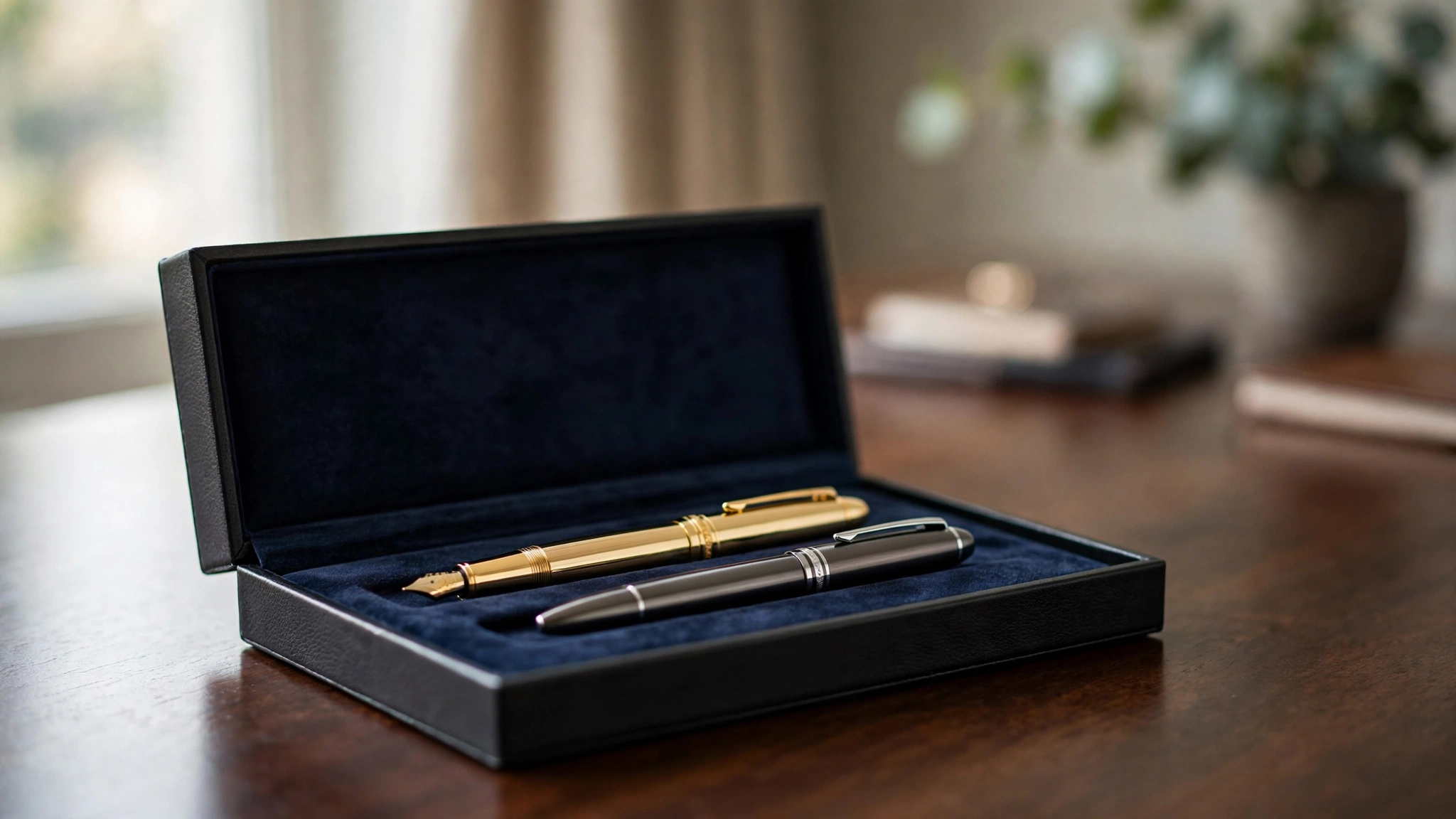
A premium pen set is a matched writing set presented in a single gift case. The set is the product — the case is not packaging added at the end, it is part of what the recipient experiences. A typical set has three elements: the pens, the case, and the presentation. Get any one of them wrong and the whole gift feels cheaper than it cost.
Set composition: 1-piece, 2-piece and 3-piece
A 1-piece set is a single pen in a fitted gift case, sometimes with a spare refill tucked into the case. It is the simplest form and the easiest to get right: one good pen, one good case, no decisions about matching. It suits mid-level client contacts, bulk festive gifting where the budget is tight, and any situation where the pen itself is the statement. Its weakness is that it can look sparse in a large case — the case has to be sized to the pen, not the other way round.
A 2-piece set is the classic corporate pen set: usually a ballpoint and a rollerball, or a fountain pen and a ballpoint, in one case. The two pens are matched — same finish, same trim, same branding position. This is the most versatile composition for client gifting, because it covers two writing styles: the ballpoint for everyday signing and forms, the rollerball or fountain pen for the moments that matter. It suits senior managers, key clients and partners, and it is the composition most buyers should start with.
A 3-piece set adds a third element — often a mechanical pencil, a second rollerball, or a pen plus a letter opener or a small desk accessory. It looks the most generous and photographs the best, which matters when the gift is opened in front of colleagues. But it is also the easiest to get wrong: a third piece that nobody uses makes the set feel padded rather than premium. Choose a 3-piece set only when the third piece is genuinely useful to the recipient — a pencil for an architect or engineer, for example — and when the case still closes cleanly and feels balanced in the hand.
The case matters as much as the pens
The case is the first thing the recipient touches and the last thing they see on their desk. A rigid case with a fitted interior — velvet, suede or moulded foam — holds the pens in place and protects them in transit. A flimsy case with loose elastic loops lets the pens rattle, and a rattling pen set feels cheap whatever the pens cost. Check three things on the case: that it closes with a clean snap or magnetic catch rather than a loose flap; that the interior lining is not glued loosely at the edges; and that the case survives being dropped from desk height without the pens shifting. Suppliers rarely volunteer this information — ask for a sample and test it yourself.
What “premium” actually means here
Premium, in a pen set, is not a brand name. It is a combination of four things: weight, finish, mechanism and consistency. Weight means the pen has a satisfying heft without being tiring to hold — a metal barrel rather than a plastic one painted to look like metal. Finish means the coating is even, with no visible seams, bubbles or colour variation between the two pens in the set. Mechanism means the twist or click action is smooth and silent, and the cap — if there is one — fits snugly without wobbling. Consistency means every set in the bulk order matches the sample. That last point is the one that separates a good supplier from a bad one, and it is why the quality-control section at the end of this guide exists.
2. Pen Types Inside a Set: Nib and Ink
The pens inside the set decide how the gift writes, and how it writes decides whether it gets used. A pen that writes badly, whatever it looks like, ends up in a drawer. There are three pen types you will meet in corporate pen sets, and each one suits a different recipient.
Fountain pens: the signature pen
A fountain pen writes with a nib — a shaped metal tip that delivers ink from a cartridge or a converter — and it is the most personal of the three types. The writing feel is smooth and expressive, and a fountain pen is the pen a recipient reaches for to sign something important. That is why fountain pens dominate the top end of client gifting: they signal ceremony.
But fountain pens have real constraints. They need a nib size matched to the writer — a fine nib for small handwriting, a medium nib for most people, a broad nib for large, confident writing. They need ink, and the recipient needs to know how to change a cartridge. And they are the pen type most likely to leak in a bag or dry out if left unused for months. Choose a fountain pen set for recipients who write by hand regularly and will enjoy the ritual — senior leaders, founders, lawyers, authors, and clients in traditional industries. Do not choose one for a recipient you know writes almost entirely on a keyboard, or for a field-based recipient who will carry the set in a bag all day.
When you do order a fountain pen set, specify the nib size in writing — medium is the safe default — and ask the supplier whether the set includes a spare cartridge and whether the pen takes standard international cartridges. That last question matters more than it sounds, and it is covered properly in the refill section below.
Rollerball pens: the safe premium choice
A rollerball uses liquid or gel ink delivered through a ball, like a ballpoint, but with a much smoother, freer flow. It writes like a fountain pen without the maintenance: no nib to choose, no cartridge ritual to learn, no leaking if it is left cap-off for a few minutes. For most client recipients, the rollerball is the best single choice in a set, because it feels premium the moment it is picked up and it asks nothing of the recipient in return.
Rollerballs are also the most forgiving pen in a 2-piece set. Pair a rollerball with a ballpoint and you have covered both moods: the rollerball for the signature and the letter, the ballpoint for the form, the checklist and the pocket. If you are ordering one set for a mixed group of clients and you are unsure how each person writes, a rollerball-led 2-piece set is the safest premium option.
Ballpoint pens: the workhorse
A ballpoint uses thick, oil-based ink and a rotating ball. It is the most practical pen type — it writes on almost any paper, it does not leak, it works in any position, and its refill lasts a long time. On its own, a ballpoint rarely feels premium, which is why a ballpoint-only set needs to earn its place through weight, finish and case quality. Inside a 2-piece or 3-piece set, though, the ballpoint is the practical partner: it is the pen the recipient will actually use daily, while the rollerball or fountain pen is the one they will remember.
How to match pen type to recipient
A simple rule covers most decisions. If the recipient signs documents by hand and values ceremony, lean fountain. If the recipient writes notes, letters and cards and you want the gift to feel premium from the first stroke, lean rollerball. If the recipient is practical, travels constantly, or will use the pen in the field, make sure a ballpoint is in the set. And if you are ordering for a group you do not know personally, choose a rollerball-and-ballpoint 2-piece set: it is the combination with the fewest ways to go wrong.

3. Choosing by Seniority
A pen set is one of the few corporate gifts where the same category works at every seniority level — but the set itself has to change. Giving the same set to a CXO and to a junior client contact is not fairness; it is a missed signal. The recipient reads the set as a measure of how the relationship is valued, and a flat, one-size-fits-all order tells every recipient the same thing, whether you meant it or not.
CXOs, board members and investors
For the most senior recipients, the set should feel considered rather than expensive. A 2-piece or 3-piece set with a fountain pen, in a rigid case with a fitted interior, is the right shape. The finish should be restrained — deep lacquer, brushed metal, matte black or dark blue — rather than bright or novelty. Engraving should be discreet: the recipient’s name or initials on the pen, the company name small on the case, never a large logo across the lid. These recipients receive many gifts; the ones they keep are the ones that respect their taste. For more on the etiquette of gifting at this level, Arrow Gifter’s guide to gifts for investors, board members and advisors covers the broader principles — discretion, no hint of obligation, and quality over display.
Senior leadership and key clients
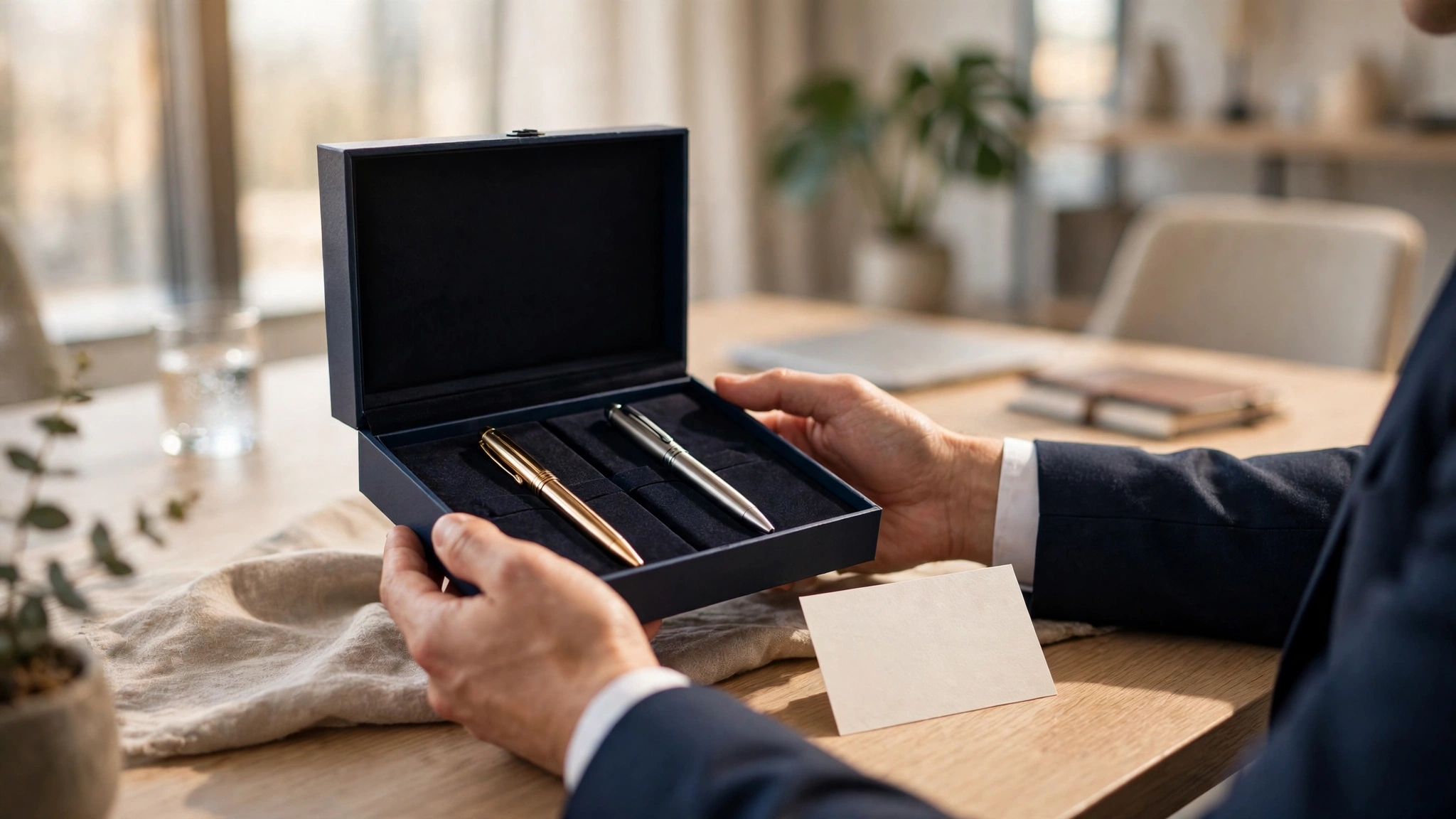
For senior managers, long-standing clients and key accounts, a 2-piece set — rollerball plus ballpoint, or fountain plus ballpoint — is the right level. The finish can be a little more expressive than the CXO tier: a coloured lacquer, a two-tone trim, a textured barrel. Engraving can carry the recipient’s name on one pen and the company name on the case. This is also the tier where a small personal touch earns its keep: a handwritten message card inside the case, or the set presented with a short note from the founder, changes how the gift is received. Keep the message short and specific — a sentence about the relationship, not a paragraph about the company. Arrow Gifter’s corporate gift message examples has wording that works for this tier without sounding formulaic.
Mid-management and regular client contacts
For mid-level managers, regular client contacts and channel partners, a well-made 1-piece or 2-piece set in a good case is the right level. The pen should still have real weight and a clean finish — this is not the tier for a plastic pen in a cardboard sleeve — but the set does not need a fountain pen or a three-piece composition. A rollerball in a fitted case, with the company name engraved small on the barrel, is a strong, honest gift at this level. The same judgement applies to dealer and distributor gifting: the year-end gifts for distributors and dealers guide explains how to tier dealer gifts so the top performers feel recognised without the whole programme becoming unaffordable.
Junior contacts, event attendees and bulk recipients
For junior contacts, event attendees and large festive lists, a pen set still works — but the set should be a 1-piece set, and the budget should go into the pen and the case rather than into a second pen nobody asked for. A single ballpoint or rollerball with a clean finish, in a rigid case, engraved with the company name, is a gift the recipient will use. It is also the tier where the temptation to order the cheapest set available is strongest, and the most damaging: a light, rattling pen in a flimsy case does more harm than no gift at all, because it is the only impression the recipient takes away. If the budget does not stretch to a decent 1-piece set for the whole list, reduce the list or choose a different gift category rather than ordering a set you would be embarrassed to receive.
4. Choosing by Budget
Budget bands are where most pen-set orders go wrong, because suppliers quote per set and buyers compare the numbers without comparing what is inside them. A ₹1,500 set and a ₹2,500 set can look identical in a photograph and feel entirely different in the hand. Use the bands below as a planning tool, and always compare quotes on the same specification — same composition, same finish, same case, same engraving — or the comparison is meaningless.
Under ₹1,000: the entry tier
At this band, a 1-piece ballpoint or rollerball set in a rigid case is realistic. Expect a metal-barrel pen with a clean finish, a simple fitted case, and laser engraving included. Do not expect a fountain pen, a lacquer finish, or a leather case at this price — and be suspicious of any supplier who promises them. The risk at this band is quality drift across a bulk order: the sample is good, the 200th set is not. Order a sample, then order a small pilot batch and check it against the sample before releasing the full order. This band suits large festive lists, event attendees and junior contacts.
₹1,000–₹2,500: the working premium tier
This is the band where most corporate pen-set orders should sit. A 2-piece set — rollerball plus ballpoint, or fountain plus ballpoint — in a well-made case with a fitted interior is realistic here, with engraving on both the pen and the case included. Finishes open up: lacquer, brushed metal, two-tone trim, textured barrels. This band suits senior managers, key clients, channel partners and promotion gifts, and it is the band where the difference between a good supplier and a cheap one is most visible — in the smoothness of the mechanism, the evenness of the finish, and the consistency across the order. For context on how this band fits into a wider gifting budget, the promotion gifts for new managers guide shows how a single well-chosen item can carry a recognition moment without a large budget.
₹2,500–₹5,000: the executive tier
At this band, a 2-piece or 3-piece set with a fountain pen becomes realistic, in a premium case — leather-bound, wooden, or a rigid case with a high-quality lining. Nib choice, spare cartridges and a presentation sleeve should be part of the specification. This band suits CXOs, board members, investors and the most important clients, and it is the band where personalisation earns its keep: the recipient’s name engraved on the pen, a short message card, and a case that feels like it was made for the person rather than for the order. Do not spend this band on a 3-piece set with a useless third piece; spend it on a better 2-piece set.
Above ₹5,000: the statement tier
Above ₹5,000, you are buying craftsmanship and provenance — a named penmaker, a hand-finished nib, a limited finish. This tier suits a very small number of recipients: a founding client, a retiring board member, a partner who changed the company’s year. The rules change at this level: the set should be chosen individually, the recipient’s writing habits should be known, and the gift should be presented in person or with a personal letter, not shipped in a courier box. For the broader question of how to tier recognition gifts across a whole organisation, the long-service award gifts guide explains how to reserve the top tier for the milestones that genuinely warrant it.
A note on comparing quotes
When two suppliers quote different prices for what looks like the same set, ask both for the same five facts before deciding: the pen’s barrel material and weight; the finish type and how it is applied; the case material and interior; what engraving is included and where; and which refill the pen takes and whether a spare is included. A quote that omits any of these is not a cheaper quote — it is an incomplete one. And always ask whether the quoted price includes GST, engraving, the case and delivery, or whether those arrive as separate lines later. Gifts given to clients have tax treatment that varies with the situation, so for anything beyond a small festive list, check the current position on the GST portal — this is general guidance, not professional tax advice.
5. Choosing by Occasion
The same recipient can deserve a different set on different occasions, and the occasion should shape the choice as much as the seniority does.
Festive gifting: Diwali and Christmas
Festive gifting is the highest-volume occasion and the one where pen sets work hardest. The recipient is receiving several gifts at once, so the set has to stand out on a desk full of hampers and dry fruit. A 2-piece set in a strong case, with festive-appropriate engraving — the company name and the year, rather than a festive slogan that dates the gift — is the right choice. Order early: festive pen sets are a common choice, and suppliers’ engraving capacity is the bottleneck, not the pens. The Christmas gifts for clients in India guide covers festive timing and presentation in more detail.
Client onboarding and new relationships
For a new client in the first 90 days, a pen set is a confident choice: it says the relationship is expected to last and to involve signatures. A 1-piece or 2-piece set, presented with a short welcome note, works well. Keep the branding restrained — the recipient is still forming an impression of your company, and a large logo on the case reads as advertising rather than appreciation. The new client onboarding gifting playbook sets out the full 90-day approach, of which the pen set is one touchpoint among several.
Milestones, promotions and long service
For a promotion, a long-service milestone or a retirement, the pen set carries symbolic weight: it marks a moment in a career. Here the set should be chosen for the individual, not the tier — a fountain pen for someone who signs, a rollerball for someone who writes, and engraving that marks the occasion and the date rather than just the company name. A set given at a milestone is kept; a generic set given at a milestone is forgotten. The quarterly and annual award gifts framework explains how to place a pen set inside a recognition programme so it does not arrive as an isolated gesture.
Deal closure and thank-you gifts
When a deal closes or a client does something that deserves thanks, timing matters more than price. A pen set ordered after the moment has passed is just a gift; a pen set that arrives within days of the event is a message. Keep one or two sets in stock, unengraved, for exactly this purpose, and add a handwritten card rather than waiting for engraving. Speed, here, is worth more than personalisation.
Events, conferences and speaker gifts
For speakers, panellists and guests of honour, a pen set is a safe, professional choice that travels well and does not need to be sized, fitted or explained. A 1-piece or 2-piece set in a rigid case, with the event name and year engraved small on the case, works. Avoid engraving the speaker’s name unless you are certain of the spelling — a misspelled name on a gift is worse than no name at all.
6. Engraving on the Set Case — and on the Pen
Engraving is where a pen set becomes a branded gift, and it is also where the most avoidable mistakes happen. There are two surfaces to decide about: the pen and the case. They serve different purposes, and they should not carry the same thing.
Engraving the pen
The pen barrel is a small, curved surface. It suits a name, initials, or a short word — not a company name, a tagline, or a logo with fine detail. Laser engraving is the standard method: it is precise, durable and clean on metal. Ask the supplier for a proof — a photograph of the engraved sample — before production, and check three things: that the text is straight and centred on the barrel; that the depth is even, with no scorched or pale patches; and that the text is legible at arm’s length, which is the distance from which the recipient will first see it. For a fountain pen, engrave the barrel, never the nib — the nib is a precision part, and engraving it can affect how the pen writes.
Engraving the case
The case lid is the branding surface. It suits the company name, a small logo, or the company name plus the year. The key decision is size: the branding should be visible when the case is closed and sitting on a desk, but it should not dominate the case. A good rule is that the logo should occupy no more than a third of the lid’s width, and it should sit centred, not crowded into a corner. On a leather case, blind embossing — pressing the design into the leather without colour — looks more premium than gold foiling, which can flake over time. On a wooden case, laser engraving is clean and durable. On a metal case, keep the engraving shallow and precise.
What to avoid
Do not engrave a tagline, a website address or a phone number on a pen set. Nobody has ever kept a pen because of the website printed on it, and the clutter makes the gift look like merchandise. Do not engrave in a script font so elaborate that the recipient cannot read their own name. Do not engrave the recipient’s name on the case and the company name on the pen — the assignment is the other way round. And never approve engraving from a text description alone: always see a proof, and always check the spelling of every name against the recipient list, not against your memory.
7. Refill Compatibility: The Hidden Running Cost
This is the section most buyers skip and most recipients notice. A pen set is only as good as its refill, because the day the ink runs out is the day the gift is tested. If the recipient can buy a replacement refill in any stationery shop, the set keeps working for years. If the refill is a proprietary cartridge available only from one supplier, the set becomes a display piece the moment the ink runs out.
The three refill realities
Standard international cartridges are the best outcome for a fountain pen: they are made by many manufacturers, available in stationery shops and online, and interchangeable across brands. Ask the supplier, in writing, whether the fountain pen takes standard international cartridges. If it takes only a proprietary cartridge, ask what it costs, how it is ordered, and whether the supplier will still stock it in two years. If the supplier cannot answer, choose a different pen.
Rollerball and ballpoint refills are usually standard sizes — the common Parker-style refill fits a wide range of pens — but “usually” is not a specification. Ask which refill standard the pen uses, and include a spare refill in the case. A spare refill costs the supplier almost nothing and tells the recipient that the gift was thought through to the end of its life, not just to the moment of opening.
The case should hold the spare. A spare refill loose in the bottom of a courier box is a spare refill lost. A spare refill in a fitted slot in the case is a spare refill the recipient will find when they need it. Specify this when you order: the case interior should have a place for the refill, or the refill should be clipped to the pen.
A practical test
Before approving a bulk order, take the sample pen, remove its refill, and try to buy a replacement from a stationery shop or an online store without the supplier’s help. If you can, the recipient can. If you cannot, neither can they — and you have just discovered the gift’s real lifespan. This single test is worth more than any brochure claim about the pen’s quality.
8. Set Quality Control: What to Check on a Sample
A pen set order fails in the details, and the details are only visible on a physical sample. Never approve a bulk order from photographs. Order a sample set, check it against the list below, and then check the first production batch against the sample. The five minutes this takes per set is the difference between a gift that impresses and a complaint that reaches the CXO.
- Weight and balance. Hold the pen as if writing. It should feel substantial but not tiring, and the balance point should sit near the middle of the barrel, not at either end. A pen that is heavy at the back will tire the hand within minutes.
- The mechanism. Click or twist the pen twenty times. The action should be smooth, silent and identical every time. A gritty, uneven or noisy mechanism will only get worse with use.
- The writing test. Write a full page with each pen in the set — not a signature, a page. Check for skipping, scratching, blotting and feathering on ordinary office paper. A fountain pen that scratches is a nib problem, not a paper problem, and it will not improve.
- The finish. Look at both pens in the set side by side under bright light. The finish should match exactly — same colour, same depth, same sheen. Check the seams, the trim rings and the clip for gaps, rough edges or colour variation.
- The case. Open and close the case ten times. The catch should hold, the lining should stay fixed, and the pens should not shift when the closed case is shaken gently. Then drop the closed case from desk height onto a carpeted floor and open it: the pens should be exactly where they were.
- The engraving. Read every engraved word at arm’s length. Check the spelling, the alignment and the depth. Compare the proof with the sample — they should be identical.
- The refill. Remove the refill and confirm it is the standard the supplier quoted. Check that a spare is included and that it fits in the case.
- Consistency across the batch. When the production batch arrives, open five sets at random and compare them with the sample. If any one of them differs — a different finish, a looser mechanism, a missing spare refill — stop and raise it with the supplier before distributing a single set. One bad set in a client’s hands costs more than the whole order saved.
For the wider discipline of checking a bulk gift before it goes out, the sample approval checklist for bulk corporate gifts sets out the twelve checks that apply to any bulk order; the eight above are the pen-set-specific version of the same discipline. And before you commit to a quantity, confirm the supplier’s minimum order: the minimum order quantity guide explains how MOQ varies by product type and what it means for a pen-set order.
9. Common Mistakes to Avoid
- Ordering one set for everyone. Seniority, occasion and relationship should change the set. A flat order is a missed signal, not a saving.
- Choosing the pen for its looks alone. A beautiful pen that writes badly is a drawer ornament. Always write a full page with the sample.
- Engraving without a proof. Spelling mistakes on a gift are permanent, public and entirely avoidable.
- Ignoring the refill. A set whose refill cannot be replaced is a gift with an expiry date. Ask the question before you order, not after the ink runs out.
- Letting the case do the talking. A large, flashy case with a mediocre pen inside is the fastest way to make a premium budget look cheap. Spend on the pen first, the case second.
- Over-branding. A logo on the case, a name on the pen, and nothing else. A tagline, a website and a phone number turn a gift into merchandise.
- Ordering too late for festive. Engraving capacity, not pen stock, is the bottleneck in November and December. Order festive sets by mid-October at the latest, and confirm the engraving slot in writing.
- Skipping the batch check. The sample is not the order. Open five sets from the production batch and compare them with the sample before distributing any of them.
10. How to Brief a Supplier: A Short Checklist
A good brief prevents most of the problems above. Send the supplier this list and ask for a written reply to each point before you pay a deposit:
- Set composition — 1-piece, 2-piece or 3-piece — and which pen types are included.
- Barrel material, finish type and weight of each pen.
- Nib size for any fountain pen (medium is the safe default) and ink colour.
- Case material, interior lining, and whether a spare refill slot is included.
- Engraving: what goes on the pen, what goes on the case, the method, and a proof before production.
- Refill standard for each pen, and whether a spare refill is included.
- Minimum order quantity, price per set including GST, engraving, case and delivery.
- Sample lead time, production lead time, and the engraving slot for festive orders.
- The batch-check arrangement: five sets from the production run compared with the sample before dispatch.
A supplier who answers all nine clearly is a supplier you can work with. A supplier who waves any of them away is telling you where the problems will be.
Frequently Asked Questions
1. What is the best pen set gift for a CXO or board member?
A 2-piece or 3-piece set with a fountain pen, in a rigid case with a fitted interior, with restrained finishes — deep lacquer, brushed metal or matte black — and discreet engraving: the recipient’s name on the pen, the company name small on the case. The set should feel considered rather than expensive, and it should be presented with a short personal note rather than shipped anonymously.
2. Is a fountain pen or a rollerball better in a corporate pen set?
It depends on the recipient. A fountain pen suits someone who writes by hand regularly and values ceremony — it is the signature pen. A rollerball suits most recipients better: it writes as smoothly as a fountain pen with no maintenance, no nib choice and no leaking. If you are ordering for a group you do not know personally, a rollerball-and-ballpoint 2-piece set is the safest premium option.
3. How much should a company spend on a premium pen set for clients?
As a planning guide: under ₹1,000 for a 1-piece set for large festive lists and junior contacts; ₹1,000–₹2,500 for a 2-piece set for senior managers and key clients; ₹2,500–₹5,000 for an executive 2-piece or 3-piece set with a fountain pen for CXOs and the most important clients; above ₹5,000 only for a very small number of statement recipients. Always compare quotes on the same specification, including GST, engraving, case and delivery.
4. Should the company logo go on the pen or on the case?
The recipient’s name or initials go on the pen; the company name or a small logo goes on the case lid. The pen barrel is a small, curved surface that suits a name, not a logo. The case lid is the branding surface, and the logo should occupy no more than a third of the lid’s width. Never add a tagline, website address or phone number — it turns a gift into merchandise.
5. What is the minimum order quantity for corporate pen sets in India?
It varies by supplier and by set: entry-level sets often start at 25–50 units, while executive sets with custom engraving and premium cases can carry higher minimums. Confirm the MOQ in writing before paying a deposit, and ask whether the quoted price includes GST, engraving, the case and delivery.
6. How do I check a pen set’s quality before ordering in bulk?
Order a physical sample and check eight things: weight and balance, the click or twist mechanism, a full page of writing with each pen, the finish under bright light, the case catch and lining, the engraving proof, the refill standard and a spare refill — then open five sets from the production batch and compare them with the sample before distributing any of them.
7. Can the recipient replace the refill when the ink runs out?
They should be able to — and that is a question to ask the supplier before ordering. Fountain pens should take standard international cartridges; rollerball and ballpoint pens usually use a common Parker-style refill. Include a spare refill in the case, and test it yourself: remove the sample’s refill and try to buy a replacement without the supplier’s help. If you cannot, neither can the recipient.
Conclusion
A premium pen set is one of the most forgiving gifts in corporate gifting — and one of the easiest to get subtly wrong. The category is right for almost every client, at almost every seniority, on almost every occasion. What decides whether the gift works is the specification: the composition, the pen types, the finish, the case, the engraving, the refill and the quality control. Get those right and the set does its job for years, sitting on the recipient’s desk, writing well, and quietly carrying your company’s name. Get them wrong and the gift is a drawer ornament with a logo on it.
Start with the recipient, not the catalogue. Decide the seniority first, then the budget, then the occasion — and let those three answers choose the set. Check the sample properly, ask the refill question, see the engraving proof, and open five sets from the batch before you send any of them out. Do that, and a pen set stops being a safe, forgettable gift and becomes the one the recipient actually uses.
Choosing the right pen set is a small decision that carries a large signal — it tells a client exactly how much the relationship is worth to you. If you are planning pen sets for clients, partners or senior leaders and want help matching the set to the recipient, the budget and the occasion, talk to the Arrow Gifter team. Share the recipient list and the occasion, and they will help you specify the composition, the engraving and the sample check — so the set that arrives on the client’s desk is the one you meant to send.
1 Comment