Pre-Curated Gift Sets vs Build-Your-Own Kits: Cost, Time and Quality Compared
Every corporate gifting programme in India eventually reaches the same fork in the road. On one side, the pre-curated gift set: a ready-made kit, chosen by the vendor, ordered as a single item, delivered as a finished box. On the other, the build-your-own kit: a set assembled from items you choose yourself — this notebook, that bottle, this pen, that snack — packed to your specification, branded your way. Both are legitimate. Both are ordered by thousands of companies every year. And every year, the team that has to choose between them argues the same argument: the pre-curated people say a custom kit is slow, expensive and risky, the build-your-own people say a ready-made set is generic and forgettable.
Both sides are half right, which is why the argument never resolves. A pre-curated set and a build-your-own kit are not two versions of the same gift. They solve different problems, they fail in different ways, and they are judged by the recipient on different measures. A pre-curated set is judged on whether the whole box feels considered — because the recipient experiences it as one gift. A build-your-own kit is judged on whether each item earns its place — because the recipient can see that somebody chose each thing. A pre-curated set that arrives late is a problem because the vendor’s schedule slipped. A build-your-own kit that arrives late is a problem because your own decisions slipped. A pre-curated set with one weak item is forgiven, because the rest of the box carries it. A build-your-own kit with one wrong item is remembered, because you chose it.
This guide does not pick a winner. It works through the honest head-to-head between the two — fully loaded cost, time, quality control and error risk — and then gives you a decision rule you can apply to your own programme, by team size and by occasion, plus the hybrid model most experienced teams actually end up using. It is written for the person who has to order, not for the person who has to receive: the trade-offs are stated plainly, the mistakes are named, and the answer is decided by your constraints, not by fashion.
One boundary before we start. This guide compares the two formats. It does not list every pre-curated set combination or every item you could put in a custom kit — the pre-curated gift sets guide on this site already covers ready-made sets as an overview, with their budget tiers and occasions, and the standardisation versus customisation guide covers the programme-level dilemma of giving everyone the same thing versus tailoring gifts. The Christmas hampers versus gift boxes guide covers hamper and box formats for bulk orders, and the dry fruit hampers vs gadget gifts comparison shows how a similar choice plays out between two gift categories rather than two formats — so this guide stays on the format question, and does not re-cover either of those. What follows is the comparison itself: what each format costs, how long each one takes, how each one is checked, where each one goes wrong, and how to choose.
What the Two Options Actually Are
A pre-curated gift set is a finished kit designed by the vendor: a fixed combination of items, in a fixed box, at a fixed per-unit price, usually offered in two or three tiers. You choose the tier, the quantity and the branding — the contents are already decided. The vendor has already solved the packing, the weight, the box size and the presentation, because the same set is produced many times over. When you order five hundred of them, you are ordering five hundred copies of a product that already exists. The pre-curated gift sets guide on this site describes these sets in full — the tiers, the occasions they suit, and the trade-offs of buying a finished product — and this guide takes that overview as its starting point rather than repeating it.
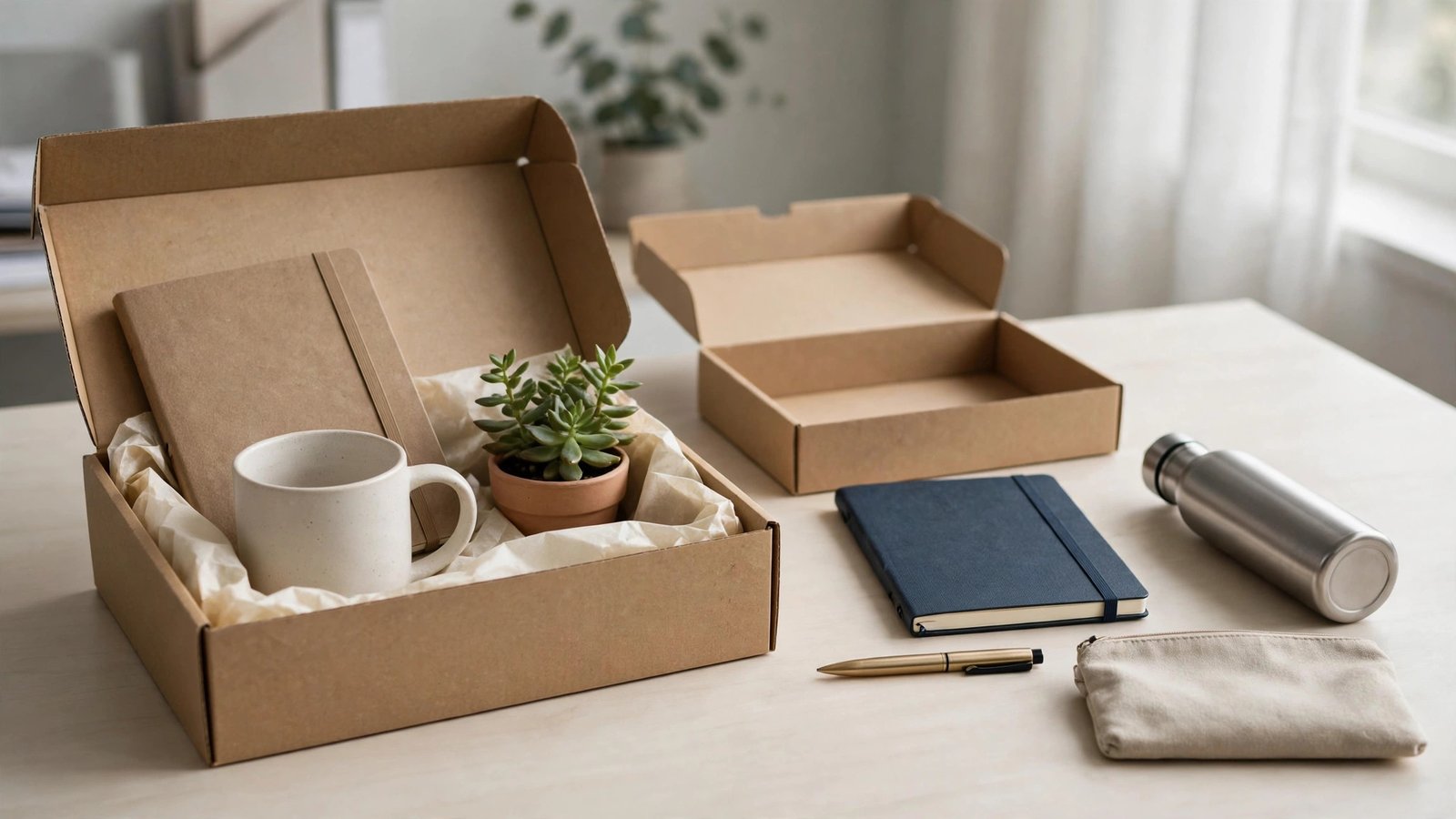
A build-your-own kit is a set assembled to your specification: you choose each item, the vendor sources and brands them, and the kit is packed to your order. Nothing about it exists until you design it. The items may come from different suppliers, the branding may use different methods on different surfaces, and the packing is designed around your combination rather than inherited from a standard box. When you order five hundred of them, you are ordering five hundred copies of a product that is being made for the first time.
The first thing to notice is where the work sits. With a pre-curated set, the vendor has already done the design work, and your work is selection: pick the tier, approve the sample, confirm the numbers. With a build-your-own kit, you do the design work, and the vendor does the execution: you choose the items, you approve each one, you confirm the packing. That single difference explains most of what follows. A pre-curated set is fast because the decisions are already made. A build-your-own kit is slow because every decision is yours, and every decision has to be made, approved and communicated before production starts.
The second thing to notice is where the risk sits. With a pre-curated set, the risk is concentrated in the vendor’s product: if the set is good, five hundred good boxes arrive; if the set has a weak item, five hundred boxes carry the same weakness. With a build-your-own kit, the risk is spread across your choices: each item you pick is a separate chance to get it right or wrong, and each supplier behind each item is a separate point of failure. A pre-curated set fails uniformly. A build-your-own kit fails unevenly — one item late, one item misprinted, one item out of stock — and uneven failure is harder to manage, because the fix for one item does not fix the others.
The third thing to notice is what the recipient can see. A pre-curated set looks like a product: consistent, finished, professional. A build-your-own kit looks like a decision: personal, considered, specific to the occasion. Neither impression is better in the abstract. But if your programme’s goal is to look polished and reliable at scale, the pre-curated set has an advantage a custom kit has to work hard to match. And if your goal is to make the recipient feel that somebody thought about them specifically, the build-your-own kit has an advantage a ready-made set cannot match. The decision starts with knowing which of those two goals you are actually pursuing — and being honest about whether your team has the time to pursue the second one properly.
Pre-Curated vs Build-Your-Own: The Honest Head-to-Head
The table below compares the two formats on the dimensions that actually decide whether a gifting programme works. Neither side wins on every row. The point is to make the trade-offs visible, so the decision is made on your constraints rather than on whichever department argues loudest.
| Dimension | Pre-curated gift set | Build-your-own kit |
|---|---|---|
| Fully loaded cost per person | Lower — one price, one packing run, one shipment profile | Higher — item sourcing, multiple branding setups, custom packing, more handling |
| Decision time | Days — pick a tier, approve the sample, confirm numbers | Weeks — choose items, compare suppliers, approve each item, design packing |
| Production lead time | Shorter — the set already exists; only branding and packing remain | Longer — sourcing, artwork, samples and packing design all start from zero |
| Quality control | One sample to approve; one packing standard; consistent across the order | Each item needs its own sample and check; consistency depends on your checks |
| Error risk | Low and uniform — the same set, the same box, the same process | Higher and uneven — wrong item, misprint, stock-out or packing error per item |
| Branding | Limited to the set’s branding areas; logo placement already decided | Full control — brand each item, choose methods, place the logo where it works |
| Personalisation | Tier-level only — different tiers for different audiences | Item-level — different items for different people, teams or occasions |
| Flexibility after ordering | Low — changing the set means changing the product | Higher — swap one item without redesigning the whole kit |
| Scalability | Excellent — the same set scales from 50 to 5,000 with little extra work | Harder — each item’s supply, MOQ and lead time must scale together |
| Recipient experience | Polished and consistent; can feel generic if the set is overused | Personal and considered; can feel uneven if one item is weak |
| Best for | Festive programmes, large headcounts, tight deadlines, first-time buyers | Onboarding kits, CXO and client gifts, small teams, distinctive occasions |
| Worst for | Programmes where the gift must feel personal or occasion-specific | Large headcounts, tight deadlines, teams without time to manage the build |
| Vendor dependence | High — you rely on the vendor’s taste and stock | Lower — you control the items, but you manage more suppliers |
| Waste risk | A weak item is repeated in every box | An unpopular item is your choice, and you own the consequence |
Read the table as a whole and the pattern is clear. Pre-curated sets win on cost, speed, consistency and simplicity. Build-your-own kits win on control, personalisation and distinctiveness. Neither wins on quality alone — a good pre-curated set beats a badly built custom kit, and a well-built custom kit beats a tired pre-curated set. And neither wins on risk: a pre-curated set’s risk is that it feels generic, and a custom kit’s risk is that it goes wrong in a way a ready-made set never could. The standardisation versus customisation guide on this site makes the same point from the programme level: standardisation buys you reliability and scale, customisation buys you relevance and feeling, and the right answer is a deliberate choice about which one your programme needs more of right now.
Cost Per Person: The Fully Loaded Comparison
Cost is where most comparisons between the two formats go wrong, because most buyers compare the wrong numbers. They compare the pre-curated set’s per-unit price with the sum of the custom kit’s item prices, and conclude that building your own is cheaper — or they compare the pre-curated set’s price with a single premium item and conclude that ready-made is a rip-off. Both comparisons miss most of the money. The honest comparison is the fully loaded cost per person: everything that has to be paid before a gift is in a recipient’s hands, divided by the number of recipients.
For a pre-curated set, the fully loaded cost is relatively simple. There is the per-unit price of the set, which already includes the items, the box and the packing. There is the branding cost, which is usually a single setup for the set’s branding area — a sleeve, a box lid or a card. There is shipping, which is predictable because every box is identical in size and weight. And there is a small allowance for damage and replacements, which is also predictable because the packing is standardised. The budget planning guide on this site sets out the fully loaded method in full — contents, branding, packing, shipping, wastage and tax treated as one number — and it is the method to use here, because the two formats hide their costs in different places.
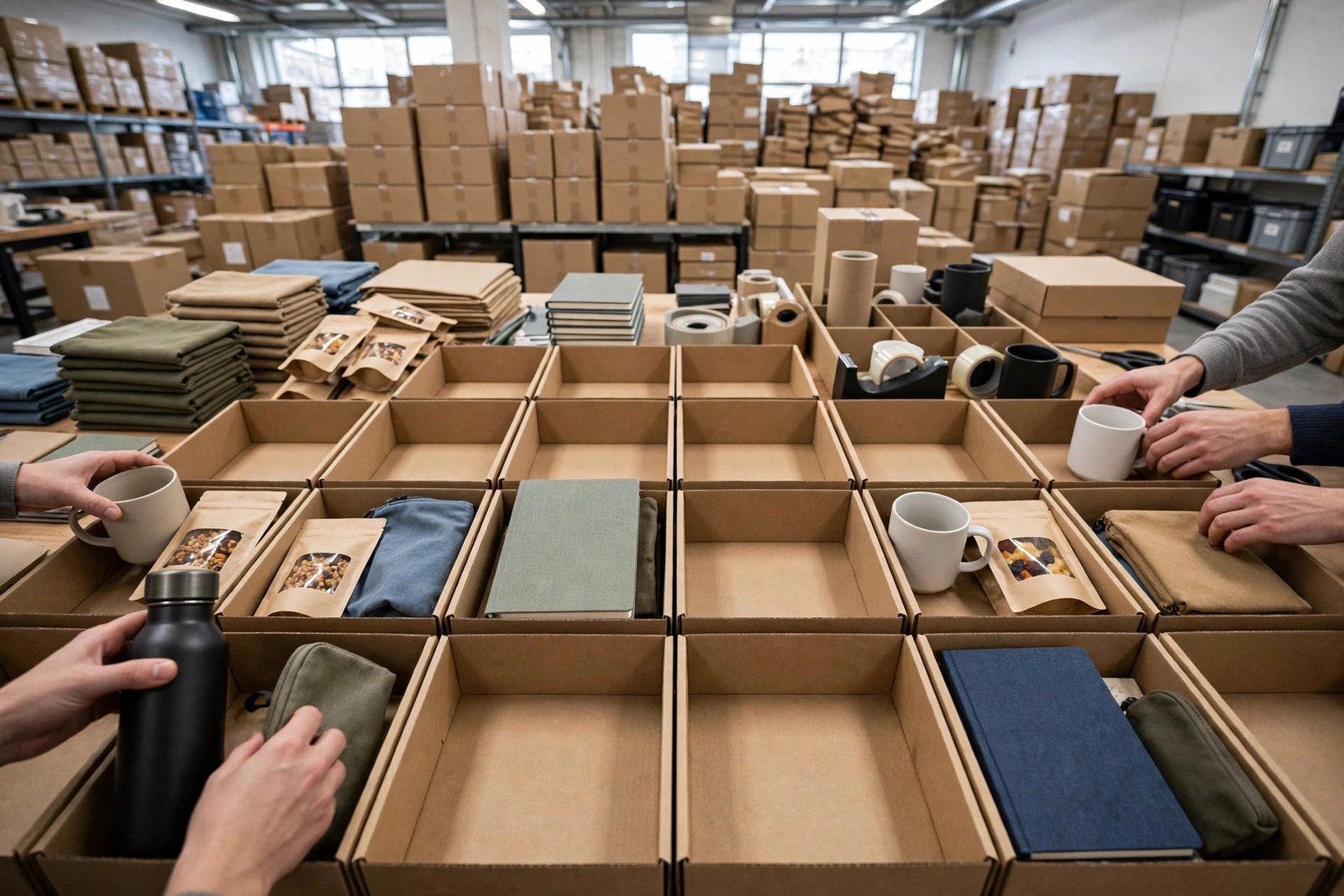
For a build-your-own kit, the fully loaded cost has more lines, and several of them are easy to miss. There is the cost of each item, which may come from different suppliers at different prices. There is a branding setup for each item that carries the logo — and branding a bottle, a notebook and a pouch uses three different methods, three different setups and three different minimums. There is the packing cost, which is higher because the box, the fill and the arrangement are designed for your combination rather than inherited from a standard product. There is the handling cost: somebody has to pick each item, check it and place it, and the more items in the kit, the more handling each box needs. There is the shipping cost, which is harder to predict until the finished kit is weighed, because the box size and weight depend on your choices. And there is the rework cost: when one item is wrong, the whole kit may have to be opened and repacked, and that labour is charged somewhere.
Then there are the costs that do not appear on any invoice. The first is your team’s time. Designing a custom kit takes meetings, shortlists, samples and approvals — and the hours of an HR manager, a procurement executive and a marketing approver are real costs, even if nobody invoices for them. The second is the cost of delay. A custom kit that takes three weeks to design and approve, and then runs into a stock problem on one item, can miss the occasion it was bought for — and a gift that arrives after the occasion is money spent on a gesture that no longer lands. The third is the cost of leftovers. A custom kit’s items are ordered in their own quantities, with their own minimums, and the item that does not fit the final count leaves surplus stock that has to be stored, reused or written off. A pre-curated set has the same problem in principle, but in practice the vendor absorbs it, because the set is a standard product with other buyers.
None of this means build-your-own is always more expensive. At small quantities, the difference is often small, because the pre-curated set’s price already includes the vendor’s design and packing work — work you would otherwise do yourself. At large quantities, the difference grows, because every extra handling step and every extra branding setup is multiplied by the headcount. The guide to bulk discounts versus per-unit customisation on this site works through exactly this trade-off: bulk buying lowers the per-unit price of a standard product, while customisation adds a per-unit cost that volume does not remove. A pre-curated set benefits from the first effect. A build-your-own kit suffers from the second.
The practical rule is simple. Before you compare prices, list every cost line for both formats — items, branding setups, packing, handling, shipping, replacements, your team’s time — and compare the totals per person. If the custom kit is still cheaper after that, it genuinely is cheaper, and you should build it. If it is only cheaper before packing, branding and handling are counted, it is not cheaper at all — it is just a price that has not finished being calculated. And if the two totals are close, choose on time and risk rather than on price, because a small saving is not worth a missed deadline or a quality failure.
Time: Decision Time, Production Time and the Real Deadline
Time is the dimension that decides more programmes than cost does, because cost can be negotiated and quality can be fixed, but a missed occasion cannot be recovered. Both formats take time. They take it in different places, and the difference matters more than the total.
A pre-curated set is fast in the ways that matter most. The decision is quick: you review two or three tiers, you pick one, you approve the sample. The production is quick: the set already exists, so the remaining work is branding and packing, both of which the vendor has done many times before. The delivery is predictable: identical boxes, known weight, known courier profile. The lead-time guide on this site explains how far in advance physical gifts should be ordered, and a pre-curated set is the format that fits most comfortably inside that window — because there are fewer steps between your decision and the courier’s van.
A build-your-own kit is slow in the ways that are hardest to compress. The decision is slow: you have to choose each item, compare options, check availability, and get approval for a combination nobody has seen before. The production is slow: each item has its own sourcing, its own artwork, its own sample and its own lead time, and the kit cannot be packed until the slowest item arrives. The delivery is less predictable: the finished kit’s size and weight are only known once it is packed, and the courier profile has to be confirmed at the end, not the start. And the whole schedule has a hidden dependency: if one item is delayed, the entire kit is delayed, because you cannot ship a kit with a missing item. The Christmas delivery deadlines guide on this site makes the same point for the festive season — the order-by date is the real deadline, not the delivery date — and for a custom kit, the order-by date is earlier than most teams expect, because the design work has to happen before the ordering work can even start.
There is also a second kind of time that rarely appears in a vendor’s quote: approval time. A pre-curated set needs one approval — the sample of the finished set. A build-your-own kit needs an approval for each item, an approval for the branding on each item, and an approval for the finished kit as a whole. If your organisation needs a senior sign-off, each of those approvals is a meeting, an email chain and a wait. Three approvals take three times as long as one, and they take longer than three times as long in practice, because each one waits for the previous one. Teams that have never built a custom kit before routinely underestimate this, and the underestimate is what turns a comfortable six-week plan into a last-minute rush.
The honest way to compare the two formats on time is to work backwards from the occasion. Take the delivery date you need, subtract the courier time, subtract the packing time, subtract the production time, and subtract the decision and approval time — and see what date you actually have to start. For a pre-curated set, that start date is usually two to three weeks before the occasion for a standard order, longer only if the branding is complex. For a build-your-own kit, the start date is usually five to eight weeks before the occasion, because the design and approval work has to happen first. If today is already past the custom kit’s start date, the decision is made for you: order the pre-curated set, and save the custom build for the next occasion, when you can start early enough to do it properly.
Quality and Quality Control: One Sample vs Many
Quality control is where the two formats differ most in practice, and where the difference is least visible before you order. Both formats can produce a beautiful gift. They differ in how much checking it takes to be sure, and in what happens when the checking finds a problem.
A pre-curated set is checked once. You approve a sample of the finished set — the box, the items, the packing, the branding, all together, exactly as the recipient will receive it. If the sample is good, the production run will be good, because the vendor is producing the same product they have produced before, with the same materials, the same packing and the same process. The sample approval checklist on this site sets out what to check before production — and for a pre-curated set, the checklist is short, because there is one product to check rather than several. The vendor’s own quality control also works in your favour: a product that is made repeatedly is a product whose failure modes are already known, and a vendor who makes the same set every week has already fixed the problems you would otherwise discover.
A build-your-own kit is checked many times, and each check is a separate job. Each item needs its own sample, because each item comes from a different place and is branded by a different method. The notebook’s print has to be checked. The bottle’s engraving has to be checked. The pouch’s stitching has to be checked. And then the finished kit has to be checked as a whole, because items that are individually fine can still sit badly together — a bottle that is too tall for the box, a notebook that slides around, a pouch that hides the branding on the item beneath it. The sample approval discipline is the same, but the number of samples is multiplied, and so is the number of chances for something to be missed.
The difference shows up most clearly when something goes wrong. If a pre-curated set has a problem, the problem is the same in every box, which makes it easy to describe, easy to prove and easy to fix — the vendor replaces the item, or replaces the set. If a build-your-own kit has a problem, the problem may be in one item, in one batch of one item, or in the packing of some boxes and not others — which makes it harder to describe, harder to prove and slower to fix. The guide to what happens when a corporate gift order goes wrong on this site covers the recovery playbook, and the recovery is always faster when the problem is uniform, because a uniform problem has a uniform fix.
There is one more quality difference, and it is the one recipients actually notice. A pre-curated set is consistent: every recipient gets the same box, the same items, the same presentation. That consistency is a form of quality — it means nobody can tell from their gift whether they were first or last on the list. A build-your-own kit can be consistent too, but consistency has to be built into it deliberately: the packing has to be standardised, the item placement has to be specified, and somebody has to check that box number five hundred looks like box number one. Without that discipline, a custom kit drifts — the early boxes are packed carefully, the late boxes are packed in a hurry, and the last recipients get a visibly worse gift than the first. If you build your own kit, budget for that discipline: a written packing specification, a reference box kept aside, and a spot check of boxes from the start, middle and end of the run.

Error Risk: Where Each Format Goes Wrong
Every gifting programme has errors. The question is not whether errors happen, but where they happen, how often, and how expensive they are to fix. The two formats fail in different places, and knowing the failure modes in advance is the cheapest insurance there is.
A pre-curated set’s errors are few, and they are mostly the vendor’s. The common ones are a weak item in the set that nobody noticed at sample stage, a branding error repeated across the whole run — a wrong logo file, a misspelt company name, a colour that does not match the brand — and a stock problem, where the vendor runs out of the set and substitutes an item without telling you. All three are preventable at the sample stage: check the sample carefully, confirm the logo file with the logo formats guide on this site, and confirm stock in writing before you pay. The branding risk deserves emphasis, because it is the one error that a pre-curated set shares with a custom kit: a wrong logo is wrong on five hundred boxes, not one, and the only reliable protection is a physical sample with the real artwork, approved in writing, before production starts.
A build-your-own kit’s errors are more numerous, and several of them are yours. The common ones are choosing an item that is out of stock or discontinued, choosing items whose minimum order quantities do not match — one item needs a hundred units, another needs five hundred, and your headcount is two hundred and fifty — choosing items that do not fit together in the box, approving branding on one item that does not match the branding on the others, and collecting recipient details that do not match the kit — the address list, the size list, the name list for personalised items. The MOQ guide on this site explains how minimums vary by product type, and it is worth reading before you design a custom kit, because a kit is only as orderable as its most restrictive item. The address collection guide matters too: a custom kit with personalised items needs accurate names and addresses, and an error in the name list becomes an error printed on the gift itself, which cannot be fixed by repacking.
There is also a class of error that only a custom kit can make: the error of taste. A pre-curated set has been tested by the market — if it sells, it is because recipients generally like it. A custom kit has been tested by nobody except you. The item combination that looks good on a spreadsheet can look odd in a box: a premium pen beside a cheap snack, a serious notebook beside a novelty item, a bottle in a colour that clashes with the box. None of these is a defect, and none of them will be caught by quality control, because quality control checks whether the item is as specified, not whether the specification was a good idea. The only protection is a physical sample of the finished kit, looked at by someone who was not involved in choosing it, before the full order is placed.
The practical way to compare the two formats on error risk is to count the decisions. A pre-curated set asks you to make three decisions: which tier, how many, what branding. A build-your-own kit asks you to make three decisions per item, plus the packing, plus the branding, plus the list. Each decision is a chance to be right and a chance to be wrong, and the kit with more decisions has more chances to go wrong. That is not an argument against custom kits — it is an argument for giving a custom kit the time, the samples and the checks it needs, and for not building one when the programme does not have the time to support it.
When the Pre-Curated Set Wins, and When the Custom Kit Wins
The comparison only becomes useful when it is tied to a real programme. Here is where each format wins, stated plainly.
The pre-curated set wins when the headcount is large. At five hundred recipients and above, the cost, time and consistency advantages compound, and the custom kit’s handling and checking costs multiply with every box. It wins when the deadline is tight — a festive programme with three weeks to go, a sudden recognition moment, a first-time programme that has to land cleanly. It wins when the team is small or stretched, because it asks for three decisions rather than thirty. It wins when the audience is broad and mixed, because a well-chosen set offends nobody and pleases most people. The inclusive holiday gifting guide on this site works through exactly this for support staff, security and housekeeping teams — a single well-chosen gift, standardised packaging, and no one able to tell from the box that one person’s gift cost less than another’s. And it wins when the programme is recurring — the same set, ordered every quarter or every festival, becomes a known quantity, and the vendor’s reliability becomes your reliability. The comparison of gifting for 50 employees versus 5,000 on this site makes the same point about scale: what changes with headcount is not the gift, it is the process around the gift, and a pre-curated set is the process that scales most easily.
The build-your-own kit wins when the audience is small and known. A welcome kit for twenty new joiners, a CXO gift for ten clients, a speaker gift for a conference panel — in each case the recipients are few enough that each item can be chosen with them in mind, and the effort is proportionate to the audience. It wins when the occasion is distinctive: a product launch, a milestone anniversary, a retirement, a deal closure — occasions where a generic set would feel like a missed opportunity, and where the gift is meant to say something specific. It wins when the brand has to be expressed in a particular way — a company whose identity is tied to sustainability, or craft, or technology — because a custom kit can carry that identity in every item, while a pre-curated set can only carry it in the branding. And it wins when the team has the time and the taste to do it well, because a custom kit designed by people who know their recipients is a better gift than any ready-made set, and the recipients can tell the difference.
It also matters who the gift is for. For employees in general, the pre-curated set is usually the right default: it is fair, consistent and reliable, and fairness matters more than distinctiveness when five hundred people are comparing notes. For clients and senior stakeholders, the custom kit is often the right default: the audience is smaller, the stakes are higher, and the gift is judged as a statement about the relationship. For new joiners, the custom kit wins more often than people expect, because a welcome kit is the new employee’s first physical impression of the company, and a kit that feels designed for them sets a tone that a standard set cannot. The gift cards versus physical gifts guide on this site makes the same distinction from the other direction: a physical gift’s advantage is that it is experienced, and a custom kit is experienced more personally than a standard set.
The Hybrid Model: The Option Most Teams Actually Use
In practice, most experienced teams do not choose between the two formats. They combine them. The hybrid model takes the pre-curated set as the core — the finished, reliable, cost-effective base — and adds one element of choice or personalisation on top. It captures most of the custom kit’s feeling at a fraction of its cost, time and risk, and it is the model worth considering before you commit to either extreme.
The simplest hybrid is a pre-curated set plus one chosen item. The vendor’s set provides the box, the packing and the bulk of the contents; you add one item that makes the kit specific to the occasion or the audience — a notebook in the company’s colours for a product launch, a local speciality for a regional office, a small tech accessory for a tech team. The set stays standard, so the cost and the lead time stay close to the pre-curated numbers, and the one added item carries the personalisation. The packing has to be checked — the added item must fit the box and sit well with the rest — but that is one check, not a full redesign.
The second hybrid is a pre-curated set with a choice. Instead of choosing the items yourself, you let the recipient choose: two or three set options, or a choice of one item within the set — a colour, a flavour, a size. The vendor still produces standard sets, so the production stays simple, and the recipient gets the feeling of a gift chosen for them. This works best when the choice is simple — two options, not ten — and when the choice is collected early, because the vendor needs the numbers per option before packing starts. The address collection discipline applies here too: a choice that is collected late, or collected inaccurately, creates the same errors as a custom kit, without the custom kit’s advantages.
The third hybrid is tiered: a pre-curated set for the broad audience, and a build-your-own kit for the small group that matters most. Everyone gets a good, consistent gift; the top performers, the key clients or the senior leaders get a kit designed for them. This is the model that best matches how most companies actually think about gifting — a fair base for everyone, and something special for the few — and it keeps the custom kit’s cost and effort proportionate to the size of the audience that receives it. The branded versus unbranded guide on this site makes a similar point about branding: the logo helps where it is earned and hurts where it is forced, and the same logic applies to customisation — it helps where it is noticed, and it is wasted where it is not.
A hybrid only works if the boundary is clear. Decide in writing what is standard and what is chosen, who decides the chosen part, and by when. A hybrid with an unclear boundary drifts into a custom kit — more decisions, more checks, more risk — without anyone noticing until the schedule slips. The discipline that makes a pre-curated set reliable is the same discipline that makes a hybrid reliable: fix the standard part early, limit the chosen part to one decision, and approve a physical sample of the finished combination before production.
A Decision Table: Team Size and Occasion
If the comparison still feels abstract, use the table below. Find your team size and your occasion, and start from the format it suggests. Then adjust for your deadline and your team’s available time — a format that is right in principle but impossible in the time available is the wrong format.
| Team size | Festive programme (Diwali, Christmas, New Year) | Onboarding / welcome kits | Client & CXO gifting | Recognition & awards |
|---|---|---|---|---|
| 10–25 people | Pre-curated set, or hybrid with one chosen item | Build-your-own — small, known audience | Build-your-own — high stakes, small numbers | Hybrid — standard base, personal touch for winners |
| 26–100 people | Pre-curated set | Hybrid — standard kit, one personalised item | Hybrid or build-your-own for key clients | Pre-curated set, tiered by award level |
| 101–500 people | Pre-curated set, tiered by audience | Pre-curated set, with a welcome note | Build-your-own for the top tier only | Pre-curated set, tiered by award level |
| 500+ people | Pre-curated set — consistency and cost dominate | Pre-curated set — scale makes custom builds impractical | Build-your-own for the top tier only; pre-curated for the rest | Pre-curated set, tiered by award level |
Two notes on the table. First, the deadline overrides it: if the occasion is three weeks away, order the pre-curated set whatever the table says, because a custom kit designed in a rush is worse than a ready-made set chosen calmly. Second, the team’s time overrides it too: if nobody on the team has the hours to design, sample and check a custom kit, the table’s recommendation for a custom kit is a recommendation you cannot execute, and the pre-curated set is the honest answer.
Common Mistakes
Comparing the wrong prices. The most expensive mistake is comparing a pre-curated set’s per-unit price with the sum of a custom kit’s item prices, and concluding the custom kit is cheaper. Compare fully loaded costs — items, branding setups, packing, handling, shipping, replacements and your team’s time — or do not compare costs at all. The hidden costs guide on this site lists the charges that most commonly appear after the quote, and a custom kit attracts more of them than a ready-made set.
Building a custom kit on a pre-curated timeline. A custom kit needs five to eight weeks from the first decision to delivery. Ordering it on a three-week timeline does not make it faster; it makes it rushed, and a rushed custom kit is worse than a ready-made set in every dimension that matters — quality, consistency and the recipient’s experience. If the timeline is short, the pre-curated set is not the compromise. It is the correct choice.
Approving a custom kit from a list instead of a sample. A spreadsheet cannot tell you whether the items sit well together in the box, whether the colours clash, or whether the branding on one item matches the branding on the others. Approve a physical sample of the finished kit, looked at by someone who did not choose it. If the vendor cannot provide one, that is information about the vendor.
Choosing items by price instead of by recipient. A custom kit tempts you to fill the box: a cheap item here, a leftover item there, a novelty item because it was on offer. Every item in the kit is a statement about what you think of the recipient. An item that was chosen because it was cheap says so, and the recipient can tell. If an item does not earn its place for the recipient, leave it out — a kit with four good items is a better gift than a kit with six items, two of which are filler.
Ordering a pre-curated set and then customising it item by item. This is the most common way a pre-curated set loses its advantages. Each change — swap this item, change that branding, add a different ribbon — turns the standard product into a custom one, with custom lead times and custom costs, but without the custom kit’s design discipline. If you want to change more than one thing about a pre-curated set, you are building a custom kit, and you should plan it as one.
Forgetting the tax and compliance treatment. Gifting has tax and compliance implications, and the treatment can differ by format, by value and by recipient. The GST guide on this site covers the practical position for corporate gifts in India, and it is worth reading before you finalise the per-person value — for either format. Tax points are general guidance, not professional advice, and a specific question should go to your tax adviser.
Treating the gift as the end of the programme. The gift is delivered, the programme is not finished. Somebody has to handle the damaged boxes, the wrong addresses, the recipients who did not receive theirs, and the feedback — good and bad — that comes back. A pre-curated set makes this easier, because the problems are uniform and the fixes are standard. A custom kit makes it harder, because the problems are varied. Either way, budget a day for it, and name the person who owns it before the gifts go out.
How to Tell Whether Your Choice Worked
A gifting programme is judged after delivery, not at the order stage, and the two formats are judged on different evidence. For a pre-curated set, the evidence is simple: did the boxes arrive on time, intact, and identical? Did the recipients use or display anything in them? Did anyone complain, and if so, about the same thing — which points to the set — or about different things, which points to the delivery? A pre-curated set that arrives on time and intact has done its job, and the only question left is whether the set itself was well chosen, which you can judge from the feedback and from whether the same set is worth ordering again.
For a build-your-own kit, the evidence is more detailed, because the investment was larger. Did each item work — was it used, kept, mentioned? Did any item fail, and if so, was it the item or the branding? Did the kit feel like a designed whole, or like a collection of items that happened to share a box? Did the packing survive the courier, and did the last boxes look as good as the first? And the hardest question: was the extra cost and time visible to the recipient, or would a pre-curated set have produced the same reaction for less? Answer that question honestly, because it decides whether the next programme should be custom again, or whether the hybrid model would have captured the same feeling for a fraction of the effort.
For either format, the most useful measure is the simplest one: would you order the same thing again, for the same audience, at the same price? If the answer is yes, the format was right. If the answer is no, the reason tells you what to change — and the reason is usually not the format itself, but the timing, the checking, or the choice of items. SHRM’s guidance on employee recognition is a useful reference here: recognition works when it is timely, specific and sincere, and the format of the gift matters less than whether those three conditions were met. A pre-curated set delivered on time, with a message that names the reason, beats a custom kit delivered late with a generic card — and that is true whatever the budget. The message card wording guide on this site has examples that name the reason plainly, without sounding like a form letter.
FAQs
1. Is a pre-curated gift set always cheaper than a build-your-own kit?
Not always, but usually, once the fully loaded cost is counted. A pre-curated set has one price, one packing run and one branding setup. A custom kit adds a branding setup per item, custom packing, more handling and more of your team’s time. At small quantities the difference can be small, because the set’s price already includes the vendor’s design and packing work. The honest test is to list every cost line for both formats and compare the totals per person.
2. How much time does a build-your-own kit really take?
Plan for five to eight weeks from the first decision to delivery: choosing items, checking availability and minimums, artwork and samples for each item, packing design, approvals, production and courier time. The slowest item sets the schedule, because the kit cannot be packed until every item has arrived. A pre-curated set typically needs two to three weeks for a standard order. If your occasion is less than five weeks away, the custom kit is not realistic.
3. Can I customise a pre-curated set without turning it into a custom kit?
Yes, within limits. Changing the branding — your logo, a message card, a sleeve — keeps the set standard. Adding one chosen item, or offering a choice between two set options, is the hybrid model, and it works well. But swapping several items, changing the box or rebranding every item turns the set into a custom kit, with custom lead times and costs. If you want to change more than one thing, plan it as a custom build.
4. Which format is better for a first corporate gifting programme?
A pre-curated set, in almost every case. A first programme has no established supplier relationships, no packing standard and no internal approval rhythm, and a ready-made set removes all three risks at once. It also gives you a baseline: you learn what your recipients like, what the delivery looks like and what the real fully loaded cost is — and that knowledge makes the next programme, custom or not, much easier to run.
5. How do I quality-check a build-your-own kit properly?
Approve a physical sample of each item, then approve a physical sample of the finished kit — the items packed together, in the real box, with the real branding. Keep a reference box aside, write a packing specification, and spot-check boxes from the start, middle and end of the run. Check that the last boxes look like the first ones, because packing quality drifts over a long run, and the last recipients should not get a worse gift than the first.
6. When is a build-your-own kit genuinely worth the extra cost?
When the audience is small and known, the occasion is distinctive, and the extra effort will be visible to the recipient — a welcome kit for new joiners, a gift for a key client, a milestone or a deal closure. If the audience is large, the occasion is routine, or the recipients will not notice the difference, the extra cost buys little, and a pre-curated set — or the hybrid model — is the better use of the budget.
7. What is the hybrid model, and who should use it?
A pre-curated set as the core, plus one element of choice or personalisation: one chosen item, a choice between two set options, or a custom kit for a small top tier and a standard set for everyone else. It captures most of a custom kit’s feeling at a fraction of its cost, time and risk. It suits almost every programme that is tempted by a custom kit but constrained by budget or deadline — which is most programmes.
Choosing between a pre-curated set and a build-your-own kit is not really a choice between two products. It is a choice about your programme: how much time you have, how many people you are gifting, how well you know them, and what the gift is meant to say. Get those four answers right and the format usually chooses itself — and if it does not, the hybrid model will.
If you are planning a programme and want a second opinion on the format, the costing or the timeline, talk to the team at Arrow Gifter. Bring the occasion, the headcount and the date you need delivery, and they will work through the fully loaded cost and the realistic lead time for both formats — and tell you honestly when a ready-made set is the right answer and the custom build can wait for the next occasion. The right gift is the one that arrives on time, in one piece, and makes the recipient feel considered. The format is just the route you take to get there.
Leave a comment