
Christmas Hampers vs Christmas Gift Boxes: Which Works Better for Bulk Orders?
Every December, the same question lands on an HR or procurement desk in India: should we send Christmas hampers, or Christmas gift boxes? Both look festive in a catalogue photograph. Both can be branded. Both can be ordered in bulk. But once you are ordering for hundreds or thousands of people — across offices, home addresses and cities — the two formats behave very differently. One is forgiving on variety and generous in feel; the other is forgiving on packing, consistency and delivery. Choosing the wrong one does not just cost money. It creates damaged parcels, uneven gifts, dietary misses and a week of chasing couriers in the busiest month of the year.
This guide compares the two formats properly, for bulk corporate orders: what each one is, what it costs at scale, how it packs and travels, what the recipient actually experiences, and when each one wins. It is written for the person who has to defend the choice internally, brief a vendor clearly, and make sure every recipient — in the office, at home, in another city — receives the same quality of gift.
The Short Answer First
If you need one line for your internal note, here it is: a hamper wins when generosity and variety matter most and the gift will be shared or enjoyed at home; a gift box wins when consistency, branding, packing speed and safe delivery matter most at volume.
In practice, that means hampers suit smaller, higher-tier lists — key clients, senior leaders, distributors and long-service employees — where a generous, abundant look is part of the message. Gift boxes suit large, all-employee runs, hybrid teams and multi-city dispatch, where every parcel must look identical, survive a courier journey and be easy to check, pack and replace.
Many companies end up with a hybrid: a gift box as the standard employee gift, and a hamper as the premium tier for clients and senior staff. That is often the right answer, not a compromise. It gives the bulk run the control it needs and the premium tier the generosity it deserves, without forcing one format to do a job it is bad at.
The rest of this guide explains why, so the choice is a decision rather than a guess.
What Do We Mean by a Hamper, and by a Gift Box?
The two terms are used loosely by vendors, so agree the definitions before you compare quotes. A quote for a "hamper" from one supplier and a "box" from another may describe almost the same product — or completely different ones.
A Christmas hamper is traditionally an open or basket-style container — a wicker basket, a tray, a crate or a large open box — filled with a visible assortment of items, usually food and drink: dry fruits, chocolates, cookies, tea or coffee, preserves, savouries and sometimes a small non-food item. The appeal is abundance. The recipient sees the variety at once. Hampers are often finished with cellophane, ribbon and a festive sleeve, and they are designed to be displayed, shared and enjoyed over days or weeks.
A Christmas gift box is a closed, rigid or sturdy cardboard box containing a curated set of items, packed in compartments, tissue or inserts, and closed with a lid. The contents may include food, but they are just as often a mix: a mug, a notebook, a candle, a bottle, a small gadget or a set of desk essentials, plus a message card. The appeal is coherence and surprise. The recipient opens a box and discovers a set that belongs together, rather than surveying an assortment.
The distinction matters for bulk ordering because it changes everything downstream: how the gift is assembled, how it is branded, how it is packed for a courier, how it is checked for quality, and how it is replaced when something goes wrong. A hamper is assembled to be seen; a box is assembled to be closed, stacked and shipped. Keep that image in mind through the comparison that follows.
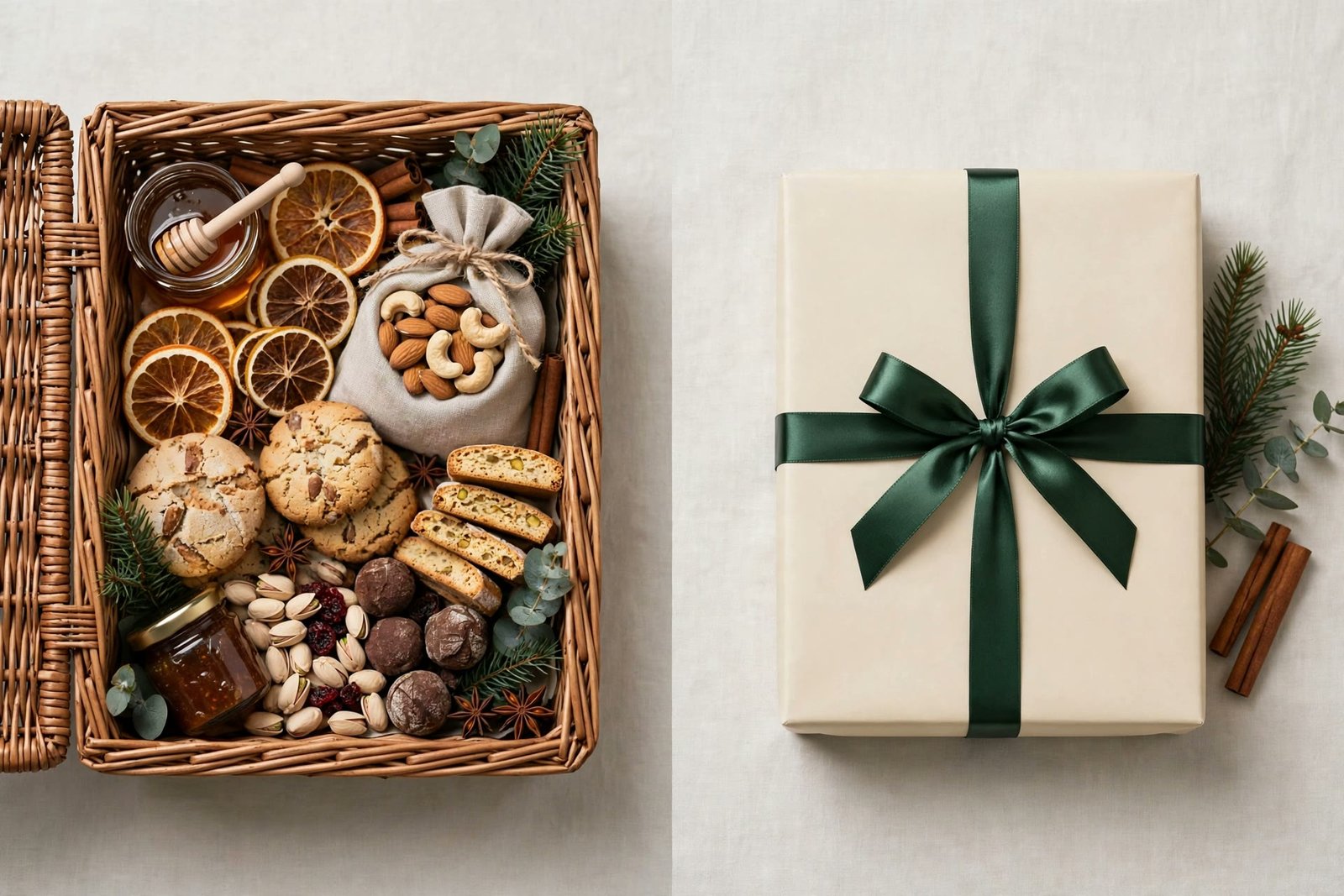
Side-by-Side Comparison
| Factor | Christmas hamper | Christmas gift box |
|---|---|---|
| First impression | Generous, abundant, festive | Neat, premium, curated |
| Best for | Smaller premium lists, clients, senior staff, sharing at home | Large employee runs, hybrid teams, multi-city dispatch |
| Variety | High — many items visible at once | Controlled — a few items chosen to work together |
| Consistency at volume | Harder — baskets and assortments vary | Easier — identical boxes, identical inserts |
| Branding | Sleeve, ribbon, tag; logo often secondary to the assortment | Lid, sleeve, insert and message card; branding is cleaner |
| Packing speed | Slower — each hamper is arranged by hand | Faster — standard packing line, repeatable steps |
| Courier safety | More fragile — open tops, glass jars, cellophane tears | Safer — closed, stackable, easier to protect |
| Home delivery | Good if shelf life and fragility are managed | Excellent — built for transit |
| Dietary and preference handling | Harder at scale — many food items to check | Easier — fewer items, clearer variants |
| Replacement for damage | Harder — matching an assortment takes time | Easier — replace one identical box |
| Shelf life risk | Higher — fresh and mixed food items | Lower if items are chosen for shelf life |
| Cost control at volume | Harder — assortment costs drift | Easier — fixed bill of materials per box |
| Personalisation | Message card and tag; item personalisation is limited | Message card, name printing, sleeve and insert personalisation all possible |
Neither column is a verdict on its own. The right format depends on who receives it, how many there are, where they are, and what the gift is meant to say. The sections below turn each row of that table into a decision you can actually make.
Cost at Bulk: Where the Money Actually Goes
At bulk scale, the headline price per gift tells only part of the story. A hamper and a box at the same headline price can have very different total costs once packing, branding, courier charges, damage and replacement are counted. Ask any vendor for a landed cost, not just a unit price: product cost, container and packaging, branding, packing labour, courier or dispatch charges, taxes, and a replacement allowance.
Hampers tend to cost more to assemble well. Each one is arranged by hand, the container itself — a basket, tray or crate — is a real cost, and the assortment means many small supplier items to source, check and stock. At small volumes that is fine; the labour is part of the premium feel. At a thousand units, hand-arrangement becomes a bottleneck, and small variations between hampers become visible. A hamper programme also tends to drift in cost: one jar substituted here, a slightly larger basket there, and the per-unit cost moves without anyone approving it.
Gift boxes tend to control cost better at volume because the bill of materials is fixed: one box, one set of items, one insert, one message card. Once the sample is approved, the vendor can repeat it. That repeatability is what keeps a thousand-unit run consistent and quotable. It also makes tiering cheaper: the same box design can carry a value set, a mid set and a premium set, with the items changing rather than the whole format.
Budget bands in this guide are planning guides to test against a vendor quote, not market prices. A value band suits a clean, well-made single item or small set for a very large all-employee run. A mid band suits a fuller box or a well-composed hamper for standard employees, managers and key teams. A premium band suits a generous hamper or a matched premium box set for CXOs, top clients and long-service employees. The mistake is to average: buying one mid-range format for everyone often means it is too plain for senior recipients and unnecessarily elaborate — and fragile — for a thousand-person courier run.
Ask the vendor three cost questions before you choose: what is included in the unit price and what is charged separately; what happens to the price if the quantity changes by 10 or 20 percent after the order; and what the replacement cost is for a damaged unit. The answers will usually tell you which format the vendor can actually deliver at your volume.
Packing, Branding and Quality Control
This is where gift boxes usually pull ahead at bulk scale, and it is worth understanding why before you fall in love with a hamper photograph.
A gift box packs on a line. The box is erected, the insert is placed, items go in the same order every time, tissue and the message card go on top, the lid closes, and the outer shipper goes on. A supervisor can check a finished box in seconds: lid closed, sleeve straight, label correct, weight right. A damaged or wrong box is spotted before dispatch, and a replacement is an identical box from the same run.
A hamper packs by arrangement. Items are placed to look abundant from the top and the sides, cellophane is wrapped and gathered, ribbon is tied, and the whole thing is protected for transit without crushing the display. That is skilled, slower work, and quality is harder to check at speed: a hamper that looks generous from one angle may have a gap from another, and a jar that shifted in transit changes the look entirely. At a hundred units, a good team can manage it. At a thousand, the packing line for hampers is longer, slower and more variable than the line for boxes.
Branding follows the same logic. On a gift box, branding is controlled: a printed lid, a belly band or sleeve, a branded insert and a message card, all produced to the same artwork. On a hamper, branding is usually a sleeve, ribbon or tag wrapped around an assortment that is itself unbranded — the food items carry their own packaging. That can still look premium, but the brand presence is lighter and less consistent. If your goal is a clear, professional brand moment when the box is opened, the gift box gives you more control. If your goal is generosity first and branding second, the hamper’s abundance does the work.
Sample approval matters for both formats, but for different reasons. For a box, approve the exact closed box: the insert fit, the lid closure, the sleeve alignment and the message card print. For a hamper, approve the exact finished hamper as it will travel, not just as it looks on a display table: ask to see one packed in its shipper, shaken gently, and opened again. If it does not survive that test in the sample room, it will not survive a courier network in December.
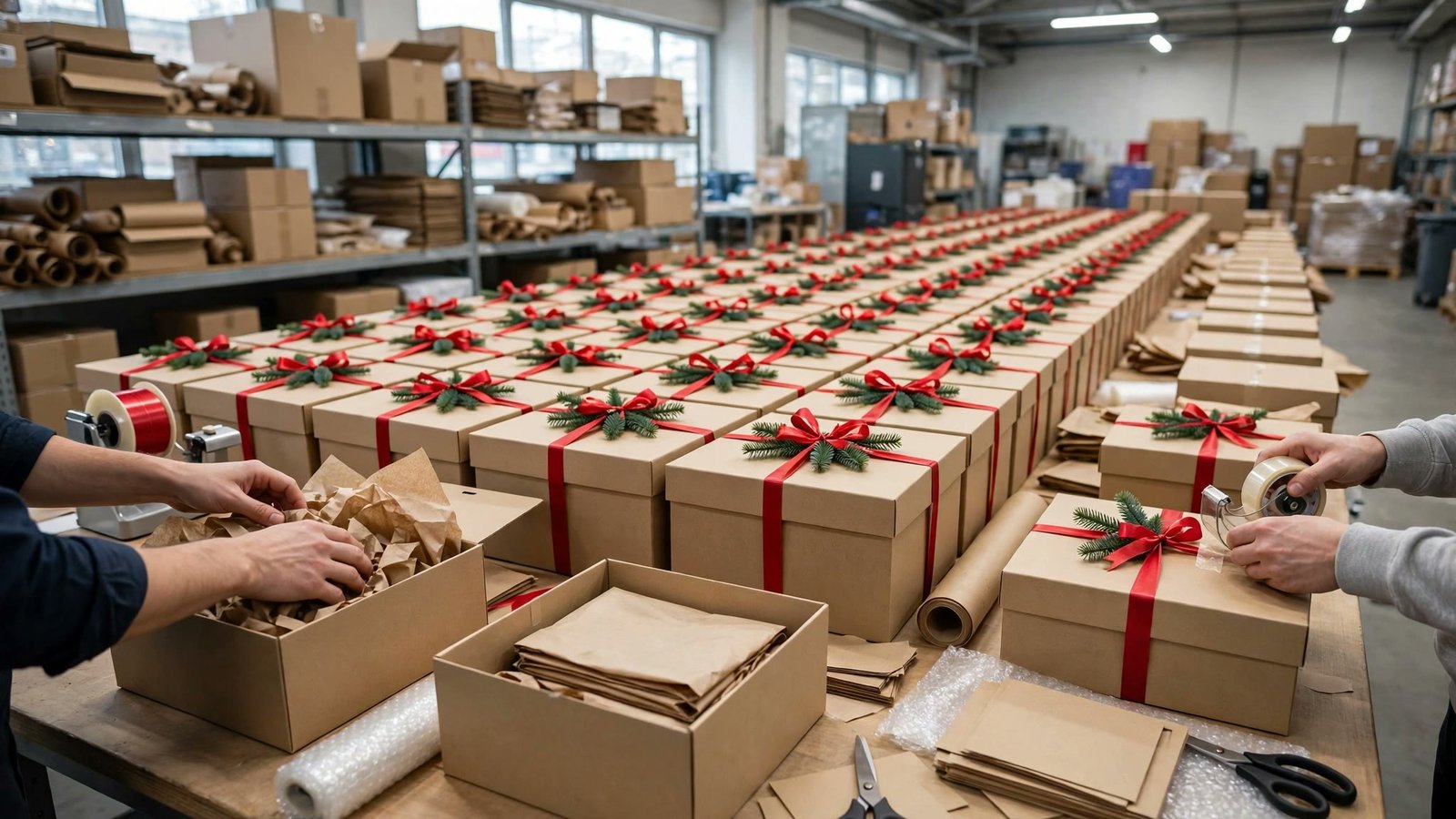
Delivery: Office, Home and Multi-City
Delivery is the test most hamper programmes fail quietly. A gift that looks perfect in the vendor’s warehouse can arrive torn, crushed or half-empty at a home address, and the recipient remembers the arrival, not the catalogue.
Office delivery suits both formats. Hampers can be delivered in bulk to an office, checked on arrival and distributed by hand, which avoids the courier risk entirely. If your programme is office-only, a hamper’s fragility matters far less, and its display value matters more. Gift boxes also work well for office distribution, and they stack and store more easily in a facilities room before distribution day.
Home delivery strongly favours gift boxes. A closed box survives handling, stacking and a doorstep drop far better than a cellophane-wrapped basket. It also protects privacy: the contents are not visible to a courier, a neighbour or a family member before the recipient opens it. For hybrid teams, the home-delivery discipline is the whole programme — our guide to Christmas gifts for remote employees in India sets out the address, PIN-code and tracking discipline in detail, and it applies with even more force to hampers, where a damaged parcel cannot simply be re-sent from identical stock.
Multi-city delivery also favours gift boxes, for the same reason plus one more: consistency. When gifts go to Delhi, Mumbai, Bengaluru and smaller cities, the box that arrives in each city should be the same box. Hampers, assembled by hand and sometimes by different local teams, drift between cities. If you do choose hampers for a multi-city programme, ask the vendor to confirm in writing whether they are assembled centrally and dispatched, or assembled locally per city — and who checks quality in each city.
Our guide to Christmas corporate gift delivery deadlines in India covers the last-order and dispatch logic for the festive season. Apply it to either format, but build in extra time for hampers: slower packing, more fragile transit and harder replacements all push the safe order date earlier. A gift box programme ordered late can sometimes be rescued with a ready format; a hamper programme ordered late usually cannot.
What the Recipient Actually Experiences
It is easy to choose by catalogue photograph. It is better to choose by the recipient’s evening after delivery.
A hamper says: here is a lot, for you and your household to enjoy. It is shared — dry fruits on the table, chocolates for the family, tea for guests. That sharing is a strength for clients and senior staff, and it is why hampers feel generous even when the individual items are modest. It is also a risk: a hamper is a public gift. If it contains alcohol, or food a recipient cannot eat for dietary, health or personal reasons, the awkwardness is visible to the household, not private to the recipient.
A gift box says: this was chosen for you. The unboxing is private, sequential and personal — lid off, tissue aside, message card first, then items revealed one by one. That sequence is why a message card matters more in a box than in a hamper: it frames the whole set before the recipient judges any single item. A box also travels better into the recipient’s daily life: a mug, a bottle, a notebook or a candle stays in use after the festive week, while a hamper is consumed and gone. For employee recognition, that lasting use can matter more than festive abundance.
Dietary and personal preferences deserve a direct decision, not a hope. At bulk scale, you cannot personalise every hamper, but you can offer variants: a standard box, a vegetarian or no-chocolate variant, a no-alcohol assurance, and a non-food box for recipients who prefer it. Boxes make variants manageable because the variant is a different bill of materials, produced and labelled as such. Hampers make variants harder because every item in the assortment must be checked against the variant rule. Whichever format you choose, state the variant plan in the brief, collect preferences only where you can actually act on them, and never promise a personalised hamper you cannot check item by item.
Shelf life is the other recipient reality. A hamper with fresh or short-life items must reach the recipient before a holiday trip, a long courier transit or a warm warehouse stay spoils it. A box built from shelf-stable items — good tea, coffee, dry snacks with a reasonable date, non-food items — removes that worry. If food is central to your gift, confirm manufacturing and expiry dates on the sample, confirm the dispatch window, and avoid perishable items for home delivery during holiday weeks unless the courier timeline is guaranteed.

When a Hamper Wins
Choose a hamper, or keep hampers for a defined tier, when most of these are true:
- The list is smaller and senior: key clients, CXOs, board members, distributors or long-service employees where generosity is the message.
- The gift will be enjoyed at home and shared, and that sharing is a feature, not a risk.
- Delivery is office-based or local, or the vendor can guarantee careful, short-transit delivery.
- The budget allows hand-arrangement and a premium container, and the timeline allows slower packing.
- Branding can be light — a sleeve, ribbon and message card — because the assortment itself carries the impression.
- Dietary risk is low for that group, or the group is small enough to handle preferences individually.
For clients in particular, a hamper can avoid the "advertising" problem that a heavily branded box sometimes creates. Our guide to Christmas gifts for clients in India explores that balance — a premium hamper, lightly branded, can feel like a genuine thank-you rather than a marketing item, precisely because the brand does not dominate the gift.
When a Gift Box Wins
Choose a gift box as the standard format when most of these are true:
- The list is large — hundreds or thousands — and consistency matters more than individual abundance.
- Recipients are hybrid, remote or multi-city, and gifts travel by courier to home addresses.
- You need clean branding: a printed lid, sleeve, insert and message card that look identical in every city.
- You need fast, checkable packing and a simple replacement process for damage.
- You need variants for dietary or personal preferences, produced as distinct, labelled sets.
- You need tiering without redesigning the format: value, mid and premium sets in the same box family.
- The timeline is tight, and a ready or semi-ready box format can still be produced and dispatched on time.
Gift boxes also suit teams that want the gift to last beyond Christmas. A desk set, a quality bottle, a candle or a notebook in a well-designed box is still in use in February, carrying a quiet brand reminder. A hamper, however generous, is remembered as a festive moment. Both are valid goals; they are simply different ones, and the box’s lasting-use advantage is often underrated in December planning.
The Hybrid Model Most Companies Actually Need
The most common successful pattern is not hamper or box. It is both, tiered by audience:
- All employees: a gift box, identical, courier-safe, with a message card and one or two useful items. This is the programme that must not fail, so it gets the most controllable format.
- Managers, key teams and long-service employees: a fuller gift box, or a box plus one premium item, in the same box family so the programme still looks coherent.
- Key clients, CXOs and distributors: a premium hamper, lightly branded, delivered with care, where generosity and sharing are the point.
- Support staff, security and housekeeping teams: do not forget this group in either format. A gift box at the standard employee tier, delivered with the same care and timing, is far better than a hamper for some teams and nothing for others. Inclusive holiday gifting is a programme decision, not a format decision, and it should be settled before products are chosen.
Tiering by format, done openly and fairly, avoids the resentment that comes from visible inequality. Keep a common core — the same message card standard, the same packaging quality, the same delivery timing — across tiers, and let the format and contents differ by relationship and role, not by favour. If a hamper tier is visibly more generous, that is defensible for a key client; if office staff receive hampers and remote staff receive nothing, that is not a tiering decision, it is a delivery failure.
Ordering Checklist: Hamper or Box, the Same Discipline Applies
Whichever format you choose, the ordering discipline is the same — and it is where most December programmes are won or lost:
- Groups and tiers decided before products: employees, managers, clients, distributors, support teams — with headcounts per group, including remote and multi-city splits.
- Format decided per group, not per catalogue: hamper for the premium tier, box for the bulk run, or a single format for all, with reasons recorded.
- Sample approved as it will travel: for a box, the exact closed box; for a hamper, the exact finished hamper packed in its shipper.
- Bill of materials frozen: every item, container, insert, sleeve and card listed, so a substitution needs approval rather than happening quietly.
- Variants defined: dietary, non-food and no-alcohol variants where relevant, with quantities per variant.
- Name and address lists frozen and checked: PIN codes validated, remote addresses prioritised, and a named owner for list accuracy.
- Production and dispatch dates confirmed in writing: per city where relevant, with a buffer for the longest transit times.
- Quality check agreed: what is checked per unit, how many units are spot-checked, and who can reject a batch.
- Replacement stock held back: a small percentage of the total order for damage, wrong items and late additions, with a named replacement owner.
- Distribution plan per channel: office handout, home courier and multi-city dispatch, each with its own date and owner.
If you are ordering for Christmas, work backwards from the distribution date, not forwards from the brief. Our delivery-deadlines guide sets out that logic, and the rule of thumb is simple: the more fragile and hand-assembled the format, the earlier the safe order date. Do not let a hamper programme’s slower packing surprise you in mid-December.
Common Mistakes in the Hamper vs Box Decision
Choosing by photograph. A hamper always photographs more generously than a box. Judge the sample in hand, packed as it will travel, not the catalogue image.
Ordering one format for every audience. A hamper for a thousand couriers, or a plain box for a key client, both waste the format’s strength. Tier the format to the audience.
Forgetting dietary and personal preferences until packing day. Variants must be planned in the brief, with quantities, or they cannot be produced. A last-minute dietary request on a hamper assortment is a rework, not a tweak.
Underestimating courier damage for hampers. Cellophane tears, jars shift, baskets crush. If the programme is courier-heavy, the box’s closed, stackable design is not a minor advantage — it is the deciding one.
Over-branding a hamper, or under-branding a box. A hamper plastered with logos loses its generous feel; a box with no branding at all loses the programme’s identity. Match the branding to the format: light and elegant on a hamper, clean and controlled on a box.
No replacement plan. Damage at volume is a certainty, not a surprise. A programme without replacement stock spends December apologising, whichever format it chose.
Announcing a delivery date the vendor has not confirmed. Never promise recipients a date until production and dispatch dates are confirmed in writing — and for hampers, confirmed with the slower packing timeline included.
A Simple Decision Worksheet
Answer these five questions with your team, and the format usually chooses itself:
- How many recipients, and how many are home-delivery rather than office handout? Over a few hundred, or mostly home-delivery, the box’s consistency and courier safety weigh heavily.
- Who is the most senior or most valuable group on the list, and what should their gift say? If the answer is generosity and abundance, give that group a hamper tier.
- What is the latest safe dispatch date, and can the vendor meet it with hand-assembled hampers? If not, choose the box, or move the hamper tier earlier.
- What dietary, personal and cultural preferences must be honoured, and can variants be produced reliably in each format? Boxes make variants easier to control.
- What should the recipient still have or remember in February? If the answer is a useful item in daily use, the box’s curated set wins; if the answer is a festive shared memory, the hamper wins.
Write the answers down, share them with the vendor, and ask the vendor to confirm — in writing — that the chosen format, quantity, variants and dates are achievable. That one page of decisions prevents most December disputes, because it turns a taste preference into a brief.
Frequently Asked Questions
1. Which is better for bulk corporate orders: a Christmas hamper or a gift box?
It depends on the audience and delivery channel. Gift boxes usually work better for large, courier-delivered employee runs because they are consistent, stackable and easier to check and replace. Hampers usually work better for smaller premium lists — key clients and senior staff — where generosity and sharing matter most and delivery can be handled with care.
2. Are Christmas hampers more expensive than gift boxes?
Not always on headline price, but hampers often cost more in total at volume because of hand-arrangement, the container itself and assortment sourcing. Always compare landed cost — product, packaging, branding, packing labour, courier and replacement allowance — not just the unit price.
3. Can Christmas hampers be sent safely by courier to home addresses?
They can, but they need more protection and carry more damage risk than closed gift boxes, especially with glass jars, cellophane wrapping and open baskets. For mostly home-delivery programmes, a closed gift box is the safer format, and any hamper tier should be packed and tested as it will travel.
4. How do we handle dietary preferences in a bulk Christmas programme?
Plan variants in the brief, not at packing time: a standard set, a vegetarian or no-chocolate variant, a no-alcohol assurance and a non-food option where needed. Gift boxes make variants easier to control because each variant is a fixed set; hampers require every assortment item to be checked against the variant rule.
5. Can we use both hampers and gift boxes in one programme?
Yes, and for most companies this is the best model: gift boxes as the standard employee gift, and hampers as the premium tier for key clients, CXOs and distributors. Keep a common standard for message cards, packaging quality and delivery timing across tiers so the programme feels coherent and fair.
6. When should we order Christmas hampers vs gift boxes?
Work backwards from the distribution date. Hampers need earlier ordering because packing is slower and more variable; gift boxes can sometimes be rescued later with a ready format. Confirm production and dispatch dates with the vendor in writing, per city where relevant, before announcing a delivery date internally.
7. What should a corporate Christmas gift box contain?
A coherent set rather than unrelated items: for example, a useful everyday item, a festive food item with a reasonable shelf life, and a message card. Avoid over-branding — one clear logo placement plus a genuine message — and choose items the recipient will still use after the festive week.
Conclusion
Christmas hampers and Christmas gift boxes are not rivals where one is always better. They are different tools for different jobs. A hamper is generous, abundant and made to be shared — ideal for a smaller, premium list where the impression matters and delivery can be handled with care. A gift box is consistent, brandable, courier-safe and easy to control at volume — ideal for a large employee programme, hybrid teams and multi-city dispatch, where every recipient must receive the same quality at the same time.
For most Indian companies ordering in bulk, the honest answer is a tiered programme: gift boxes as the reliable standard for employees, and hampers as the premium tier for clients and senior leaders, with a common standard of message, packaging quality and delivery care across both. Decide the groups first, choose the format per group, approve the sample as it will travel, and order early enough that the format you chose can actually be packed and delivered well.
Get that right, and the gift does what a Christmas gift should do: it arrives intact, it looks intentional, and it tells each recipient — employee, client or partner — that they were thought of, not just counted.
A Natural Next Step
If you are deciding between hampers and boxes for this Christmas, start with three numbers: how many recipients in total, how many need home delivery, and the date the gifts must be in hand. With those, a vendor can tell you honestly whether a hamper programme is achievable at your volume and timeline, or whether a gift box — possibly with a hamper tier for key clients — is the safer, better-presented choice. For wider festive planning, our guide to Christmas gifts for clients in India, our guide to Secret Santa gifts for office teams and our guide to New Year welcome-back gifts for employees show how December and January programmes should differ, rather than repeating the same gift. When you are ready to brief a supplier, reach out through the contact page with your groups, format per group, variants and target delivery date, and ask for a landed cost — product, packaging, branding, packing and courier — before you approve a sample.
7 Comments