
Branded Hoodies and Jackets for Companies: Fabric, GSM and Embroidery vs Print Guide
Branded Hoodies and Jackets for Companies: Fabric, GSM and Embroidery vs Print Guide
A branded hoodie is the corporate gift people actually wear. It is not put on a shelf, it is not left in a drawer, and it does not get re-gifted at the next office Secret Santa. An employee who receives a good hoodie wears it on the commute, at a weekend outing, on a video call from home — and the company’s name travels with it, without ever looking like an advertisement. That is also why it is so easy to get wrong. A hoodie with thin, scratchy fleece, a zip that catches, a logo that cracks after three washes, or sizes that run two sizes small will quietly undo the goodwill the gift was meant to create — and unlike a desk calendar, the recipient has to put the failure on their body.
This guide is for HR, admin, marketing and procurement teams planning branded hoodies and jackets for companies in India. It covers every hoodie and jacket style worth ordering, the fleece GSM bands that decide quality, the zip-up vs pullover decision, embroidery vs print on fleece, sizing for bulk orders, budget bands, and the order-by dates that get winter stock delivered on time. It is the specification companion to our general corporate apparel guide, which covers T-shirts, polos, jackets and hoodies at overview level. If your order is polos, read our branded polo T-shirt guide when it publishes; if it is hoodies or jackets, this is the guide. The GSM bands, sizes and budget bands below are planning guides to test against your vendor’s confirmed specification sheet and quote — not vendor promises — because the right answer depends on your fabric, quantity and branding method.
Why Hoodies and Jackets Earn Their Place — and When They Don’t
Before choosing a style, it is worth being honest about whether a hoodie or jacket is the right gift at all. Three strengths justify it, and two situations argue against it.
First, everyday use without ceremony. A hoodie is worn, not displayed. It works on a cold morning commute, in an over-air-conditioned office, on a weekend, and on a team offsite. That repeated use is what makes it valuable as a brand item: the logo is seen in ordinary life, not only at the event where it was handed out. For employee appreciation and new-year welcome-back gifts in particular, a hoodie signals that the company thought about what the person would actually use, not what photographs well in a hamper.
Second, winter timing that works in your favour. Hoodies and jackets are seasonal in India in a way that T-shirts are not. A well-timed order in October or November lands just as the weather turns in North India, which makes the gift feel considered rather than generic. The same hoodie ordered in March arrives when nobody needs it, and the goodwill is halved. Timing is part of the gift, which is why the ordering timeline later in this guide matters as much as the fabric.
Third, clean tiering across the team. Hoodies and jackets scale across budgets without changing the ordering process. A midweight zip-up works for an all-employee winter run, while a premium heavyweight hoodie or a softshell jacket suits leadership, key clients and long-service recognition. One product family, one vendor, three tiers.
The two situations where a hoodie or jacket is the wrong choice: teams in warm climates where a heavy garment will never be worn — a Chennai or Kochi team in December does not need the same fleece weight as a Delhi team — and programmes where the recipient’s size is genuinely unknown and cannot be collected. A hoodie in the wrong size is unwearable in a way that a wrong-sized mug is not. The honest test is simple: will this person reach for it in their normal week, in their actual climate? If yes, it is a strong choice. If the answer is “maybe, if it gets cold enough”, pick something else. For the recognition thinking behind winter and year-end gifting, SHRM’s employee recognition resources are a useful general reference.
Hoodie and Jacket Styles: The Full Range
Not all hoodies and jackets are the same product. The style decides the cost, the branding area, how the recipient uses it, and how it survives washing and packing. Here is each style, honestly assessed.
Pullover Hoodies: The Classic
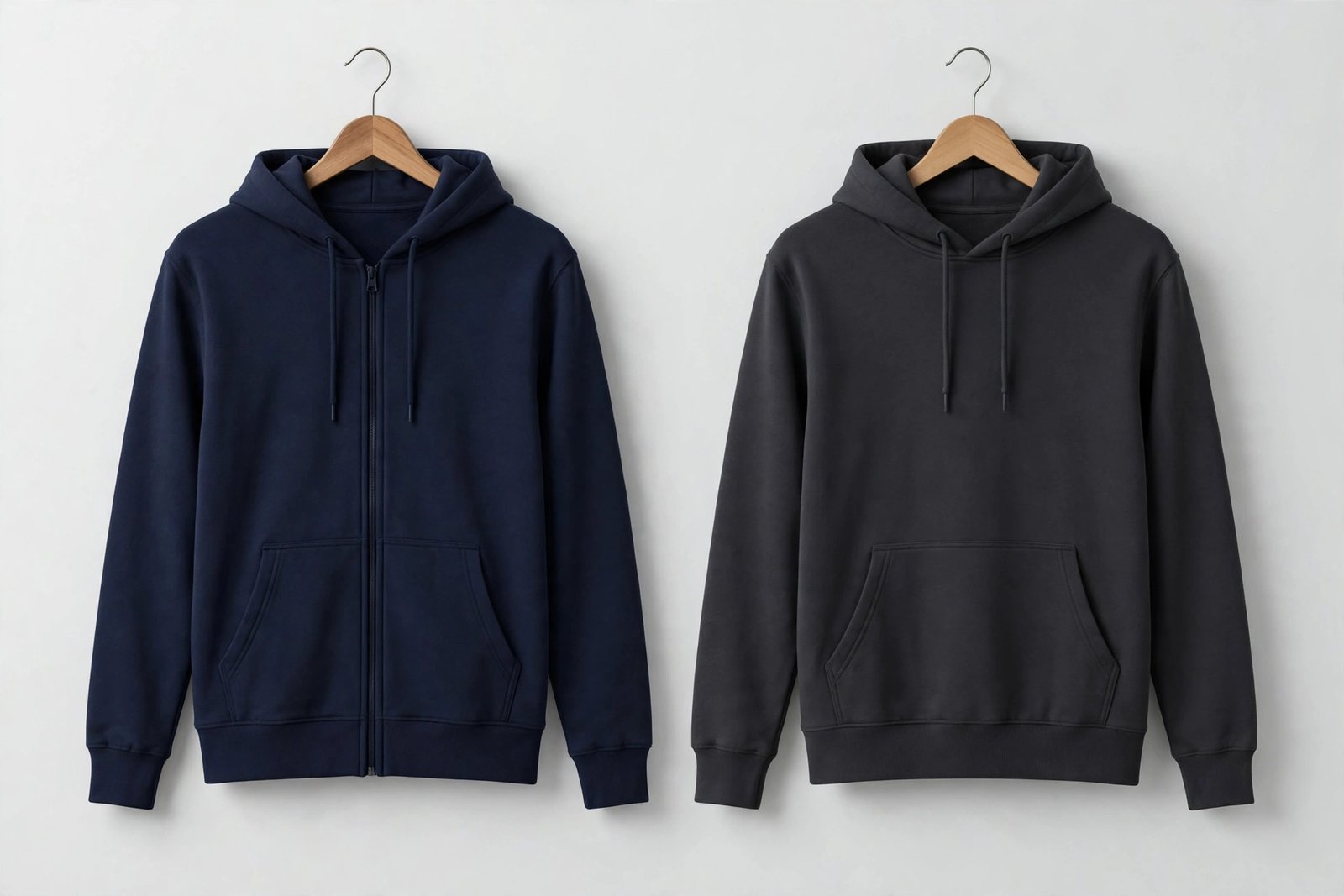
The pullover hoodie is the standard corporate hoodie: a front kangaroo pocket, a drawstring hood, ribbed cuffs and hem, no zip. It is the most comfortable option for everyday wear and the simplest to produce, which usually makes it the best value at volume.
Pullover hoodies suit all-employee winter runs, tech and creative teams, welcome kits, team offsites and employee appreciation, because they are warm, relaxed and easy to wear. The trade-offs are real: the branding area is limited to the chest and back, the hood adds weight and bulk to packing, and a pullover is harder to put on over formal clothing. When you approve a sample, wear it for an hour — sit, stretch, raise your arms — and see whether the cuffs stay put and the hood sits flat. That single test tells you more than a catalogue photo ever will.
Best for: all-employee runs, tech and creative teams, welcome kits, offsites, winter appreciation.
Watch out for: thin fleece, drawcords that fray, cuffs that lose elasticity, a hood that pulls the garment backwards.
Zip-Up Hoodies: The Practical Choice
A zip-up hoodie opens fully at the front, which makes it easier to put on over other clothing and easier to regulate temperature — zip up in the cold, zip down indoors. It is the more practical choice for offices, client-facing teams and anyone who moves between indoors and outdoors during the day.
Zip-up hoodies suit managers, field and sales teams, event staff and mixed-use programmes, because they layer well over a shirt or a T-shirt. The trade-offs: the zip is a failure point — a cheap zip catches, separates or breaks — and the two front panels complicate large chest branding, since the design cannot run across the zip. A full-zip hoodie also costs more than a pullover in the same fabric, because of the zip, the extra stitching and the pocket construction.
Best for: managers, field and sales teams, event staff, layered office wear.
Watch out for: cheap zips, misaligned zip teeth, front panels that gap, pockets that sit unevenly.
Crewneck Sweatshirts: The Understated Option
A crewneck sweatshirt is a hoodie without the hood: same fleece, same warmth, a cleaner and slightly more formal silhouette. It suits companies that find a hood too casual for their culture, and it is often the best choice for client-facing teams who need warmth without the streetwear look.
Crewnecks are also the easiest sweatshirt to brand, because the chest is a single uninterrupted panel. They work well for premium sets, CXO gifts and teams where the hood would never be used. The trade-off is that they are less distinctive as a gift — a recipient may already own several crewnecks, so the quality of the fabric has to carry the impression.
Best for: client-facing teams, premium sets, companies that find hoods too casual.
Watch out for: a neckline that stretches out of shape, thin ribbing at the collar, a fit that is too boxy or too slim.
Bomber Jackets: The Smart Outer Layer
A bomber jacket is a short, zip-front jacket with ribbed cuffs and hem, usually in a smooth outer fabric with a lined interior. It reads as smarter than a hoodie and works as an outer layer over office clothing, which makes it a good choice for leadership gifts, client gifts and premium recognition.
Bombers suit CXO and key-client tiers, sales leadership and winter recognition, because they look intentional rather than casual. The trade-offs are cost — a good bomber costs noticeably more than a hoodie — and climate: a lined bomber is warm, but in a mild winter it can be too much garment for the weather. Confirm the lining weight with the vendor before ordering for a South Indian team.
Best for: CXO gifts, key clients, leadership recognition, premium winter sets.
Watch out for: linings that bunch, zips that snag on the lining, cuffs that lose shape.
Softshell Jackets: The Workhorse Outer Layer
A softshell jacket is a lightweight, wind-resistant and water-repellent outer layer, usually in a smooth polyester or polyester-blend shell with a brushed or fleece inner face. It is the most practical jacket for field teams, travelling employees and outdoor events, because it protects against wind and light rain without the bulk of an insulated jacket.
Softshells suit field sales teams, travelling employees, outdoor events and teams that move between locations, because they layer over anything and pack flat. The trade-offs: a softshell is not a warm garment on its own — it needs a layer underneath in a real winter — and the smooth shell fabric limits branding methods. Embroidery works well; large prints do not, because the fabric flexes and the print can crack. Our guide to gifts for field sales teams covers the wider kit a travelling team needs alongside the jacket.
Best for: field and sales teams, travelling employees, outdoor events, layered winter wear.
Watch out for: shell fabric that feels plasticky, zips that snag, a fit that is too tight to layer over a shirt.
Fleece Jackets: The Mid-Layer
A fleece jacket is a zip-front jacket in a soft, brushed fleece, lighter and less bulky than a hoodie, and easier to layer under a coat. It suits office wear, indoor-outdoor work and teams that want warmth without the casual look of a hoodie.
Fleece jackets work well for all-employee winter runs in moderate climates, admin and facilities teams, and as a layer inside a winter kit. The trade-off is pilling: cheap fleece pills quickly, especially under the arms and at the cuffs, and a pilled jacket looks old within weeks. Ask the vendor whether the fleece is anti-pill, and check the sample after a wash, not only before it.
Best for: moderate climates, office wear, winter kits, admin and facilities teams.
Watch out for: pilling, thin fleece at the price point, zips that catch on the fleece pile.
Puffer and Insulated Jackets: The Cold-Climate Option
A puffer or insulated jacket is a quilted outer layer with synthetic or down-alternative filling, designed for genuinely cold weather. It is the right choice for North Indian winters, hill-station teams, outdoor night events and employees who work early mornings or late nights outdoors.
Puffers suit leadership and premium tiers in cold regions, and any team whose work happens outdoors in December and January. The trade-offs are cost, bulk — puffers are expensive to ship and hard to pack — and climate mismatch: a puffer ordered for a team in a warm city will never be worn. Reserve puffers for the regions and roles that genuinely need them, and brand them subtly, because a large print on a quilted surface rarely looks clean. Embroidery on the chest is usually the right call.
Best for: North Indian winters, outdoor night work, premium cold-climate gifts.
Watch out for: filling that clumps after washing, stitching that leaks filling, a fit that is too puffy to layer.
Windcheaters: The Light, Branded Layer
A windcheater is a lightweight, windproof jacket, usually unlined, that packs small and works for monsoon and light winter use. It is the most affordable jacket option and the easiest to brand at scale, because the smooth fabric takes print well and the garment folds flat for packing.
Windcheaters suit large event runs, marathons, outdoor campaigns and monsoon-season programmes, where the priority is a light, visible, branded layer rather than warmth. The trade-off is that a windcheater is not a warm gift — do not order it as a winter gift for a Delhi team in December. It is a layer, not a winter solution.
Best for: events, marathons, outdoor campaigns, monsoon-season programmes, large runs.
Watch out for: fabric that feels like a plastic bag, zips that fail, a fit that balloons in the wind.
Fabric and GSM: The Specification That Decides Quality
GSM — grams per square metre — is the single most useful number in a hoodie order. It measures the weight of the fabric, and it is the best proxy for warmth, drape and perceived quality. A vendor who cannot tell you the GSM of the fleece is a vendor who has not specified the product, and you should not order from them.
Fleece GSM Bands for Corporate Hoodies
| GSM band | Feel and warmth | Best for | What to check |
|---|---|---|---|
| 240–280 GSM | Lightweight fleece; comfortable in mild weather, easy to layer | Mild-winter teams, South Indian offices, indoor wear, events | Feels thin at the low end; confirm it is brushed, not flat |
| 280–320 GSM | Midweight fleece; the standard corporate hoodie weight | All-employee winter runs, welcome kits, tech and creative teams | The safe default; most good corporate hoodies sit here |
| 320–380 GSM | Heavyweight fleece; warm, structured, premium hand-feel | Premium tiers, CXO gifts, North Indian winters, recognition | Heavier to pack and ship; confirm the hood weight does not pull |
| 380–450 GSM | Premium heavyweight fleece; very warm, substantial drape | Luxury recognition, leadership gifts, cold-climate teams | Cost rises sharply; check the zip and seams handle the weight |
The 280–320 GSM band is the safe default for most companies. Go lighter only when the climate or the use case genuinely demands it — a Chennai team in December does not need 380 GSM — and go heavier only when the recipient and the budget justify it, because a very heavy hoodie on a mild day is worn once and shelved. Always confirm the GSM on the vendor’s specification sheet and on the physical sample: ask the vendor to state the GSM in writing, and compare the sample against a hoodie you already own whose weight you know.
Cotton, Blends and Fleece Types
100% cotton fleece feels soft and natural and prints well, but it shrinks more, wrinkles more and takes longer to dry. It suits premium, low-volume orders where the feel matters most.
Cotton-polyester blends (typically 80/20 or 60/40) are the workhorse of corporate hoodies: the cotton gives softness, the polyester gives shape retention, faster drying and less shrinkage. Most bulk corporate orders use a blend, and for good reason.
Polyester fleece is durable, light and quick-drying, but it can feel less premium and can hold odours. It suits sports, events and outdoor programmes better than office gifting.
Brushed fleece has a soft, raised inner face — the familiar cosy inside of a good hoodie. It is the finish to ask for on any hoodie meant to be worn, not just displayed.
Loopback fleece (French terry) has an unbrushed looped inner face. It is lighter, breathes better and suits mild weather, but it feels less warm and less premium than brushed fleece.
Anti-pill fleece is treated to resist the small balls of fibre that form on cheap fleece after washing. It costs a little more and is worth it on any order above a hundred units, because pilling is the defect recipients notice first and forgive least.
What Else to Specify With the Vendor
GSM is the headline number, but it is not the whole specification. Put these in the order as well: fabric composition in percentages; brushed or loopback finish; anti-pill treatment, yes or no; colour fastness, confirmed in writing; shrinkage allowance, confirmed in writing; and the country or mill of origin for the fabric, if the vendor can state it. A vendor who can answer all six is a vendor who has actually specified the product. A vendor who answers only with a price has not. Before committing to a bulk order, run every one of these checks on a physical branded sample. Our sample approval checklist for bulk corporate gifts lists twelve things to verify, and it is worth following in full: a sample that fails on fabric, zip or embroidery is a sample that saves you from a thousand-unit mistake.
Zip-Up vs Pullover: Which Should Your Company Choose?
This is the decision most teams get stuck on, so here it is plainly. The right answer depends on how the hoodie will be worn, not on which one looks better in a catalogue.
| Factor | Zip-up hoodie | Pullover hoodie |
|---|---|---|
| Ease of wearing | Opens fully; easy over a shirt or formal wear | Pulled over the head; harder over formal clothing |
| Temperature control | Zip up or down as the day changes | On or off; no middle setting |
| Branding area | Chest split by the zip; back is the main canvas | Full uninterrupted chest and back |
| Layering | Layers well over a shirt; works as an outer layer | Layers under a coat; works as a mid-layer |
| Durability risk | The zip is the failure point — check it on the sample | Drawcords and cuffs are the failure points |
| Cost at the same GSM | Usually higher (zip, extra stitching, pocket work) | Usually lower at the same fabric weight |
| Best for | Managers, field teams, event staff, layered office wear | All-employee runs, tech teams, welcome kits, offsites |
Choose a zip-up when the recipients will wear the hoodie over office clothing, move between indoors and outdoors, or need to regulate temperature through the day. Field sales teams, event staff and managers usually fit this pattern.
Choose a pullover when the hoodie is a comfort gift — a winter appreciation gift, a welcome-kit item, an offsite memento — and the priority is warmth and simplicity over versatility. All-employee runs usually fit this pattern, and the lower cost at the same GSM means the budget can go into better fabric instead of a zip.
Choose both when the programme has two distinct audiences: zip-ups for client-facing and field roles, pullovers for the wider team. One order, two styles, one vendor — and the tiering reads as intentional rather than inconsistent.
Embroidery vs Print on Fleece: What Actually Works
Fleece is a difficult surface to brand. It is thick, soft and textured, which is exactly what makes it comfortable — and exactly what makes branding fail. The method you choose matters more on a hoodie than on a T-shirt, so choose it deliberately.
| Method | How it works on fleece | Best for | Watch out for |
|---|---|---|---|
| Embroidery | Thread stitched into the fabric; sits on top of the pile | Chest logos, small designs, premium tiers, jackets and softshells | Fine detail is lost; small text blurs; needs a stabiliser backing |
| Screen printing | Ink pressed through a mesh onto the fabric surface | Large back prints, bold designs, high-volume orders | Ink can sink into the pile and look faded; cracks if the fleece stretches |
| Direct-to-film (DTF) printing | Design printed on film, then heat-pressed onto the garment | Detailed, multicolour artwork on hoodies and jackets | Can feel stiff on thick fleece; adhesion fails if the press is wrong |
| Heat transfer / vinyl | Cut or printed vinyl heat-pressed onto the fabric | Names, numbers, small runs, personalisation | Peels at the edges on fleece; not a long-life option on heavy GSM |
Embroidery is the default for corporate hoodies and jackets, and the reasons are practical: it looks premium, it survives washing, it does not crack, and it suits the small chest logo that most companies actually want. The rules for good embroidery on fleece are simple. Keep the design simple — a logo with fine lines or small text will not read on a textured surface. Ask the vendor for the stitch count: a left-chest logo of about 3–4 inches wide typically runs in the region of 4,000–8,000 stitches, and a design that needs far more than that is probably too detailed for fleece. Confirm that a stabiliser backing is used behind the embroidery, because without it the stitches sink into the pile and the logo looks sunken. And approve a physical embroidered sample on the actual garment — a digital mock-up cannot show how thread sits on fleece.
Screen printing works when the design is bold and the order is large. A big back print, a simple graphic, a single colour — these print well on fleece, provided the printer uses enough ink to sit on the pile rather than sinking into it. Ask for a printed sample and wash it three times before approving the order: a print that cracks or fades after three washes will not survive a season.
DTF printing is the best option for detailed, multicolour artwork that embroidery cannot reproduce, but it needs a careful press. On heavyweight fleece the film can feel stiff, and a bad press peels. Approve a sample, wash it, and check the edges.
Heat transfer is for personalisation, not for the main logo. Names and numbers on the sleeve or back are a reasonable use; a main chest logo in heat transfer on fleece will peel and look cheap within weeks. Do not let a vendor sell it as a premium option.
Artwork readiness is a common bottleneck in every branding decision. If your logo is only available as a low-resolution file, fix that before the sample stage, not during production. Our guide to logo file formats for gift branding explains exactly which formats a printer or embroiderer needs and why a JPG pulled from a website will not produce a clean result.

Sizing for Bulk Hoodie and Jacket Orders
Sizing is the biggest operational risk in a hoodie or jacket order. A garment that fits one employee well may be uncomfortable for another, even when both select the same labelled size — and a hoodie in the wrong size is unwearable, not merely imperfect.
Get the Measurements, Not Just the Labels
Request the supplier’s size chart with actual garment measurements — chest width, body length, sleeve length — in inches or centimetres. Do not accept a chart that lists only S, M, L, XL with no measurements, because a medium from one vendor is a large from another. Confirm whether the sizing follows Indian, international or brand-specific standards, and check whether the cut is regular, slim or oversized: an oversized-fit hoodie in size L is a different garment from a regular-fit hoodie in size L.
A practical size guide for planning — confirm against your vendor’s actual chart before ordering:
| Size | Chest width (approx.) | Body length (approx.) | Who it usually fits |
|---|---|---|---|
| S | 20–21 inches | 26–27 inches | Smaller builds |
| M | 21–22 inches | 27–28 inches | The most common size in most Indian teams |
| L | 22–24 inches | 28–29 inches | Larger builds |
| XL | 24–26 inches | 29–30 inches | Broad builds |
| XXL | 26–28 inches | 30–31 inches | Order only against a confirmed request |
These are planning figures, not a standard — your vendor’s chart is the document that matters. Measure a hoodie the recipient already owns and likes, and match the measurements rather than the label.
Collecting Sizes Without Chaos
Collect size preferences through a clear, secure process with a deadline. Share measurement instructions — a simple diagram showing where to measure chest and length — rather than asking people to guess their size. Offer a size-sampling session for larger programmes where practical: a rack of sample sizes in the office for a day resolves more arguments than a week of emails. And confirm the supplier’s replacement policy before ordering: some vendors will exchange unworn sizes, some will not, and that policy changes how much buffer you need.
For the wider process of collecting employee details for delivery, our guide on how to collect employee addresses for gift delivery without chaos covers the consent and template discipline that applies to size collection as well.
Unisex, Men’s and Women’s Fits
Most corporate hoodie orders use a unisex fit, and for a mixed team that is usually the right call — one fit, one size run, simpler logistics. But be honest about the trade-off: a unisex hoodie is cut to a men’s block, and on many women it fits long in the body and wide in the shoulders. If the programme is for a team with a large proportion of women, ask the vendor about a women’s cut for the same fabric, or at least confirm the unisex fit on a female wearer before approving the order. Do not assume one fit serves everyone equally.
The Size Buffer
Order a small buffer in the most common sizes — M and L in most Indian teams — because size exchanges are the most common post-delivery problem. A buffer of 5–10% in M and L, held at head office, covers the exchanges without a reprint. A reprint of twenty hoodies costs nearly as much in setup as the original run, so the buffer is cheap insurance.
Colour, Logo Placement and Artwork
Colour. Navy, charcoal and black are the safe corporate colours: they hide wear, they suit every skin tone, and they carry a logo cleanly. Maroon, bottle green and heather grey are good second choices. Bright colours photograph well at events but are worn less often afterwards — and a hoodie that is not worn is a wasted gift. If the programme is an event, a brighter colour may be right; if it is an employee gift, a colour the recipient would choose for themselves is right. Confirm colour consistency across the batch on the sample: fleece dye lots vary, and a navy that shifts between batches looks like two different orders.
Logo placement. The left chest is the standard corporate placement for embroidery — discreet, professional, and the placement recipients accept most readily. The centre chest suits a larger embroidered or printed design. The back suits a large print for event hoodies. The sleeve suits a small secondary mark, and the hood itself should never carry branding — it folds, it moves, and a logo there looks like a mistake. One clear logo placement beats three small ones.
Logo size. For embroidery, a left-chest logo of 3–4 inches wide is the usual specification. For a back print, 10–12 inches wide is the common range. Larger than that on fleece, and the design starts to fight the fabric — it stiffens, it cracks, it pulls. Keep the artwork simple, keep the colours few, and let the garment carry the impression rather than the logo.
Budget Bands: Planning Without False Precision
Exact prices depend on fabric, GSM, style, quantity, branding method and delivery, so any article quoting a single “market price” for a custom hoodie should be treated with caution. What is genuinely useful is planning in bands, then getting a vendor quote for your exact specification.
- Value band (large all-employee runs): midweight 280–320 GSM pullover hoodie, cotton-polyester blend, one branding method, one or two colours. The goal is a clean, well-made item at a per-unit cost that survives a large headcount.
- Mid band (managers, key teams, regular clients): heavyweight 320–380 GSM zip-up or pullover, brushed anti-pill fleece, embroidery on the chest, individual packing. This is also the band where a hoodie-plus-jacket set starts to make sense for winter.
- Premium band (CXOs, board members, top clients): premium heavyweight fleece or a softshell or bomber jacket, embroidery, personalisation, premium packaging. The unit cost is higher, but the quantity is small, so the total stays manageable. For the etiquette of gifting at this level, our guide to gifts for investors, board members and advisors is worth reading alongside this one.
The mistake to avoid is averaging: buying one mid-range hoodie for everyone often means it is too plain for senior recipients and unnecessarily expensive for a thousand-person run. Tiering the same product family across bands usually costs less overall and lands better with every group. The same tiering logic applies across the whole winter programme — it is the approach behind our year-end gifts for top-performing employees guide, and it works just as well for hoodies.
Winter Timing: When to Order Hoodies and Jackets
A hoodie is a seasonal gift in India, and the season is short. In North India the cold sets in from late November and runs through January; in much of the rest of the country the window is shorter and milder. The delivery target is mid-to-late November, so the garments are in hand before the cold arrives and before offices close for the year-end break. Work backwards from there.
| Stage | Planning target (for delivery by mid–late November) | What happens |
|---|---|---|
| Shortlist styles, fabrics and GSM | August to September | Pullover vs zip-up decided; GSM band agreed; tiers set |
| Budget approval and vendor shortlist | September | Two or three vendors compared on specification, not just price |
| Physical samples and artwork approval | September to October | Sample checked for GSM, feel, zip, embroidery and size |
| Final order and artwork freeze | Early to mid-October | Order confirmed; no further artwork changes after this date |
| Production and branding | October to early November | Fabric, cutting, stitching, embroidery or printing, packing |
| Quality check and dispatch | Early to mid-November | Final QC, packing by size and location, courier booking |
| Delivery | Mid to late November | Hoodies and jackets reach offices and homes before the cold |
The single most important date in that table is the artwork freeze in early to mid-October. Every delay before that date can be absorbed; every delay after it eats directly into production and dispatch time. If your artwork or logo files are not ready by mid-October, freeze what you have and order — a good hoodie on time beats a perfect hoodie in January.
Quantity changes the timeline in two ways. First, production time grows with quantity — a 200-unit run and a 2,000-unit run do not take the same time on the same machines. Second, large orders need more dispatch time, because couriers move them in batches and size-sorted packing takes longer than bulk packing. If your order is above 2,000 units, move every stage in the table two weeks earlier. The full lead-time logic, including how production and dispatch scale, is covered in our guide on how early to order corporate gifts.
If You Are Starting Late
Late orders happen — a budget approved in November, a new client list, a merger. Do not try to force a fully custom order through a timeline that cannot hold it. Change the product, not the deadline:
- Choose a ready stock style with chest embroidery only instead of a fully custom fabric and print. The garment already exists; only the embroidery is added, which takes days, not weeks.
- Drop personalisation. Individual names add a data step and a checking step. Premium presentation without personalisation beats personalised hoodies that arrive in January.
- Reduce the size range. Ordering the three most common sizes from ready stock is faster than a full size run on a custom fabric.
- Confirm stock and dispatch dates in writing before promising a delivery date internally. A vendor’s verbal “should be fine” is not a commitment.
Our Christmas corporate gift delivery deadlines guide covers the same late-order logic for festive gifting, and the principle is identical: a realistic late order beats an optimistic custom order that arrives after the moment has passed.
Quantities, Minimum Orders and the Buffer
Ordering the right quantity is a planning exercise, not a guess. Count in three groups: employees, clients, and a buffer — and count sizes separately from quantities, because a total of 500 hoodies is not a plan until it is split by size.
Employees. Use the HR headcount as of the order date, not the headcount you hope to have in January. New joiners who arrive after the order can receive a hoodie from the buffer; joiners who were counted and then left are wasted units.
Clients. This is the group most often under-counted. Agree the client list with the sales and account teams before ordering, not after production has started. A client list that grows by fifty names in November is a problem that should have been solved in September.
Buffer. Order 5–10% above the counted total, concentrated in the most common sizes. The buffer covers damaged units, wrong sizes, last-minute additions, and the inevitable few addresses that were wrong. Hoodies are expensive relative to the cost of a reprint; a reprint of fifty hoodies costs nearly as much as the original run in setup alone.
Minimum order quantities shape the order, because a vendor will not start a custom embroidery or print run below its MOQ. Hoodies typically carry MOQs of 50–100 units for embroidery and higher for custom fabric colours, but the number varies by vendor and method — always confirm it before choosing a style your quantity cannot support. Check the minimum order quantity for corporate gifts in India guide for the full breakdown by product type.
How quantities change the whole exercise depends on scale. A 50-person order and a 5,000-person order are different projects, not the same project multiplied. Our comparison of corporate gifting for 50 employees vs 5,000 explains what changes in price, planning and process as the headcount grows — including when it is worth splitting an order across two vendors or two styles.
Delivery Across India: Offices, Homes and Multiple Locations
A hoodie order is not finished when it leaves the factory. It is finished when it is on the recipient’s back, and for most Indian companies that means multiple locations and multiple climates.
Single-location delivery is the simplest case: one office, one delivery, one handover. Even here, agree the delivery date and the person who will receive and distribute the garments before dispatch. A delivery that arrives while the admin team is on leave is a delivery that sits in a storeroom.
Multi-location delivery needs a location-wise packing list: how many hoodies go to each office, split by size, labelled by location, with a named contact at each one. Ask the vendor to pack and label by location and size rather than shipping one bulk consignment to head office for onward distribution — the onward leg is where garments get mixed up and delayed. And consider climate by location: the same order may need heavier GSM for the Delhi office and lighter GSM for the Chennai office. One fabric for the whole country is a compromise that serves nobody well.
Home delivery applies to remote and hybrid employees. It needs a verified address list, collected with consent, and a courier that delivers to residential addresses — not every corporate courier does. For remote employees specifically, our Christmas gifts for remote employees guide covers delivery-ready formats that travel well, and a hoodie packs and ships better than most gifts in its price band.
Client delivery is a different exercise again. Client hoodies and jackets should go out with a short note, not as an anonymous courier parcel, and they should arrive before the cold sets in — a winter jacket delivered in January reads as an afterthought. Our Christmas gifts for clients in India guide covers the judgement calls that matter here: which clients, which tier, and how the gift is presented.
Whatever the delivery model, build one contingency into the plan: a small reserve stock held at head office for the inevitable replacements — a wrong size, a damaged zip, a new joiner in December. The reserve is the buffer from the quantity section, held back rather than distributed.
Common Mistakes That Spoil a Good Hoodie or Jacket Order
Most hoodie and jacket orders fail on the same handful of avoidable errors.
Ordering the style before the audience. A pullover for a field team that needs to layer, a puffer for a warm-climate team, a windcheater as a winter gift. Choose the style for the recipient’s actual climate and working day, not the catalogue.
Leaving the GSM unspecified. “Good quality fleece” means different things to different vendors. Specify the GSM band, confirm it on the sample, and check the sample against a garment you already own.
Approving artwork from a screen. Thread, print adhesion, fleece texture and zip quality cannot be judged from a PDF. Approve a physical branded sample, on the exact fabric and GSM you are ordering, and wash it before approving the order.
Trusting a generic size chart. A medium from one vendor is a large from another. Request garment measurements, measure against a garment the recipient likes, and run a size-sampling session for large programmes.
Ordering one fabric for the whole country. Delhi in December and Chennai in December are different climates. Split the GSM by location where the order allows it.
No buffer in common sizes. Ordering exactly the headcount guarantees a shortfall in M and L. Order 5–10% above the counted total, concentrated where the demand is.
Promising a delivery date the vendor has not confirmed in writing. Internal promises should follow the vendor’s written commitment, not precede it.
A Hoodie and Jacket Sample-QC Checklist for HR and Procurement Teams
Use this checklist on the physical branded sample before approving production. If any box cannot be ticked, the order is not ready.
- GSM confirmed in writing and matches the sample’s feel and weight
- Fabric composition confirmed (cotton-polyester percentages) and finish stated (brushed or loopback)
- Anti-pill treatment confirmed, or pilling risk accepted in writing
- Zip runs smoothly the full length, teeth aligned, no catching on the fleece or lining
- Drawcords finished (not frayed), eyelets secure, hood sits flat and does not pull the garment back
- Cuffs and hem ribbing hold their shape after stretching; no loose threads at seams
- Embroidery or print approved on the actual garment, not a mock-up; stitching backed with stabiliser
- Print or DTF checked after three washes — no cracking, fading or peeling at the edges
- Colour matches the approved swatch and is consistent across the sample set
- Garment measurements checked against the vendor’s size chart, in inches, on a real measuring tape
- Fit checked on a real wearer (and on a female wearer, if the order is unisex)
- Packing confirmed: individually packed, labelled by size and location, with a named contact per location
Frequently Asked Questions
1. What GSM is best for corporate hoodies in India?
The standard corporate hoodie sits in the 280–320 GSM midweight band — warm enough for a North Indian winter, light enough to layer, and the best value at volume. Lighter 240–280 GSM fleece suits mild-winter teams and South Indian offices; heavier 320–380 GSM suits premium tiers and genuinely cold regions. Always confirm the GSM in writing on the vendor’s specification sheet and check it against the physical sample.
2. Is embroidery or printing better for branded hoodies?
Embroidery is the default for corporate hoodies: it looks premium, survives washing, does not crack, and suits the small left-chest logo most companies want. Screen printing works for large, bold back designs on high-volume orders, and DTF printing suits detailed multicolour artwork. Heat transfer is best reserved for names and numbers, not the main logo. Whatever the method, approve a physical sample on the actual garment and wash it before approving production.
3. Should a company order zip-up or pullover hoodies for employees?
Choose a zip-up when recipients will wear the hoodie over office clothing, move between indoors and outdoors, or need to regulate temperature through the day — field teams, event staff and managers usually fit this pattern. Choose a pullover when the hoodie is a comfort gift and the priority is warmth and simplicity — all-employee winter runs and welcome kits usually fit this pattern, and the lower cost at the same GSM can go into better fabric instead of a zip.
4. How do you get hoodie sizes right for a bulk corporate order?
Request the vendor’s size chart with actual garment measurements — chest width, body length and sleeve length in inches — and match measurements rather than labels, because a medium from one vendor is a large from another. Share measurement instructions, run a size-sampling session for large programmes, and hold a 5–10% buffer in the most common sizes (usually M and L) for exchanges.
5. What is the minimum order quantity for custom branded hoodies?
Minimum order quantities vary by vendor, style and branding method. Embroidered hoodies typically carry lower MOQs than custom fabric colours or large print runs, but the exact number depends on the vendor. Always confirm the MOQ in writing before choosing a style or fabric your quantity cannot support. See our guide to minimum order quantities for corporate gifts in India for the full breakdown by product type.
6. When should companies order branded hoodies for winter in India?
Work backwards from a mid-to-late November delivery, so the garments arrive before the cold sets in. Shortlist styles and GSM in August to September, approve physical samples and artwork in September to October, and freeze the artwork and final order in early to mid-October. Orders above 2,000 units should move every stage two weeks earlier. A late order should switch to ready stock styles with chest embroidery only, rather than forcing a custom order through a timeline that cannot hold it.
7. How much does a branded corporate hoodie cost?
There is no single market price — the cost depends on fabric, GSM, style, quantity, branding method and delivery. What works is planning in bands: a value band for large all-employee runs (midweight pullover, one branding method), a mid band for managers and key teams (heavyweight zip-up or pullover, embroidery, individual packing), and a premium band for CXOs and top clients (premium fleece, softshell or bomber, personalisation). Get a vendor quote for your exact specification before committing a budget.
Conclusion
A branded hoodie or jacket is a small gift that carries a large amount of planning. The style decides how it is worn, the GSM decides whether it feels premium or cheap, the branding method decides whether the logo survives the season, the sizing decides whether it is worn at all, and the order date decides whether it arrives while it is still needed. Get those five decisions right — style for the real climate and working day, GSM specified in writing, embroidery or print chosen for fleece rather than for a catalogue, sizes measured rather than guessed, artwork frozen by mid-October — and the rest of the order follows naturally.
The garment itself is the easy part. The discipline is the specification, and the specification rewards the team that samples properly and freezes its decisions in October, not the team that discovers the deadline in December. Order early, sample properly, wash the sample, and keep a buffer in the common sizes. Your recipients will pull the hoodie on the first cold morning of the season and see a company that planned ahead — which is exactly the impression a winter gift should leave.
If you are planning branded hoodies or jackets for your team, start with the style and GSM decisions in this guide, then confirm them against a physical branded sample from your vendor before the artwork freeze in mid-October. For the wider apparel programme — T-shirts, polos and the budgeting and sizing discipline that applies to all of it — read our general corporate apparel guide. And if your order also includes polo T-shirts, our branded polo guide covers pique vs jersey and collar construction in the same depth. Arrow Gifter helps HR, admin and procurement teams across India plan, brand and deliver corporate hoodies, jackets and winter kits — get in touch to discuss your styles, quantities, sizes and delivery locations.
1 Comment