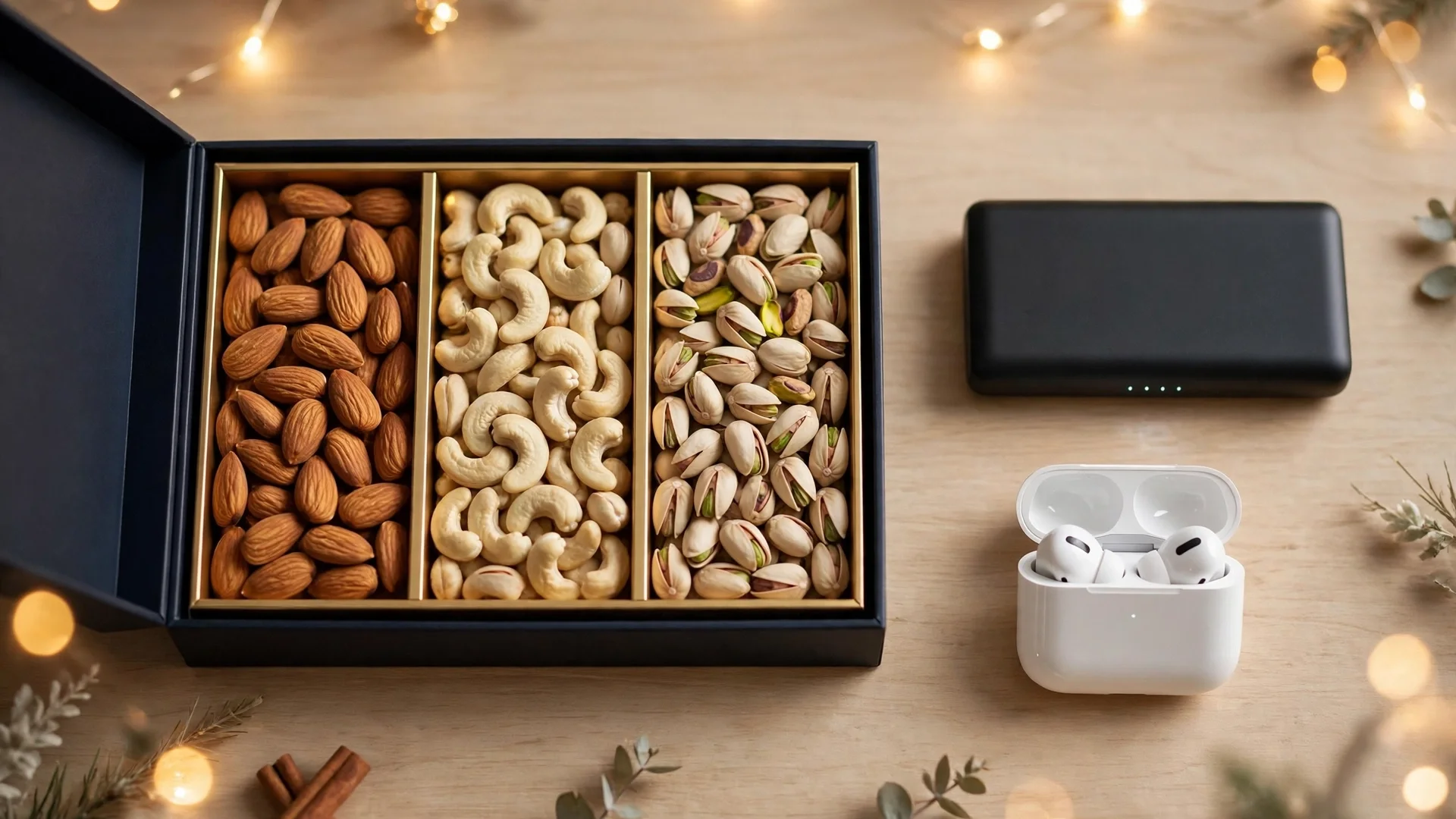
Dry Fruit Hampers vs Gadget Gifts: Which Do Employees Actually Prefer for Festivals?
Dry Fruit Hampers vs Gadget Gifts: Which Do Employees Actually Prefer for Festivals?
Every festival season in India, the same two options land on the HR desk. On one side, the dry fruit hamper — the safe, traditional, instantly recognisable festive gift. On the other, the gadget — the power bank, the speaker, the earbuds — the modern, useful, “everyone will actually use it” gift. Both are defensible. Both have been ordered by thousands of companies. And every year, the team that has to choose between them argues the same argument: the hamper people say a gadget is impersonal and will be forgotten, the gadget people say a hamper is boring and will be eaten and forgotten faster.
Both sides are half right, which is why the argument never resolves. A dry fruit hamper and a gadget are not two versions of the same gift. They do different jobs, they fail in different ways, and they are judged by the recipient on completely different measures. A hamper is judged in the first week, at home, by the whole family. A gadget is judged over months, at work, by one person. A hamper that arrives late is a problem because the festival has passed. A gadget that arrives late is a problem because the recipient has already bought one. A hamper with a quality problem is discovered at the first handful. A gadget with a quality problem is discovered at the first charge — and then complained about for a year.
This guide does not pick a winner. It works through the honest head-to-head between the two — shareability, shelf life, dietary risk, transit and delivery, branding area, cost per person, and what different recipients actually prefer — and then gives you a decision framework you can apply to your own programme. It is written for the person who has to order, not for the person who has to receive: the trade-offs are stated plainly, the mistakes are named, and the answer is decided by recipient and occasion, not by fashion.
One boundary before we start. This guide compares the two options as categories. It does not list every hamper combination or every gadget model — the Christmas hampers versus gift boxes guide on this site already covers hamper and box formats for bulk orders, and the power bank guide covers one gadget category in full depth. What follows is the comparison itself: what each option does well, what each one risks, and how to choose.
What the Two Options Actually Are
A dry fruit hamper, in corporate gifting, is a curated box of dry fruits — typically almonds, cashews, pistachios, raisins and dates, sometimes with a small addition such as chocolates, a candle or a message card — packed in a rigid box, a tin or a basket, and usually branded on the box or sleeve. Its value is in the contents and the presentation together: the recipient opens it, sees abundance, and shares it. It is a festive gift in the most literal sense — it belongs to the festival, and it is consumed during it.
A gadget gift is a single useful electronic item — most commonly a power bank, a Bluetooth speaker, wireless earbuds, a smartwatch or a charging kit — packed in its own retail-style box, usually branded on the item or its sleeve. Its value is in its usefulness over time: the recipient uses it daily, at work or on the move, and the brand travels with it. It is a practical gift in the most literal sense — it solves a small daily problem, and it keeps solving it.
The first thing to notice is that the two gifts are consumed on different timelines. A hamper is consumed in days or weeks, and its value is concentrated in the moment of opening and sharing. A gadget is consumed over months, and its value is spread across every use. That single difference explains most of what follows: a hamper’s quality is judged immediately and forgiven quickly, because it is gone; a gadget’s quality is judged slowly and remembered for a long time, because it is still on the desk in March.
The second thing to notice is who the gift is actually for. A hamper is, in practice, a gift to the recipient’s household — the family eats it together, and the company’s gesture is experienced by several people at once. A gadget is, in practice, a gift to one person — it is used by the recipient alone, and the company’s gesture is experienced privately. Neither is better in the abstract. But if your programme’s goal is to make the whole family feel included, the hamper has an advantage a gadget cannot match. And if your goal is to give one person something they will use every day, the gadget has an advantage a hamper cannot match. The decision starts with knowing which of those two goals you are actually pursuing.
Dry Fruit Hampers vs Gadget Gifts: The Honest Head-to-Head
The table below compares the two options on the dimensions that actually decide whether a festive gift works. Neither side wins on every row. The point is to make the trade-offs visible, so the decision is made on the recipient and the occasion rather than on whichever department argues loudest.
| Dimension | Dry fruit hamper | Gadget gift |
|---|---|---|
| Shareability | High — the family shares it at home; several people enjoy one gift | Low — used by one person alone; rarely shared |
| Shelf life | Months, sealed — but the festival window matters; value fades after the occasion | No expiry — but models go out of date and batteries age |
| Dietary risk | Real — nut allergies, diabetes, fasting rules, Jain and vegetarian considerations | None — diet-neutral; the risk is compatibility and tech comfort instead |
| Transit & delivery | Heavy, breakable contents; heat and moisture matter; no battery rules | Light, compact; but lithium batteries face courier and airline rules |
| Branding area | The box, sleeve and ribbon — large, visible, premium | The item itself and its box — small surface, durable visibility |
| Cost per person | Contents + premium packaging + heavier shipping | Item + branding + lighter shipping; setup costs for printing |
| Lead time | Shorter production, longer packing; order early for festive rush | Longer — artwork, sample, production and testing add days |
| Reuse & recall | No reuse — but strong festival memory; the box may be kept | Daily reuse for months — the brand is seen every time it is used |
| Perceived value | Feels generous at opening; value is in abundance and presentation | Feels useful over time; value is in daily function |
| Best for | Festival programmes, families, clients, mass distribution, all ages | Employees, field and travel teams, remote workers, younger teams |
| Worst for | Recipients with allergies or dietary restrictions; late delivery | Recipients who are not tech-comfortable; senior clients who value tradition |
| Waste risk | Contents can go stale or be re-gifted if quality is poor | The item can sit unused in a drawer if it duplicates what they own |
| Flexibility | Hard to tailor per person — one box for everyone | Easier to offer a choice of two or three models |
| Compliance | Food labelling rules apply — check FSSAI labelling on the pack | Battery and certification rules apply — check BIS certification |
Read the table as a whole and the pattern is clear. Hampers win on shareability, festival feeling, inclusivity across ages, and the moment of opening. Gadgets win on daily reuse, brand recall over time, diet neutrality, and lighter shipping. Neither wins on cost alone — a hamper’s packaging and shipping can cost as much as a gadget’s branding, and a gadget’s per-unit price can be lower than a premium hamper’s contents. And neither wins on risk: a stale hamper and a faulty gadget fail in exactly the same way, by telling the recipient the company did not check before it ordered.
The table also explains why the debate never resolves. The two options are optimised for different jobs. If the gift’s job is to mark the festival and to be enjoyed by the household, the hamper is the honest answer. If the gift’s job is to give one person something useful that carries the brand for months, the gadget is the honest answer. Most companies have both kinds of jobs at once, which is why the answer is almost never “always hampers” or “always gadgets”, but a rule for which recipient gets which treatment — and that rule is what the rest of this guide builds. The gift cards versus physical gifts guide on this site makes the same point from the other direction: a physical gift’s advantage over a gift card is that it is experienced, not just spent — and the hamper and the gadget are the two most common forms that physical advantage takes.
Shareability: Who Actually Gets to Enjoy It
Shareability is the hamper’s strongest card, and it is worth understanding properly, because it is the one advantage a gadget cannot replicate at any price.
A dry fruit hamper is opened at home, usually in the evening, usually with family around. The box is opened, the contents are looked at, and then they are shared — a handful here, a bowl there, a portion set aside for a parent or a child. The gift is experienced by several people, and the company’s name is on the box while all of it happens. For an employee, that matters: the gift is not just something they received at work, it is something their family enjoyed, and the family remembers who sent it. For a festive programme, that is the closest a corporate gift gets to being a household gesture rather than an office transaction.
A gadget cannot do this. A power bank is used by one person. Earbuds are used by one person. A speaker is the closest a gadget gets to being shared, and even then it is shared in the sense that other people can hear it — the gift itself still belongs to one person. That is not a flaw; it is the nature of a personal tool. But it means the gadget’s goodwill is concentrated in one person, while the hamper’s goodwill is spread across a household. If your programme is trying to reach the employee’s family — and during Diwali, most festive programmes are — the hamper reaches further for the same spend.
There is a flip side, and it is worth stating honestly. Shareability also means the hamper is consumed and gone. A week after Diwali, the box is empty, and the only thing left is the memory and possibly the box itself. A gadget, by contrast, is still on the desk in February, still being used, still carrying the brand. The hamper’s goodwill is broad and short-lived; the gadget’s goodwill is narrow and long-lived. Which one matters more depends on what the programme is for. If the programme is a festival gesture, breadth wins — the festival is the moment, and the family is the audience. If the programme is a year-round recognition gesture that happens to fall near a festival, longevity wins — the gift should still be working when the festival is a memory.
One more practical point about shareability: it changes the failure mode. A hamper that is shared and enjoyed is a success even if one item in it is not to someone’s taste — the rest of the box carries it. A gadget that is not used is a total failure, because there is nothing else in the box to redeem it. That is why the hamper is the lower-risk choice when you do not know the recipient well: it has several chances to please, spread across several people. The gadget has exactly one chance, with one person, and if that person already owns a power bank, the gift is finished before it starts.
Shelf Life and the Ordering Window
Shelf life is the dimension most buyers underestimate, because they think of it as a property of the product rather than a property of the programme. It is both — and the programme side is where the mistakes happen.
A sealed dry fruit hamper typically keeps for several months, and the pack will carry its own printed date — always check it, and always order stock packed for the current season rather than stock left over from the last one. The real shelf-life problem is not that dry fruits expire quickly; it is that their value expires with the festival. A hamper delivered a week after Diwali is a different gift from the same hamper delivered a week before it. The contents are identical, the box is identical, and the recipient’s reaction is not. The first says the company planned ahead. The second says the company forgot, and the gift is a leftover. The Christmas delivery deadlines guide on this site makes the same point for the December season: the order-by date is the real deadline, not the delivery date, and festive gifting is a calendar discipline before it is a purchasing decision.
That is why the hamper’s ordering window is unforgiving in a way the gadget’s is not. Hamper packing is labour-intensive — sorting, weighing, packing, sealing, boxing — and every supplier in India is doing it at the same time, for the same festival, in the same few weeks. Capacity runs out. The best packing slots go first. A hamper order placed late does not just cost more; it risks arriving after the festival, when the gift’s entire meaning has changed. Order the hamper early, confirm the packing date in writing, and build in a buffer for the courier’s festive load.
A gadget has no expiry date, and that is a genuine advantage — it can be ordered earlier, stored safely, and delivered whenever the programme needs it. But it has a different kind of shelf life: the model goes out of date. A power bank bought in bulk in August and delivered in November is still a good power bank, but if a newer model has launched in between, the recipient will notice, and the gift will feel like last season’s stock. Gadgets also age in storage — batteries lose charge, and a gadget that arrives with a dead battery makes a poor first impression. The lead-time guide on this site covers how far in advance physical gifts should be ordered, and the same discipline applies here: order the gadget early enough to secure stock and branding, but not so early that the model is stale by delivery day.
The practical rule is simple. For a hamper, the risk is the calendar — order early, confirm the packing date, and protect the delivery window. For a gadget, the risk is the model — confirm the model is current at delivery, check the battery on arrival, and do not buy stock so early that it feels dated. Both risks are manageable. Neither is forgivable if it is discovered by the recipient.

Dietary Risk: The One Problem Only Hampers Have
Dietary risk is the hamper’s real weakness, and it is the one dimension where the gadget wins outright. It deserves a full section, because it is the reason a hamper programme can fail for reasons that have nothing to do with quality or budget.
Dry fruits are, by their nature, a food gift — and food gifts carry the risks that all food carries. Nut allergies are the most serious: almonds, cashews and pistachios are tree nuts, and a nut allergy can be severe. A company that sends a nut hamper to an employee with a nut allergy has not just sent a useless gift; it has sent a gift the recipient cannot safely keep in the house. That is a failure the recipient will remember, and it is entirely avoidable.
Beyond allergies, there are the quieter dietary realities. Some recipients are managing diabetes, and a box of dates and raisins is not a gift they can enjoy freely. Some are fasting, or observing dietary rules that exclude certain items. Some follow Jain dietary practice, which excludes root vegetables and, in its stricter forms, certain dried fruits and honey. Some are simply on a diet, or do not eat dry fruits at all. None of these people will complain — they will quietly re-gift the hamper, or leave it unopened, and the company’s gesture will have reached nobody.
None of this makes the hamper a bad gift. It makes it a gift that needs a question asked before it is ordered. The question is simple: do we know anything about our recipients’ dietary needs? For a small team, the answer is often yes — someone in HR knows who has an allergy. For a large programme, the answer is usually no, and that is where the risk concentrates. There are three honest ways to handle it.
First, offer a choice. A hamper programme that offers two or three options — a dry fruit hamper, a non-food hamper, and a gadget — removes the dietary risk entirely, because the recipient chooses what suits them. The standardisation versus customisation guide on this site covers the programme-level version of this choice, and the same logic applies here: a small amount of choice costs a little more in administration and saves the programme from its worst failure.
Second, include a clear contents list on the box or the accompanying card, naming every item and flagging the nuts. A recipient with an allergy who can read the contents and pass the box on safely is in a very different position from one who has to guess. It is a small detail, and it costs nothing.
Third, check the labelling. Packaged food in India should carry FSSAI labelling — the FSSAI logo and licence number, the ingredients, the net weight and the expiry date. A supplier who cannot show it is a supplier to avoid, and the sample approval checklist on this site is the tool for checking it: approve the actual hamper, from the actual batch, before production, and check the pack labelling as part of the sample.
The gadget, by contrast, is diet-neutral. It carries no allergy risk, no fasting problem, no dietary rule. Its exclusion risk is different: some recipients are not comfortable with technology, some already own the item, and some — particularly senior recipients — may read a gadget as impersonal where a hamper would have read as traditional. That is a real risk, and it is covered in the recipient section below. But it is a risk of taste, not of safety — and a gift that is merely not to someone’s taste is a much smaller failure than a gift someone cannot safely eat.
One final point on dietary risk, because it is often missed: the hamper’s dietary problem is also a data problem. Collecting dietary information from employees is personal health information, and it should be collected carefully, voluntarily, and with a clear statement of why it is being asked. The employee address collection guide on this site covers the process discipline for collecting recipient details without chaos, and the same principles apply: ask only what you need, keep it to the people who need it, and do not store it beyond the programme. Never make dietary disclosure a condition of receiving a gift.
Transit, Delivery and Damage
Festive gifting in India is a logistics exercise before it is a purchasing exercise, and the two options behave very differently in transit. This is the section that decides whether the gift arrives as a gift or as a problem.
A dry fruit hamper is heavy, and weight is money in courier pricing — but weight is not the real problem. The real problems are heat, moisture and breakage. Dry fruits packed in a rigid box travel well if the box is good; they travel badly if the box is thin, the seal is weak, or the pack is crushed under heavier parcels. In a North Indian summer, or in a delivery van in May, heat can soften chocolates included in the hamper and can affect the pack. In the monsoon, moisture is the enemy of any paper-based packaging. And a hamper that arrives with a dented box, a torn sleeve or a crushed corner has lost most of its value before it is opened — because the presentation is the gift, and a damaged presentation is a damaged gift.
That means the hamper’s packaging is not a decoration; it is the delivery system. A rigid box, a proper inner tray, a sleeve that protects the print, and an outer shipping carton that can take a knock — these are not premium extras, they are the minimum. When you approve the sample, approve the shipping carton as well as the gift box, and ask the supplier what happens when a parcel is dropped. The corporate gift order playbook on this site covers what to do when an order goes wrong — damage, delay and wrong branding — and the best use of that playbook is to never need it: build the damage rate into the order, order a small percentage of spares, and confirm the replacement process before the festival, not after it.
A gadget is lighter and more compact, and that is a genuine advantage for a programme that ships to many addresses — particularly for remote and hybrid teams, where the gift goes to a home address rather than an office desk. But the gadget has its own transit rules, and they are stricter than most buyers expect. Any gadget with a lithium battery — a power bank, earbuds, a smartwatch — is subject to courier and airline rules on battery carriage. Power banks, in particular, cannot travel in checked airline baggage and are restricted in air freight; the power bank guide on this site covers the certification and carriage rules in detail, including BIS certification, and the point for this comparison is simple: a gadget order that ships by air needs the battery paperwork in order, and a gadget order that ships by road needs the time that road transport takes.
The other transit difference is the failure mode. A damaged hamper is visible the moment the box is opened — the recipient sees it, and the company can replace it quickly, because the replacement is a box off the same shelf. A faulty gadget is often invisible until the recipient tries to use it — a power bank that does not charge, earbuds that do not pair, a speaker that crackles — and by then the recipient has already formed an opinion. Replacing a faulty gadget takes longer, because the replacement needs to be tested, and because the fault may be in the whole batch rather than one unit. That is why the gadget’s sample approval matters more, not less, than the hamper’s: approve a working sample of the actual model, test it, charge it, pair it, and only then approve production.
One practical note that applies to both: the delivery address list is the single most common point of failure in a festive programme. Wrong addresses, old addresses, employees who have moved, offices that have closed — every one of them turns a gift into a return, a re-shipment or a loss. The employee address collection guide on this site covers how to collect addresses without chaos, and the discipline is worth repeating here: collect addresses fresh for the programme, confirm them, and do not reuse last year’s list without checking it. A hamper sent to the wrong address is a wasted hamper. A gadget sent to the wrong address is a wasted gadget and a data problem.
Branding Area: Where Your Logo Can Go
Branding is where the two options diverge most sharply in what they offer the company — and where the branded versus unbranded gifts guide on this site becomes directly relevant, because the branding decision and the gift decision are the same decision, made twice.
A hamper offers a large branding area, and it offers it in the most visible place: the box. A rigid gift box has a lid, a sleeve, a ribbon and a message card, and each of them can carry the logo, the company name, or a festive message. The branding is premium by nature — foil stamping on a rigid box, a debossed mark on a lid, a printed sleeve in the company’s colours — and it is seen by everyone who handles the box, including the recipient’s family. The hamper’s branding is also, by its nature, temporary: the box is kept or discarded, the sleeve is removed, and the branding leaves with the packaging. But during the festival, when the box is on the table and being opened, the branding is at its most visible.
A gadget offers a small branding area, and it offers it in the most durable place: the item itself. A power bank has a flat surface for a laser-engraved logo. Earbuds have a charging case. A speaker has a grille or a base. The branding area is small — a logo of a few centimetres, at most — but it is seen every time the item is used, for months. The gadget’s branding is also, by its nature, permanent: once the logo is engraved on a power bank, it is there for the life of the item. That permanence is both the advantage and the risk. A well-made gadget with a quiet logo is a daily brand reminder. A poorly made gadget with a loud logo is a daily reminder of a bad gift.
The practical difference is in what the branding costs and how long it takes. Hamper branding is mostly packaging branding — printing a sleeve, stamping a box — and it is usually fast, because the packaging is made to order anyway. Gadget branding is mostly item branding — engraving, UV printing, laser marking — and it usually takes longer, because it needs artwork approval, a branded sample, and a production run. The minimum order quantity guide on this site covers how order size changes the cost, and the same logic applies here: gadget branding usually has a setup charge and a minimum quantity, and on a small order the setup can be a meaningful part of the cost. Hamper branding, by contrast, is often bundled into the packaging cost, and the minimum quantity is set by the packing run rather than the branding.
There is also a subtlety worth naming: the hamper’s branding is seen by the family, and the gadget’s branding is seen by colleagues. A hamper on the dining table is seen by the people the employee lives with. A power bank on a meeting-room table is seen by the people the employee works with. If the programme’s goal is brand visibility inside the company and among professional peers, the gadget’s branding works harder. If the goal is goodwill in the employee’s household, the hamper’s branding works harder. Neither is better — but they are different audiences, and the choice should be made knowing which audience the programme is for.
One rule applies to both, and it is the most important branding rule in this guide: choose the item first, and the branding second. A logo on a stale hamper does not save the hamper. A logo on a faulty gadget does not save the gadget. The logo file formats guide on this site covers what file a vendor actually needs, and the sample approval checklist covers the twelve things to check before production — and the first check, for either option, is the same: is the gift itself good enough to deserve the logo?

Cost Per Person: The Fully Loaded Comparison
Cost is where the hamper-versus-gadget debate is most often argued on the wrong numbers. The catalogue price is not the cost. The cost is the fully loaded cost per person — item, packaging, branding, shipping, sampling, tax and rework — and on that measure the two options are closer than most buyers expect.
A hamper’s cost is dominated by two things: the contents and the packaging. The contents are the dry fruits themselves, and their price moves with the market — almonds, cashews and pistachios are commodities, and their prices shift by season. The packaging is the rigid box, the tray, the sleeve and the ribbon, and good packaging is not cheap — but it is also the reason the hamper looks like a premium gift rather than a bag of nuts. Then there is shipping, and a hamper is heavy: a box of dry fruits weighs meaningfully more than a power bank, and for a programme that ships to hundreds of home addresses, the shipping line can be a large part of the total. The hidden costs guide on this site lists the costs that do not appear in a catalogue price, and for a hamper programme the ones to watch are packaging, shipping weight, festive surcharges, and the spares you need for damaged boxes.
A gadget’s cost is dominated by the item itself and the branding. The item price is set by the model and the quantity — and the bulk discounts versus per-unit customisation guide on this site covers how volume changes the price. The branding is a setup charge plus a per-unit charge, and on a small order the setup matters. Shipping is lighter, which helps, but the gadget has a cost the hamper does not: testing and returns. A faulty gadget has to be replaced, and the replacement has to be shipped, and the faulty unit has to be dealt with. Budget for a small failure rate, and confirm the replacement process in writing before the order goes in.
The honest comparison, then, is not “hampers cost X and gadgets cost Y” — any specific rupee figure would be invented, and prices move by season, supplier and quantity. The honest comparison is structural: a hamper’s cost is in the contents, the packaging and the shipping weight; a gadget’s cost is in the item, the branding setup and the returns. At the same budget, a hamper usually buys more visible generosity — a full box, beautifully packed — while a gadget usually buys more durable usefulness — one good item, used daily. Which of those two things the recipient values more is not a cost question. It is a preference question, and it is the subject of the next section.
One cost discipline applies to both, and it is the discipline that saves more programmes than any other: build the budget from the fully loaded cost per person, not from the catalogue price. The corporate gifting budget planning guide on this site gives the framework — a simple method for building a budget so that branding, packaging, shipping and tax are lines in it, not surprises. Use it before the order, not after, and the hamper-versus-gadget choice becomes a decision about value rather than a negotiation about price. And check the tax position in the GST and tax compliance guide on this site — the treatment of gifts, and the input tax credit position, is general guidance to confirm with a tax adviser, not a reason to choose one option over the other.
What Employees Actually Prefer — and Why the Answer Changes by Recipient
“Which do employees actually prefer?” is the question in the title, and it deserves a direct answer: there is no single answer, because employees are not one audience. The preference changes by who the recipient is, and by what the gift is for. Here is how it breaks down, recipient by recipient.
For most employees, in a festival programme, the hamper is the safer preference. Diwali is a family festival, and a hamper is a family gift. An employee who receives a dry fruit hamper takes it home, shares it, and the family experiences the company’s gesture. An employee who receives a gadget takes it to their desk, uses it alone, and the family never sees it. For a programme whose purpose is to mark the festival, the hamper matches the occasion in a way the gadget does not — and most employees, asked which they would rather receive at Diwali, will choose the thing their family can enjoy. That is not a guess about taste; it is a statement about what a festival gift is for.
For field, sales and travel teams, the gadget is often the better preference. A field sales team lives on the road, and a power bank is not a luxury for them — it is a tool they will use every day. The gifts for field sales teams guide on this site covers lightweight, useful and durable ideas for people who travel, and the logic applies directly here: a gift that fits in a bag, survives a journey, and solves a daily problem is worth more to a travelling employee than a hamper they have to carry home. For these teams, the gadget wins on usefulness, and usefulness is the measure that matters.
For remote and hybrid employees, the gadget has a practical edge. A remote employee receives the gift at home, by courier, and a gadget ships lighter, arrives in better condition, and is used in the place where the employee works — the home desk. A hamper also ships to a home address, and it is enjoyed at home — but for a remote employee, the hamper’s shareability advantage is smaller, because the employee is already at home, and the gadget’s daily-use advantage is larger, because the home desk is where the gadget lives. The Christmas gifts for remote employees guide on this site covers delivery-ready ideas for hybrid teams, and the same thinking applies: for a distributed team, choose the gift that survives the courier and earns its place on the desk.
For clients, the hamper is usually the better choice. A client gift should feel chosen, not distributed — and a hamper, beautifully packed, with a personal message card, reads as a considered festive gesture in a way a gadget rarely does. A gadget sent to a client carries a risk the hamper does not: it can read as a promotional item, particularly if it is heavily branded, and it can duplicate something the client already owns. The Christmas gifts for clients guide on this site covers premium client ideas, and the principle is the same: for a client, choose the gift that feels personal, and the hamper, with its presentation and its message card, is the more personal of the two. The corporate gift message examples guide on this site is worth using here — the message card is what turns a hamper from a box of dry fruits into a gesture, and the wording matters as much as the contents.
For CXOs and senior leaders, the hamper wins clearly. A senior leader does not need a power bank, and a gadget — however good — is unlikely to impress someone who can buy any gadget they want. A premium hamper, on the other hand, is a traditional gesture of respect, and it is judged on its quality and presentation rather than its usefulness. For the most senior recipients, the best answer is often a premium hamper with quiet branding or none at all — the branded versus unbranded gifts guide on this site covers when a logo helps and when it hurts, and for a CXO the answer is usually that the gift should speak for itself.
For younger teams and tech companies, the gadget has a real appeal. A team of engineers, developers or designers will use a good gadget daily, and will judge it on its quality — which is why, if you choose a gadget for this audience, the quality has to be genuinely good. A cheap gadget sent to a tech team is worse than no gadget at all, because the recipients know exactly what a good one costs and what a bad one feels like. The corporate gifts for IT companies guide on this site covers swag and onboarding ideas for tech teams, and the same standard applies: for a tech-savvy audience, a gadget is a good choice only if it is a good gadget.
For support, admin and facilities teams, the hamper is the more inclusive choice. These teams span ages, roles and tech comfort, and a hamper is enjoyed by everyone in the same way, regardless of age or technical confidence. A gadget, by contrast, divides the audience: the tech-comfortable recipients love it, and the others leave it in a drawer. For a broad, mixed team, the hamper’s universality is a genuine advantage — and the inclusive holiday gifting guide on this site makes the same point for support staff, security and housekeeping teams: choose the gift that works for everyone, not the gift that works for the loudest group.
The pattern across all of these is consistent. The hamper is the better choice when the gift is for the festival, for the family, for a client, for a senior leader, or for a broad and mixed team. The gadget is the better choice when the gift is for one person’s daily use, for a travelling or remote team, or for a tech-savvy audience that will judge it on quality. Most companies have more than one of these audiences at once — which is why the best programmes do not choose one option for everyone, but choose by recipient group. And that is the subject of the hybrid section below.
When the Hamper Wins, and When the Gadget Wins
For a quick decision, here is the summary. The hamper wins when the programme is a festival gesture, when the recipient’s family is part of the audience, when the recipients are clients or senior leaders, when the team is broad and mixed, when the budget needs to feel generous at the moment of opening, and when you do not know the recipients well enough to risk a single-item choice. The gadget wins when the gift is for one person’s daily use, when the recipients travel or work remotely, when the team is tech-savvy and will judge quality, when the programme ships to many home addresses, when brand recall over months matters more than the festival moment, and when you can offer a choice of models so nobody receives a duplicate of something they already own.
Neither wins on its own for every programme. The companies that get festive gifting right are the ones that stop asking “hamper or gadget?” as a single question, and start asking it per recipient group. The next section is how to do that without doubling the administration.
The Hybrid Option: Hamper Plus a Small Gadget, or Let Them Choose
There are two hybrid answers, and both are better than a forced choice between the two options. The first is to combine them: a hamper with a small gadget inside it. The second is to let the recipient choose. Each suits a different programme.
The combined hamper — a dry fruit box with a small gadget tucked in, such as a compact power bank, a charging cable set or a pair of earbuds — gives the recipient both experiences: the family shares the dry fruits, and the individual keeps the gadget. It is the most generous-feeling option, and it is the one that most reliably pleases a mixed audience. It also costs more, and it has a real operational complication: the hamper and the gadget have different supply chains, different lead times, and different sample approvals. The pre-curated gift sets guide on this site covers pre-curated sets as a format, and the same discipline applies here: if you combine, confirm the whole set — hamper, gadget, packaging — as one sample, and confirm the total cost per person before committing. A combined hamper that is done badly — a poor gadget in a good box, or a good gadget in a damaged box — is worse than either option done well.
The choice model — offering each recipient a choice between a hamper and a gadget, or between two or three options — is the most recipient-friendly answer, and it removes the two biggest risks in this guide at once: the dietary risk of the hamper, and the duplication risk of the gadget. A recipient with a nut allergy chooses the gadget. A recipient who already owns a power bank chooses the hamper. Nobody receives a gift they cannot use. The cost is administrative: collecting choices, managing two supply chains, and reconciling the orders. For a programme of a few hundred people, that cost is manageable, and it is usually worth it. For a programme of several thousand, it is a real project, and it needs to be planned as one — the corporate gifting scale guide on this site, comparing gifting for 50 employees with 5,000, shows how the process changes with headcount, and the choice model is a good example: it is easy at 50, and it is a system at 5,000.
There is a third hybrid worth naming, because it is the cheapest and often the most effective: the hamper for everyone, plus a gadget for a smaller group. The whole company receives the festive hamper, and the top performers, the field teams or the remote workers receive a gadget as well. The year-end gifts for top performers guide on this site covers recognition beyond cash bonuses, and the same structure applies: a universal gesture for everyone, and a targeted gift for the people it will matter most to. That structure respects both the festival and the individual, and it does so without forcing a single choice on the whole company.
Common Mistakes
Ordering the hamper too late. The festive packing window is the single most common failure in a hamper programme. Order early, confirm the packing date, and build in a buffer. A hamper that arrives after the festival is not a late gift; it is a different gift, and a worse one.
Choosing a gadget on price alone. A cheap gadget is the fastest way to damage a programme. The recipient will use it, it will fail, and the company will be remembered for the failure. If the budget does not stretch to a good gadget, choose the hamper — a good hamper at the same budget is a better gift than a bad gadget.
Ignoring the allergy question. Never send a nut hamper to a large group without asking whether anyone has a nut allergy, and never make the question a condition of receiving a gift. Offer a choice, or offer a non-food alternative, and include a contents list on the box.
Branding the gadget loudly and the hamper cheaply. The branding should match the gift: a quiet logo on a good gadget, and premium packaging on a good hamper. A loud logo on a cheap gadget reads as advertising. A cheap box on a good hamper reads as carelessness.
Sending the wrong logo file. Gadget branding needs the right file — a vector logo, in the right format, in the right colours — and a wrong file means a wrong print, a delay, or a rework. The logo file formats guide on this site covers what a vendor actually needs, and the sample approval checklist covers the checks to run before production. Approve the branded sample on the actual item, not on a photograph.
Forgetting the message card. A hamper without a message card is a box of dry fruits. A gadget without a message card is a piece of electronics. The message card is what makes either one a gift, and the corporate gift message examples guide on this site has the wording. Write it, print it, and put it in the box — do not leave it to the last day.
Reusing last year’s address list. People move, offices close, teams change. Collect addresses fresh, confirm them, and do not assume last year’s list is still right. A gift sent to the wrong address is a wasted gift and a data problem.
Treating the choice as permanent. The hamper-versus-gadget decision is not a policy; it is a decision for this programme, this year, for these recipients. What worked last Diwali may not work this year, because the team has changed, the budget has changed, or the recipients have already received the same gift twice. Decide fresh each year, and measure what happened, as the next section describes.
A Decision Framework: Seven Questions Before You Order
Answer these seven questions in order, and the hamper-versus-gadget decision will usually make itself.
1. Who is the gift really for — the employee, or the employee’s household? If the household, lean hamper. If the individual, lean gadget.
2. What is the gift for — the festival, or the person’s daily work? If the festival, lean hamper. If daily work, lean gadget.
3. Do we know anything about dietary needs or allergies in this group? If yes, and there is a risk, either offer a choice or lean gadget. If no, and the group is large, offer a choice — do not guess.
4. How will the gift travel — to an office, or to hundreds of home addresses? If home addresses, weigh the gadget’s lighter shipping against the hamper’s heavier box, and confirm the courier’s festive capacity either way.
5. What does the budget buy at this quantity — a generous hamper, or a good gadget? Be honest about the fully loaded cost per person. A good hamper beats a bad gadget, and a good gadget beats a thin hamper.
6. Will the recipient already own this gadget? If the team received power banks last year, do not send power banks this year. A duplicate gadget is a wasted gift. A hamper, by contrast, is never a duplicate — it is consumed and gone.
7. Can we offer a choice? If the programme is small enough to manage it, a choice between a hamper and a gadget removes the two biggest risks in this guide. If it is too large, choose by recipient group instead — hampers for clients and senior leaders, gadgets for field and remote teams, hampers for the broad base.
Write the answers down, and keep them with the order. Next year, the answers will be the starting point — and the programme will get better every year, instead of starting from the same argument.
How to Tell Whether Your Choice Worked
A festive programme that is never measured will be debated forever on opinions. A programme that is measured, even simply, produces an answer — and the answer is usually clear enough to settle the next order before it starts.
Ask the recipients. After the festival, ask a small set of questions while the gift is still fresh: did you use it, did your family enjoy it, would you have preferred the other option, and would you want the same gift again next year? That conversation, held within a few weeks of delivery, is worth more than any survey, and it tells you exactly what to change. For employees, add one question: are you still using it? For clients, add one more: did the gift feel personal? The answers to those two questions are the hamper-versus-gadget decision, in the recipients’ own words.
Watch for the visible signs. A hamper that worked is visible in the moment: the box on the table, the contents shared, the thank-you messages that mention the family. A gadget that worked is visible over months: the power bank on the desk, the earbuds on the commute, the speaker in the meeting room. A hamper that did not work is visible too: the unopened box, the re-gifted hamper, the silence. A gadget that did not work is visible in a drawer, uncharged and unused. Both failures are visible if you look — and both are worth recording before the next order.
Count the real cost. After the programme, count the total cost per person — item, packaging, branding, shipping, sampling, tax and any rework — and compare it with what the other option would have cost at the same quantity. Then count the waste: how many hampers were damaged in transit, how many gadgets were returned or replaced, how many gifts were never used. The option that delivered more use for the same spend is the option that worked, and that is the number to take into the next order.
Decide, and write it down. The most useful outcome of measuring a programme is a written rule for the next one: this option, for this recipient group, at this budget, with this lead time. Write it down while the evidence is fresh, and the next order starts from a rule rather than a debate. A company that does this for two or three festivals ends up with a gifting programme that is genuinely tuned to its people — and that is a competitive advantage no single gift, hamper or gadget, can buy on its own.
FAQs
1. Which is better for employees — a dry fruit hamper or a gadget gift?
It depends on the recipient and the occasion. For a festival programme, most employees prefer a dry fruit hamper, because it is shared with the family and it matches the occasion. For daily use, a gadget is often preferred, particularly by field, sales and remote teams who will use it every day. The best programmes choose by recipient group rather than forcing one option on everyone — hampers for the festive gesture, gadgets where daily usefulness matters.
2. Are dry fruit hampers still a good corporate gift, or are they outdated?
They are still a good gift, and they are not outdated — they are traditional, and tradition is part of what makes them work at a festival. A hamper is judged on its quality and presentation, not its novelty: good dry fruits, honestly packed, in a rigid box with a personal message card, will always be well received. What is outdated is a poor hamper — stale contents, a flimsy box, no message card. Choose the hamper on quality, and it is as good a gift as it ever was.
3. What should I do about nut allergies when sending dry fruit hampers?
Ask before you order, offer a choice, and label the contents. Collect dietary information voluntarily and only from the people who need it, offer a non-food alternative or a gadget option for anyone with an allergy, and include a clear contents list on the box naming every item. Never make dietary disclosure a condition of receiving a gift, and never send a nut hamper to a large group without asking the question first.
4. Do gadgets make better corporate gifts than hampers for clients?
Usually not. A client gift should feel chosen and personal, and a hamper — beautifully packed, with a message card — reads as a considered festive gesture in a way a gadget rarely does. A gadget sent to a client can read as promotional, particularly if it is heavily branded, and it can duplicate something the client already owns. For clients, choose the hamper, keep the branding quiet, and let the message card do the work.
5. How early should I order dry fruit hampers for Diwali?
Earlier than you think. Hamper packing is labour-intensive, and every supplier is packing for the same festival at the same time. Order early, confirm the packing date in writing, and build in a buffer for the courier’s festive load. The order-by date is the real deadline, not the delivery date — a hamper that arrives after Diwali is a different gift from the same hamper delivered before it.
6. Can I combine a dry fruit hamper and a gadget in one gift?
Yes, and it is often the best answer for a mixed audience: the family shares the dry fruits, and the individual keeps the gadget. But confirm the whole set — hamper, gadget and packaging — as one sample before production, and confirm the total cost per person before committing. A combined hamper that is done badly, with a poor gadget in a good box or a good gadget in a damaged box, is worse than either option done well.
7. How do I decide between a hamper and a gadget for my team?
Answer seven questions: who is the gift really for, what is it for, do we know about dietary needs, how will it travel, what does the budget buy at this quantity, will the recipient already own this gadget, and can we offer a choice? The answers will usually point to one option — or to a split by recipient group. Write the answers down, and use them as the starting point for next year’s programme.
The question was never really whether a dry fruit hamper is better than a gadget. It is what this gift, for this person, on this occasion, is supposed to do — and whether the hamper or the gadget does it better.
Start with the recipient, not the catalogue. If the gift is for the festival and the family, choose the hamper, and choose it on quality — good dry fruits, a rigid box, a contents list, and a message card that says something real. If the gift is for one person’s daily work, choose the gadget, and choose it on quality too — a good model, properly branded, tested before it ships. If you have both kinds of recipients, split the programme rather than forcing one choice on everyone. And whatever you decide, order early, approve a real sample, and count the full cost before the order goes in.
If you are planning a festive programme, a client gift, a welcome kit or a year-round recognition order and you want help getting the choice right — the hamper, the gadget, or the combination, matched to your team, your recipients and your budget — talk to Arrow Gifter. Tell us who the gift is for, when it has to arrive, and what it has to do, and we will put together a programme your recipients actually use, share and remember.
Leave a comment