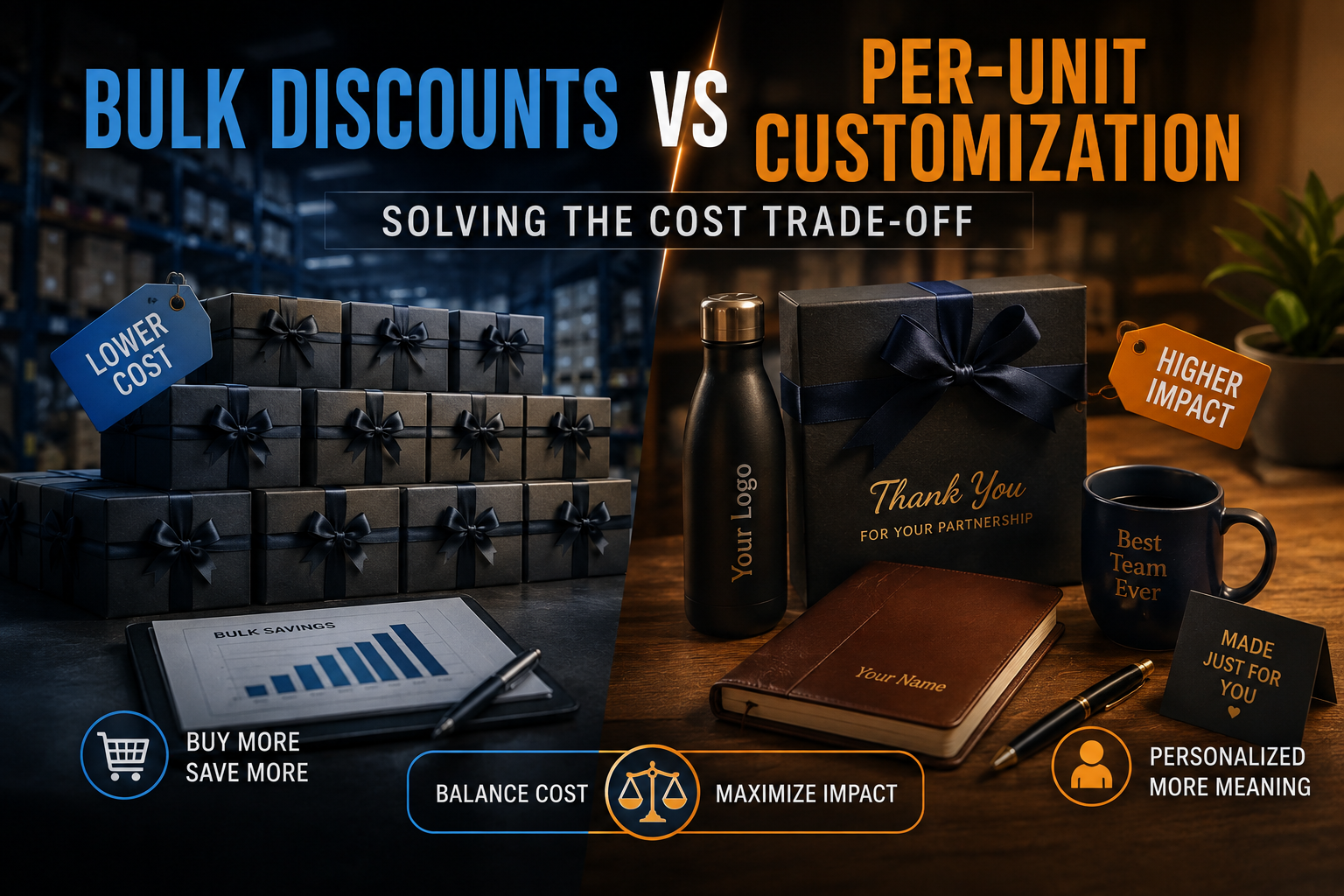
Bulk Discounts vs Per-Unit Customization: Solving the Cost Trade-off
Corporate gifting becomes more complicated when Procurement and HR teams need to balance two competing priorities: getting the best bulk price and delivering a personalized experience to each recipient.
Buying larger quantities can unlock better pricing, but individual customization can increase production, handling, packaging, and quality-control costs. The more personalization a company adds, the harder it can become to maintain the benefits of bulk procurement.
This creates a common corporate gifting dilemma:
Should you maximize bulk discounts or invest in per-unit customization?
There is no universal answer. The right approach depends on the purpose of the gifting campaign, recipient type, order volume, budget, and level of personalization required.
For Procurement and HR teams, the key is to understand where customization genuinely creates value and where standardization can deliver the same recipient experience at a lower cost.
A well-planned strategy can combine both approaches—using bulk corporate gifting discounts wherever possible while reserving individual personalization for situations where it has a meaningful purpose.

Understanding the Bulk Discount Advantage
Corporate gift vendors generally offer better pricing when larger quantities are purchased because fixed costs can be distributed across more units.
Production setup, sourcing, packaging procurement, branding preparation, and logistics planning may become more efficient as order volume increases.
For example, a vendor may quote:
| Quantity | Approx. Unit Price |
|---|---|
| 100 units | ₹1,200 |
| 500 units | ₹1,050 |
| 1,000 units | ₹950 |
| 2,500 units | ₹875 |
The larger order creates an opportunity for Procurement to reduce the average cost per recipient.
However, bulk purchasing is only beneficial when the organization actually needs the quantity being ordered.
A lower unit price should never be considered a saving if excess inventory remains unused.
Why Per-Unit Customization Increases Costs
Personalization adds another layer to the procurement process.
Instead of producing 1,000 identical products, the vendor may need to process 1,000 individual names, messages, codes, labels, or designs.
This can increase:
- Production time
- Data-processing requirements
- Quality checks
- Packaging complexity
- Handling
- Error risk
- Rework
- Dispatch complexity
For example, printing one company logo on 1,000 notebooks may be relatively straightforward.
Printing 1,000 different employee names requires a more complex workflow.
The difference can have a noticeable impact on the final price.
What Are Bulk Corporate Gifting Discounts?
Bulk corporate gifting discounts are price reductions or improved commercial terms offered when an organization purchases larger quantities.
The discount may apply to:
- Product price
- Branding
- Packaging
- Shipping
- Customization
- Setup charges
- Overall order value
However, not every vendor structures discounts in the same way.
Some vendors may reduce the product price but maintain customization charges. Others may offer better packaging or logistics terms instead of reducing the unit price.
Therefore, Procurement teams should always ask for a complete quotation rather than assuming that a bulk order automatically means the lowest final cost.
The Real Cost Trade-Off
The decision becomes clearer when you compare two hypothetical approaches.
Option A: Standardized Bulk Order
1,000 identical gifts at ₹900 each:
Total = ₹9,00,000
Option B: Individual Customization
1,000 gifts at ₹900 each + ₹150 personalization:
Total = ₹10,50,000
The customization adds ₹1,50,000 to the campaign.
The question is not whether ₹1,50,000 is expensive.
The question is:
Does the additional ₹150 per recipient create enough value to justify the additional investment?
That depends on the purpose of the campaign.
When Bulk Discounts Should Be the Priority
Bulk pricing generally makes more sense when:
- The recipient group is large
- The same product is suitable for everyone
- The gifting objective is broad appreciation
- The campaign has a strict budget
- The gift is primarily functional
- Individual personalization adds little value
- The organization has predictable annual demand
For example, a conference with 2,000 attendees may not require individually named gifts.
A standardized branded notebook or travel accessory may provide an effective experience while keeping the procurement cost under control.
In this situation, maximizing bulk purchasing efficiency makes sense.
When Individual Customization Is Worth the Extra Cost
Per-unit customization can be valuable when the relationship or occasion is highly personal.
Examples include:
- Employee milestone awards
- Long-service recognition
- Leadership gifts
- VIP client gifting
- Executive appreciation
- Strategic partner gifting
- Personalized onboarding
- Special achievement recognition
Imagine an employee completing 10 years with the company.
A standard branded gift may communicate appreciation.
A personalized gift featuring the employee’s name, milestone, or a meaningful message may communicate something much stronger.
In such cases, the additional cost may be justified because personalization supports the purpose of the gift, not merely its appearance.
Don’t Personalize Everything
One of the easiest ways to lose control of a corporate gifting budget is to assume that every recipient needs an individualized gift.
Personalization should be treated as a strategic feature rather than a default requirement.
Ask:
Does the recipient benefit from this personalization?
Does it strengthen the intended relationship?
Would the campaign feel significantly less meaningful without it?
If the answer is no, standardization may be the better option.
This allows organizations to preserve customization for the recipients who are most likely to value it.
Use Recipient Segmentation
A hybrid model is often the most effective solution.
Instead of choosing between complete standardization and complete personalization, divide recipients into groups.
For example:
Tier 1 — VIP Recipients
Personalized premium gifts with individual names or messages.
Tier 2 — Priority Recipients
High-quality gifts with company branding and selected personalization.
Tier 3 — General Recipients
Standardized bulk gifts with professional branded packaging.
This structure allows Procurement to benefit from volume purchasing while giving HR the flexibility to create a more personal experience where it matters.
Negotiate Customization at the Order Level
Procurement teams should not assume that individual customization must always be charged at the standard per-unit rate.
Ask vendors whether customization costs can be reduced when the total order is large.
For example, instead of:
1,000 units × ₹150 personalization = ₹1,50,000
the vendor may offer:
1,000 units × ₹90 personalization = ₹90,000
because the overall volume justifies a lower customization cost.
You can also negotiate setup charges separately.
The goal is to make the vendor recognize the value of the complete order, not just individual customization requests.
Ask Vendors for Multiple Pricing Scenarios
Rather than asking for one quotation, request several options.
For example:
Option 1: Standard product + logo branding
Option 2: Standard product + logo + branded packaging
Option 3: Standard product + individual names
Option 4: Standard product + individual names + personalized message
This makes the incremental cost of each feature visible.
Procurement and HR can then decide which elements actually justify their cost.
It also prevents the common problem of approving an expensive fully customized package without understanding what each additional feature contributes.
Consider Batch-Level Personalization
There is a middle ground between completely standardized and completely individualized gifts.
Batch-level personalization means customizing gifts for groups rather than every individual.
For example, different departments, locations, teams, or business units may receive different designs or messages.
A company might use:
- One design for employees
- Another for clients
- Another for channel partners
- Another for event attendees
This can create a sense of relevance without requiring 1,000 completely unique production files.
Batch-level customization can therefore provide some personalization while maintaining operational efficiency.
Packaging Can Create the Same Premium Effect
Sometimes the perceived value of personalization can be achieved through packaging rather than individual product customization.
Instead of printing each employee’s name directly onto the product, the company could use:
- Personalized message cards
- Individual name labels
- Customized thank-you notes
- Branded gift sleeves
- Recipient-specific inserts
These options may provide a personalized experience while keeping the underlying product standardized.
This is particularly useful for large employee gifting programs.
Don’t Ignore Operational Costs
The financial trade-off is not limited to the vendor’s personalization charge.
Individual customization can also increase internal administrative work.
HR may need to:
- Collect recipient data
- Validate spelling
- Confirm departments
- Approve artwork
- Resolve duplicate names
- Manage changes
- Verify final production files
Procurement may need to spend more time on:
- Vendor coordination
- Proof approvals
- Quality checks
- Packaging verification
- Delivery tracking
These internal costs should be considered when evaluating the value of customization.
Calculate the Fully Loaded Cost
A reliable comparison should use the total cost rather than the basic product price.
A simple formula is:
Fully Loaded Cost = Product + Branding + Customization + Packaging + Logistics + Taxes + Handling
Then calculate:
Cost Per Recipient = Fully Loaded Cost ÷ Number of Recipients
For example:
Bulk Standardized Program
Product: ₹800
Branding: ₹50
Packaging: ₹75
Logistics: ₹75
Total per recipient = ₹1,000
Personalized Program
Product: ₹800
Branding: ₹50
Customization: ₹125
Packaging: ₹75
Logistics: ₹75
Total per recipient = ₹1,125
The personalization premium is ₹125 per recipient.
For 2,000 recipients, that becomes:
₹2,50,000 additional investment.
The organization can then make a strategic decision about whether that additional investment is justified.
Avoid the MOQ Trap
Bulk discounts sometimes encourage organizations to purchase more than they actually need.
Suppose a vendor offers a significant discount at 5,000 units, but the organization requires only 3,500.
The lower unit price may look attractive.
But Procurement should calculate:
Cost of unused inventory + storage + future usability + potential obsolescence
If the product has a campaign-specific logo, date, event name, or packaging, unused inventory may have very little future value.
A smaller order at a slightly higher unit price may therefore be financially smarter.
Negotiate Based on Annual Volume
If the organization regularly purchases corporate gifts, annual purchasing potential can be more valuable than one large order.
Instead of negotiating every campaign independently, Procurement can discuss an annual volume arrangement.
For example:
“We expect to purchase approximately 5,000–8,000 corporate gifts across multiple campaigns during the year.”
The vendor may then offer preferred pricing across selected categories.
This can help Procurement achieve better rates without forcing the organization to buy everything at once.
A Practical Decision Framework
Before choosing between bulk discounts and individual customization, ask five questions:
1. Who Is Receiving the Gift?
A large event audience and a strategic client may require completely different approaches.
2. What Is the Purpose?
Is the goal awareness, appreciation, recognition, relationship building, or employee engagement?
3. How Valuable Is Personalization?
Will the recipient genuinely notice or appreciate the additional customization?
4. What Is the Incremental Cost?
Calculate the additional cost per recipient and across the entire order.
5. Can a Hybrid Approach Work?
If personalization is important for only a portion of recipients, segment the audience rather than customizing everything.
The Best Strategy: Combine Scale With Selective Personalization
In many corporate gifting programs, the smartest approach is not choosing between bulk discounts and customization.
It is combining them.
Procurement can negotiate bulk pricing based on the overall order quantity while HR can identify specific recipient groups that deserve personalization.
For example:
1,000 employees
800 receive a standardized premium gift.
150 receive a gift with personalized packaging.
50 senior employees receive fully personalized gifts.
This approach preserves economies of scale while allowing the organization to create stronger moments for priority recipients.
Final Thoughts
The debate between bulk discounts and per-unit customization should not be treated as a simple price-versus-personalization decision.
Both have a legitimate role in corporate gifting.
Bulk purchasing helps organizations control unit costs, simplify production, and improve procurement efficiency.
Customization can increase emotional value, strengthen recognition, and make important relationships feel more personal.
The key is knowing where each approach creates the greatest value.
For Procurement and HR teams, the most effective strategy is to calculate the fully loaded cost, negotiate based on total order value, segment recipients, and reserve expensive customization for occasions where it genuinely matters.
Instead of asking, “Should we choose bulk discounts or personalization?”, ask:
“Where can scale save us money, and where can personalization create enough additional value to justify its cost?”
That mindset allows organizations to benefit from bulk corporate gifting discounts without turning every gift into a standardized transaction—and without allowing personalization costs to consume the entire gifting budget.
Leave a comment