
Corporate Gifts Under ₹750: The Middle Budget Band, Done Premium
Every corporate gifting budget in India has a personality. ₹500 is a token — honest, affordable, and limited. ₹1,000 is a statement — enough for a gift an employee would genuinely buy for themselves. And then there is ₹750, the budget almost nobody talks about and almost everybody actually has. It is the figure finance approves without a board conversation, the figure HR lands on when ₹500 feels too thin and ₹1,000 feels too hard to defend, and the figure that covers a huge share of real programmes: joining kits, mid-year appreciation, festival gifting for support teams, milestone gifts, and the second tier of a tiered programme where senior staff get ₹1,000 and everyone else gets ₹750.
The problem is that ₹750 is also the budget most likely to be spent badly. It is close enough to ₹1,000 that teams plan as if they had ₹1,000, and close enough to ₹500 that vendors quote as if they had ₹500. The result, too often, is a gift that costs exactly ₹750 and looks like it cost ₹400: a decent item in a flimsy box, a logo printed slightly off-centre, a delivery charge nobody budgeted for, and a programme that quietly overran by 15 per cent because nobody did the landed-cost arithmetic before ordering.
This guide is about spending ₹750 properly. It is not a price list, and it does not pretend to quote product prices — real prices depend on the product, the quantity, the branding and the vendor, and any article that prints a fixed price list for a bulk corporate order is either guessing or out of date. What this guide does instead is three things. First, it sets out the fully loaded cost method this site already publishes for the ₹1,000 band, and applies the same method to ₹750 so the split is honest and defensible. Second, it works through what ₹750 genuinely unlocks over ₹500 — and what it still does not buy — using the ₹500 and ₹1,000 guides this site has already published as the anchors, so the comparison is against real published reasoning rather than a fresh set of claims. And third, it gives a decision framework, a headcount maths table, a worked example and a mistakes list, so an HR or procurement team can plan a ₹750 programme, defend it to finance, and deliver a gift that feels like the company meant it.
One boundary before we start. This guide is band strategy, not a catalogue. It covers what the ₹750 band can and cannot do, how to split the money, which categories work in it, and how to order and distribute without overrunning. It does not re-write the two guides it builds on: our guide to Christmas gifts for office staff under ₹1,000 sets out the full ₹1,000 programme — product ranges, premium packaging, branding and distribution — and the best corporate gifts under ₹500 post sets out what the ₹500 band buys. This guide takes both as its starting point and stays on the middle band itself: what ₹750 changes, and what it does not.
Why ₹750 Exists as a Band — and Why It Gets So Little Respect
Ask ten HR teams what their per-head gifting budget is and you will hear three numbers: ₹500, ₹750 and ₹1,000. The ₹500 figure is the most common cap for mixed-seniority teams, because it is comfortable for interns and senior staff alike. The ₹1,000 figure is the most common figure for Christmas gifting for office staff, because it is high enough to buy something genuinely good and round enough to survive a finance approval. And ₹750 is the figure in between — the one that appears in real budgets more often than in blog posts, because it is the compromise number: the number finance offers when HR asks for ₹1,000, and the number HR accepts when the headcount makes ₹1,000 unaffordable.
That is exactly why it deserves a guide of its own. A compromise budget is not a smaller version of a ₹1,000 budget and it is not a larger version of a ₹500 budget. It has its own arithmetic, its own trade-offs and its own failure modes, and planning it as if it were either of the other two is how it goes wrong. Plan it as ₹1,000 and the product creeps up, the packaging gets cut, and the programme overruns. Plan it as ₹500 and the team buys a single modest item, spends nothing on presentation, and delivers a gift that looks like a ₹500 gift that cost ₹750.
The ₹750 band also has a specific place in a tiered programme, and that is where it is most commonly used. Many companies run two or three tiers: a higher band for leadership, clients and long-service employees, a middle band for the general workforce, and a lower band for large-volume occasions. In that structure ₹750 is usually the middle tier — the band that has to carry the most people, the most occasions and the most scrutiny, because it is the one most employees actually receive. Getting it right matters more than getting the top tier right, because the top tier reaches a handful of people and the middle tier reaches the whole company. A ₹750 gift that feels premium does more for morale than a ₹1,500 gift that reaches ten people.
There is a second reason the band matters. ₹750 is the budget at which the gift stops being a single item and starts being a set. That is the single most important fact about it, and the rest of this guide follows from it. At ₹500, the honest answer is usually one good item, well presented. At ₹1,000, the answer is one good item plus one or two smaller ones, or a well-curated hamper. At ₹750, the answer is a choice: one better item, or two or three coordinated smaller items in one box. That choice — one thing done well, or a set done coherently — is the decision that decides whether the band works, and it is a decision the ₹500 and ₹1,000 guides do not have to make in the same way.
The Fully Loaded Cost Method: What ₹750 Really Means
The single most important idea in corporate gifting budgeting is also the simplest: the budget that matters is not the headline figure but the landed cost — product, packaging, packing, branding, delivery and a small allowance for damage and last-minute additions. Our guide to Christmas gifts for office staff under ₹1,000 states this plainly, and its arithmetic is the anchor for everything that follows. A ₹1,000 per-head budget is not ₹1,000 of product. Working backwards from the total, the product budget usually lands somewhere between ₹650 and ₹800, with the rest going to packaging, branding, packing and delivery. The published split for a bulk order at ₹1,000 is: product ₹650–₹800; packaging — the box, tissue, ribbon, sleeve and message card — ₹100–₹180; branding, where it is used, ₹30–₹80 per unit depending on the method; packing and handling ₹20–₹40; delivery or distribution ₹0–₹100 depending on whether gifts are handed out in the office or couriered to home addresses; and a small contingency for damage, misprints and late additions of ₹30–₹50. Add those up and the honest range is ₹830–₹1,150, which is why the product budget has to be set first and defended: if the product creeps to ₹900, something else has to give, and it is usually the packaging — which is exactly the wrong place to cut.
Apply the same method to ₹750, and the arithmetic is just as revealing. The table below is not a supplier price list and it is not a quote. It is a planning split, derived by applying the ₹1,000 guide’s own proportions to a ₹750 total, so that a team can see where the money has to go before a vendor is even approached. The real prices will come from the vendor’s quote at the team’s quantity; the split is what keeps that quote honest.
| Cost line | ₹1,000 band (published) | ₹750 band (derived planning split) | What it covers |
|---|---|---|---|
| Product | ₹650–₹800 | ₹480–₹600 | The gift itself — the item or items in the box |
| Packaging | ₹100–₹180 | ₹80–₹150 | Rigid box, tissue, ribbon or belly band, sleeve, message card |
| Branding | ₹30–₹80 | ₹25–₹60 | One logo application, done well, on one surface |
| Packing and handling | ₹20–₹40 | ₹15–₹30 | Packing, checking, sorting by team or location |
| Delivery / distribution | ₹0–₹100 | ₹0–₹75 | In-office handout, or courier to home addresses |
| Contingency | ₹30–₹50 | ₹20–₹40 | Damage, misprints, late additions, spares |
| Total | ₹830–₹1,150 | ₹620–₹955 | Fully loaded cost per head |
Read the ₹750 column carefully, because it contains the whole lesson of this guide. At the low end of every line, the total is ₹620 — comfortably inside the budget, with ₹130 of headroom. At the high end of every line, the total is ₹955 — ₹205 over budget. That is not an error in the table. It is the point. At ₹750, you cannot have everything at the top of every range. You cannot have the best product, the best box, full branding, courier delivery to every home address and a generous contingency all at once. Something has to be chosen, and the choice has to be made deliberately, before the order is placed, rather than discovered when the invoice arrives.
The practical rule is this: pick two lines to spend on, and hold the rest at the low end. If the gift is being handed out in the office, delivery is ₹0, and that frees roughly ₹75 for the product or the packaging. If the gift is going to home addresses, courier delivery typically adds ₹60–₹150 per gift depending on distance and weight — a figure the ₹1,000 guide publishes, and one that eats a much larger share of a ₹750 budget than of a ₹1,000 budget — so the product budget has to be lower, or the company has to accept that remote employees cost more to gift. If the branding is a simple single-colour print on the box, branding sits at the low end of its range. If the gift is a set of three items, the product line needs the top of its range and the packaging line has to be disciplined.
The other discipline the table enforces is the product budget itself. At ₹750, the product line is ₹480–₹600. That is the number to give the vendor as the product brief — not ₹750. A vendor who hears “₹750 budget” will quote a ₹750 product, and the programme will overrun the moment packaging and delivery are added. A vendor who hears “₹480–₹600 of product, in a rigid box, with one logo application, delivered to the office” can quote accurately, and the quote can be compared honestly against other vendors. This is the single most useful sentence in this guide: brief the vendor on the product budget, not the total budget.
One more warning from the ₹1,000 guide applies with even more force at ₹750. The ₹1,000 guide notes that a ₹100 overshoot per head is ₹10,000 at 100 people and ₹2,00,000 at 2,000. At ₹750 the same maths bites harder, because the overshoot is a larger share of the budget: a ₹50 overshoot per head is ₹5,000 at 100 people, ₹25,000 at 500, and ₹1,00,000 at 2,000. The headcount table later in this guide works this out in full, but the principle is worth stating now: at a middle budget, small per-head drift is a large programme cost, and the only defence is the landed-cost split, agreed before ordering.
What ₹750 Unlocks Over ₹500
The ₹500 band, as the best corporate gifts under ₹500 post and the Secret Santa guide on this site show, is a real and workable budget — but it is a narrow one. The ₹1,000 guide puts the boundary plainly: below about ₹500, the range of genuinely good gifts narrows sharply, and the gift starts to feel like a token. At ₹500, the honest programme is usually one good, useful, well-presented item: a decent bottle, a good notebook, a useful desk accessory, a small hamper. It works. It is also, by definition, a single-item programme, and a single item has a ceiling on how premium it can feel, however good the item is.
₹750 buys five things that ₹500 does not. None of them is a more expensive version of the same item. All of them are structural changes to what the gift is.
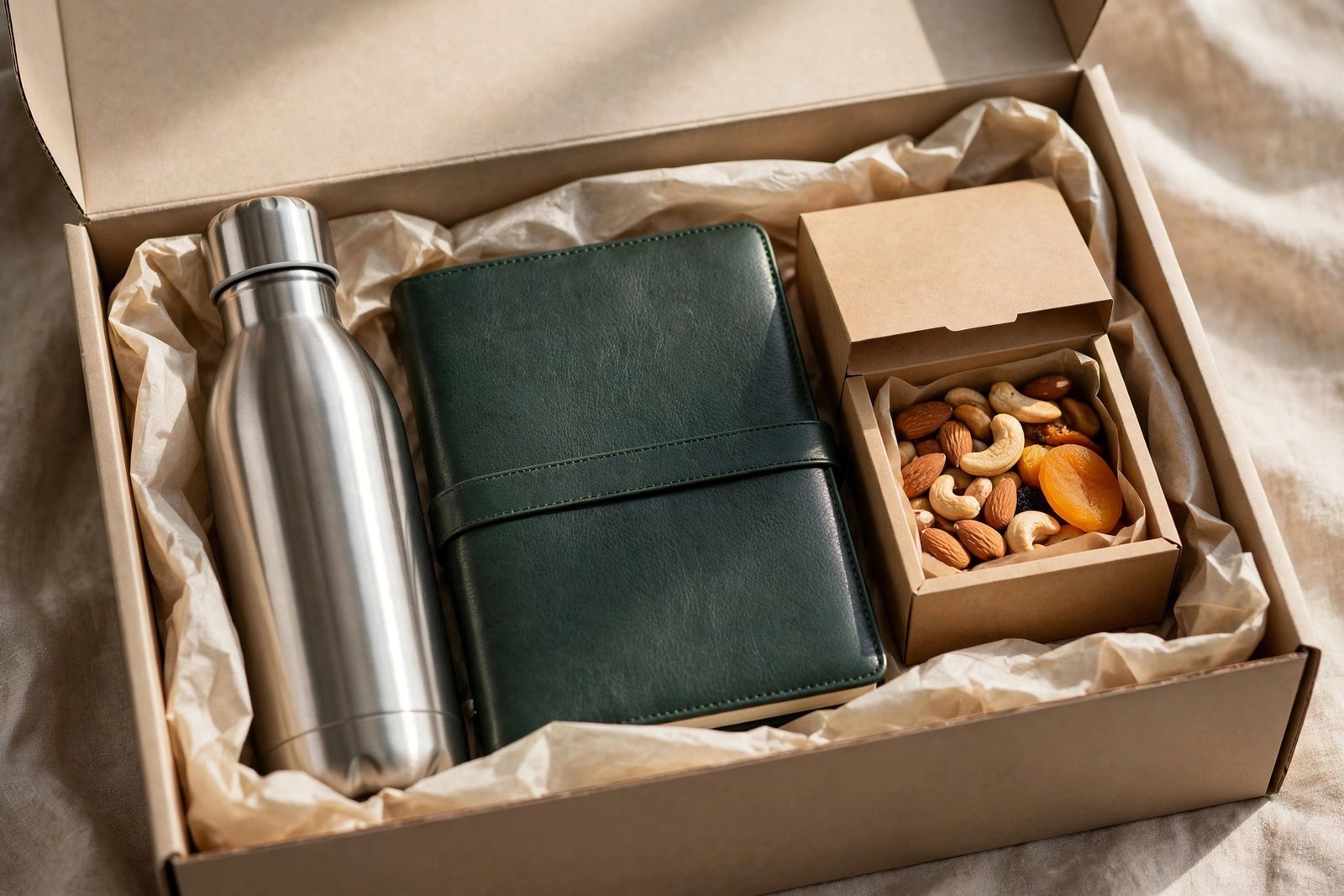
1. A set instead of a single item. This is the biggest unlock. At ₹750, a coordinated set of two or three items in one box becomes genuinely possible: a steel bottle with a notebook and a snack, a diary with a pen and a small plant, a mug with a tea selection and a message card. The Secret Santa guide on this site makes the point for the ₹500–₹1,000 range: three coordinated items in matched packaging feel like a ₹1,500 gift, and coordination, not quantity, creates the premium effect. At ₹750 that coordination is affordable without cutting corners on the items themselves. A set also solves a real problem with single items: taste. One item has to suit everyone; a set gives every recipient at least one thing they will use, and the set as a whole reads as a considered gift rather than a purchased object.
2. Better materials, not more items. The second unlock is quality within a category. At ₹500, the bottle is a basic steel bottle; at ₹750, it can be a better-gauge steel bottle with a cleaner finish and a lid that does not leak. At ₹500, the diary is a standard paper diary; at ₹750, it can be a better-bound diary with thicker paper and a ribbon marker. At ₹500, the hamper is a small snack selection; at ₹750, it can be a curated hamper with four or five good items rather than eight mediocre ones — the same rule the ₹1,000 guide applies to hampers, applied one band down. The test for any item is the same at every budget: would the employee use it in January, after the festive wrapping is gone? At ₹750, more items pass that test, because the material quality is high enough that the item survives daily use.
3. A rigid box instead of a floppy one. The third unlock is packaging, and it is the highest-return place to spend the extra ₹250. The ₹1,000 guide’s packaging rule is that a ₹700 gift in a ₹150 box feels like a ₹1,000 gift, while a ₹900 gift in a ₹30 box feels like a ₹500 gift — and the recipient judges the gift by the box before judging it by the contents. At ₹500, the packaging budget is thin, and the box is often the first thing cut. At ₹750, a rigid kraft or deep-coloured box with a clean lid, tissue paper in a single colour, a ribbon or belly band and a message card is affordable at bulk scale, and it is the difference between a gift and a parcel. One box size for the whole programme simplifies packing, stacking, storage and distribution, and it means every employee receives a gift that looks the same from the outside, whatever is inside.
4. One branded item, done well. The fourth unlock is branding that does not look like an afterthought. At ₹500, branding is often skipped, or applied cheaply to every surface. At ₹750, the budget supports the rule our guide to branded vs unbranded corporate gifts sets out: brand one thing well — the box, the bottle, or the diary — and leave the rest unbranded. One clean brand mark, executed properly, says more about the company than a logo on every surface. The branding method matters too: our comparison of engraving vs printing vs embossing works through which method suits which material, and at ₹750 the choice is usually a single-colour print or a simple engraving on the main item, rather than the cheapest available method on everything. Branding at bulk scale typically adds ₹30–₹80 per unit depending on the method, and that money has to come from somewhere in the landed-cost arithmetic — at ₹750, it comes from the discipline of branding one thing rather than everything.
5. Choice, without chaos. The fifth unlock is the cheapest premium signal of all: a small element of choice. Two box colour options at sign-up, a choice between two gift sets, a vegetarian variant of a hamper, a choice of tea or coffee in a drinkware set. The Secret Santa guide shows how a choice of two box colours makes a centrally ordered programme feel personal without adding cost or complexity. At ₹500, choice is usually unaffordable because it complicates packing and ordering. At ₹750, a single binary choice — this set or that set — is affordable, and it changes how the gift is received: the recipient chose something, so the gift feels considered rather than distributed.
None of these five unlocks is about spending more on the same thing. They are about spending differently: coordination over quantity, material over size, packaging over product, one brand mark over many, and a small choice over none. That is what “done premium” means at ₹750, and it is the difference between a middle budget spent well and a middle budget spent as if it were a small budget with extra money attached.
What ₹750 Still Cannot Buy
Honesty about what a budget cannot buy is as useful as honesty about what it can, because the most expensive mistakes in corporate gifting are the ones where a team buys a cheap version of an expensive idea. The ₹1,000 guide lists the exclusions for its band, and they apply at ₹750 with even more force — because at ₹750, the margin for absorbing a bad choice is smaller.
Branded electronics of any quality. A genuinely good power bank, a decent pair of earphones, a quality Bluetooth speaker — none of these fit in ₹750 once packaging and delivery are counted, and a cheap version is worse than no version at all. A power bank that fails is a gift that actively damages the company’s reputation, and a cheap pair of earphones is a daily reminder of a poor decision. The ₹1,000 guide is blunt about this, and the rule holds at ₹750: if the electronics are not good, do not buy them. Small tech accessories that are genuinely useful rather than impressive on a spec sheet — a good cable, a phone stand, a cable organiser — can work, but they belong in a set as a supporting item, not as the main gift.
Premium leather goods. A genuinely good leather wallet, a leather diary cover of real leather, a leather bag — these do not fit in ₹750 at bulk scale, and the versions that appear to fit are usually PU leather of indifferent quality, or real leather of a grade that will not age well. If leather is the idea, the honest move is to step the programme up to ₹1,000, or to choose a different material at ₹750. The point is made for a different comparison in our guide to dry fruit hampers vs gadget gifts: the category that looks premium on a spec sheet is not always the category that delivers premium in the hand.
Heavy individual personalisation. Individual names engraved on every item, per-person messages printed on every box, a different gift for every recipient — all of these push the total past the budget at bulk scale, unless the headcount is small enough to absorb the cost. Personalisation does not have to mean engraving every name; it has to mean the recipient can tell someone thought about them. At ₹750, the affordable personalisation is a handwritten-style message card with the employee’s name, a small tag noting the team or the year, or a choice between two gift options. The heavy work — individual engraving, variable-data printing across a large order — belongs in the bulk customisation workflow, and our guide to engraving and printing at scale sets out how that workflow is managed when a programme genuinely needs it.
High-end hampers with imported dry fruits. A well-curated hamper works at ₹750, but the hamper has to be curated, not stuffed: four or five good items beat eight mediocre ones. Imported dry fruits, premium chocolates at quantity, and anything with a short shelf life or a cold chain will push the total past the budget, and anything that needs refrigeration, careful handling or fragile transit should be avoided for a bulk programme: the damage rate eats the budget, and a broken gift is the worst possible outcome. The comparison in our guide to Christmas hampers vs gift boxes for bulk orders is directly useful here: for a large headcount, a rigid gift box is usually easier to pack, stack, carry and distribute than a loose hamper, and it survives handling far better.
Anything that depends on the recipient’s taste, size or habits. Perfume, clothing, alcohol, strong fragrances, food that ignores common dietary patterns — these are risky at every budget, and at ₹750 the risk is not worth taking, because the budget does not allow a second, safer option alongside. The gift should be neutral: it should not depend on gender, religion, clothing size or personal habits. That is not a limitation of the band. It is a rule of corporate gifting, and the ₹750 band is no exception to it.
The point of this section is not to make ₹750 sound small. It is to protect the budget from its own ambitions. A ₹750 programme that buys a good set, in a rigid box, with one brand mark, is a premium programme. A ₹750 programme that buys a cheap power bank in a floppy box is a programme that spent ₹750 to look like ₹300. The difference is not the budget. It is the discipline.
Gift Categories That Work in the ₹750 Band
What follows is not a price list. It is a category guide: the kinds of gifts that work at ₹750, what makes each one premium at this band, and what to watch for. Real prices depend on the product, the quantity, the branding and the vendor, and the team should brief the vendor on the product budget of ₹480–₹600 from the landed-cost table, not on the ₹750 total. Within that product budget, these categories are the ones that consistently deliver.
Drinkware, upgraded. The workhorse of the middle band. A quality steel bottle or a good ceramic mug is used daily, survives the office, and carries a logo cleanly without looking like advertising. The difference between a good and a bad choice here is quality: a bottle that keeps water cold, a mug with a decent glaze, a tumbler that does not leak. At ₹750, drinkware works best as the main item in a set — a bottle with a small snack, a mug with a tea selection — rather than as a single item, because the set is what lifts it from a ₹500 gift to a ₹750 gift. Ask the vendor for a sample and use it for a week before ordering hundreds: our sample approval checklist for bulk corporate gifts sets out exactly what to check, and a bottle that dents or a mug that chips is a daily reminder of a poor decision.
Desk sets and stationery. A good diary with a pen, a notebook with a desk organiser, a desk set with a small plant — these work at ₹750 because they are useful every working day, they are easy to brand well, and they are easy to pack. The quality test is the same as for drinkware: thicker paper, a binding that survives a year of use, a pen that writes well. A diary that falls apart in February is worse than no diary at all. Stationery also has a practical advantage at this band: it is light, it packs flat, and it survives courier delivery far better than ceramics or glass, which matters when the programme includes remote employees.
Curated food hampers. The most reliable option at this budget, and the hardest to get wrong — provided the hamper is curated, not stuffed. A well-curated hamper — dry fruits, premium tea or coffee, a good-quality snack, a small sweet — works because it is shareable with the family, does not depend on knowing one person’s taste, and is useful rather than decorative. At ₹750, the hamper should contain four or five good items, with a contents card that names what is inside: the card adds a premium feel for almost no cost. Offer a vegetarian variant, label contents clearly, and avoid alcohol. For a large headcount, a rigid gift box is usually easier to pack, stack, carry and distribute than a loose hamper, and it survives handling far better.
Wellness and self-care sets. A small wellness set — a candle, a bath or body item, a sleep mask, a small plant — works at ₹750 for the same reason hampers work: it is useful, it is shareable, and it does not depend on taste. The watch-out is quality: a candle that smells of chemicals is worse than no candle at all, and a cheap version of a premium idea is the classic ₹750 mistake. Buy the best version of a modest thing, not the worst version of an impressive thing. Wellness sets also suit the choice principle well: a choice between two sets, or a choice of scent from a short list, adds a personal feel without adding complexity.
Small tech accessories, as supporting items. A good cable, a phone stand, a cable organiser, a webcam cover — these are genuinely useful, they are cheap enough to sit inside a set, and they do not carry the failure risk of a power bank or earphones. They should not be the main gift at ₹750, because a cable on its own is not a gift, it is an accessory. But as the second or third item in a set — a bottle, a notebook and a cable organiser, for example — they add a modern, useful note that the recipient will actually use. The rule is simple: tech accessories support the gift; they do not replace it.
Apparel-adjacent items, chosen carefully. A good cap, a quality tote, a well-made scarf — these can work at ₹750, but they carry the taste and size risk that other categories avoid, and they need a sample approved before a bulk order. If the programme is for a specific team or event where the item makes sense — a tote for a conference, a cap for a field team — they can be excellent. If the programme is for the whole company, they are riskier than drinkware, stationery or hampers. The deciding question is the same as for every category: would the employee use it in January, after the festive wrapping is gone?
One category deserves a note of its own: gift cards. The trade-off is worked through in full in our guide to gift cards vs physical gifts for employees, and the short version is that a gift card is not a gift in the same sense as a physical gift: it is flexible, it is easy to distribute, and it is forgettable. At ₹750, a gift card of ₹750 is a defensible choice for a remote or distributed team where delivery is expensive, but it should not be presented as a premium gift programme. If the team chooses gift cards, the honest move is to say so, and to spend the packaging and branding budget on a good card presentation rather than pretending the card is a hamper.
The ₹750 Decision Framework: Five Questions Before You Order
A budget band is only useful if it comes with a decision method. These five questions, answered in order, will settle almost every ₹750 programme. They are written for the person who has to order, not for the person who has to receive, and they are designed to be answered in a single meeting with HR, admin and finance in the room.
1. How many people, and where are they? Headcount and location decide the delivery line of the landed-cost table, and the delivery line decides the product budget. A 100-person team in one office can spend the delivery money on the product. A 500-person team across five cities cannot. A hybrid team with remote employees needs the courier figure — typically ₹60–₹150 per gift depending on distance and weight — inside the ₹750 from the start. Collect and verify addresses early, confirm them in writing, and do not leave address collection to the week of dispatch. Delivery-ready ideas for hybrid teams are set out in our guide to Christmas gifts for remote employees, and its central point applies here: remote employees cost more to gift, and the budget has to admit that before the order is placed, not after.
2. One item or a set? This is the defining decision of the band. A single premium item — a very good bottle, a very good diary — is simpler to order, simpler to pack, and simpler to brand. A set of two or three coordinated items feels more generous and more considered, but it needs more packing, more checking, and a box that holds the items properly. There is no universally right answer. The rule of thumb is: if the occasion is a milestone or a celebration, a set reads better. If the occasion is a joining kit or a practical gift, a single good item reads better. If the team is unsure, the set is usually the safer choice at ₹750, because coordination is the band’s biggest unlock, and a set is where that unlock shows. Whether to buy a ready-made set or build one from individual items is a separate decision, covered by our guide to pre-curated vs build-your-own gift kits — a pre-curated set is usually faster and simpler at this budget, while a built-your-own set only pays off when the team has a specific combination in mind.
3. What is the one thing to brand? Brand one thing well — the box, the bottle, or the diary — and leave the rest unbranded. This is the rule from our guide to branded vs unbranded corporate gifts, and it matters more at ₹750 than at ₹1,000, because the branding budget is smaller and the temptation to brand everything is stronger. The method matters as well: our comparison of engraving vs printing vs embossing works through which method suits which material, and the practical choice at ₹750 is usually a single-colour print on the box or the main item, or a simple engraving on metal. Approve a physical sample on the actual production product, never a digital mockup. For branding, the sample is the decision.
4. What is the minimum order quantity, and what is the lead time? At ₹750, the order is usually large enough that MOQ and lead time are real constraints, not formalities. The MOQ question is settled by our guide to the minimum order quantity for corporate gifts in India, which sets out MOQ by product type, and the practical point is that the MOQ for a set is the MOQ of its hardest item: if one item in the set needs 200 units and the team is ordering 150, the set does not work, however good it looks on paper. Lead time is the same story: a set needs more production steps than a single item, and a branded set needs more still. Order early, approve the sample before the bulk order is placed, and build a week of slack into the timeline for the things that always go wrong — a misprint, a late delivery, a last-minute addition. For small teams ordering at low quantities, the same MOQ question is worked through in our guide to corporate gifts for startups in India, which sets out the low-MOQ options for a new or small company.
5. What will this gift be compared with? Every gift is judged against the last gift the recipient received from the company, and against the gift their colleague in the next team received. If last year’s gift was ₹500, a ₹750 gift has to feel like a step up, not a slightly better version of the same thing. If the leadership tier is ₹1,000, the ₹750 gift has to feel like the same programme at a different level, not a different programme. This is the question that decides whether the extra ₹250 is visible. If the answer is that nobody will be able to tell the difference, the money is being spent in the wrong place — and the packaging, the set, or the choice is where it should go instead. SHRM’s guidance on managing employee recognition programmes makes the same point in general terms: awards should be appropriate to the achievement and the effort they represent, and recognition programmes should be properly funded rather than left to absorb the difference.
Answer these five questions, and the programme is mostly planned. The remaining work is execution: the sample, the order, the packing, the distribution. And execution is where ₹750 programmes most often fail, which is the subject of the next two sections.
Headcount Maths: What ₹750 Costs at Scale
A per-head budget is a small number. A programme budget is a large one. The table below works out the total programme cost at four headcounts, at the ₹750 band and at the two neighbouring bands, so that the person presenting the budget to finance can show the total, not just the per-head figure. The totals are simple multiplication — headcount times per-head budget — and they are the numbers that actually get approved. The annual envelope behind these numbers is covered by the corporate gift budget planning guide on this site, which sets out a simple framework for Indian businesses.
| Headcount | At ₹500 | At ₹750 | At ₹1,000 | Cost of stepping from ₹500 to ₹750 |
|---|---|---|---|---|
| 50 people | ₹25,000 | ₹37,500 | ₹50,000 | ₹12,500 |
| 100 people | ₹50,000 | ₹75,000 | ₹1,00,000 | ₹25,000 |
| 500 people | ₹2,50,000 | ₹3,75,000 | ₹5,00,000 | ₹1,25,000 |
| 2,000 people | ₹10,00,000 | ₹15,00,000 | ₹20,00,000 | ₹5,00,000 |
Two things follow from this table. The first is that the step from ₹500 to ₹750 is a 50 per cent increase in the programme budget, and it needs to be justified as a 50 per cent increase — not as “just ₹250 more”. At 500 people, the step is ₹1,25,000. That is a real number, and it is exactly why the five things ₹750 unlocks matter: the step has to buy coordination, better materials, a rigid box, one brand mark done well, and a small element of choice. If it buys none of those, the money is wasted, and the team would have been better off staying at ₹500 and spending the difference on something else.
The second is the cost of drift. The ₹1,000 guide notes that a ₹100 overshoot per head is ₹10,000 at 100 people and ₹2,00,000 at 2,000. At ₹750, a ₹50 overshoot per head — the kind of drift that happens when the product creeps from ₹550 to ₹600 and the courier charge is added late — is ₹5,000 at 100 people, ₹25,000 at 500, and ₹1,00,000 at 2,000. That is the cost of not doing the landed-cost arithmetic before ordering, and it is a cost that finance will notice and the next year’s programme will pay for. The defence is the split in the landed-cost table, agreed before the order, with the product budget of ₹480–₹600 given to the vendor as the brief, and the contingency line of ₹20–₹40 held back for the things that always go wrong.
There is one more headcount effect worth naming. At small headcounts — 50 people, say — the ₹750 band behaves almost like the ₹1,000 band: the vendor is flexible, the MOQ is not a constraint, and a small amount of personalisation is affordable. At large headcounts — 2,000 people — the ₹750 band behaves almost like the ₹500 band: the vendor needs volume, the MOQ is a real constraint, and personalisation has to be limited to a message card. This scale effect is worked through in full in our guide to corporate gifting at 50 vs 5,000 employees, and the practical point is that the same ₹750 buys a different gift at 50 people than at 2,000. The team should plan the gift for its actual headcount, not for a generic “₹750 gift”, and should ask the vendor what changes at their quantity before committing to a set that only works at a different scale.
Ordering, Sampling and Delivery at ₹750
Bulk ordering is where ₹750 programmes succeed or fail, and the failure mode is almost always the same: the order goes in too late, the sample is skipped, and the quality is discovered — too late — when hundreds of gifts are already packed. The sequence that avoids this is short, and it is worth following exactly.
Brief the vendor on the product budget, not the total budget. Give the vendor the product line from the landed-cost table — ₹480–₹600 — along with the headcount, the occasion, the delivery location and the branding requirement. Ask for a fully loaded quote: product, packaging, branding, packing, delivery and taxes, per unit, at the team’s quantity. A quote that only gives the product price is not a quote; it is the first line of an invoice that will grow. Compare quotes on the fully loaded per-unit cost, not on the headline product price, and ask what changes at the next quantity tier — the MOQ guide on this site sets out how minimum order quantities work by product type, and the answer will often change the decision.
Approve a physical sample on the actual production product. Never a digital mockup, and never a sample of a different material. For a set, approve the whole set, in the actual box, with the actual branding, as it will be delivered. Check the items the way the recipient will use them: drink from the bottle for a week, write in the diary, use the pen. Check the branding in ordinary light, check the box for sturdiness, check the packing for how the items sit together. Keep the approved sample as the physical reference for the delivered order, and check the first production batch against it. Our sample approval checklist for bulk corporate gifts sets out exactly what to check, item by item, and it is worth using rather than relying on memory.
Plan the packing as part of the order, not after it. A set of three items needs a box that holds them, tissue that stops them moving, and a packing sequence that can be repeated hundreds of times without errors. One box size for the whole programme simplifies everything. If the team is packing in-house, allow a realistic time per gift and a realistic error rate, and build spares into the order — the contingency line in the landed-cost table is for exactly this. If the vendor is packing, ask how the packing is checked, and who is responsible when a box arrives with the wrong items in it. The cheapest decision in gifting is usually the earliest one, and packing planned late is packing done badly.
Treat delivery as a budget line, not an afterthought. A gift that arrives late, or to the wrong person, or damaged, is not a gift. Distribution is the least glamorous part of the programme and the part where most middle budgets quietly fail, because delivery cost was never in the arithmetic. For in-office distribution, the cost is low but the logistics are real: sorting by team or floor, a distribution window that does not disrupt work, and a plan for people who are on leave. For courier delivery to home addresses, the cost is real — typically ₹60–₹150 per gift depending on distance and weight — and that cost has to be inside the ₹750, which means the product budget has to be lower, or the company has to accept that remote employees cost more to gift. Collect and verify addresses early, confirm them in writing, and do not leave address collection to the week of dispatch. For a programme that mixes office and home delivery, consider two different gift configurations: a full set for the office, and a lighter, courier-friendly set for home delivery, with the same branding and the same message card. The gifts do not have to be identical to be the same programme.
Build in the contingency, and use it. The contingency line — ₹20–₹40 per head in the ₹750 split — is not a rounding error. It is the budget for the things that always happen: a misprinted batch, a damaged box, a new joiner who arrived after the order was placed, a gift that has to be re-sent because the courier lost it. A programme with no contingency is a programme that will overrun, and a programme that overruns by 5 per cent at 500 people is ₹18,750 that finance did not approve. Hold the contingency back, spend it only on the things it is for, and report it as spent — not as saved, and not as available for a better product.

Common Mistakes That Undermine a ₹750 Gifting Programme
The mistakes below are the ones that recur across programmes at this budget. Most of them are not failures of taste. They are failures of arithmetic, timing or discipline — and all of them are avoidable.
1. Treating ₹750 as ₹750 of product. The most common mistake, and the most expensive. A gift that costs ₹750 on the catalogue and ₹950 delivered is not a ₹750 gift; it is a budget overrun that finance will notice and the next year’s programme will pay for. The product budget is ₹480–₹600. Brief the vendor on that number.
2. Buying a cheap version of a ₹1,000 idea. A poor-quality power bank, a flimsy backpack, a candle that smells of chemicals — a cheap version of a premium item is worse than a good version of a modest item. At ₹750, buy the best version of a modest thing, not the worst version of an impressive thing. If the idea needs ₹1,000 to be good, either step the programme up to ₹1,000 or choose a different idea.
3. Spending the budget on the product and forgetting the packaging. A ₹700 gift in a ₹150 box feels like a ₹1,000 gift. A ₹900 gift in a ₹30 box feels like a ₹500 gift. Protect the packaging budget as fiercely as the product budget, because the recipient judges the gift by the box before judging it by the contents.
4. Branding everything. A logo on the box, the bottle, the diary, the pen and the tissue paper is not branding. It is advertising, and it makes a ₹750 gift look like a promotional item. Brand one thing well and leave the rest unbranded. If the choice is between a better gift and a louder logo, choose the better gift every time.
5. Ordering late. Bulk ordering fails when the order goes in too late, the sample is skipped, and the quality is discovered when hundreds of gifts are already packed. A set needs more production steps than a single item, and a branded set needs more still. Order early, approve the sample, and build a week of slack into the timeline.
6. Ignoring the courier cost. For hybrid and remote teams, courier delivery to home addresses typically adds ₹60–₹150 per gift, and that cost has to be inside the ₹750. A programme that forgets delivery is a programme that either overruns or quietly downgrades the gift for remote employees — which is the worst possible outcome, because it treats remote employees as second-class recipients.
7. The same gift for everyone, without thinking. A single gift for the whole company is simpler to order, but it ignores dietary restrictions, personal preferences and the simple fact that people are different. A vegetarian variant, a choice between two sets, a choice of tea or coffee — these cost almost nothing and change how the gift is received. The cheapest premium signal in corporate gifting is a small element of choice, and at ₹750 it is affordable.
8. No contingency. A programme with no allowance for damage, misprints and late additions is a programme that will overrun. Hold back ₹20–₹40 per head, spend it only on the things it is for, and report it as spent.
A Worked Example: A 150-Person Team, In-Office, at ₹750
The method in this guide is easier to use with a concrete example, so here is one — labelled clearly as a worked planning example, not a quote and not a price list. The real prices will come from the vendor’s quote at the team’s quantity. The example shows how the landed-cost split is applied, and how the trade-offs in the table are actually made.
The team: 150 employees, all in one office, Diwali gifting, in-office distribution. The gift: a coordinated set of three items in one rigid box — a steel bottle, a notebook, and a small dry-fruit and snack selection — with a single-colour logo print on the box and a message card inside. The budget: ₹750 per head, ₹1,12,500 in total.
The split, using the ₹750 planning ranges from the landed-cost table: product ₹520 per head (a bottle, a notebook and a snack selection, within the ₹480–₹600 product range); packaging ₹120 per head (a rigid box, tissue, ribbon and message card, within the ₹80–₹150 range); branding ₹40 per head (a single-colour print on the box, within the ₹25–₹60 range); packing and handling ₹25 per head (within the ₹15–₹30 range); delivery ₹0 per head, because the gifts are handed out in the office; contingency ₹30 per head (within the ₹20–₹40 range). Total: ₹735 per head, ₹1,10,250 for the programme, with ₹15 per head — ₹2,250 in total — held back as unspent headroom.
Three things are worth noting about this example. First, the product budget of ₹520 is the number the vendor was briefed on, not ₹750 — and the vendor quoted against it. Second, delivery at ₹0 is what makes the example work: the same set couriered to home addresses would need ₹60–₹150 per head for delivery, which would push the total to ₹795–₹885 and over budget, unless the product budget was cut or the set was simplified. Third, the contingency of ₹30 per head — ₹4,500 in total — is what covers the five misprinted boxes, the three damaged bottles and the four new joiners who arrived after the order was placed. A programme without that line would have overrun by exactly that amount, and nobody would have been able to say where the money went.
The example also shows what the programme is not. It is not a power bank, because a good one does not fit. It is not a leather item, because good leather does not fit. It is not individually engraved, because individual engraving does not fit at 150 units. It is a coordinated set, in a rigid box, with one brand mark, and a message card with the employee’s name. That is what ₹750 buys when it is spent well — and it is a gift the recipient will use in January, which is the only test that matters.
When to Step Up to ₹1,000 — and When to Step Down to ₹500
Not every programme belongs at ₹750, and the honest move is sometimes to change the band rather than to force the gift into it. There are two directions to consider, and the decision should be made before the order is placed, not after the quote arrives.
Step up to ₹1,000 when the gift needs it. If the occasion is a major milestone — a ten-year anniversary, a retirement, a client relationship that matters — the extra ₹250 buys the things ₹750 cannot: a genuinely good single premium item, a better hamper, a higher-quality material, or a second branded item. Our guide to Christmas gifts for office staff under ₹1,000 sets out the full ₹1,000 programme, and the step from ₹750 to ₹1,000 is justified when the recipient, the occasion or the relationship needs the gift to be unambiguously premium. The headcount table shows the cost of the step: at 100 people, ₹25,000; at 500, ₹1,25,000. That is a real number, and it should be approved as a real number, not smuggled in as a per-head drift.
Step down to ₹500 when the headcount demands it. If the programme covers 2,000 people and the total budget is fixed, the step from ₹500 to ₹750 is ₹5,00,000 — and if that money is not available, the honest programme is a ₹500 gift done well, not a ₹750 gift done badly. The best corporate gifts under ₹500 post sets out what the lower band buys, and a single good item in a decent box, with a message card, is a better programme than a stretched ₹750 set with a flimsy box and no contingency. The same applies when the occasion is light — a small celebration, a token of thanks, a Secret Santa where the cap has to be affordable for everyone. The Secret Santa guide on this site makes the point well: ₹500 is the most workable cap for mixed-seniority teams, because it is comfortable for interns and senior staff alike, and a cap that everyone can afford is a cap that works.
Stay at ₹750 when the middle is the point. The band earns its place when the programme needs more than a token and less than a statement: a joining kit that has to feel considered, a mid-year appreciation gift, a festival gift for the whole workforce, the middle tier of a tiered programme. That is the band’s natural territory, and it is a large territory. Most corporate gifting in India lives in the middle, and the middle deserves to be planned as carefully as the top.
The decision is not about the number. It is about the gift the number has to buy, the people it has to reach, and the impression it has to leave. Choose the band that fits the gift, not the gift that fits the band — and if the band and the gift do not fit, change the band.
FAQs
1. What are the best corporate gifts under ₹750 for employees?
The best gifts at ₹750 are coordinated sets of two or three useful items in one rigid box — for example a steel bottle with a notebook and a small snack selection — or a single premium item with excellent packaging. The categories that work best are drinkware, desk sets and stationery, curated food hampers, wellness sets and small tech accessories as supporting items. The test for any item is whether the employee will use it in January, after the festive wrapping is gone. What does not work at ₹750 is a cheap version of an expensive idea: a poor-quality power bank, flimsy leather goods or a cheap version of a premium item is worse than a good version of a modest item.
2. Is ₹750 enough for a corporate gift that looks premium?
Yes — provided the money is spent in the right places and the budget is understood as landed cost, not catalogue price. At ₹750, the product budget is roughly ₹480–₹600, with the rest going to packaging, branding, packing, delivery and contingency. The premium feel comes from coordination, better materials, a rigid box, one brand mark done well and a small element of choice — not from buying a more expensive single item. A ₹700 gift in a ₹150 box feels like a ₹1,000 gift; a ₹900 gift in a ₹30 box feels like a ₹500 gift. Packaging is the single highest-return place to spend money at this budget.
3. What is the difference between corporate gifts under ₹750 and under ₹1,000?
The difference is what the extra ₹250 buys. At ₹1,000, the product budget is ₹650–₹800, which buys a better single item, a more generous hamper or a higher-quality material. At ₹750, the product budget is ₹480–₹600, which buys a coordinated set of two or three good items, or one good item with better packaging. The ₹1,000 band also absorbs courier delivery more easily; at ₹750, courier delivery to home addresses — typically ₹60–₹150 per gift — eats a much larger share of the budget, so the product has to be simpler or the delivery has to be in-office. Both bands use the same fully loaded cost method: product, packaging, branding, packing, delivery and contingency.
4. How should I split a ₹750 corporate gift budget?
Use the fully loaded cost method: work backwards from the ₹750 total. A planning split derived from the published ₹1,000 breakdown is product ₹480–₹600, packaging ₹80–₹150, branding ₹25–₹60, packing and handling ₹15–₹30, delivery ₹0–₹75, and contingency ₹20–₹40. You cannot have every line at the top of its range — the high end of every line totals ₹955, which is ₹205 over budget — so pick two lines to spend on and hold the rest at the low end. Brief the vendor on the product budget of ₹480–₹600, not on the ₹750 total, and ask for a fully loaded quote per unit at your quantity.
5. Can I get a personalised corporate gift under ₹750?
Yes, but the personalisation has to be light. A handwritten-style message card with the employee’s name, a small tag noting the team or the year, or a choice between two gift options are all affordable at ₹750 and change how the gift is received. Heavy individual personalisation — individual names engraved on every item, a different gift for every recipient, variable-data printing across a large order — pushes the total past the budget at bulk scale unless the headcount is small enough to absorb the cost. Personalisation does not have to mean engraving every name; it has to mean the recipient can tell someone thought about them.
6. What corporate gifts under ₹750 work for remote and hybrid teams?
For remote teams, the gift has to survive courier delivery and the delivery cost has to be inside the ₹750. Light, flat, non-fragile items work best: stationery and desk sets, curated snack hampers in a rigid box, wellness sets. Ceramics and glass are riskier in transit. Courier delivery typically adds ₹60–₹150 per gift depending on distance and weight, so the product budget has to be lower for remote employees, or the company has to accept that remote employees cost more to gift. Collect and verify addresses early, confirm them in writing, and consider a lighter, courier-friendly set for home delivery with the same branding and message card as the office set.
7. Should I buy one gift or a gift set under ₹750?
At ₹750, a set is usually the better choice — it is the band’s biggest unlock. Two or three coordinated items in matched packaging feel like a more generous and more considered gift than a single item at the same price, and a set gives every recipient at least one thing they will use. A single premium item is simpler to order, pack and brand, and it is the right choice when the occasion is practical — a joining kit, for example — or when the headcount is large and packing complexity matters. If the team is unsure, the set is usually the safer choice at ₹750, because coordination is what makes the middle band feel premium.
Conclusion
₹750 is the most under-thought budget in Indian corporate gifting, and the one that covers the most real programmes. It is not a smaller ₹1,000 and it is not a larger ₹500. It is a band with its own arithmetic, its own trade-offs and its own failure modes — and it rewards the teams that plan it on its own terms.
The arithmetic is the fully loaded cost method: product ₹480–₹600, packaging ₹80–₹150, branding ₹25–₹60, packing ₹15–₹30, delivery ₹0–₹75, contingency ₹20–₹40. The discipline is to brief the vendor on the product budget, not the total, and to pick two lines to spend on while holding the rest at the low end. The unlocks are coordination, better materials, a rigid box, one brand mark done well, and a small element of choice. The exclusions are honest: no quality branded electronics, no premium leather, no heavy individual personalisation, no high-end imported hampers. And the test, at every budget, is the same: would the employee use it in January, after the festive wrapping is gone?
A ₹750 programme that buys a good set, in a rigid box, with one brand mark and a message card, is a premium programme. A ₹750 programme that buys a cheap power bank in a floppy box is a programme that spent ₹750 to look like ₹300. The difference is not the budget. It is the discipline — and discipline, at a middle budget, is the whole job.
Planning a gifting programme on a ₹750 per-head budget? Share your headcount, the occasion and the delivery locations with Arrow Gifter, and get curated gift sets built to that brief — with the fully loaded cost per unit, packaging, one brand mark done well, and pan-India delivery handled for you. Tell the team your budget and your date, and start with the set that suits your people — not the catalogue page that happens to be cheapest this week. The gift is remembered for how it feels in the hand; at ₹750, that feeling is a choice, not an accident.
Leave a comment