
Sustainable Packaging for Corporate Gifts: Materials, Real Costs and What Recipients Notice
Open a corporate gift and the first thing you touch is not the gift. It is the box.
Before the recipient sees the product, reads the message card or forms any opinion about the company that sent it, they have already lifted a lid, pulled tissue paper aside, worked out whether the box opens cleanly or tears, and noticed — consciously or not — how much packaging there was for what is inside. In a festive hamper that first minute is the whole first impression. A beautiful gift in a flimsy, over-wrapped box reads as careless. A modest gift in a well-made, right-sized box reads as considered. Packaging is not the wrapping around the gift. For the recipient, packaging is the first part of the gift.
That is why sustainable packaging has become a real procurement question rather than a nice-to-have. Companies in India are being asked about it from three directions at once: leadership and ESG commitments that now cover gifting, recipients — especially younger employees — who notice waste and say so, and regulation, with India’s Plastic Waste Management Rules and extended producer responsibility putting the spotlight on exactly the kind of single-use packaging corporate gifting produces in bulk. The question HR and procurement teams are actually asking is not “should we care about this?” It is “what do we buy instead, what does it cost, and how do we know the vendor is telling the truth?”
This guide answers those three questions for packaging specifically. It is a companion to two guides this site already publishes. Our Green Gifting Checklist is the programme-level overview — the 14-point checklist, the GREEN framework and what to measure after a campaign — and it is the right place to start if you are setting up a sustainable gifting programme from scratch. Our Christmas hampers vs gift boxes guide covers the format decision, hamper versus box, for bulk orders. This guide takes both as its starting point and goes deep on the one thing neither of them covers in detail: the packaging itself. Which materials are genuinely better and which are only labelled that way. What each one honestly costs inside the per-head budget bands this site already publishes. The greenwashing checks to run before you believe a vendor’s claim. And what recipients actually notice when they open the box — because packaging that nobody notices is money spent on a story nobody heard, and packaging that everyone notices for the wrong reasons is worse than no change at all.
One thing to settle first: sustainable packaging is not a single product you buy. It is a series of small decisions — the board, the size, the insert, the filler, the tape, the sleeve, the courier carton — and the honest answer is that some of those decisions matter far more than others. A right-sized kraft box with no plastic filler does more than a premium “eco” box stuffed with shredded plastic ribbon. The order of decisions matters, and this guide follows it: material first, then cost, then what the recipient sees, then the checks that keep a vendor honest.
Why Packaging Decides Whether a Gift Reads as Premium or Wasteful
There is a simple test for whether packaging is working. Ask the recipient, the day after they receive the gift, what they remember. They will remember the product if they liked it, the message card if it was personal, and the packaging if it was either surprisingly good or surprisingly wasteful. Nobody remembers adequate packaging. That is the point: packaging earns its keep in two ways — by making the gift feel considered, and by not making the recipient feel guilty.
The guilt part is new, and it matters more every year. A decade ago, layers of packaging read as luxury: a rigid box, inside a sleeve, inside a bag, with tissue, filler and a ribbon, signalled that the sender had spent money. Today, for a growing share of recipients, the same layers read as waste. The same unboxing that once impressed now prompts a quiet calculation — how much of this goes straight into the bin? — and that calculation attaches itself to the sender’s brand, not to the packaging vendor’s. The gift itself can be excellent and still carry that aftertaste, because the recipient’s last interaction with the gift is disposing of its packaging.
The premium part has not gone away, it has changed shape. What reads as premium now is restraint done well: a box that fits its contents, board that feels solid rather than flimsy, printing that is clean rather than loud, a sleeve or belly band that carries the branding so the box itself can stay simple, and nothing inside the box that does not need to be there. Our Green Gifting Checklist makes the same point at programme level — premium gifting does not require excessive packaging, and a clean box, thoughtful arrangement, quality materials and restrained branding can create a sophisticated experience while reducing unnecessary material. That is not a compromise between premium and sustainable. Done well, it is the same thing.
There is also a practical reason packaging deserves its own guide rather than a paragraph inside a gifting guide: it is where the money goes that nobody budgets for. Our guide to Christmas gifts for office staff under ₹1,000 publishes the fully loaded split for the ₹1,000 band, and packaging sits inside it at ₹100–₹180 per head. Our guide to corporate gifts under ₹750 applies the same method to the ₹750 band, with packaging at ₹80–₹150 per head. At those figures, packaging is roughly a tenth to a sixth of the per-head budget — not a rounding error, and large enough that a careless packaging choice can quietly eat the budget that was meant for the gift. And those are the published splits for standard packaging. The whole point of this guide is to show what happens to that line when the packaging is sustainable — which parts cost more, which cost less, and where the real money is.
The last reason is damage. Packaging has a job before it has a story: it has to get the gift to the recipient intact. A sustainable box that collapses in transit, lets a bottle leak, or arrives crushed after a courier journey is not a sustainable choice — it is a wasted gift, a replacement order, and a second round of packaging and delivery. Our guide to what happens when a corporate gift order goes wrong covers the damage and delay playbook in full, and the packaging decisions in this guide are written with that failure mode in mind throughout. Protection first, sustainability second, presentation third — in that order, because a gift that arrives broken has no presentation at all.
The Four Materials That Actually Matter — and What Each One Honestly Does
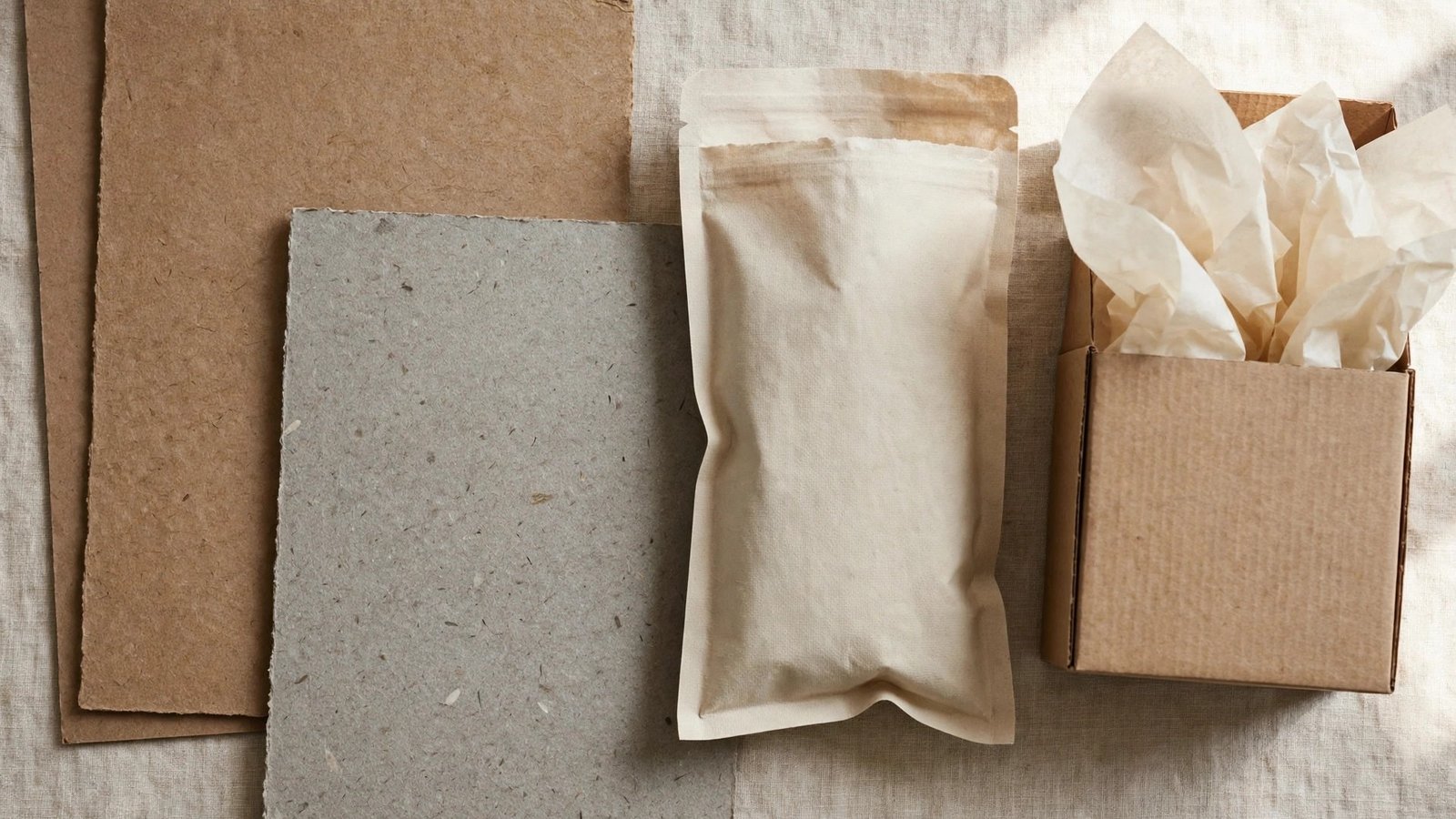
Strip away the marketing words and there are four packaging materials that cover almost every corporate gift in India: kraft board, recycled board, compostable or bio-based packaging, and reusable packaging. Everything else is a variation, a coating or a label on one of these four. Understanding what each one actually does — and what it does not do — is the whole material decision.
Kraft board is the workhorse. It is the brown, unbleached board that most people picture when they hear “eco-friendly box”, and for once the picture is roughly right. Kraft board is made from wood pulp with minimal bleaching, which is why it looks the way it does, and it is widely recyclable through ordinary paper recycling streams. It is strong for its weight, it takes printing well — especially single-colour or two-colour designs, which suit corporate branding — and it is available from most Indian packaging vendors at standard specifications. Its limits are worth stating plainly. Kraft board is not automatically recycled content: virgin kraft and recycled kraft are different products, and a vendor who says “kraft” without saying which one has not answered the question. Uncoated kraft absorbs moisture, which matters for monsoon deliveries and for gifts that will sit in a humid office. And its brown, textured look is a design choice, not a neutral one — it suits a natural, understated gift and fights with a bright, premium brand identity unless the design is built around it. Ask the vendor two questions: what percentage of the board is recycled content, and is the board certified — for example, does it carry FSC chain-of-custody certification or an equivalent? A vendor who can answer both in writing is a vendor who knows their material. A vendor who answers with “it is eco-friendly” has not answered at all.
Recycled board — grey board, recycled corrugated board, recycled rigid board — is the material with the clearest story and the murkiest labelling. Its story is genuinely good: it is made from post-consumer waste paper, it keeps material in use, and for rigid gift boxes and corrugated courier cartons it is often the strongest option per rupee. Its labelling is where the trouble starts, because “recycled” on a box can mean anything from 100% post-consumer recycled content to a small percentage of pre-consumer offcuts swept into the mix. The question to ask is not “is it recycled?” but “what percentage is post-consumer recycled content, and can you show it on the specification sheet?” Post-consumer content is the figure that matters — it is material that was actually used and recovered — and a specification sheet that states it is worth more than any leaf logo on the box. Recycled board’s practical limits are that it is usually duller and less smooth than virgin board, so fine printing and bright colours suffer, and that its strength varies more between batches, which is one more reason to approve a physical sample before a bulk run. Our sample approval checklist for bulk corporate gifts covers what to check on a packaging sample specifically, and the board specification is the first item on it.
Compostable and bio-based packaging is the material category where the gap between the claim and the reality is widest, and where careful buying matters most. Compostable mailers, bio-based filler, compostable tape and plant-based wrapping exist, and some of them are genuinely useful — particularly for food-led hampers, where a compostable inner wrap can replace a plastic sleeve around dry fruit or sweets. But “compostable” is a conditional word, not a property. Most compostable packaging needs industrial composting conditions — sustained heat, moisture and microbial activity — to break down as claimed, and those conditions do not exist in a typical Indian household bin or landfill. A compostable mailer that ends up in general waste behaves, for practical purposes, like ordinary waste. “Biodegradable” is weaker still: almost everything biodegrades eventually, and the word on its own says nothing about how long it takes or what it leaves behind. None of this means compostable packaging is a bad choice. It means the buying question is specific: under what conditions does this material break down, what certification supports that claim, and what will the recipient actually do with it? If the answer is “industrial composting” and your recipients have no access to it, the honest choice is a recyclable material they can actually recycle, not a compostable one they cannot compost. Our Green Gifting Checklist makes the same point in its supplier-claims section — terms like biodegradable, compostable and recycled can mean different things depending on the product and conditions, and a responsible procurement process relies on specific information rather than broad marketing language.
Reusable packaging is the only material choice that changes the maths entirely, because the box stops being waste at all. A good-quality jute or cotton bag, a sturdy tin, a keepsake rigid box or a storage box the recipient will actually keep turns packaging from a disposal problem into part of the gift. It is also the choice with the most honest trade-off: reusable packaging usually costs more per unit than a disposable box, and it only earns that premium if the recipient actually reuses it. A flimsy “reusable” tote that tears in a month is worse than a recyclable box, because it cost more and still became waste. The test is simple and brutal: would the recipient keep this if it had no logo on it? If yes, it is reusable packaging. If no, it is a disposable box with a green story attached. Reusable packaging works best where the gift itself is premium — executive gifts, client appreciation, long-service awards — because the packaging budget is a smaller share of a larger per-head figure, and because the recipient of a premium gift is more likely to keep a good box. Our guide to corporate gifts for small teams shows the same logic at small quantities: at 10–25 people, a better box is affordable because the total is small, and the gift is judged personally. The same logic applies to reusable packaging generally — it is easiest to justify where the per-head budget has room for it.
Two materials deserve a short warning rather than a full section, because they appear constantly in vendor quotes and are almost always the wrong choice for a sustainable programme. The first is virgin plastic in any form — plastic sleeves around every item, plastic filler, plastic ribbon, a plastic window in the box lid. It is cheap, it looks tidy, and it is the single largest source of packaging waste in a corporate gift, and it is the material India’s Plastic Waste Management Rules target most directly: identified single-use plastic items are restricted under the rules, and extended producer responsibility puts the obligation for plastic packaging waste on the producers and brand owners who put it into the market. The second is mixed-material packaging — a box that is paper on the outside, foil-laminated on the inside, with a plastic window and a magnetic strip — because it cannot be recycled through any single stream and will end up as general waste whatever the label says. If a box needs foil or lamination to look premium, that is a design problem, not a material requirement, and a good designer can get the premium feel from board choice and printing instead.
What Sustainable Packaging Actually Costs
This is the section most guides skip, and it is the one procurement teams actually need, because a sustainability decision that has not been costed is a decision finance will reverse. The honest answer is that sustainable packaging is not uniformly more expensive — some choices cost more, some cost less, and the net effect depends on which decisions you change and how many units you are ordering.
Start from the published anchor, because it is the only honest starting point. Our guide to Christmas gifts for office staff under ₹1,000 publishes packaging at ₹100–₹180 per head inside the ₹1,000 band. Our guide to corporate gifts under ₹750 puts packaging at ₹80–₹150 per head inside the ₹750 band. Those figures are for standard packaging — a printed box, an insert, filler, a sleeve and a courier carton — and they are the figures to hold in mind while reading the rest of this section. Everything below is expressed as movement from that anchor, not as a new price list, because real packaging prices depend on specification, quantity and vendor, and any guide that quotes a precise rupee figure for a box it has never ordered is inventing a price.
What usually costs more. A rigid box in recycled board costs more than a folding carton in standard board at the same size, because there is more material and more making-up work. A compostable mailer costs more than a poly mailer. Custom printing on kraft board in more than two colours costs more than the same print on white board, because kraft needs more ink coverage. A reusable bag or tin costs more than any disposable box, sometimes by a multiple. And small quantities cost more per unit across the board — a custom-printed sustainable box at 100 units carries setup and plate costs that a 500-unit run spreads thin. Our guide to the minimum order quantity for corporate gifts in India covers this quantity effect for products, and it applies exactly the same way to custom packaging: the smaller the run, the more the fixed costs dominate the per-unit figure. If your order is small, expect the sustainable packaging premium to be at its largest, and plan the per-head budget accordingly.
What usually costs less — or costs nothing. Right-sizing the box costs nothing and often saves money: a box that fits its contents needs less board, less filler and a smaller courier carton, and it is cheaper to ship. Dropping the plastic sleeve, the ribbon and the extra layer of tissue costs nothing and saves the cost of those items outright. Using a belly band or a printed sleeve to carry the branding, instead of printing the whole box, costs less than full-box printing and lets you use a standard, cheaper box underneath. Ordering a standard-size box instead of a custom size costs less, because standard sizes are die-cut in volume. And consolidating deliveries — one courier carton per office instead of one per recipient — saves packaging and delivery cost together. Our guide to employee address collection for gift delivery covers the address accuracy that makes consolidation possible, and our guide to Christmas corporate gift delivery deadlines covers the planning window that makes it achievable. The cheapest sustainable packaging decision, in almost every programme, is to use less packaging. It costs nothing, it saves money, and it is the change recipients notice most.
The net effect, honestly stated. For a typical 100–500 unit corporate order, moving from standard packaging to a genuinely sustainable specification — right-sized kraft or recycled board box, paper filler, printed sleeve instead of full-box print, no plastic — usually moves the packaging line by a modest amount in either direction, and the honest planning assumption is that it will sit at or slightly above the published anchor, not double it. That is a planning assumption to test against your vendor’s quote, not a price promise, and it holds only if you also make the savings above — right-sizing, dropping the plastic, simplifying the print. A programme that keeps every layer of conventional packaging and simply swaps each item for a “sustainable” equivalent will cost noticeably more, and will have missed the point: the biggest sustainability gain in packaging is using less of it, not buying greener versions of all of it. The question to put to your vendor is not “how much more will sustainable packaging cost?” but “show me the packaging cost line by line for the standard specification and for the sustainable specification at my quantity” — and then judge whether the difference is buying a real improvement or paying a premium for a label.
One more cost that belongs in this section because it is routinely forgotten: the courier carton. The gift box is what the recipient sees. The courier carton is what protects it, and it is usually the largest single piece of packaging in the whole order by weight — a corrugated outer carton, tape, and often a plastic shipping bag over the top. It is also the easiest piece to make sustainable, because the recipient never judges it: recycled corrugated board, paper tape instead of plastic tape, and no outer plastic bag unless the gift genuinely needs waterproofing. Ask the vendor what the courier carton is made of and whether the outer plastic bag can be dropped. It is a five-minute question that affects more packaging by weight than any decision about the gift box itself.
What Recipients Actually Notice — and What They Never See
Packaging is judged in about thirty seconds, and the judgement is almost entirely physical: how the box feels in the hand, how it opens, how much stuff comes out of it, and what is left on the table when the gift is out. Everything else — the material specification, the certification, the vendor’s sustainability story — is invisible unless you tell the recipient, and telling them is itself a decision with a right and a wrong way to do it.
What they notice first is the fit. A box that is the right size for its contents feels considered. A box that is twice the size of its contents, padded out with filler, feels wasteful before the recipient has even seen the gift. This is the single most visible packaging decision you will make, and it is free. Right-sizing is also the decision that protects the gift: a box with too much empty space lets the contents move in transit, which is how bottles break and hampers arrive shaken. If you change one thing about your packaging this year, change the size. Our Christmas hampers vs gift boxes guide covers the format choice that determines the size in the first place — a hamper needs a bigger footprint and more filler than a box holding the same items — and it is worth re-reading with fit in mind, because the format decision is where over-packaging usually starts.
What they notice second is the feel. Board quality is something recipients assess without thinking about it: a rigid box that holds its shape, a lid that closes cleanly, a surface that does not scuff the moment it is touched. Kraft board done well feels honest and solid. Kraft board done badly — thin, floppy, poorly cut — feels cheap, and no sustainability story rescues it. The same applies to recycled board: a good recycled rigid box feels premium, a poor one feels like a cost saving dressed up as a value. This is why the sample matters more for packaging than for almost anything else in gifting. A specification sheet can tell you the board weight. Only holding the box tells you whether it feels like a gift. Approve the physical packaging sample before production, with the actual gift inside it, and open it the way a recipient would — from the top, without instructions, in one go. If it tears, sticks, or needs two hands and a knife, it is the wrong box.
What they notice third is what is left behind. After the gift is out, the recipient is left with the packaging, and their judgement of it is practical: can I reuse this, can I recycle this, or does it go straight in the bin? A box they can keep — for storage, for regifting, for the desk — earns goodwill that outlasts the gift. A box that is obviously recyclable, with no mixed materials and no plastic they have to separate out, earns a quiet nod. A box that is foil-laminated, plastic-windowed and glued shut, with shredded plastic filler spilling everywhere, earns the opposite, and the recipient will remember that the company chose it. The message card is part of this too: a card printed on the same recycled stock as the box, with a short line about the packaging choice, reads as part of the gift. A separate glossy insert explaining the company’s sustainability commitments reads as marketing, and most recipients will bin it unread. Our guide to corporate gift message card wording has the formats that work for a short, honest packaging line — one sentence, specific, on the card itself, not a leaflet.
What they never notice is the story you did not tell them. A recycled board box looks, to most recipients, like a nice box. A kraft box looks like a brown box. Nobody can see the recycled content percentage, the certification, or the carbon maths, and most recipients will not go looking for it. That means the sustainability story has to be told — briefly, specifically, and on the packaging or the card — or the money spent on it buys nothing in recipient perception. The right way to tell it is one specific sentence: “This box is made from 80% post-consumer recycled board and is fully recyclable” beats “eco-friendly packaging” every time, because it is verifiable and it tells the recipient what to do with the box. The wrong way is a paragraph of claims, a leaf logo, and the word “green” used five times. If you cannot state the packaging choice in one specific sentence, the choice is probably not specific enough yet — which brings us to the checks.

The Greenwashing Checks: Seven Questions Before You Believe the Box
Greenwashing in packaging is rarely an outright lie. It is usually a true statement about a small part of the box, presented as if it described the whole box — “recyclable” on a box that is recyclable only if you remove the foil lining, the plastic window and the magnetic strip first, or “biodegradable” on filler that biodegrades in conditions your recipients will never provide. The checks below are packaging-specific. Our Green Gifting Checklist covers supplier-claim verification at programme level; these seven questions are the ones to ask about the box itself, and they work best asked in writing, before the order is placed, with the answers kept on file.
1. What exactly is this board, and what percentage is post-consumer recycled content? Ask for the board specification by name and grade, not by marketing description, and ask for the post-consumer recycled percentage as a number. A vendor who knows their material will have this on a specification sheet. A vendor who answers “it is recycled board” has told you nothing — recycled content can range from a token percentage of pre-consumer offcuts to 100% post-consumer waste, and the difference is the whole claim.
2. What certifications support the claim, and can I see them? If the board is described as certified — FSC chain-of-custody is the common one for paper and board — ask to see the certificate or the certification number, and check that it covers the supplier you are actually buying from, not a mill three steps up the chain. If the packaging is described as compostable, ask which standard it is certified to and under what conditions it composts. A certification that cannot be shown is a claim, not a certification, and it should be treated as one in any internal reporting.
3. Is the whole box recyclable, or just the main panel? Ask about every component: the board, the lining, the window, the tape, the glue, the sleeve, the insert and the filler. A box is only as recyclable as its least recyclable component, and the components are where mixed-material problems hide. If any component has to be removed before recycling, say so honestly — either remove it from the design or tell the recipient what to remove. A box that is honestly described as “recyclable once the sleeve is removed” is a better choice than a box described simply as “recyclable” that is not.
4. Under what conditions does the “compostable” item compost? Ask specifically whether it needs industrial composting, and if so, whether your recipients have any realistic access to it. If the honest answer is that most recipients will put it in general waste, choose a recyclable material instead and say so. A compostable mailer that ends up in landfill is not a sustainable choice; it is a more expensive way of producing the same waste.
5. Can I see and hold a sample of the exact specification? This is the check that catches most problems, because a sample reveals what a specification sheet hides — the board’s real feel, the print quality on kraft, whether the lid fits, whether the insert actually holds the gift, and whether the box survives being opened and closed twice. Our sample approval checklist for bulk corporate gifts sets out the twelve things to check before production, and the packaging sample deserves the same discipline as the product sample. Never approve packaging from a photograph.
6. What is the plastic content, by weight, of the whole pack — including the courier carton? Ask the vendor to list every plastic component in the order: sleeves, windows, filler, ribbon, tape, the courier carton and any outer shipping bag. The answer is often surprising, because the plastic the recipient never sees — in the courier carton — can outweigh the plastic in the gift box several times over. A programme that removes the plastic from the gift box and leaves it in the courier carton has solved the visible problem and kept the bigger one.
7. What happens to the unused boxes? Ask what the vendor does with overproduction, misprints and leftover stock, and plan your own quantities so there is as little of it as possible. Unused packaging is the purest form of packaging waste — material, printing and transport spent on a box nobody ever opened — and it is entirely within your control. Confirm the recipient list, order the right quantity with a small spare allowance, and check existing inventory before ordering more. Our guide to pre-curated gift sets vs build-your-own kits covers the quantity discipline that keeps over-ordering in check, and our guide to corporate gifts for small teams shows the same maths at 10–25 people, where two or three spares is the right allowance and ten is waste.
If a vendor cannot answer these questions, that is itself an answer. It does not necessarily mean the vendor is dishonest — many packaging vendors have simply never been asked — but it does mean you cannot verify the claim, and an unverifiable sustainability claim should not appear in your internal reporting, your ESG update or your message to recipients. Buy the box on its merits as a box, describe it honestly, and find a vendor who can answer the questions next time.
Designing the Box: Size, Inserts, Printing, Tape and Filler
With the material chosen and the cost understood, the remaining decisions are design decisions, and they are where a sustainable box either feels premium or feels like a compromise. Each one is small. Together they are the difference.
Size first, always. Measure the gift, then choose the smallest standard box size that holds it with its insert. Custom sizes cost more and are rarely necessary — standard sizes exist in a wide range, and a good insert does more for protection than an extra centimetre of box. If the gift is a set, lay the items out in the box before choosing the size; the arrangement that looks best is usually also the one that wastes least space. And remember the courier carton: the gift box plus its protective carton is the real size of the shipment, and a gift box that is right-sized but packed in an oversized courier carton has saved nothing.
Inserts do the protecting; filler does the looking. A fitted insert — corrugated dividers, a moulded pulp tray, a kraft board insert cut to the gift’s shape — holds the gift still in transit, which is what actually prevents damage. Loose filler — shredded paper, tissue, wood wool — mostly fills visual space and stops the gift rattling, and it is the first thing the recipient throws away. Use an insert where protection matters and filler where presentation matters, and use as little filler as the presentation needs. Moulded pulp inserts, made from recycled paper fibre, are worth asking about for fragile items: they protect well, they are recyclable with paper, and they look considered rather than improvised. Avoid foam inserts and plastic bubble wrap wherever the gift allows it — they are the two insert materials that turn an otherwise recyclable box into mixed waste.
Printing is where the branding lives, and where it should stay. The most sustainable-looking premium boxes use the branding sparingly: a single-colour or two-colour print on kraft or recycled board, a printed sleeve or belly band over a plain box, or a foil-free deboss for a rigid box. Full-colour, full-coverage printing on a box uses more ink, makes the board harder to recycle, and — for most corporate gifts — adds nothing the recipient notices beyond the first second. Our comparison of engraving vs printing vs embossing covers the branding methods for the gift itself, and the same logic applies to the box: choose the method that suits the material and the quantity, and ask the vendor which methods carry setup charges at your quantity. Our guide to branded vs unbranded corporate gifts covers the underlying judgement — when a logo helps and when it hurts — and for packaging the answer is usually that a logo on the sleeve and a name on the card does more than a logo printed across the whole box.
Tape and closure are small decisions with outsized waste. Paper tape — kraft tape, water-activated tape — seals a corrugated carton as well as plastic tape for most corporate gifts, and it is recyclable with the carton instead of having to be removed. Plastic tape has to be peeled off before the carton can be recycled, and most recipients will not bother. Magnetic closures and ribbon ties look premium on a rigid box but add mixed materials and cost; a well-made lid with a belly band closes just as cleanly. If the box needs to survive the monsoon in transit, the answer is a better courier carton, not plastic tape on the gift box.
Filler: paper, not plastic. If filler is needed, shredded kraft paper, tissue paper or wood wool are the honest choices — recyclable or compostable in ordinary conditions, and they look the part. Shredded plastic ribbon, plastic crinkle filler and polystyrene peanuts are the choices that undo the rest of the box’s story the moment the recipient opens it. They are also, in most cases, more expensive than paper filler at bulk quantities, which makes them a rare case where the sustainable choice and the cheap choice are the same one.
Distribution and the Second Box
The gift box is the packaging the recipient judges. The courier carton is the packaging that does the work, and for a distributed or remote team it is often the larger environmental cost. A single-office handover needs almost no courier packaging at all — the gift boxes can travel in a reusable crate or a single corrugated carton, be unpacked at the office, and be handed out by hand. A 500-person programme shipping to home addresses across India needs 500 courier cartons, 500 tape seals, and 500 delivery journeys, and the packaging decisions for that second box matter as much as the first.
The principles are the same, and simpler, because the recipient never judges the courier carton. Use recycled corrugated board. Use paper tape. Drop the outer plastic shipping bag unless the gift genuinely needs waterproofing — and if it does, ask whether a compostable mailer or a better-sealed carton solves the problem instead. Consolidate where the addresses allow it: one carton per office, per floor or per team, rather than one per person, and let the office distribute internally. Our guide to Christmas gifts for remote employees covers the remote side of distribution properly, including the members who are easiest to forget when the plan is built around a room; the packaging corollary is that remote members should get the same gift box as everyone else, in a courier carton that protects it, not a downgraded version because they are not in the office.
Timing matters too. Our guide to Christmas corporate gift delivery deadlines sets out the last-order dates HR should plan for, and packaging is one of the reasons those dates exist: a custom sustainable box has a longer lead time than a standard box from stock, because the board has to be sourced, the die has to be cut and the print run has to be scheduled. Order the packaging decision early — at the same time as the product decision, not after it — or the sustainable specification will be the first thing cut when the deadline arrives. The same applies to the sample: approve the packaging sample with the product sample, in the same week, so a packaging problem is found while there is still time to fix it.
A Packaging Brief You Can Send Your Vendor
The easiest way to get sustainable packaging right is to stop describing it in adjectives and start specifying it in writing. The brief below is written to be copied into an email to a packaging vendor. It asks for the things that matter and leaves out the things that do not. Adapt the quantities and the gift description to your order; keep the questions.
Packaging brief — [company] corporate gift, [quantity] units, delivery by [date]
- Gift: [product and dimensions]. Gift box to hold [items] with insert.
- Board: kraft or recycled board; please state the board grade and the post-consumer recycled content percentage on the specification sheet.
- Size: smallest standard size that fits the gift with insert; please confirm the internal dimensions.
- Print: [one/two]-colour print on the box, plus a printed sleeve/belly band carrying the logo and message. No foil lamination, no plastic window.
- Insert: moulded pulp or kraft board insert cut to the gift; no foam, no bubble wrap.
- Filler: shredded kraft paper or tissue only; no plastic filler.
- Tape and closure: paper tape on the courier carton; no plastic tape, no outer plastic shipping bag unless waterproofing is genuinely required — please advise.
- Courier carton: recycled corrugated board, sized to the gift box; please state the board grade.
- Sample: one physical sample of the exact specification, with the gift inside, for approval before production.
- Please quote the packaging cost line by line — box, insert, filler, sleeve, courier carton — for [quantity] units, and state the setup charges separately.
- Please confirm the lead time for the packaging from sample approval to delivery.
A vendor who answers that brief in full is a vendor you can work with on sustainability. A vendor who answers it with “we do eco-friendly packaging” has not read it, and the right response is to send it again, not to accept the adjective. Keep the vendor’s written answers with the order — they are the evidence for any claim you later make about the packaging, internally or to recipients.
Common Mistakes in Sustainable Gift Packaging
Buying the label instead of the material. “Eco-friendly”, “green” and “sustainable” on a vendor’s catalogue describe the vendor’s marketing, not the box. Buy the specification — board grade, recycled percentage, certifications — and let the label follow the facts, not lead them.
Swapping every item for a greener equivalent and keeping all of it. A programme that replaces plastic filler with paper filler, plastic ribbon with cotton ribbon, a plastic sleeve with a compostable sleeve and a printed box with a printed recycled box has spent more money and reduced waste by less than a programme that simply removed two of those layers. Reduction beats substitution, every time.
Choosing compostable packaging your recipients cannot compost. A compostable mailer is a good choice for a recipient with access to industrial composting. For everyone else it is an expensive way of producing general waste. Recyclable beats compostable whenever the recipient can actually recycle it.
Forgetting the courier carton. The gift box gets the attention and the courier carton gets the waste. Specifying the gift box carefully and leaving the courier carton to the vendor’s default is the most common packaging mistake in corporate gifting, and it is also the easiest to fix — it is a single line in the brief.
Ordering the packaging last. A sustainable box needs a longer lead time than a standard box. Deciding the packaging after the product is ordered, a week before the delivery date, guarantees either a standard box or a late delivery. Decide the packaging with the product.
Approving packaging from a photograph. Board feel, lid fit, print quality on kraft and insert fit cannot be judged from an image. Approve a physical sample with the gift inside it, or accept that the first time you see the real box will be when your recipients do.
Printing the sustainability story instead of living it. A glossy insert explaining the company’s environmental commitments, inside a box full of plastic filler, is worse than no insert at all — it invites the recipient to compare the claim with the evidence in their hands. One specific sentence on the card beats a paragraph of claims every time.
When Sustainable Packaging Is Not the Right Call
Honesty requires saying where the limits are. There are gifts and situations where the sustainable packaging choice is genuinely harder, and pretending otherwise would produce worse outcomes, not better ones.
Fragile and high-value gifts — glassware, electronics, precision items — need protection first, and the protective packaging that works may not be the most sustainable option available. A power bank or a premium pen set that arrives damaged because the insert was chosen for its story rather than its protection is a wasted gift and a replacement order, and the replacement doubles the packaging and the delivery. Our comparison of power banks as corporate gifts covers the safety and certification side of one such product; the packaging corollary is that protection is not negotiable, and the sustainable choice is the best protective option available, not the least protective one. For fragile items, that usually means a fitted insert and a strong corrugated carton — both of which can be specified in recycled materials — rather than a lighter box that cannot do the job.
Food-led gifts have their own constraint: food safety. Dry fruit, sweets and other edibles need packaging that protects them from moisture, contamination and tampering, and in some cases that means a sealed inner layer that is not the most sustainable material available. Our comparison of dry fruit hampers vs gadget gifts covers the food side of that choice; the packaging point is that the inner food-safe layer should be as minimal as safety allows, and the outer box — which is where the visible sustainability story lives — should carry the sustainable specification. Do not compromise food safety for a packaging claim. No recipient will thank you for it, and no regulator will accept it.
Monsoon and long-distance transit are the third limit. A kraft box that is perfect for a Delhi office handover may not survive a courier journey to a coastal city in July without waterproofing, and the honest answer may be a better courier carton or a compostable mailer for the outer layer rather than a compromised gift box. The point is to solve the transit problem at the courier-carton layer, where the recipient never judges the material, and to keep the gift box itself clean.
None of these limits is a reason to abandon sustainable packaging. They are reasons to apply it where it works — the box, the filler, the tape, the sleeve, the courier carton — and to be honest about where protection or safety comes first. A programme that is sustainable in four decisions out of five, and honest about the fifth, is a better programme than one that claims five out of five and is believed in none of them.
Frequently Asked Questions
1. What is sustainable packaging for corporate gifts?
Sustainable packaging for corporate gifts means choosing the box, insert, filler, tape and courier carton so the gift uses less material, the material can actually be recycled or reused by the recipient, and no component makes a false environmental claim. It is a series of decisions — board, size, insert, filler, tape, sleeve and courier carton — not a single product. Our Green Gifting Checklist covers the same thinking at programme level, and this guide covers the packaging decisions themselves.
2. Which packaging material is best for corporate gifts in India — kraft, recycled board or compostable?
There is no single best material; it depends on the gift and the recipient. Kraft board is the reliable workhorse — strong, widely recyclable and good for one- or two-colour print. Recycled board is the strongest story, but only when the post-consumer recycled percentage is stated on the specification sheet. Compostable packaging is the right choice only where recipients have realistic access to industrial composting; otherwise a recyclable material they can actually recycle is the honest choice. Reusable packaging — a good bag, tin or keepsake box — is best for premium gifts where the recipient will keep it.
3. How much does sustainable packaging for corporate gifts cost?
It depends on the specification and the quantity, and no guide can quote you a real price. The honest anchor is this site’s own published splits: packaging sits at ₹100–₹180 per head inside the ₹1,000 band and ₹80–₹150 per head inside the ₹750 band for standard packaging. Moving to a sustainable specification usually moves that line modestly in either direction — more for a rigid recycled box or reusable packaging, less when you right-size the box and drop the plastic layers. Ask your vendor to quote the packaging line by line for the standard and the sustainable specification at your quantity, and judge the difference against the published anchor.
4. How can I tell if a vendor’s “eco-friendly” gift box is really sustainable?
Ask seven questions in writing before you order: what is the board grade and post-consumer recycled percentage, what certification supports the claim and can you see it, is the whole box recyclable or just the main panel, under what conditions does the “compostable” item compost, can you hold a physical sample of the exact specification, what is the plastic content of the whole pack including the courier carton, and what happens to unused boxes. A vendor who can answer in writing is a vendor you can verify. “Eco-friendly” on its own is not an answer.
5. Is compostable packaging better than recyclable packaging for corporate gifts?
Not automatically. Most compostable packaging needs industrial composting conditions to break down as claimed, and those conditions do not exist in a typical Indian household bin. If your recipients cannot compost it, a compostable mailer ends up as general waste — and a recyclable box they can actually recycle is the better choice. Choose compostable only where the recipient can compost it, and say so honestly.
6. Do recipients actually notice sustainable packaging?
Yes — but not the way vendors describe it. Recipients notice the fit (a right-sized box feels considered, an oversized one feels wasteful), the feel (board quality, a lid that closes cleanly), and what is left behind (whether the box can be reused or recycled, or goes straight in the bin). Nobody can see a recycled-content percentage or a certification, so the sustainability story has to be told in one specific sentence on the card or the box — “made from 80% post-consumer recycled board and fully recyclable” — or the money spent on it buys nothing in recipient perception.
7. What is the biggest mistake companies make with sustainable gift packaging?
Forgetting the courier carton. The gift box gets all the attention and the courier carton — recycled or not, plastic-taped or paper-taped, plastic-bagged or not — carries more packaging by weight than the gift box itself. The second mistake is ordering the packaging last: a custom sustainable box needs a longer lead time than a standard box, so decide the packaging with the product, not after it. And the third is approving packaging from a photograph — board feel, lid fit and insert fit can only be judged by holding the sample with the gift inside it.
Conclusion
Sustainable packaging for corporate gifts is not a product you buy. It is a series of small, specific decisions — the board and its recycled content, the size of the box, the insert that protects the gift, the filler that does not need to be plastic, the tape, the sleeve, the courier carton — and the order in which you make them matters more than any single choice. Choose the material on its specification, not its label. Cost it line by line against the per-head bands you have already promised finance, and remember that using less packaging is usually the biggest saving available. Judge it the way your recipients will judge it: by the fit, the feel, and what is left on the table when the gift is out. And check it the way a procurement team should check anything it plans to claim — seven questions, in writing, before the order is placed, with the answers kept on file.
The guides around this one cover the rest of the programme. Our Green Gifting Checklist is the programme-level overview to start from. Our Christmas hampers vs gift boxes guide covers the format decision. Our guides to corporate gifts under ₹750 and Christmas gifts for office staff under ₹1,000 give you the per-head bands the packaging line sits inside. Read them together and the whole picture is there: a gift chosen well, a box chosen honestly, and a recipient who notices the care rather than the waste.
Leave a comment