
Monsoon Kits as Corporate Gifts: Umbrellas, Rain Covers and Practical Combos
Every June, the same thing happens in offices across India. The first heavy rain of the season arrives, and with it comes the daily small disaster of the commute: employees arriving with wet shoes, soaked laptop bags, damp documents and phones that got caught in a sudden downpour between the metro station and the office gate. It is a problem everyone recognises and almost nobody plans for — until a company decides to plan for it, and hands out a monsoon kit.
A monsoon kit is a seasonal gift with an unusually clear job. It is not decorative, and it is not symbolic. It keeps a person and their belongings dry on the way to work, and it keeps working for the whole season — June to September, and often into October in parts of the country. An umbrella that survives the season, a rain cover that actually fits a laptop bag, a waterproof pouch that saves a phone: these are small things, but they are used almost every working day for four months. Very few corporate gifts in the usual price bands can claim that kind of daily use.
But a monsoon kit is also easy to get badly wrong, and most of the ones handed out in India are wrong in the same ways. The umbrella is the cheapest one in the catalogue, and it turns inside out in the first strong wind. The raincoat is a thin plastic sheet that tears at the seams. The kit is a collection of rain items and nothing else, so it feels like a weather emergency pack rather than a gift. Or the kit arrives in August, when the season is already half over and the employees who needed it in June have already bought their own. The difference between a monsoon kit that gets used every day and one that gets left in a drawer is entirely in the choosing — what goes in, what stays out, how it is matched to the recipient, and when it is ordered. This guide gives HR, procurement, admin and employee-engagement teams the complete framework: the core items, the combos that work, the quality checks that matter, the branding and budget decisions, and the ordering timeline that gets the kit to people before the rain.
The travel kits guide on this site covers the kit that travels with an employee on work trips, and a monsoon kit is its seasonal companion — this article is the deep companion that goes item by item through the rainy season, so a buyer can build a kit with confidence instead of guessing.
Why Monsoon Kits Work as Corporate Gifts
Most corporate gifts are evaluated on the day they are received. A monsoon kit is evaluated over a season, on every rainy commute. That is the first reason it works: the cost per use falls with every rainy day. A kit that is used forty times in a season has delivered forty moments of usefulness for one purchase price, and very few gifts in the usual corporate price bands can claim that.
The second reason is timing. A monsoon kit arrives at the exact moment it is needed — the start of the rains — which is something most corporate gifts cannot say. A festive hamper arrives when everyone is giving hampers. A desk accessory arrives on an ordinary Tuesday. A monsoon kit arrives when the recipient is standing at the office door shaking water off their bag, and the gift solves the problem they had that morning. That timing makes the gift memorable in a way that has nothing to do with its price.
Third, a monsoon kit suits almost every kind of employee. It does not assume anything about the recipient’s size, diet, hobbies or lifestyle — the traps that catch so many other gifts. A field sales executive, a night-shift BPO employee, a new joiner, a CXO and a client all travel through the same rain, and all of them face the same small frictions. The contents change by role and by seniority, but the idea itself is universal, which makes it one of the easiest seasonal items to standardise across a large, diverse workforce.
There is also a human argument. Commuting in the rain is tiring in ways that are easy to underestimate — wet feet all day, a soaked bag, a phone that got wet, clothes that never quite dry in an air-conditioned office. A company that sends its people into that season with a thoughtful kit is saying something specific: we know this season costs you something, and we prepared for it. That message lands differently from a generic gift, because it is tied to a real experience the recipient is having right now. The quarterly and annual award gifts framework on this site shows how recognition gifting works best as a system rather than a one-off gesture — and a monsoon kit fits that system well as a repeatable seasonal item, the same way a welcome kit fits onboarding, rather than a single expensive statement piece.
None of this makes monsoon kits the right choice for every programme. A fully remote team that never commutes does not need one. But for any organisation with people travelling to an office, a client site or a field visit during the rains — and in India, that is most corporate teams — a monsoon kit deserves a proper evaluation, which is what the rest of this guide does.
One timing note matters for planning. This guide is published in November, well before the June–July monsoon season it is written for. That is deliberate: a monsoon kit is a seasonal gift that must be ordered, produced, branded and delivered before the rains arrive, and the planning for it belongs in the months before the season, not during it. A kit ordered in May is a gift. A kit ordered in July is a rescue. The ordering timeline later in this guide is built around that fact.
The Core Monsoon Kit: What Every Kit Should Include
A good monsoon kit is built in layers. The core layer is the same for almost every recipient, and it is the layer that should be decided first. Everything after that is an upgrade or a specialisation. The core items below are chosen on three tests: the recipient will use it on almost every rainy day, it survives a whole season of being carried and repacked, and it is genuinely better than the version the recipient would buy for themselves at a roadside stall.
A quality umbrella — the heart of the kit. This is where cheap kits fail first, and it is the item that decides the kit’s reputation. A good corporate umbrella is a wind-resistant, double-canopy umbrella with a sturdy shaft, a comfortable grip and a canopy large enough to cover a person and a bag. It should open and close smoothly, it should not turn inside out in the first strong gust, and it should dry without smelling. The difference between a good umbrella and a cheap one is visible in the first week of the season, and the recipient will judge the whole kit by it. If the umbrella fails, the kit fails, however good the other items are. Order a sample, open it in the wind, and check the ribs, the joints and the canopy fabric before approving a bulk order. The sample approval checklist on this site lists the checks to run before production, and the umbrella is the item that needs the most of them.
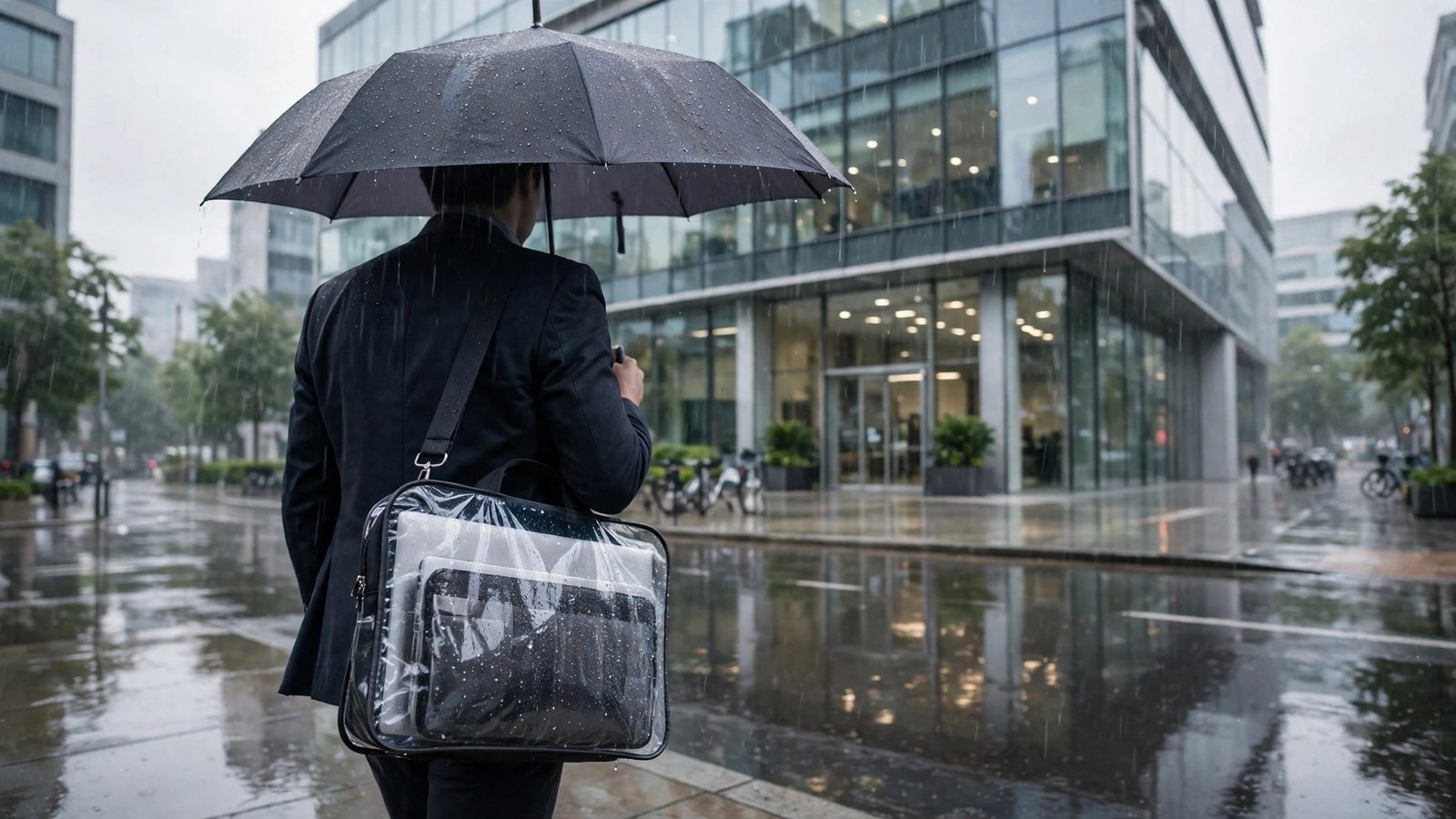
A rain cover for the laptop bag or backpack. An umbrella keeps the person dry; it does not keep the bag dry. A laptop bag slung over a shoulder gets soaked from the side, and a backpack gets soaked from the top, and the damage — a wet laptop, damp documents, a ruined notebook — is worse than wet clothes, because it cannot be fixed by drying. A fitted, waterproof rain cover with an elastic edge and a drawstring is one of the cheapest items in the kit with the highest practical value. It should fit the standard laptop bag and backpack sizes your team actually carries, not just one size, and it should fold into its own pouch so it can be carried in the bag when it is not raining. Test it with a real bag before ordering, because a cover that does not fit is worse than no cover at all.
A waterproof pouch for the phone and wallet. A phone is the item most people reach for in the rain — to book a cab, to check a map, to call the office — and it is also the item most easily ruined by it. A transparent, touch-sensitive waterproof pouch that lets the recipient use the phone without taking it out is a small, cheap item that solves a real daily problem. It should fit the large phones your team actually carries, seal properly, and come with a lanyard or a strap so it can be worn around the neck or clipped to a bag. Avoid pouches that fog up or block the touchscreen; a pouch that cannot be used is clutter.
A raincoat or poncho — chosen for the recipient, not the catalogue. A raincoat is the item that most divides recipients, because it depends entirely on how they travel. A two-wheeler commuter needs a proper raincoat with a hood and sealed seams. A person who walks from the metro needs a compact poncho that covers them and their bag and folds away small. An office worker who drives needs neither. The mistake is to include the same raincoat for everyone. The right approach is to match the rainwear to the commute: a full raincoat set for two-wheeler riders, a lightweight poncho for walkers and public-transport users, and no rainwear at all for people who travel by car — spend that money on a better umbrella instead. If the kit is being standardised for a whole office, a compact poncho is the safer choice, because it fits everyone and folds small.
Waterproof shoe covers. Wet feet are the most miserable part of a rainy commute, and they are the part most kits ignore. A pair of reusable, waterproof shoe covers — the kind that slip over office shoes and fasten with a zip or a drawstring — keeps shoes and socks dry on the walk from the station to the office, and they fold into a small pouch in the bag. They are cheap, they are used almost every rainy day, and they are the item recipients mention most often when asked what they actually used. Choose covers with a non-slip sole and a size range that covers your team; a cover that splits at the seam on the first use is worse than none.
A quick-dry towel. A small, microfibre, quick-dry towel is the item that makes the rest of the kit work in the office. It dries a wet bag, a damp seat, a phone that got splashed, and it dries itself quickly so it does not smell in the bag. It is light, it is cheap, and it is used every day of the season. A towel with the company logo, printed tone-on-tone rather than in bright colour, is also one of the few branded items in the kit that looks natural rather than promotional.
A steel bottle — the item that is not about the rain. A monsoon kit does not have to be only rain gear. A reusable steel bottle belongs in the kit for a practical reason: people drink less water in the monsoon, and a bottle on the desk is a reminder. It also gives the kit an item that is used all year, long after the rains end, which extends the kit’s life beyond the season. The steel bottles corporate gifting guide on this site covers grades, insulation and branding methods in detail — the short version for a monsoon kit is to choose a 500–750 ml bottle in 304-grade steel, with a leak-proof lid that survives being thrown into a bag, and a finish that takes engraving well. A bottle that leaks will ruin the whole kit’s reputation, so this is an item to test with a sample before ordering in bulk.
That is the core: seven items, each chosen because it will be used on almost every rainy day. A kit built on this core is already a good gift. Everything that follows is about making it better for a particular recipient or a particular kind of commute — not about adding items for the sake of a longer list.
Matching the Kit to the Recipient: Commuters, Field Teams, Night Shifts and New Joiners
A kit that is right for a field sales executive on a two-wheeler is wrong for a night-shift BPO employee who walks from the metro, and a kit built for a new joiner is wrong for a CXO. The recipient should decide the contents, not the other way around. The four groups below cover most corporate teams, and each one changes the kit in a specific way.
Commuters — the office workforce. This is the largest group, and the kit for them is the core kit, kept practical: a quality umbrella, a bag rain cover, a waterproof phone pouch, a compact poncho, shoe covers, a quick-dry towel and a steel bottle. Weight and packability matter, because the kit travels in a bag every day. A heavy kit for a daily commute is a kit that gets left at home after the first week. Keep the kit in one bag or pouch of its own, so the recipient can grab it on the way out and put it back in the evening without repacking everything.
Field sales and service teams. The gifts for field sales teams guide on this site covers lightweight, durable gifts for people who are always on the move, and a monsoon kit for a field team follows the same logic with the rain added. A field executive spends the day on the road, often on a two-wheeler, visiting clients in the rain. Their kit needs a proper raincoat set rather than a poncho, a larger and stronger umbrella, a waterproof cover for their document folder as well as their bag, and a waterproof pouch that holds a phone, a charger and a few visiting cards. The kit should also be packed in a bag that can be carried on a bike — a compact, waterproof kit bag rather than a gift box that will be left in the office. For this group, durability matters more than presentation, because the kit will be used hard every day.
Night-shift and BPO teams. The gifts for BPO employees guide on this site covers appreciation ideas for night-shift teams, and a monsoon kit for them has one specific difference: they travel when it is dark, when it is raining, and when there are fewer people around. Their kit should add a small, practical safety item — a compact torch or a reflective strip on the raincoat or the kit bag — and a hot-drink item, such as a good insulated bottle or a small flask, because a night-shift worker coming home wet and cold in the rain will use it immediately. The timing matters too: a night-shift kit should be distributed at the start of the shift, not left on a desk for the next morning, because the recipient needs it for the journey home.
New joiners — the June and July joining season. The monsoon coincides with one of the busiest joining periods of the year, when graduates and new hires start in large numbers. A monsoon kit is an excellent joining gift, because it arrives on the new joiner’s first rainy week and it says the company thought about their commute before they had to ask. The joining gifts guide on this site covers confirmation and joining gifts for interns converting to full-time roles, and the same thinking applies: a kit for a new joiner should be the core kit, with a welcome note and the practical items they need for their first month, rather than the premium version. It is also the easiest kit to standardise, because every new joiner in the season gets the same kit, which makes ordering and stocking simple.
Clients and partners. A monsoon kit for a client is a different product from the employee kit. It should be smaller, more premium and more carefully presented: a quality umbrella, a waterproof pouch and a quick-dry towel in a proper box, with a short note that mentions the season rather than the sale. The umbrella is the item that carries the brand here, because a client will use it in public, and a good umbrella with a quiet logo is seen often. Do not send a client the full employee kit — a raincoat and shoe covers are personal items, and sending them to a client feels like a utility delivery rather than a gift.
Practical Combos: Three Ready-Made Monsoon Kits
Most buyers do not want to build a kit item by item. They want a combo they can order, with a price band they can approve and a contents list they can defend. The three combos below are built on the core kit, and each one is designed for a specific audience and a specific budget. They are planning frameworks for supplier discussions, not a price list — real prices depend on the supplier, the order size, the branding method and the materials chosen. The minimum order quantity guide on this site explains how order size changes the per-unit cost in detail, and the same logic applies here: a kit ordered for 500 people costs less per unit than the same kit ordered for 25.
The everyday commuter combo (roughly ₹750–₹1,500 per kit). This is the tier for regular employees — the office workforce, the new joiners, the teams that commute by metro, bus or car. The kit is the core kit: a wind-resistant umbrella, a bag rain cover, a waterproof phone pouch, a compact poncho, shoe covers, a quick-dry towel and a steel bottle. The quality is solid and honest, the branding is simple, and the kit is built to be used, not admired. This is the tier where most organisations should start, because it delivers the best value per rupee and it is the easiest tier to standardise across a large team. If the budget is tight, the first items to cut are the poncho and the towel, and the last item to cut is the umbrella — a kit with a good umbrella and a bag cover is still a good kit, but a kit with a cheap umbrella is not.
The field and travel combo (roughly ₹1,500–₹2,500 per kit). This is the tier for field sales teams, service engineers, and anyone who spends the working day on the road. The umbrella is larger and stronger, the poncho becomes a proper raincoat set with sealed seams, the bag cover is heavier, and a waterproof document pouch and a compact torch are added. The kit is packed in a waterproof kit bag rather than a gift box, because the bag is part of the gift — it is the bag the recipient carries the kit in every day. The presentation is simpler and the contents are tougher, because this kit will be used hard, in the rain, every day of the season.
The premium and client combo (roughly ₹2,500 and above per kit). This is the tier for senior managers, frequent travellers, CXOs and key clients. The umbrella is a premium, windproof model with a wooden or leather handle. The raincoat is a quality, lightweight jacket rather than a poncho. The bottle is a better grade of steel with an engraved mark, the towel is a larger, softer microfibre, and a small leather or fabric pouch holds the phone and cards. The kit arrives in a proper rigid box, with the items arranged rather than thrown in, and a short note about the season. At this tier, personalisation matters more than quantity — initials on the umbrella handle or the pouch, a note that mentions the recipient by name, a kit that arrives before the first rain rather than after it. The premium pen sets guide on this site covers the etiquette of premium gifting in detail, and the premium monsoon kit follows the same rules: fewer items, each one better, branding kept quiet.
Whatever the tier, two budgeting rules apply. First, budget for the box and the delivery as well as the contents — a kit that arrives damaged or late costs more in reputation than it saved in packaging. Second, budget for a sample. Ordering 500 kits without seeing one first is a gamble, and the sample approval checklist exists precisely because a sample is the cheapest insurance in corporate gifting. Check the umbrella in the wind, the rain cover on a real bag, the shoe covers on real shoes, the phone pouch with a real phone, and the weight of the finished kit before approving production.
What to Leave Out: The Items That Ruin a Monsoon Kit
A monsoon kit is judged as much by what is missing as by what is included. The items below appear in many supplier catalogues, and they are the reason so many monsoon kits end up unused. Leaving them out is not a saving; it is a quality decision.
The cheapest umbrella in the catalogue. A thin umbrella with a flimsy shaft and a small canopy is not a gift; it is a disappointment that arrives in the first strong wind. It turns inside out, it breaks at the joint, and it tells the recipient that the kit was assembled to a price rather than to a standard. If the budget does not allow a decent umbrella, the kit should not include an umbrella at all — spend the money on a good rain cover and a waterproof pouch instead, and let the recipient use their own umbrella.
Thin plastic raincoats that tear. A raincoat made of thin, unsealed plastic is worse than no raincoat. It tears at the seams, it sticks to the skin, it makes the wearer sweat, and it is thrown away after one use. A raincoat in a monsoon kit must have sealed seams, a proper hood, and a fabric that breathes — or it should not be in the kit. A compact poncho made of decent material is a better choice than a cheap raincoat, because it is simpler, it covers more, and it is harder to get wrong.
Items that do not survive humidity. The monsoon is not just wet; it is humid, and humidity ruins some items faster than rain does. Paper items go limp, cheap leather goes mouldy, electronics in unsealed packaging corrode, and anything with a strong scent becomes unpleasant in a damp office. Every item in the kit should be chosen for a humid season, not just for a rainy day. The desk plants and green gifts guide on this site covers the care reality of gifts that live in an office through the seasons, and the same thinking applies here: a monsoon kit should be built for the season it will live in.
Food that does not travel in the rain. Snacks can work in a kit, but only if they survive a wet commute and a humid office. Chocolate melts, anything crumbly makes a mess, and anything in paper packaging goes soft. If food is included, choose sealed, dry, robust items — nuts, a granola bar, a small pack of dry fruit — and keep them in a sealed pouch, separate from the rest of the kit. The Christmas hampers versus gift boxes guide on this site covers hamper and box choices for bulk orders, and the same principle applies here: food in a monsoon kit must survive the journey and the humidity.
Anything the recipient already owns three of. Most people already have an umbrella, and many already have a raincoat. The kit’s job is not to duplicate those items, but to replace the worst one with a better one, or to add the item they do not have — the bag cover, the phone pouch, the shoe covers. Before finalising the contents, ask a few employees what they actually carry in the rain and what they wish they had. That conversation is worth more than any catalogue, and it is the fastest way to avoid the “another one of these” reaction.
A kit with no bag of its own. A monsoon kit that arrives as a loose collection of items in a cardboard box is a kit that will be unpacked, scattered and partly lost. The kit needs its own bag or pouch — a waterproof kit bag, a drawstring pouch, a compact organiser — so the recipient can grab the whole kit on the way out and put it back in the evening. The bag is not packaging; it is part of the gift, and it is the item that keeps the kit together for the whole season.
Branding a Monsoon Kit Without Ruining It
Branding is where most monsoon kits go wrong, because the temptation is to put the logo everywhere. A monsoon kit is a practical item — it is carried through the rain, used in public, and seen by colleagues and clients. A logo that is too loud turns a useful gift into an advertisement the recipient did not agree to carry. The branding rules below keep the brand visible without making it intrusive.
Choose the right items to brand. The umbrella, the kit bag, the bottle and the towel are the natural branding surfaces. They are the items the recipient uses in public, and a subtle mark on them is seen often. The rain cover, the phone pouch and the shoe covers are poor branding surfaces — they are either hidden or too small, and a logo on them adds nothing.
Choose the right method. A tone-on-tone print on an umbrella canopy, an engraved mark on a bottle, a debossed logo on a leather pouch — these look premium. A large, bright screen print on an umbrella looks like merchandise. The engraving versus printing versus embossing comparison in this programme covers the methods in detail, and the short version for a monsoon kit is to match the method to the material: print fabric quietly, engrave metal, and keep the logo small.
Keep it small and in one place. One logo on the umbrella, one on the kit bag, one on the bottle — that is enough. A logo on every item in the kit is not branding; it is clutter, and it makes the kit feel like a promotional giveaway rather than a gift. The branded versus unbranded comparison in this programme makes the same point: a logo helps when it signals quality, and it hurts when it signals advertising. A monsoon kit should signal quality.
Use the logo file properly. A logo that is supplied as a low-resolution image will print badly on an umbrella canopy, whatever the method. The logo file formats guide on this site explains what a vendor actually needs — a vector file for printing and engraving, a high-resolution file for anything else — and the rule applies directly to monsoon kits: supply the right file, approve the proof, and check the sample before production. A blurred logo on an umbrella is worse than no logo at all, because the umbrella is the most visible item in the kit.

Ordering, Packing and Delivery: Getting the Kit There Before the Rain
A monsoon kit is a time-sensitive gift in a way most corporate gifts are not. A hamper that arrives a week late is still a hamper. A monsoon kit that arrives after the first heavy rain is a box of items the recipient has already bought for themselves, and it is a visible failure of planning. The ordering and delivery process deserves as much attention as the contents.
Start with the monsoon calendar, not the catalogue. The first question is not what goes in the kit, but when the rains arrive where your people are. The India Meteorological Department publishes the monsoon onset and progress, and the season generally runs from June to September across most of the country, with regional variation — earlier in Kerala and the south, later in the north, and with the heaviest rain in different months in different cities. Plan the kit around the onset date for your largest office location, and build in a buffer for production delays. A kit that is ordered in April, produced in May and delivered in the last week of May arrives before the rain, and that is the whole point.
Order the sample first. The sample approval checklist on this site lists the checks to run before production — and for a monsoon kit, the sample checks are physical, not visual. Open the umbrella in the wind. Put the rain cover on a real bag and pour water on it. Put a phone in the pouch and use the touchscreen. Wear the shoe covers and walk in them. Carry the finished kit and check the weight. A sample is the cheapest insurance in corporate gifting, and a monsoon kit is exactly the kind of gift that needs it, because its failures are only discovered in use.
Pack for the commute, not the photograph. A kit should arrive in a box that protects it, but it should also be packed in a way that the recipient can transfer it to their bag without repacking everything. Items in their own pouches, the umbrella in its sleeve, the shoe covers in their bag, the kit in a waterproof kit bag of its own — the kit should be usable the moment it is opened. The address collection guide on this site covers the process of collecting employee addresses for gift delivery, and the same care applies here: confirm the delivery address and the date with the recipient, not just with their manager, because the recipient is the one who needs the kit before the rain.
Plan for delivery to homes, not just the office. Many teams now work hybrid, and a monsoon kit that is delivered to the office on a day the recipient works from home is a kit that sits on a desk while the recipient gets wet at home. For hybrid teams, deliver the kit to the home address, or hold a distribution day when the whole team is in the office. The lead-time guide on this site explains how far in advance corporate gifts should be ordered, and monsoon kits follow the same logic with one addition: the delivery must reach the person before the season, not just the building. The corporate gift order playbook on this site covers what to do when an order goes wrong — damage, delay and wrong branding — and the best use of that playbook is to avoid needing it, by ordering early and checking the sample.
Common Mistakes That Ruin Monsoon Kits
Most monsoon kit failures are not failures of budget. They are failures of judgement, and they are easy to avoid once they are named.
Ordering in July. A monsoon kit ordered when the rains have already started is a kit that arrives when the need has passed. The season’s first heavy rain is the deadline, not the start of the ordering window. Order in April, deliver in late May, and the kit is a gift. Order in July, and it is an apology.
Buying a kit, not building one. A ready-made kit from a catalogue is convenient, but it is built for nobody in particular. It contains items the supplier wants to sell, not items your team needs. Building the kit — choosing each item against the recipient and the commute — takes more time, but it is the difference between a kit that is used and a kit that is stored. The pre-curated gift sets guide on this site covers the difference between ready-made sets and custom kits, and the same thinking applies: a pre-curated set is a starting point, not a finished answer. A monsoon kit should be built, not bought off the shelf.
Ignoring the commute. A kit for a two-wheeler rider is not a kit for a metro commuter. A kit for a field team is not a kit for a night shift. Ordering one kit for everyone is the fastest way to make the kit feel impersonal. Ask people how they travel, check the trip type, and match the kit to the person — or at least to the group they belong to.
Over-branding. A logo on every item, a bright print on the umbrella, a tagline on the box — the kit becomes an advertisement, and the recipient leaves it at home. Keep the branding quiet, small and on the right items, and the kit will travel.
Skipping the sample. A sample is the cheapest insurance in corporate gifting, and skipping it is the most expensive mistake. An umbrella that turns inside out, a rain cover that does not fit, a phone pouch that blocks the touchscreen — all of these are discovered in a sample, and all of them are expensive to discover in a bulk order. The sample approval checklist exists for this reason, and a monsoon kit is exactly the kind of gift that needs it.
Forgetting the delivery. A kit that arrives after the first rain is a failure, however good its contents. Plan the delivery around the monsoon onset, confirm the address with the recipient, and build in a buffer for production delays.
How to Tell Whether Your Monsoon Kits Are Working
A monsoon kit programme is easy to measure, because the evidence is visible. After the first month of the season, ask employees whether they used the kit, what they used most, what they did not use, and what they wish had been in it. That conversation, held while the season is still running, is worth more than any survey, and it tells you exactly what to change in the next order.
Watch for the signs of a kit that works: the umbrella by the office door every morning, the bag cover on the laptop bag, the shoe covers in the drawer by the entrance, the bottle on the desk. Watch for the signs of a kit that does not: the kit still sealed in its box a month into the season, the umbrella left behind because it broke, the raincoat never worn because it tears. The difference between the two is rarely the budget. It is the choosing — the contents, the quality, the branding and the delivery — and that is entirely within the buyer’s control.
Frequently Asked Questions
What should be included in a corporate monsoon kit for employees?
The core kit is a quality wind-resistant umbrella, a rain cover for the laptop bag or backpack, a waterproof pouch for the phone and wallet, a compact poncho or raincoat, waterproof shoe covers, a quick-dry towel, and a reusable steel bottle. Those seven items cover almost every rainy commute. Everything else — a raincoat set for two-wheeler riders, a torch for night-shift staff, premium upgrades for clients — is matched to the recipient and the commute.
How much does a corporate monsoon kit cost in India?
As a planning band, an everyday commuter kit runs roughly ₹750–₹1,500, a field and travel kit roughly ₹1,500–₹2,500, and a premium or client kit roughly ₹2,500 and above. These are budgeting bands for supplier discussions, not a price list — real prices depend on the supplier, order size, branding method and materials. Always confirm the final per-unit cost, including the box and delivery, with your supplier.
When should we order monsoon kits for employees?
Order in April and deliver in late May, before the monsoon onset in your largest office location. The season generally runs from June to September across India, with regional variation — earlier in the south, later in the north. A kit ordered in July arrives when employees have already bought their own rain gear, so the ordering deadline is the first heavy rain, not the middle of the season.
Is an umbrella a good corporate gift?
Yes — if it is a good umbrella. A wind-resistant, double-canopy umbrella with a sturdy shaft is one of the most-used items in a monsoon kit, and it is seen in public every rainy day. A cheap umbrella that turns inside out in the first strong wind is worse than no umbrella at all, because it tells the recipient the kit was assembled to a price. Order a sample and test it in the wind before approving a bulk order.
What should not go in a corporate monsoon kit?
The cheapest umbrella in the catalogue, thin plastic raincoats that tear at the seams, items that do not survive humidity, food that melts or goes soft in a wet commute, and anything the recipient already owns three of. Every item should be chosen for a humid season, not just for a rainy day, and the kit needs its own waterproof bag so the items stay together.
Are monsoon kits a good gift for clients?
Yes, as a smaller, more premium version: a quality umbrella, a waterproof pouch and a quick-dry towel in a proper box, with a short note about the season. Do not send a client the full employee kit — a raincoat and shoe covers are personal items, and sending them to a client feels like a utility delivery rather than a gift.
How do we deliver monsoon kits to a hybrid team?
Deliver to home addresses, or hold a distribution day when the whole team is in the office. A kit delivered to the office on a day the recipient works from home sits on a desk while the recipient gets wet at home. Confirm the delivery address and date with the recipient, not just with their manager, and build in a buffer for production delays.
A monsoon kit is one of the most useful seasonal gifts a company can give, because it is used on the very days it is needed, and it keeps being used for the whole season. Built well, it is a small piece of planning that says the company thought about the journey to work, not just the gift. Built badly, it is a box of items that gets left behind. The framework in this guide — the core kit, the recipient matching, the three combos, the budget tiers, the branding rules and the delivery plan — is the difference between the two, and it is the framework to use before the next monsoon is ordered.
The new year welcome-back gifts guide on this site shows how a seasonal kit works as a joining and return-to-office gift, and a monsoon kit follows the same logic: the right items, for the right people, delivered before the moment they are needed. Order it in April, deliver it in May, and your team will walk into the monsoon prepared — and they will remember who prepared them.
If your team commutes, travels for work, or works night shifts through the Indian monsoon, a monsoon kit is one of the few seasonal gifts that gets used on the very next rainy day — and on every rainy day after it. Start with the core kit in this guide, match the upgrades to the recipient and the commute, order a sample before the bulk run, and get the kit to people before the first heavy rain. Arrow Gifter can help you build a monsoon kit around your team, your commutes and your budget — talk to us about the people you have in mind, and we will put together a kit that actually keeps them dry.
1 Comment