
Custom Company Diaries and Planners 2027: Paper, Binding and Branding Options Explained
Custom Company Diaries and Planners 2027: Paper, Binding and Branding Options Explained
A diary is the most honest corporate gift a company can give. It is used every working day, it sits open on a desk in front of colleagues and clients, and its quality is judged in the first week — not by a marketing claim, but by whether the ink bleeds through, whether the pages lie flat, and whether the cover still looks respectable in March.
That is why the specification matters more than the catalogue photograph. Two diaries can look identical in a vendor’s PDF and behave completely differently in a recipient’s hands: one has paper that takes a fountain pen without ghosting, the other bleeds through with a ballpoint. One opens flat and stays open; the other springs shut every time the reader lets go. One carries a debossed logo that still looks understated and premium a year later; the other carries a foil stamp that has already started flaking.
This guide is the specification companion to our general overview of New Year desk calendars and diaries for 2027. That guide helps you choose formats and plan the order. This one goes deep on the three decisions that determine whether the diary is actually good: paper, binding and branding. It is written for HR, admin, marketing and procurement teams in India who need to brief a vendor precisely, judge a physical sample properly, and avoid the mistakes that turn a premium gift into desk clutter.
Paper First: Why GSM Decides Whether the Diary Gets Used
Paper is the part of a diary the recipient touches most and the part buyers check least. A vendor will happily discuss cover materials and foil colours for an hour; paper weight is usually a single line in the quotation, and it is the line that decides the diary’s fate.
GSM is the number to ask for. GSM stands for grams per square metre — the weight of the paper. Higher GSM generally means thicker, more opaque paper that resists show-through and feels more substantial. For corporate diaries in India, the useful range is:
| Paper weight | What it feels like | Best for |
|---|---|---|
| 70 GSM | Standard notebook paper; fine for pencil and ballpoint, some show-through with gel pens | Value-band diaries, large all-employee runs where cost matters most |
| 80 GSM | The workhorse: noticeably better opacity, handles most pens well | Mid-band diaries and weekly planners — the sensible default for most companies |
| 90–100 GSM | Premium feel; minimal ghosting even with fountain pens and markers | Premium and CXO diaries, daily planners, gifts where the writing experience is part of the point |
| 100+ GSM | Thick, almost card-like; luxurious but adds weight and cost | Executive daily planners in small quantities; rarely justified for all-employee runs |
The practical rule is simple: if the diary is a premium gift, the paper should be at least 80 GSM, and 90 GSM if recipients are likely to use fountain pens or gel pens. If the budget only allows 70 GSM, say so openly and manage expectations — it is a perfectly usable diary, but it is not a premium one, and the branding should not promise otherwise.
Bleed-through is the test that matters. Ask the vendor for a paper sample and test it with the pens your recipients actually use — a standard ballpoint, a gel pen and, if your senior team uses them, a fountain pen. Write on one side, then look at the reverse. Light “ghosting” (a faint shadow) is normal at 70–80 GSM; visible ink bleeding through to the other side is not acceptable at any tier, because it makes half the diary unusable. Do this test before approving the order, not after the bulk delivery arrives.
Paper colour and ruling deserve a decision, not a default. Cream or off-white paper is easier on the eyes for long writing sessions and reads as more premium than stark white; white paper reproduces printed layouts and coloured inks more crisply. Ruled pages suit daily planners and note-taking; plain pages suit executives who sketch, mind-map or write freely; dotted or grid pages suit a small minority and are best offered as an option rather than imposed on everyone. If the diary includes printed content — company information pages, a holiday list, goal-setting pages — check that the print is crisp and the holiday list is correct for the states where your recipients are based. A wrong holiday date is the single most common complaint about corporate diaries, and it is entirely preventable.
Ask about the paper’s origin only in general terms. Vendors may describe paper as “Indian mill” or “imported”; what matters is the sample in your hand, not the label. Judge the paper by writing on it, not by the description in the quotation.

Binding: The Decision That Decides How the Diary Behaves
Binding is the least glamorous specification and the one recipients notice fastest. A diary that will not lie flat is a diary that gets closed and forgotten. Binding also decides durability: a diary is opened and closed hundreds of times a year, and a weak binding fails in February.
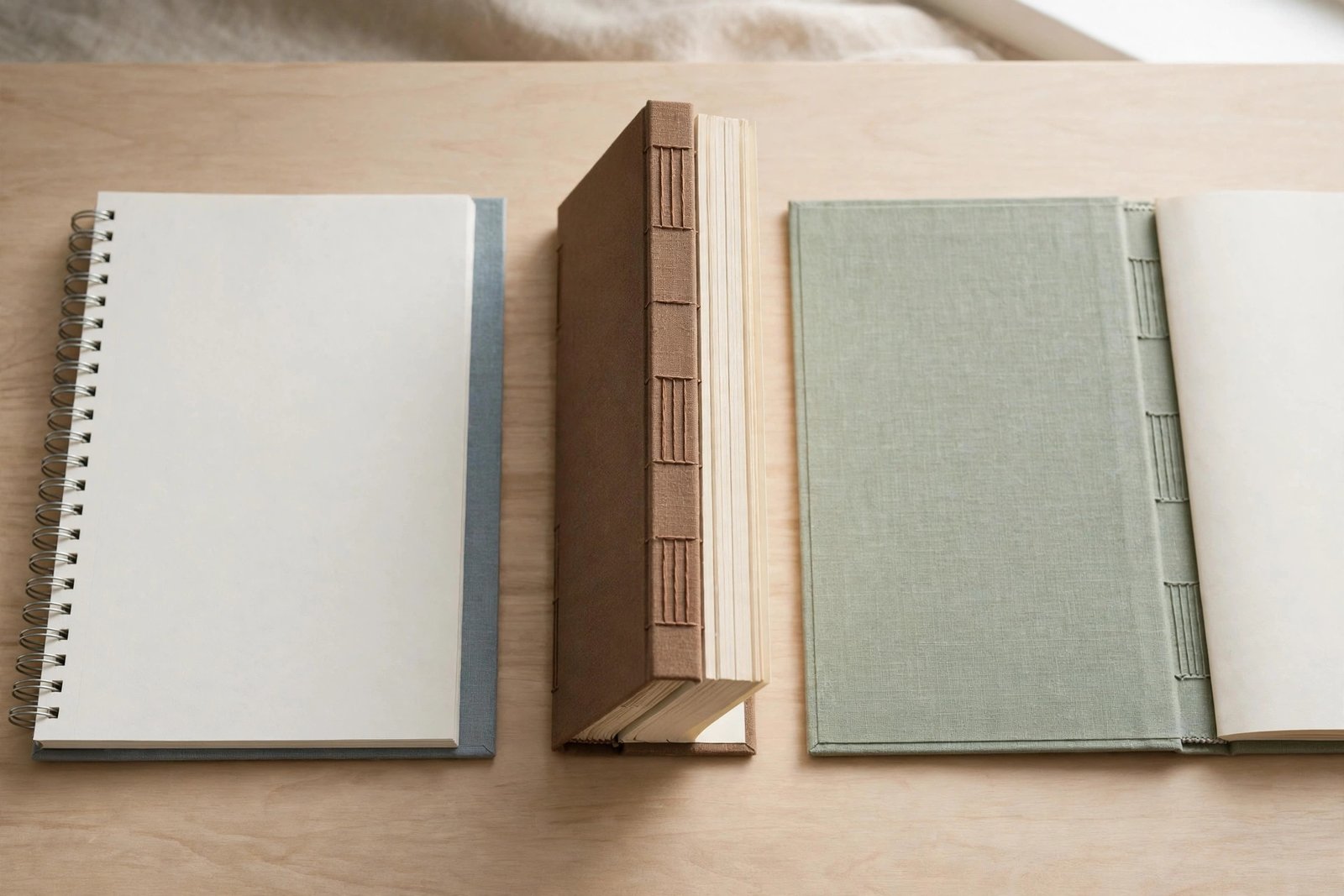
Thread-sewn (Smyth-sewn) binding is the premium standard. Signatures of pages are stitched together with thread, then glued into the cover. The result opens flat — genuinely flat, at 180 degrees — and stays open. It is the most durable binding available and the right choice for daily planners and premium executive diaries. Its trade-offs are cost and production time: it is the most expensive binding and it takes longer, so it belongs in the premium tier and needs to be ordered early.
Section-sewn binding is a close relative: pages are sewn in sections and the book still opens well, at a slightly lower cost than full thread-sewing. It is a strong choice for mid-band weekly planners where lay-flat behaviour matters but the budget does not stretch to Smyth-sewn.
Wiro (wire-o) binding uses a metal wire coil through punched holes. It lies perfectly flat, turns pages a full 360 degrees, and is the most practical binding for planners that are written in while standing or in meetings. It is also the most visibly functional — the wire is part of the look — so it suits modern, practical planners better than formal executive diaries. Check the wire quality: a thin or poorly closed wire snags, bends and eventually pulls out. Ask the vendor to show you a sample that has been opened and closed repeatedly.
Spiral (plastic coil) binding is the lower-cost cousin of wiro. It works, it lies flat, and it is fine for value-band planners and desk calendars. It looks less premium than wiro and the plastic coil is more likely to deform in a bag, so reserve it for large runs where cost is the deciding factor.
Perfect binding (pages glued at the spine, like a paperback book) is the weakest choice for a diary that will be used daily. It looks clean and it is cheap, but the spine cracks with repeated opening, pages loosen, and the book will not lie flat. It is acceptable for a slim monthly diary or a notebook-style giveaway; it is the wrong binding for a daily planner that must survive a full year. If a vendor proposes perfect binding for a 365-page daily diary, that is a reason to ask questions, not to approve.
| Binding | Lies flat? | Durability | Look | Best for |
|---|---|---|---|---|
| Thread-sewn (Smyth) | Yes, fully | Highest | Premium, classic | Executive daily planners, CXO tier |
| Section-sewn | Yes, nearly | High | Premium | Mid-band weekly planners |
| Wiro (wire-o) | Yes, 360° | High | Modern, practical | Planners used in meetings, field teams |
| Spiral (plastic coil) | Yes | Medium | Functional | Value-band planners, large runs |
| Perfect (glued) | No | Lowest | Clean, book-like | Slim monthly diaries only — avoid for daily planners |
One more check that costs nothing: open the sample diary to the middle and to the first and last pages, and let go. A well-bound diary stays open; a poorly bound one springs shut. Then close it and check whether the pages sit evenly — uneven page edges are a sign of poor trimming and a diary that will look tired within weeks.
Planner Layouts: Dated, Undated, Daily, Weekly
The layout decides whether the diary matches how the recipient actually plans their work — and this is where a generic “one diary for everyone” order most often goes wrong.
Daily planners give one page per day. They suit CXOs, senior managers and anyone whose diary is genuinely full. They are thick, heavy and expensive, which is why they belong in the senior and key-client tier rather than the all-employee run. Before ordering daily planners for everyone, ask whether most recipients would actually fill a page a day; for many employees, a daily planner is mostly blank pages, and blank pages feel wasteful.
Weekly planners give a week at a glance and are the most versatile corporate format. They suit managers, team leads and client gifts where you want something substantial without the bulk of a daily planner. For most companies, the weekly planner is the right default for the mid band.
Monthly and executive diaries combine a monthly overview with notes pages. They are a good middle tier: more useful than a pocket diary, less bulky than a daily planner, and easy to brand.
Dated vs undated is a decision with real consequences. Dated diaries feel complete and premium, but they expire: a dated 2027 diary ordered late and delivered in February has already lost a month of value, and any unsold stock is worthless after December. Undated planners never expire and can be ordered any time of year, which makes them a safer choice for late orders, joining kits and year-round gifting — but they feel less like a “2027 diary” and more like a notebook. For the New Year moment, dated is usually right; for welcome kits and ongoing gifting, undated is the smarter stock to hold.
What else goes inside matters too. Useful additions include a year-at-a-glance page, a holiday list verified for your recipients’ states, a few notes pages at the back, and — for senior tiers — goal-setting or meeting-notes pages. Resist the temptation to fill the diary with printed company content: pages of product information or brand messaging inside a diary are the fastest way to make a gift feel like a brochure. One tasteful inside-cover message is enough.
Covers and Materials: Where Perceived Value Is Made
The cover is what the recipient sees first and what colleagues see on the desk. It does more for perceived value than any other single choice — and it is where the cheapest-looking mistakes happen.
PU leather (faux leather) is the standard for corporate diaries in India: it looks and feels close to leather, it takes foil and debossing well, it is durable, and it is far more affordable than genuine leather. It is the right choice for most tiers. Check the sample for a consistent grain and a finish that does not look plasticky in bright light.
Genuine leather is the premium option and should be reserved for CXO, board and top-client tiers, where the quantity is small and the difference is genuinely felt. It costs several times more than PU, and the difference is only worth it when the recipient will notice — senior leaders usually will, and the diary is a daily object, so the investment is visible every day.
Hardbound (cloth or printed board) suits diaries with a designed cover — a company illustration, a pattern, or a full-colour print. It reads as editorial and considered rather than executive. It is a good choice when the design is the message, for example a calendar-diary set with a matching visual identity.
Soft cover is lighter and cheaper and suits pocket diaries, field-team planners and large runs where weight and shipping cost matter. It is the least premium-looking option, so do not dress it up with expensive branding — the mismatch between a soft cover and a gold foil logo is visible.
Colour choice is a branding decision. Dark covers (navy, charcoal, deep green, burgundy) carry foil and debossing best and look premium on any desk. Light covers show dirt and wear faster and suit screen or UV printing better than foil. Brand colours can work as a cover colour, but a diary that is entirely brand-coloured can look like merchandise; a dark cover with the brand colour used as an accent — a ribbon marker, a page edge, a belly band — usually looks more considered.
Small details carry disproportionate weight: a ribbon marker in the brand colour, an elastic closure, a pen loop, a back pocket for loose papers. None of these is expensive, and all of them signal that someone thought about how the diary will actually be used. Ask the vendor to include at least one of them in the mid and premium tiers.
Branding Options Explained: Foil, Deboss, Print — and When Each Wins
Our overview guide compares branding methods at a glance; here is the detail that decides which method to choose for your cover material, your tier and your artwork.
Foil stamping applies metallic foil — usually gold, silver or copper — with heat and pressure. It is the classic premium diary finish: restrained, elegant and instantly read as premium. It works best on dark PU or leather covers with a simple logo, initials or a short line of text. Its limits are real: it is not the method for full-colour artwork, large photographic areas or very fine detail, and a cheap foil on a cheap cover flakes. If you choose foil, approve the foil shade on the actual cover material — gold on navy looks different from gold on black, and the screen will not tell you.
Debossing and embossing press the design into the cover without colour (debossed, pressed in) or raised from it (embossed). Debossing is the quietest, most executive finish available — a logo you feel rather than see. It suits leather-look and PU covers and is the right choice for CXO and board-level gifts where understatement is the point. It needs a clean, simple logo: intricate detail does not survive the press. Embossing is bolder and suits patterns and larger marks. Both methods add a one-time die cost, which is why they are more economical at larger quantities.
UV printing cures ink with ultraviolet light and produces a slightly raised, glossy finish. It reproduces full-colour artwork, photographs and gradients that other methods cannot, and it suits calendar leaves, sleeves and belly bands where the design is the star. On diary covers, reserve UV for designs that genuinely need colour; for a simple logo, foil or debossing usually looks more premium.
Screen printing is the standard method for flat, light-coloured surfaces and for calendars. It reproduces logos and brand colours accurately and is cost-effective at volume. Its limit is fine detail: very small text and intricate logos lose sharpness, and the ink sits on the surface rather than in it, so it can wear on a diary that is handled daily.
Digital printing handles full-colour, variable data — including individual names — without a plate or die. It is the most flexible method for personalisation and for short runs, and it is the method to choose when every diary carries a different name. Its finish is flatter than foil or deboss and it can look less premium on a dark cover, so pair it with a good cover and restrained artwork.
Laser engraving applies to metal accessories rather than the diary itself — a metal pen, a metal bookmark, a metal plate on the cover. It is precise, permanent and understated, and it is an excellent way to personalise a premium set without touching the diary cover at all.
Sleeves and belly bands wrap the product in a branded band or sleeve instead of branding the product itself. They are the fastest route to a branded look, they work when the product is already made, and they are easy to change if the artwork is late. Their weakness is that the band is discarded — so the lasting brand impression is weaker than a debossed cover. Use sleeves when speed matters more than permanence, or as a complement to a branded cover, not as a substitute for it.
The decision rule, in one line: choose the method for the cover material and the tier, not for the catalogue. A foil-stamped logo on a good diary beats a full-colour printed logo on a poor one, every time. And always approve a physical branded sample — colour, foil shade and deboss depth all shift between screen and reality, and the sample is the only place you can see it.
For the practical side of supplying artwork, the file-format discipline in our guide to logo file formats for gift branding applies directly: a vector logo file is what foil and deboss dies are made from, and a low-resolution image is the most common reason a branding sample comes back wrong.
What to Ask Your Vendor Before You Approve
A good vendor welcomes specific questions; a vague quotation is a warning sign. Before approving a diary order, get written answers to these:
- What is the exact paper GSM and type? Not “premium paper” — the number, and a sample you can write on.
- What binding is quoted, and what would the next binding up cost? The difference between perfect binding and section-sewn is often smaller than the difference in how the diary behaves.
- What is the MOQ per format and per branding method? Minimums vary by product and by method — a deboss die may need a higher quantity to be economical. Our guide to minimum order quantities for corporate gifts in India explains how MOQ shapes the whole order.
- Is the holiday list verified, and for which states? Confirm it in writing. Do not assume a generic list covers your recipients.
- What personalisation data do you need, and by when? Name lists must be frozen and checked; a single misspelt name on a debossed diary is a wasted unit.
- Can I see a physical branded sample of the exact specification? Not a catalogue photograph, not a similar diary — the exact paper, binding, cover and branding. Use the discipline in our sample approval checklist for bulk corporate gifts before committing: check quality, personalisation, packaging and delivery, not just the photograph.
- What is the production time after artwork approval, and what is the dispatch date in writing? Diaries have a hard deadline — they are useless if they arrive after the year starts. Our guide to how early to order corporate gifts explains how to work backwards from the delivery date.
- What is the buffer quantity and the replacement policy for damaged or misprinted units? Order a small buffer — typically 3–5% — because a diary with a misspelt name or a damaged cover cannot be given, and reprinting a handful of units is rarely economical.
Budget Bands: What the Specification Costs
Exact prices depend on format, quantity, paper, cover and branding method, so any article quoting a single “market price” for a custom diary should be treated with caution. What is genuinely useful is planning in bands, then getting a vendor quote for your exact specification.
- Value band (large all-employee runs): 70 GSM paper, spiral or perfect binding for slim formats, soft or basic hardbound cover, screen print or sleeve branding. The goal is a clean, well-made item at a per-unit cost that survives a large headcount.
- Mid band (managers, key teams, regular clients): 80 GSM paper, section-sewn or wiro binding, PU leather cover, foil stamping or debossing, a ribbon marker and a pen loop. This is the band where the diary starts to feel like a gift rather than a handout.
- Premium band (CXOs, board members, top clients): 90–100 GSM paper, thread-sewn binding, PU or genuine leather cover, debossing with individual names, premium packaging. The unit cost is higher, but the quantity is small, so the total stays manageable.
The mistake to avoid is averaging: buying one mid-range diary for everyone often means it is too plain for senior recipients and unnecessarily expensive for a thousand-person run. Tier the same product family across bands — the diary that goes to a CXO and the diary that goes to a new joiner can share a design language while differing in paper, binding and branding. That is how you control cost without making anyone feel like an afterthought.
For the premium tier specifically, the etiquette and expectations in our guide to gifts for investors, board members and advisors are a useful cross-check: senior recipients judge a gift by its restraint and quality, and a diary is one of the few gifts where both are visible every day.
Common Mistakes That Waste a Diary Order
Mistake 1 — Approving from a photograph. Paper weight, binding quality, foil shade and deboss depth cannot be judged from a screen. A physical sample of the exact specification is not optional; it is the order.
Mistake 2 — Choosing the binding on price alone. Perfect binding on a daily planner is the most common specification error in corporate diary orders. The diary looks fine on delivery day and falls apart by March. Spend the difference on binding before spending it on packaging.
Mistake 3 — Ignoring the holiday list. A diary that misses a major regional holiday, or marks the wrong date, will be noticed by exactly the people you most wanted to impress. Verify the list against the states where your recipients are based, in writing, before artwork is approved.
Mistake 4 — Branding every page. A logo on the cover is branding. A logo on every page is advertising, and it makes a premium gift feel like merchandise. One clear placement on the cover, a discreet mark on the inside cover if you must — and leave the pages clean.
Mistake 5 — Promising personalisation the data cannot support. Individual names on diaries are a powerful touch, but only if the name list is frozen, checked and submitted on time. A misspelt name is worse than no name at all. If the list cannot be frozen, use a belly band with the name instead — it can be reprinted cheaply.
Mistake 6 — Ordering the same diary for everyone. A daily planner for a field team, a soft-cover diary for a CXO, a dated diary delivered in February — all three are the same error: the specification was chosen for the order, not for the recipient. Tier by recipient, and let the specification follow.
Mistake 7 — Forgetting the buffer. Diaries are personalised, dated and produced in one run. A 3–5% buffer for damage, misprints and late joiners is not waste; it is the difference between a complete delivery and an awkward apology.
Choosing by Recipient and Company Size
Small teams (10–50 employees). Keep it simple: one weekly planner in the mid band for everyone, with individual names debossed or foil-stamped. The quantity is small enough that the premium specification is affordable, and the personalisation makes a small team feel genuinely considered. For low-MOQ sourcing realities, see our guide to corporate gifts for startups.
Mid-size companies (50–500 employees). Tier in two or three bands: a value-band diary for the wider team, a mid-band weekly planner for managers and key clients, and a premium daily planner for senior leadership. Centralise the specification — one paper, one binding per tier, one branding method per tier — so the order is manageable and the quality is consistent. For how gifting logistics change with headcount, see our comparison of corporate gifting for 50 employees vs 5,000.
Large companies (500+ employees). The specification becomes a system: standardised tiers, a single vendor or a small panel, a frozen name list with a clear cut-off, and multi-city dispatch planned from the start. At this scale the diary order is also a data exercise — addresses, names and state-wise holiday lists — so build the data step into the timeline rather than discovering it in November.
Clients vs employees. The same diary specification reads differently in each relationship. For employees, the diary is a working tool — paper quality and layout matter most. For clients, it is a brand impression — cover, branding and packaging matter most, and the diary should feel like a considered gift rather than a branded handout. Our guide to Christmas gifts for clients in India covers the client-gifting judgement in full; the diary specification should follow the same instinct. For the year-end moment that diaries usually accompany, see our guide to year-end gifts for top-performing employees.
Frequently Asked Questions
1. What paper GSM is best for corporate diaries?
80 GSM is the sensible default for most corporate diaries — it handles ballpoint and gel pens well with only light ghosting. Choose 90–100 GSM for premium and CXO diaries, especially if recipients use fountain pens. 70 GSM is usable for large value-band runs but will show through with gel pens. Whatever the GSM, test a physical paper sample with the pens your recipients actually use before approving the order.
2. Which diary binding is best for corporate gifting?
Thread-sewn (Smyth-sewn) binding is the premium standard — it lies fully flat and is the most durable. Section-sewn is a strong mid-band alternative. Wiro binding lies flat and turns 360 degrees, making it the most practical choice for planners used in meetings. Avoid perfect (glued) binding for daily planners: the spine cracks with repeated opening and the book will not lie flat.
3. Should we order dated or undated diaries for 2027?
Dated diaries feel complete and premium and are right for the New Year moment, but they expire — a dated 2027 diary delivered in February has already lost a month of value. Undated planners never expire and suit late orders, joining kits and year-round gifting, but feel less like a “2027 diary”. For the New Year gift, dated is usually right; for ongoing gifting, hold undated stock.
4. Is foil stamping or debossing better for a diary cover?
Both are premium finishes and the choice depends on the tier and the artwork. Foil stamping (usually gold or silver) is the classic premium look and works best on dark covers with a simple logo. Debossing — the logo pressed into the cover without colour — is the quietest, most executive finish and suits CXO and board-level gifts where understatement is the point. Both need a clean, simple logo; intricate detail does not survive either process.
5. How much do custom diaries cost for companies in India?
There is no single market price — cost depends on format, quantity, paper GSM, cover material, binding and branding method. Plan in bands rather than a single figure: a value-band diary for large all-employee runs, a mid-band weekly planner with 80 GSM paper and foil or debossed branding for managers and clients, and a premium daily planner with 90+ GSM paper and thread-sewn binding for CXOs and top clients. Get a vendor quote for your exact specification.
6. What should we check in a diary sample before a bulk order?
Check six things: write on the paper with a ballpoint, a gel pen and a fountain pen and look for bleed-through; open the diary flat at the middle and at the first and last pages and see whether it stays open; check the foil shade and deboss depth on the actual cover material; verify the holiday list against the states where your recipients are based; confirm the logo artwork is sharp at the size it will be produced; and check the ribbon marker, pen loop and packaging. Never approve a bulk diary order from a catalogue photograph.
7. When should we order custom diaries for January delivery?
Work backwards from a delivery target of mid-to-late December. Shortlist formats and approve budgets by September to early October, approve physical samples and artwork in October, confirm the final order and freeze personalisation name lists in early to mid-November, and allow November to early December for production, branding and dispatch. If you are starting late, change the product — ready formats with sleeve branding — rather than the deadline.
Conclusion
A custom diary is not a complicated gift, but it is an unforgiving one. Its quality is tested daily, in public, by the person using it — and the three specifications that decide the verdict are paper, binding and branding.
Choose paper by writing on it: 80 GSM as the sensible default, 90 GSM or above for premium tiers, and a bleed-through test with the pens your recipients actually use. Choose binding by how the diary must behave: thread-sewn or section-sewn for executive diaries that must lie flat and last the year, wiro for practical planners, and perfect binding only for slim formats that will not be opened daily. Choose branding for the cover material and the tier: foil and debossing for premium restraint, digital print for personalisation, sleeves for speed — and approve a physical branded sample before the bulk order, every time.
Get those three decisions right, tier them honestly by recipient, and verify the holiday list in writing, and the diary will do what it is meant to do: sit open on a desk, used every working morning, carrying your company’s name without shouting — for the whole of 2027.
If your 2027 diary order is currently a single line in a quotation — “premium diary, custom branding” — the specification in this guide is the fix. Ask your vendor for the paper GSM, the binding type and the branding method in writing, test a physical branded sample, and verify the holiday list before you approve.
Arrow Gifter works with HR, admin and procurement teams across India to supply custom diaries and planners within honest budget bands — from value-band weekly planners for large teams to thread-sewn, debossed daily planners for CXOs and key clients — with samples approved before you commit and delivery planned around your January deadline. Share your headcount, your tiers and your delivery date, and we will help you specify a diary your recipients will still be using in December 2027.
Leave a comment