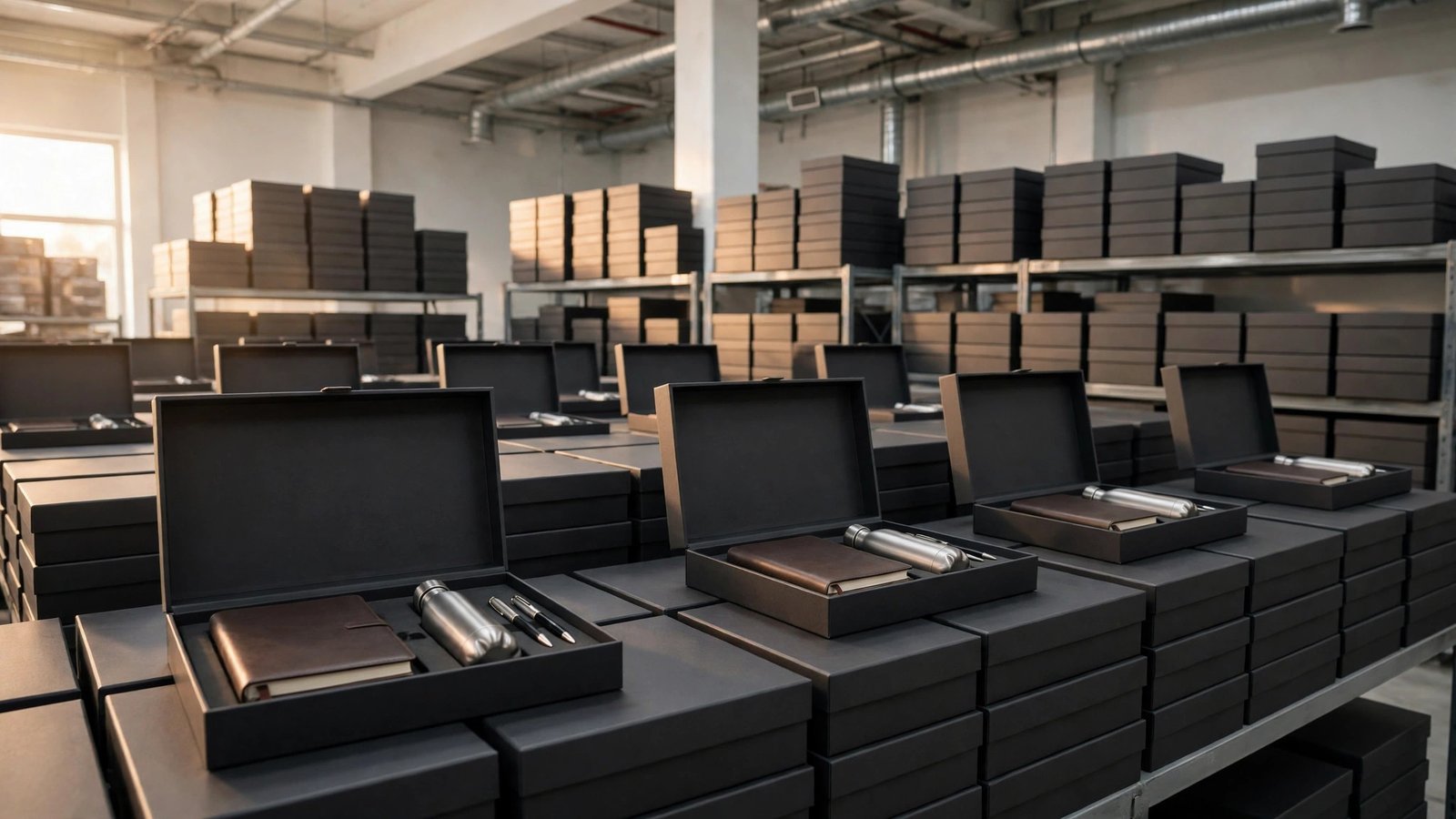
What Is the Minimum Order Quantity for Corporate Gifts in India? MOQ by Product Type
You have a headcount of 40, a budget approved, and a gift in mind — customised diaries with your company logo for the new financial year. You call a vendor, describe the diary, and the first question back is not about the colour or the price. It is: “How many pieces?”
You say 40. There is a pause. “Our MOQ is 100.”
That single number — the minimum order quantity, or MOQ — decides whether your gifting plan is possible at all, what each gift will cost, how long production will take, and whether the branding you want is even available. Yet most HR and procurement teams discover it only after they have already chosen a gift, set a budget and promised a delivery date to their leadership.
This guide explains what MOQ means in corporate gifting in India, why vendors set it, what the typical minimum is for each common product type, how it affects your per-piece price, what your options are when your headcount is below the minimum, and how to negotiate it without damaging the vendor relationship. The MOQ figures below are indicative planning ranges drawn from common vendor practice in the Indian corporate gifting market — they vary by vendor, by product quality and by branding method, so always confirm the exact figure with your supplier before you commit a budget.
What MOQ Means — and Why It Exists
MOQ is the smallest number of units a vendor will produce or supply for a single order of a particular product. If a vendor’s MOQ for a branded diary is 100, they will not accept an order for 40 diaries with your logo on them — not at any price they are willing to quote, and usually not at all.
It is not a sales tactic. It is a production reality, and it comes from four costs that do not change whether the vendor makes 10 pieces or 1,000.
Setup cost. Custom branding — a printing screen, an engraving plate, an embossing die, a debossed mould — has to be made before the first piece is produced. That setup cost is the same for an order of 50 and an order of 5,000. Spread across 5,000 pieces it is negligible; spread across 50 it can double the per-piece price. The MOQ is the point at which the setup cost stops making the order uneconomic for the vendor.
Raw material buying. Vendors buy materials in standard packs — a carton of 100 mugs, a bundle of 50 diaries, a roll of fabric that yields a fixed number of bags. An order smaller than a standard pack leaves the vendor holding leftover stock they may never sell. The MOQ often matches the size of the pack the vendor has to buy.
Production-line time. A printing or engraving run has a fixed time cost: setting up the machine, calibrating the print, running a test piece, cleaning up afterwards. A run of 25 pieces takes nearly as long as a run of 250. Vendors protect their production capacity by refusing runs that are too small to justify the time.
Quality control. A sample has to be approved, a first production piece has to be checked, and a batch has to be inspected before dispatch. That quality process costs the same for a small order as a large one, and it is one of the reasons a reputable vendor will not take a very small customised order — the quality risk is the same, the revenue is not.
Understanding these four costs changes how you negotiate. You are not arguing against a policy; you are asking a vendor to absorb costs that do not shrink with your order size. The negotiation works when you find a way to cover those costs — a higher per-piece price, a simpler branding method, a product the vendor already stocks — rather than when you ask the vendor to ignore them.
MOQ by Product Type: The Indicative Ranges
No two vendors quote identical minimums, and the same product can carry a different MOQ depending on the branding method, the quality tier and whether the item is stocked or made to order. The ranges below are indicative planning figures for the Indian corporate gifting market. Treat them as the starting point for your vendor conversation, not as a price list.
| Product type | Typical MOQ range (indicative) | What drives the minimum |
|---|---|---|
| Gift hampers (pre-curated) | 25–50 | Packing labour and courier cartons; hampers are assembled, not manufactured, so the minimum is low |
| Custom gift boxes / curated kits | 50–100 | Box printing and assembly; a custom-printed box needs a print run of its own |
| Ceramic / steel mugs | 50–100 | Printing screens and kiln or curing batches; single-colour print is usually the lower end |
| Steel bottles / sippers | 50–100 | Laser engraving setup and bottle blanks bought in cartons |
| Diaries and planners | 100–250 | Paper, binding and cover printing are all batch processes; debossing dies add setup cost |
| Desk calendars | 100–200 | Offset printing economics; calendars are printed in sheets, so small runs waste paper |
| Pen sets | 50–100 | Engraving or printing setup; premium metal pens trend higher |
| Laptop bags and backpacks | 25–50 | Embroidery or print setup per design; bags are stocked items, so the minimum is moderate |
| T-shirts and polo shirts | 50–100 | Screen printing screens per colour; embroidery has a digitising cost per design |
| Hoodies and jackets | 25–50 | Higher unit value justifies a lower minimum; embroidery setup is the constraint |
| Power banks | 50–100 | Certification, testing and printing setup; low-quality stock is often available at lower minimums |
| Desk plants and green gifts | 25–50 | Sourcing and pot customisation; plants are perishable, so vendors avoid very small runs |
| Scented candles | 50–100 | Wax pouring and labelling batches; custom fragrance runs trend higher |
| Gift cards and vouchers | No MOQ (often 1+) | No manufacturing involved; the minimum is usually a denomination or a total value, not a quantity |
| Premium executive gifts (leather goods, desk sets) | 10–25 | High unit value; vendors accept small runs because the revenue per piece justifies the setup |
Two patterns in this table are worth noting before you plan anything.
First, the more custom the product, the higher the MOQ. A hamper assembled from stocked items can be ordered in 25s. A diary with your logo debossed on the cover, a custom-printed box and a printed belly band is a manufactured product, and its MOQ reflects three separate production processes. Every layer of customisation you add pushes the minimum up.
Second, the higher the unit value, the lower the MOQ. A vendor will run 10 premium leather desk sets because 10 pieces at a high price covers the setup cost. The same vendor will not run 10 steel bottles, because 10 pieces at a low price does not. If your headcount is small, a premium gift is often easier to order than a cheap one — a fact that surprises many teams, and one that should shape your shortlist.

How MOQ Changes Your Per-Piece Price
MOQ and price are the same conversation. The per-piece price a vendor quotes you is not a property of the product — it is a property of the quantity.
A vendor’s cost for your order has two parts: the fixed cost (setup, plates, screens, dies, design time) and the variable cost (the product itself, the printing per piece, the packing per piece). The per-piece price you pay is the fixed cost divided by the quantity, plus the variable cost. As the quantity rises, the fixed cost is spread thinner, and the per-piece price falls — steeply at first, then gradually.
That is why a diary that costs ₹450 a piece at 100 units might cost ₹320 a piece at 500 units, and why the jump from 50 to 100 units often saves more per piece than the jump from 500 to 1,000. The steepest savings are always at the low end of the quantity range, which is exactly where most HR teams are ordering.
Three practical consequences follow.
Ordering just above the MOQ is the most expensive way to buy. If the MOQ is 100 and you order 100, you are paying the highest per-piece price the vendor will quote for that product. Ordering 120 or 150 — if your headcount and budget allow it — often reduces the per-piece price enough to cover the extra units. Always ask for the price at two or three quantities, not one: the MOQ, your actual headcount, and the next round number above it. The difference may be smaller than you expect, and it may make the difference between a gift that looks cheap and one that looks considered.
Rounding up to a standard pack size can be cheaper than ordering your exact headcount. Vendors buy and pack in standard quantities — 50, 100, 250, 500. An order of 110 diaries may cost more per piece than an order of 100, because the vendor has to open a second pack for 10 extra pieces. Ask what the vendor’s standard pack sizes are, and plan your quantity around them. The 10 extra diaries become spares for new joiners, damaged pieces or last-minute additions — which, in any real gifting programme, you will need.
A low MOQ is not always a good deal. A vendor offering a MOQ of 25 on a product every other vendor quotes at 100 is usually offering one of three things: a stocked, unbranded product with your logo added as an afterthought; a lower-quality product where the setup cost is small because the branding is a sticker, not a print; or a vendor who will recover the setup cost by charging a much higher per-piece price. Ask what the per-piece price is at the low MOQ, and compare it with the per-piece price at the standard MOQ. The honest comparison is total cost for your headcount, not the MOQ number alone.
What to Do When Your Headcount Is Below the MOQ
This is the most common MOQ problem in Indian corporate gifting, and it affects small teams, startups, regional offices and any programme aimed at a defined group — a leadership team of 12, a client list of 30, a new branch of 25. The vendor’s MOQ is 100 and your headcount is 40. You have four real options.
Option 1: Choose a product with a naturally low MOQ. Gift hampers, premium executive gifts and gift cards have the lowest minimums in the market, because they involve the least manufacturing. A pre-curated hamper at a MOQ of 25 will usually accept an order of 40 without any negotiation. If your headcount is small, start your shortlist with the low-MOQ categories and only move to manufactured products if the budget allows a higher per-piece price. For help deciding between a hamper and a rigid gift box for a bulk order, see our comparison of Christmas hampers vs gift boxes for bulk orders.
Option 2: Reduce the customisation. The MOQ is driven by the branding process, not by the product. A diary with a debossed logo has a MOQ of 100; the same diary with a printed belly band or a branded sleeve has a much lower minimum, because the branding is on a separate, cheaply printed item rather than on the product itself. A mug with a full-colour print has a higher MOQ than the same mug with a single-colour logo. Ask the vendor which branding method carries the lowest MOQ for the product you want, and whether a simpler method gets you under your headcount.
Option 3: Pay the MOQ and keep the spares. Order the minimum quantity and keep the extra units for the rest of the year. A company with 40 employees that orders 100 diaries has 60 spares — which become new-joiner welcome gifts, replacement gifts for damaged pieces, and gifts for the next quarter’s milestones. If the product is not date-specific — a diary dated 2027 is, a steel bottle is not — the spares are an asset, not waste. Do the maths: the cost of 60 spare bottles that will be used over a year is often less than the premium you would pay for a low-MOQ vendor.
Option 4: Combine orders across teams or occasions. The MOQ applies to a single production run of a single design, not to your company as a whole. If HR needs 40 diaries and marketing needs 40 of the same diary for an event, that is one order of 80, not two orders of 40. If the festive hamper and the welcome kit share a branded item — a steel bottle, a notebook — order them together. The most effective MOQ strategy in a large company is often internal: coordinate the gifting calendar so that similar items are ordered once, in a single run. Our guide to New Year welcome-back gifts and new joiner ideas covers the kind of first-impression gifting that shares items with festive programmes.
How to Negotiate MOQ Without Damaging the Relationship
MOQ is negotiable, but only in the ways that respect the vendor’s costs. The negotiations that work are the ones where you offer the vendor something in return for the lower minimum.
Offer a higher per-piece price. The simplest negotiation, and the one vendors respect most. “Your MOQ is 100 and I need 50 — what is the per-piece price at 50?” is a reasonable question, and most vendors will answer it. The price will be higher, sometimes substantially. Your job is to decide whether the higher per-piece price still fits your budget, and whether the gift is worth it. Do not ask for the MOQ to be waived and the price to stay the same — that is asking the vendor to lose money, and it will be refused or, worse, accepted and recovered through lower quality.
Offer a longer lead time. A vendor who can fit your small order into a gap between larger production runs — a quiet week, a machine that is already set up for a similar product — can accept a lower MOQ, because the setup cost is already covered. If you can order six weeks ahead instead of two, say so early in the conversation. Lead time is a currency in this negotiation, and it costs you nothing if you plan ahead. For the planning timelines that make this possible, see our guide to Christmas corporate gift delivery deadlines in India.
Offer a repeat commitment. “We need 50 now and 50 again in three months” is a different proposition from “we need 50”. A vendor who can see a second order coming can spread the setup cost across both, and may hold your printing plate or embroidery file for the second run. Put the repeat order in writing, even if the date is approximate — a vendor who trusts the second order will price the first one differently.
Offer a simpler product from the vendor’s existing stock. Vendors hold stock of popular items — plain steel bottles, standard diaries, common pen sets — and the MOQ on a stocked item is often far lower than on a made-to-order one, because the manufacturing has already happened. Ask what the vendor already has in stock that can be branded with your logo, and whether the MOQ on those items is lower. You may find that the gift you wanted is available at half the MOQ, simply because the vendor already owns the stock.
Do not bluff about quantity. The fastest way to lose a vendor’s trust is to promise 500 pieces to get a low price and then order 100. Vendors remember, and the next time you need a favour — a rush order, a lower MOQ, a replacement for a damaged batch — the answer will be no. Negotiate on the quantity you will actually order, and be honest about it.
Sample Approval: The MOQ Step Most Teams Skip
Every discussion of MOQ should include the sample, because the sample is where a low MOQ becomes a risk. Most vendors will produce one sample piece — or a small sample batch — before the full production run, so you can approve the product, the branding and the quality. The sample is usually charged separately, and it is usually not counted against the MOQ.
There are two things to know about samples and MOQ.
First, a vendor who waives the MOQ often waives the sample too — or rather, they skip it, because producing a sample for an order of 25 costs the vendor nearly as much as producing the order itself. If a vendor agrees to a very low MOQ without offering a sample, ask directly whether you will see a physical sample before production. If the answer is no, you are ordering blind, and the risk is yours.
Second, the sample approval is your last chance to change the product. Once you approve the sample and the vendor starts the production run, changes cost money and time — a new printing screen, a new batch of materials, a delayed delivery. Check the sample against a written list: the product quality, the logo placement, the logo size, the colour match, the spelling of any text, the packaging, and the contents of a hamper or kit. Photograph the approved sample and keep it. If the delivered order differs from the sample, that photograph is your evidence. For a full checklist of what to verify before production starts, our companion guide on sample approval — the next topic in this series — will cover the twelve checks in detail.

MOQ, Quality and the Vendor You Choose
MOQ is also a signal about the vendor, and it is worth reading it that way.
A vendor with a very high MOQ on a simple product may be a manufacturer who only runs large batches — good for a 5,000-piece festive order, wrong for a 60-piece leadership gift. A vendor with a very low MOQ on everything may be a reseller who buys finished stock and adds a logo — fine for a simple order, risky if you need custom packaging or a specific product. Neither is a bad vendor; they are different kinds of vendor, suited to different orders.
The right question is not “what is your MOQ” but “what is your MOQ for this product, with this branding, at this quantity, and what does the per-piece price look like at my headcount”. A vendor who answers that question clearly — with the setup cost explained, the pack sizes stated and the price at two quantities — is a vendor who understands their own production. A vendor who answers with a single number and no explanation is a vendor you will have to manage closely.
There is also a quality dimension that rarely gets discussed. At a very low MOQ, the vendor’s quality control process is the same as at a high MOQ — but the cost of that process is spread across far fewer pieces, so the vendor is under more pressure to skip steps. A 25-piece order that skips the first-piece inspection is an order where a printing error affects a fifth of the total. Ask how quality control works at your quantity, not just at the vendor’s standard quantity. The answer tells you more about the vendor than the MOQ does.
For teams buying for clients rather than employees, the stakes are higher still — a flawed gift to a client is a flawed impression. Our guide to Christmas gifts for clients in India sets out how to choose premium client gifts that do not look like advertising, and the MOQ logic in this guide applies to those gifts in exactly the same way.
MOQ for Different Audiences: Employees, Clients, Partners
The MOQ conversation changes with the audience, because the headcount and the expectations change with it.
Employees. The largest and most predictable audience. A company of 200 employees ordering a festive gift will usually clear the MOQ on most products without trying. The MOQ problem for employee gifting is usually the opposite — ordering too many, because the headcount used for the order includes people who have left, people on long leave, and people at locations that need a separate shipment. Get the headcount right before you ask about the MOQ, and re-check it a week before the order is placed. For the wider question of planning festive gifting by headcount and budget, see our guide to Christmas gifts for office staff under ₹1,000.
Clients. Smaller lists, higher expectations, and the MOQ problem is at its worst. A client list of 30 names and a vendor MOQ of 100 is a mismatch that cannot be solved by ordering more — you cannot gift a client three diaries. For client gifting, start with the low-MOQ categories: premium hampers, executive desk sets, leather goods, gift cards. If the gift you want carries a high MOQ, consider a two-tier approach — the premium gift for the top 10 clients, and a hamper at a lower MOQ for the remaining 20. Tiered gifting is also the right approach for partners and distributors: our guide to gifts for channel partners in India explains how to plan tier-wise partner gifting without overspending, and the MOQ logic applies tier by tier.
Distributors and dealers. Large lists, and the MOQ is rarely a problem — a distributor list of 300 will clear almost any minimum. The issue here is the opposite: the order is large enough that the per-piece price should be negotiated hard, and the MOQ should be irrelevant. If a vendor is quoting a high MOQ on a 300-piece order, the vendor is not set up for your scale. Our guide to year-end gifts for distributors and dealers in India covers tier-wise ideas for this audience.
Event attendees and speakers. Event gifting is where MOQ planning most often fails, because the headcount is an estimate until the registration list closes. If you expect 80 attendees and the MOQ is 100, order 100 and keep the spares for the next event — the alternative, ordering 80 and being told the MOQ is 100 a week before the event, is worse. And remember that speakers and panelists should receive a different, usually premium, tier — which carries its own, usually lower, MOQ. For the thinking on tiered event gifting, see our guide to Women’s Day event gifting kits for attendees, speakers and panelists.
Common MOQ Mistakes
Choosing the gift before checking the MOQ. The single most common mistake, and the one this guide exists to prevent. The gift is chosen, the budget is approved, the leadership is told — and then the vendor says the MOQ is 100 and the headcount is 40. Check the MOQ at the shortlist stage, before the gift is presented internally. It takes one phone call.
Comparing vendors on MOQ instead of total cost. A vendor with a MOQ of 50 and a per-piece price of ₹600 costs more for an order of 50 than a vendor with a MOQ of 100 and a per-piece price of ₹350 — if you are willing to order 100 and keep the spares. Always compare the total cost for your actual headcount, including setup charges, sample charges, packing and delivery. The MOQ number alone tells you almost nothing about what you will pay.
Forgetting the setup charges. Some vendors quote a low MOQ and a low per-piece price, and then add a setup charge — for the printing screen, the engraving plate, the embroidery digitising — as a separate line item. A setup charge of ₹5,000 on an order of 50 adds ₹100 per piece. Ask for the full landed cost, including setup, sample, packing, GST and delivery, before you compare vendors. For GST treatment of corporate gifts, the official GST portal is the authoritative source — and any tax treatment should be confirmed with your tax adviser, as general guidance, not professional advice.
Ordering the exact headcount. People leave, people join, gifts get damaged in transit, a courier loses a box. An order of exactly 200 for a headcount of 200 leaves no margin, and a single damaged gift becomes an employee who received nothing. Order 5–10% above your headcount where the budget allows, and round up to the vendor’s pack size. The spares are not waste; they are insurance.
Assuming the MOQ is the same for every branding method. A diary with a debossed logo and a diary with a printed sleeve are different products from a production point of view, with different MOQs. If the MOQ is too high, ask whether a different branding method on the same product brings it down — before you abandon the product entirely.
Treating MOQ as fixed. It rarely is. Lead time, repeat orders, simpler branding and stocked products all move it. The vendors who say the MOQ is fixed are usually the vendors who have not been offered anything in return. Ask the question, and offer something — time, a repeat order, a simpler design — in exchange.

Business Insights: What MOQ Really Tells You About Your Gifting Programme
MOQ is not just a vendor constraint. It is a diagnostic tool for your gifting programme, and it reveals three things worth knowing.
First, it reveals whether your gifting is planned or reactive. A team that discovers the MOQ a week before the delivery date is a team that is ordering reactively, and reactive ordering pays the highest per-piece prices, accepts the lowest quality control, and has no time to negotiate. A team that checks the MOQ at the shortlist stage, six weeks before delivery, can negotiate on lead time, compare vendors on total cost, and order spares. The MOQ is the same number in both cases; the difference is when you learn it.
Second, it reveals whether your gifting is coordinated. A company where HR orders 40 diaries, marketing orders 40 of the same diary, and the events team orders 40 more — three separate orders, each below the MOQ, each paying the highest per-piece price — is a company that is spending more than it needs to for the same gifts. One coordinated order of 120 costs less per piece, clears the MOQ easily, and arrives in a single shipment. The MOQ rewards coordination, and it punishes silos.
Third, it reveals the real cost of your gift. The per-piece price at the MOQ is the honest price of a customised gift for a team of your size. If that price is higher than your budget, the gift is wrong for your headcount — not because the vendor is expensive, but because the product’s production economics do not fit your scale. Choosing a different product is not a compromise; it is the correct decision, made on real numbers rather than on a catalogue price that assumed an order of 1,000.
FAQs
What is MOQ in corporate gifting?
MOQ — minimum order quantity — is the smallest number of units a vendor will produce or supply for a single order of a particular product. If a vendor’s MOQ for a branded diary is 100, they will not accept an order for fewer than 100 diaries with your logo. The MOQ exists because setup costs, raw-material packs, production-line time and quality control cost the same whether the vendor makes 10 pieces or 1,000.
What is the typical minimum order quantity for corporate gifts in India?
It depends on the product. Indicative ranges in the Indian market are roughly 25–50 for pre-curated hampers and premium executive gifts, 50–100 for mugs, bottles, pens and t-shirts, and 100–250 for diaries and desk calendars. Gift cards usually have no quantity minimum. These are planning ranges, not fixed prices — always confirm the exact figure with your vendor, because the branding method and the quality tier change the number.
Can I order corporate gifts below the MOQ?
Usually yes, if you pay a higher per-piece price, accept a simpler branding method, or give the vendor a longer lead time. Some vendors will also accept a lower quantity if you commit to a repeat order. What rarely works is asking for the MOQ to be waived with no change in price, lead time or design — that asks the vendor to absorb costs that do not shrink with your order.
Why is the MOQ higher for customised gifts than for plain ones?
Because customisation adds fixed setup costs — a printing screen, an engraving plate, an embossing die, an embroidery file — that have to be made before the first piece is produced. Those costs are the same for 50 pieces and 5,000 pieces, so the vendor sets a minimum quantity at which the setup cost stops making the order uneconomic. The more customisation layers you add, the higher the MOQ.
What is a good MOQ for a small team of 20–30 people?
For a team of 20–30, start with the low-MOQ categories: pre-curated hampers (typically 25–50), premium executive gifts (typically 10–25) and gift cards (no minimum). If you want a manufactured product such as a diary or a mug, expect to pay a higher per-piece price for a below-MOQ order, or to order the minimum and keep the spares for new joiners and the next gifting cycle.
Does a lower MOQ mean a better vendor?
Not necessarily. A very low MOQ can mean a stocked product with minimal branding, a lower-quality item, or a vendor who recovers the setup cost through a much higher per-piece price. Compare vendors on the total landed cost for your headcount — product, setup, sample, packing, GST and delivery — not on the MOQ number alone.
Should I order more than my headcount to meet the MOQ?
If the product is not date-specific, yes — ordering the minimum and keeping the spares is often the cheapest option. Spares become new-joiner welcome gifts, replacements for damaged pieces, and gifts for the next milestone. Avoid it for date-specific products such as a 2027 diary or a dated desk calendar, where the spares expire. And always order 5–10% above your headcount as a buffer against damage and last-minute additions.
How far in advance should I check the MOQ?
At the shortlist stage, before the gift is presented internally and the budget is approved — ideally six weeks before the delivery date. Checking the MOQ early gives you time to negotiate on lead time, compare vendors on total cost, coordinate orders across teams, and change the product if the minimum does not fit your headcount. Discovering the MOQ a week before delivery leaves no room for any of that.
Conclusion
The minimum order quantity is the first number that matters in any corporate gifting programme, and it is the number most teams learn last. It decides whether your chosen gift is possible at all, what each piece will cost, how long production will take, and whether the branding you want is available. It is not a sales tactic and it is not negotiable into nothing — it is the point at which a vendor’s fixed costs stop making a small order uneconomic.
The practical rules are simple. Check the MOQ at the shortlist stage, before the gift is approved internally. Compare vendors on total landed cost for your headcount, not on the MOQ number alone. Ask for the price at two or three quantities, and round up to the vendor’s pack size. If your headcount is below the minimum, choose a low-MOQ product, simplify the branding, pay the higher per-piece price, or order the minimum and keep the spares. And negotiate with something to offer — lead time, a repeat order, a simpler design — rather than asking the vendor to absorb costs that do not shrink.
Get the MOQ right and the rest of the programme — the gift, the branding, the delivery — has a foundation to stand on. Get it wrong and the best gift idea in the world stalls on a single phone call.
Natural CTA
If your team is planning its next gifting cycle and wants to know what is genuinely possible at your headcount — which products clear the minimum, what the real per-piece price looks like, and how to plan around it — talk to a gifting partner who will answer the MOQ question before you choose the gift, not after. Arrow Gifter works with HR, procurement and employee-engagement teams across India on festive gifting, welcome kits, client appreciation and event gifting, from choosing the right product for your headcount to branding, packing and delivering it to every employee’s door. Share your headcount, your timeline and your budget, and we will help you plan a programme where the quantity, the price and the delivery all work together. Reach out through the Arrow Gifter website to start the conversation.
4 Comments