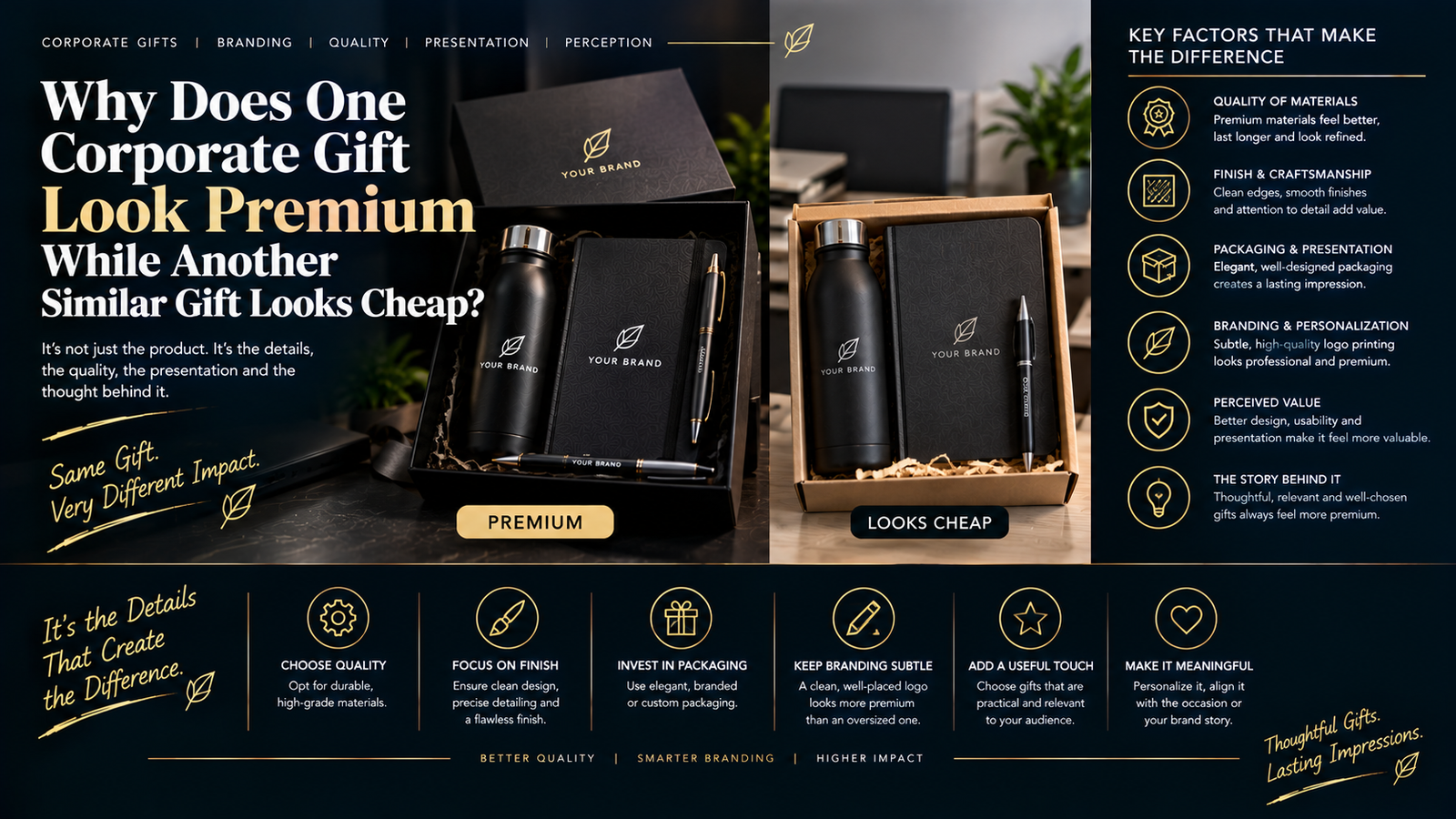
Why Does One Corporate Gift Look Premium While Another Similar Gift Looks Cheap?
Have you ever seen two corporate gifts that contain almost the same product, yet one looks elegant and thoughtfully designed while the other feels inexpensive? The difference is not always the product’s price. Material quality, finishing, packaging, colour coordination, branding, and presentation all influence how a gift is perceived.
For HR teams and marketing professionals, understanding the premium corporate gift appearance can make a real difference when planning employee appreciation programmes, client gifting campaigns, festive hampers, and branded merchandise. A gift represents more than the item inside the box. It also communicates the care, professionalism, and attention to detail behind the gesture.
A standard notebook can look sophisticated when paired with a refined cover, subtle branding, and quality packaging. Meanwhile, a more expensive notebook can look ordinary if it has poor finishing, excessive promotional text, or damaged packaging.
The good news is that businesses do not always need a bigger budget to improve the way their gifts look and feel. By understanding the elements that influence perceived value, HR and marketing teams can make smarter product choices and create more memorable gifting experiences.

What Makes a Corporate Gift Look Premium?
A corporate gift looks premium when its materials, finish, design, branding, packaging, and overall presentation work together. The product should feel appropriate for its intended use, look well-made, and arrive in a condition that reflects the company’s standards.
Several factors contribute to a premium impression:
- Material quality: The product feels durable and well-constructed.
- Finishing: Edges, stitching, printing, surfaces, and fittings look neat.
- Design: Colours, shapes, and visual details feel coordinated.
- Packaging: The gift is protected and presented thoughtfully.
- Branding: The company logo is clear, appropriately sized, and well-positioned.
- Personalisation: Names or messages are accurate and relevant.
- Presentation: Items are arranged carefully, without clutter or unnecessary decoration.
These elements work together. Excellent packaging cannot completely compensate for a poor-quality product, and an expensive product may lose its appeal if it arrives scratched or carelessly packed.
The objective is to create a consistent experience from the first impression to the moment the recipient uses the gift.
1. Material Quality Changes How a Gift Is Perceived
Material is one of the first things people notice when handling a corporate gift. Even when two products serve the same purpose, differences in texture, weight, construction, and durability can make them feel very different.
Consider two reusable bottles. Both may have similar capacities and colours, but one has a secure lid, a smooth finish, and sturdy construction. The other has uneven coating, loose fittings, and visible manufacturing marks. The first is more likely to feel well-made, regardless of whether it costs significantly more.
The same principle applies to notebooks, pens, bags, apparel, and desk accessories.
What HR and marketing teams should inspect
- The material’s texture and consistency.
- The quality of stitching, seams, closures, and fittings.
- The smoothness and durability of the surface finish.
- Whether the product feels comfortable and practical to use.
- Whether the item is likely to withstand regular use.
A premium appearance does not necessarily require luxury materials. A well-made cotton bag, carefully finished notebook, or durable metal pen can look polished when selected thoughtfully.
Practical tip: Request physical samples before confirming bulk orders. Product photographs may not reveal the actual texture, construction, or finish.
2. Finishing Separates Polished Gifts from Ordinary Ones
Two gifts made from similar materials can look completely different because of their finishing.
Uneven stitching, rough edges, scratches, inconsistent printing, loose components, and visible adhesive marks can make a product appear poorly made. Clean finishing creates a more professional impression.
For example, compare two branded diaries. One has a neatly aligned cover, consistent stitching, clean page edges, and a firmly attached logo. The other has a misaligned logo, uneven corners, and visible glue marks. Even if both contain the same number of pages, the first looks more refined.
Before approving a product, inspect:
- Alignment of printed or engraved elements.
- Consistency of colour and surface coating.
- Stitching and edge finishing on fabric products.
- Fit and closure of boxes, lids, and accessories.
- Smoothness of surfaces and absence of visible defects.
- Consistency between the approved sample and bulk production.
For large corporate gifting orders, quality checks should not stop after approving the initial sample. Ask the supplier how finished products will be inspected before dispatch.
3. Packaging Influences the First Impression
Packaging shapes the recipient’s expectations before they see the gift itself. A product placed in a crushed carton or loose plastic wrapping can feel less special than the same product presented in a clean, well-fitted box.
However, premium packaging does not have to mean expensive packaging. A sturdy box, neat tissue paper, a simple sleeve, or a well-designed paper insert can improve presentation without significantly increasing the overall cost.
Packaging choices that improve perceived value
| Packaging element | Premium effect | What to avoid |
|---|---|---|
| Sturdy gift box | Creates structure and protects the contents | Thin, crushed, or poorly fitted boxes |
| Tissue paper | Adds a neat layer to the presentation | Excessive or crumpled filler |
| Paper sleeve | Creates a coordinated branded finish | Blurry printing or misaligned artwork |
| Gift insert | Keeps products organised | Loose items moving inside the box |
| Message card | Adds a thoughtful finishing touch | Spelling mistakes or generic, cluttered text |
| Ribbon or seal | Provides a simple decorative detail | Too many competing decorative elements |
Packaging should match the gift, occasion, audience, and delivery conditions. A festive hamper may benefit from more decorative elements, while an executive gift set may look better with restrained colours and clean lines.
For gifts shipped across India, protective packaging is equally important. A visually attractive box loses its impact if it cannot withstand handling during transit.
4. Colour Coordination Creates a More Refined Look
Colour affects the way a corporate gift is perceived. A coordinated palette can make ordinary products look carefully selected, while too many unrelated colours may create a cluttered appearance.
For corporate gifting, start with two or three complementary colours. Use brand colours selectively and balance them with neutral shades when appropriate.
Some combinations worth considering include:
- Navy and cream: Professional and understated.
- Black and silver: Modern and structured.
- White and muted gold: Suitable for elegant celebratory gifts.
- Kraft brown and forest green: A natural, earthy aesthetic.
- Brand colours with neutral accents: Useful for consistent corporate identity.
These combinations are design options, not universal rules. Your company’s visual identity and the recipient’s expectations should guide the final choice.
Consistency matters more than choosing a particular colour. When the gift box, notebook, ribbon, and message card share a visual direction, the complete set feels more intentional.
Avoid combining too many patterns, finishes, and accent colours unless the design specifically calls for them.
5. Branding Can Elevate a Gift—or Make It Look Cheap
Corporate gifts often need to display a company logo, but branding should complement the product rather than dominate it.
Oversized logos, excessive slogans, inconsistent colours, and poorly placed graphics can make a product resemble a low-cost promotional giveaway. By contrast, a small, clear logo on a well-designed product can look professional and sophisticated.
How to achieve better branding
Choose the right placement. Position the logo where it feels natural on the product. A notebook cover, bottle surface, or bag panel may offer different possibilities.
Use appropriate branding techniques. Printing, embroidery, and laser engraving create different visual effects. The best option depends on the material, artwork, intended durability, and budget.
Maintain brand consistency. Use approved logo files, colours, proportions, and clear-space guidelines.
Keep the design uncluttered. Avoid adding several messages when one logo or a short line of text is sufficient.
Approve a proof. Check spelling, alignment, colour, and scale before authorising production.
For marketing teams, the goal is to balance brand visibility with usability. A gift that recipients genuinely want to use can keep the brand visible without relying on oversized promotional graphics.
6. Product Selection and Coordination Matter More Than Quantity
A corporate gift can look cheap when it contains many unrelated products with no clear connection. Adding more items does not automatically create more value.
A smaller, coordinated set often looks more premium than a larger collection of random giveaways.
For example, a notebook, pen, and reusable bottle in complementary colours create a practical everyday kit. A mug, snack selection, and personalised message card can form a simple appreciation hamper.
Compare these approaches:
| Less coordinated approach | More refined approach |
|---|---|
| Several unrelated products | A small set built around a clear purpose |
| Different colours and finishes | A consistent visual palette |
| Items placed loosely in a box | Organised placement with suitable inserts |
| Generic products chosen only for price | Useful products selected for the audience |
| Excessive branding on every item | Consistent, restrained brand placement |
Think about the recipient before selecting products. An employee welcome kit should be practical and welcoming. A client appreciation gift may need a more considered presentation. An event giveaway should be easy to distribute and relevant to attendees.
The best product combination is the one that makes sense for its audience and purpose.
7. Personalisation Adds Meaning When It Is Done Correctly
Personalisation can increase the perceived thoughtfulness of a gift. A recipient’s name, a work-anniversary message, or a short thank-you note can make a standard product feel more relevant.
However, poor personalisation can have the opposite effect. Misspelled names, uneven engraving, incorrect titles, or inconsistent placement can make a gift look rushed.
To improve personalisation quality:
- Use a verified list of recipient names.
- Confirm spelling and formatting before production.
- Standardise the placement and size of names.
- Approve a sample or proof before bulk customisation.
- Use concise messages suited to the occasion.
- Check personalised items during final quality control.
If individual engraving is too expensive for the campaign, consider personalised message cards or a branded insert. These options can add meaning without requiring a separate production process for every item.
Personalisation should feel natural and accurate rather than being added simply to make the gift appear more expensive.
8. Presentation and Arrangement Complete the Experience
The way a gift is assembled can change its overall appearance. Even good products may look disappointing if they are packed carelessly.
A well-arranged gift box allows recipients to see the products clearly and understand how the items fit together.
For better presentation:
- Place larger products at the base or rear of the box.
- Keep smaller items visible and easy to access.
- Use dividers or inserts where needed.
- Position labels and logos consistently.
- Add a message card in a deliberate location.
- Ensure the box closes securely without damaging the contents.
Avoid overfilling the box with filler or adding decorative elements that serve no purpose. The presentation should feel balanced rather than crowded.
For bulk gifting programmes, request a fully assembled sample before approving the final design. This helps HR and marketing teams assess the complete experience rather than evaluating each product separately.
9. How to Maintain a Premium Look Without Increasing the Budget
Creating a premium corporate gift does not mean spending more on every component. It means identifying the details that matter most and allocating the budget accordingly.
Start by establishing the total cost per recipient. Include products, branding, packaging, assembly, shipping, and applicable taxes. Then compare alternatives that improve presentation without unnecessary additions.
Consider these cost-control strategies:
- Select fewer, better-coordinated products.
- Choose readily available items to reduce sourcing complexity.
- Use one packaging design across the entire order.
- Keep branding simple and consistent.
- Personalise cards when individual product engraving is costly.
- Order appropriate quantities to improve pricing where possible.
- Avoid decorative extras that do not improve usability or presentation.
- Compare itemised quotations from multiple suppliers.
For example, if your budget is ₹1,000 per gift, you might prioritise one well-finished product, one complementary accessory, and neat packaging rather than filling the box with several low-quality items.
The exact combination will depend on the audience and occasion. The important principle is to spend deliberately, not simply to spend more.
10. How to Choose a Supplier Who Understands Premium Presentation
A corporate gifting supplier should understand more than product availability and price. It should be able to explain how product materials, branding, packaging, and assembly will work together.
Before confirming a bulk order, ask the supplier:
- Can you provide physical samples?
- What branding techniques are suitable for the selected products?
- Can you create coordinated packaging?
- How do you check quality during bulk production?
- Can you provide an approved pre-production sample?
- What is included in the quotation?
- How will the order be packed and shipped?
- What happens if products arrive damaged or incorrectly branded?
Ask for a complete sample set where practical. This allows your team to assess the product, packaging, branding, and arrangement as one experience.
Arrow Gifter offers corporate gifting solutions that include customised corporate gifts, branded merchandise, executive gift sets, corporate apparel, office accessories, and curated hampers. Businesses can explore product combinations suited to their budgets, branding requirements, and gifting occasions.
Frequently Asked Questions
1. Why do some corporate gifts look more expensive than they are?
Premium-looking gifts often combine good finishing, coordinated colours, subtle branding, useful products, and thoughtful packaging. These details influence perceived value even when the products are reasonably priced.
2. Does packaging make a corporate gift look premium?
Yes, packaging can significantly influence the first impression. A sturdy box, neat arrangement, and well-designed message card can improve presentation, provided the product itself also meets reasonable quality expectations.
3. How can HR teams improve the appearance of bulk employee gifts?
Choose practical products, use a consistent colour palette, approve samples, standardise branding, and check personalised details. A coordinated set usually looks more polished than several unrelated items.
4. How can marketing teams make branded merchandise look premium?
Use good-quality products, choose an appropriate branding technique, keep logo placement consistent, and avoid excessive promotional text. Ensure the finished merchandise aligns with the company’s visual identity.
5. Are expensive corporate gifts always better?
No. Price alone does not determine perceived quality or usefulness. A carefully selected and well-presented gift may be more appropriate than an expensive product that does not suit the recipient or occasion.
6. What should businesses check before placing a bulk corporate gift order?
Review product samples, materials, finishing, branding proofs, packaging, delivery schedules, and itemised pricing. Confirm the agreed specifications in writing and establish a quality-checking process before dispatch.
Final Thoughts
The difference between an ordinary corporate gift and a premium-looking one often comes down to execution. Material quality, clean finishing, thoughtful packaging, coordinated colours, subtle branding, and accurate personalisation all contribute to the final impression.
For HR and marketing teams, the most effective approach is to evaluate the entire gifting experience rather than judging products by price alone. Choose items that suit the recipient, coordinate the design, inspect samples, and work with a supplier that can maintain quality across the complete order.
A strong premium corporate gift appearance is not about making every product look luxurious. It is about making each detail feel intentional, consistent, and appropriate for your brand.
Leave a comment