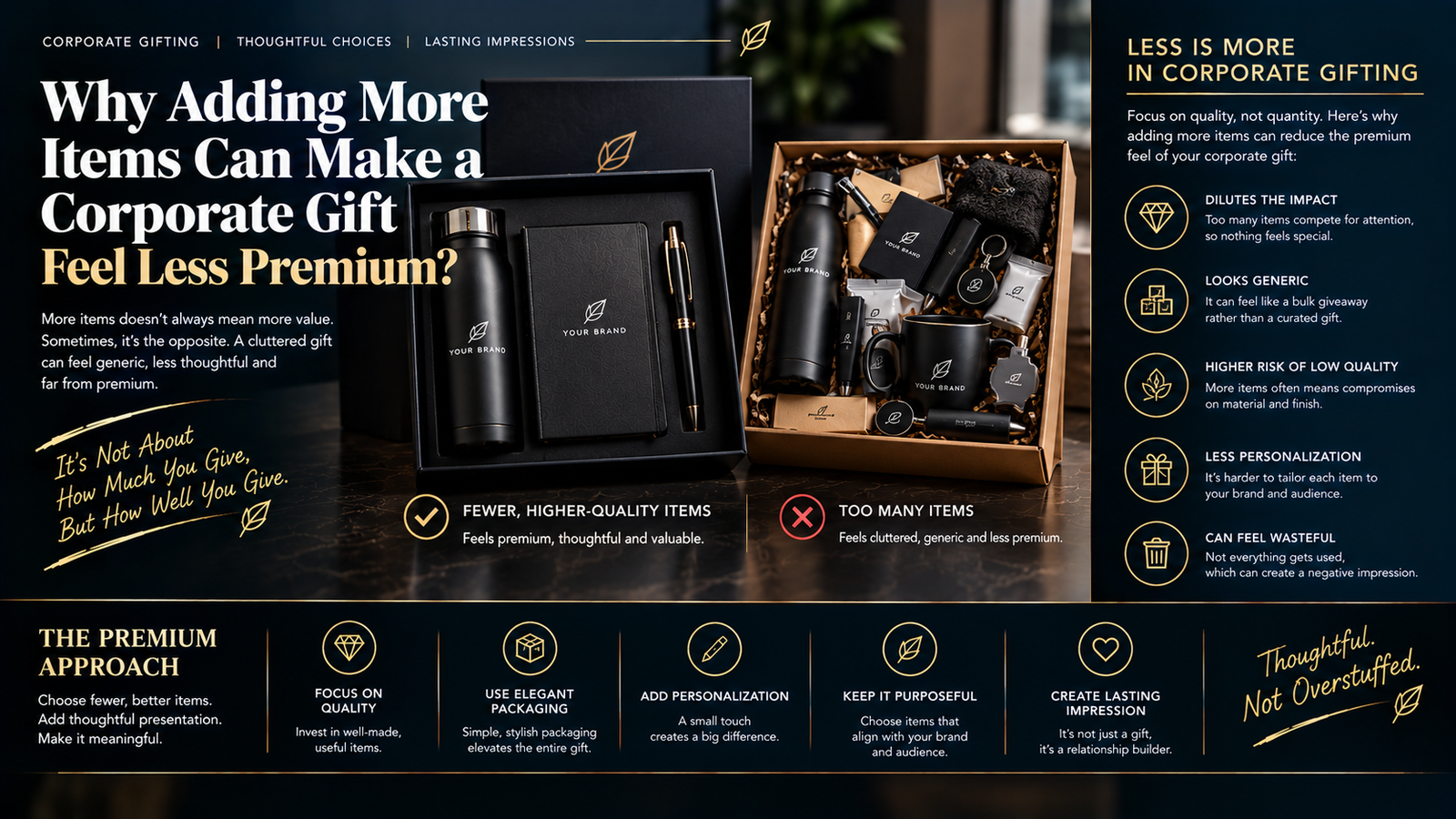
Why Adding More Items Can Make a Corporate Gift Feel Less Premium
When planning corporate gifts, it is tempting to believe that more items automatically create more value. A hamper containing a notebook, pen, bottle, mug, keychain, snack box, desk accessory, and several small extras may appear generous at first glance. Yet, when recipients open it, the experience may feel cluttered rather than luxurious.
The reason is simple: premium corporate gifting is not about how many products fit inside a box. It is about how well those products work together.
For HR teams, corporate gifts can support employee recognition, onboarding, work anniversaries, and festive celebrations. For Marketing teams, they can strengthen client relationships, reinforce brand identity, and create a memorable impression. In both cases, the right selection of products often communicates more care than a large collection of unrelated items.
This is where premium corporate gift curation becomes important. Instead of filling a hamper to make it look substantial, businesses can select a smaller number of useful, well-made products that share a clear purpose and feel cohesive.
In this guide, we explore why adding more items can reduce the perceived value of a corporate gift, how thoughtful curation improves the recipient experience, and how businesses can build premium gift sets without unnecessarily increasing their budgets.
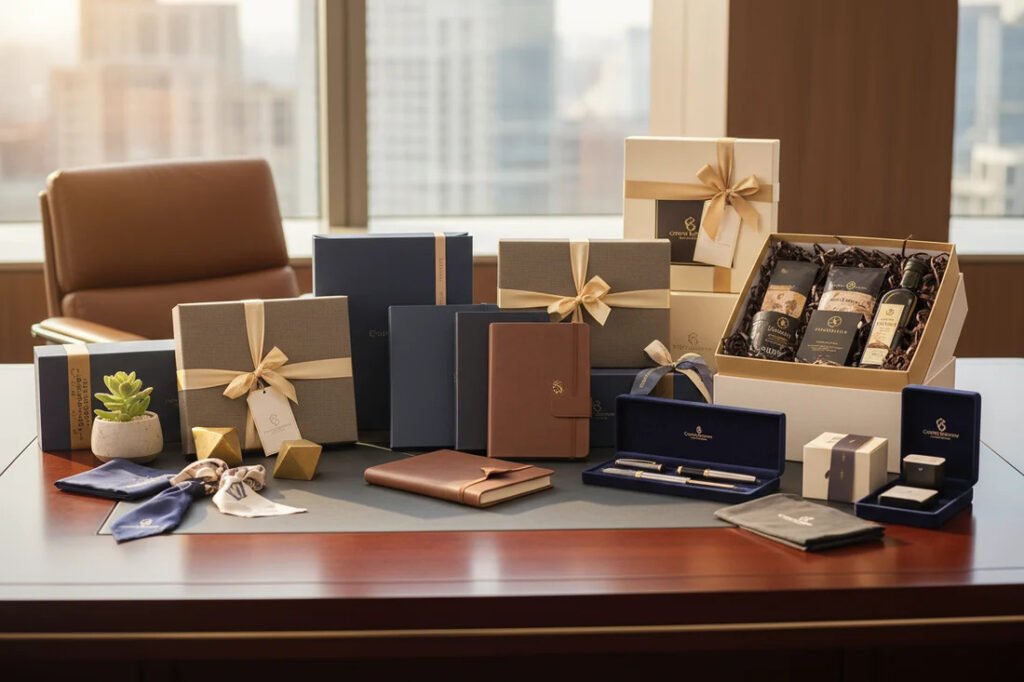
1. Why More Items Do Not Always Mean More Value
A corporate gift is judged through several factors: usefulness, quality, presentation, relevance, and the thought behind the selection.
Imagine receiving two gift boxes.
The first contains eight inexpensive products with inconsistent colours, mixed quality, generic branding, and little connection between the items.
The second contains three carefully selected products: a quality notebook, a refined pen, and a reusable bottle. The colours coordinate, the products serve complementary purposes, and the packaging presents everything neatly.
Although the first box contains more products, the second may feel more considered and valuable.
This happens because recipients do not necessarily calculate the value of a gift by counting its contents. They respond to the overall experience, including how the products look, feel, and fit together.
Adding more items can reduce perceived value when:
- The products are low quality or feel disposable.
- Several items serve the same purpose.
- The gift box becomes overcrowded.
- Branding appears inconsistent or excessive.
- The products have little relevance to the recipient.
- Packaging and presentation become secondary considerations.
The objective should not be to minimise the number of products at all costs. It should be to make every item earn its place in the gift set.
2. What Makes a Corporate Gift Feel Premium?
A premium gift is not necessarily the most expensive gift. It is a gift in which the product quality, presentation, personalisation, and recipient relevance work together.
Product quality
Materials, finishing, durability, and usability all influence how a gift is perceived. A well-made bottle or notebook may create a stronger impression than several poorly finished accessories.
For example, a sturdy bottle with a clean logo application can become part of an employee’s everyday routine. A fragile bottle with uneven printing may be forgotten quickly, regardless of how many additional products accompany it.
Visual consistency
Products that share a coordinated colour palette, finish, or design language tend to look more intentional.
A black notebook, a matching pen, and a neutral-coloured bottle can create a cohesive executive gift set. Adding several brightly coloured, unrelated items may weaken that visual harmony.
Thoughtful packaging
Packaging shapes the recipient’s first impression. A well-fitted box, neatly arranged products, suitable protective inserts, and a thoughtful message can make a compact gift feel special.
However, premium packaging should also be practical. Excessive layers, oversized boxes, and unnecessary fillers can increase costs and waste without improving the experience.
Relevance to the recipient
A useful gift demonstrates that the organisation has considered who will receive it.
A new employee might appreciate a notebook, bottle, and welcome message. A long-standing client might prefer a refined desk accessory or a carefully curated food hamper, subject to their preferences and applicable gifting policies.
The most effective gifts are selected for the occasion and recipient, rather than assembled simply to reach a particular item count.
3. How Excessive Items Can Weaken a Gift Set
A. The gift loses its central idea
The strongest gift sets often have a recognisable theme. They may support productivity, travel, wellbeing, celebration, or everyday office use.
When too many unrelated products are added, the theme becomes difficult to identify. A business gift intended to support a productive workday might contain stationery, a novelty toy, a generic keychain, unrelated snacks, and several decorative accessories.
Individually, these items may be acceptable. Together, they can make the set feel like a collection of leftover inventory rather than a carefully planned gift.
A practical rule: Define the purpose of the gift before selecting products. Every item should support that purpose or add a clearly useful complementary benefit.
B. The weakest item can affect the entire experience
Recipients often evaluate a gift as a complete package. If a set includes one excellent product and several noticeably inferior items, the cheaper products may reduce the perceived quality of the overall gift.
For instance, a premium diary paired with a flimsy pen, a poorly finished keychain, and a low-quality accessory may create a mixed impression.
Instead of adding products simply to increase quantity, allocate more of the budget to the items recipients are most likely to use.
C. The presentation becomes cluttered
A crowded box can make even good products appear less attractive. Items may overlap, packaging may become difficult to close, and the recipient may struggle to identify the main product.
Premium presentation usually benefits from visual hierarchy: one primary item, a few complementary products, and enough space for each item to be seen clearly.
A well-organised box does not need to be large. It needs to fit its contents appropriately.
D. Branding becomes excessive
Corporate gifting is an opportunity to reinforce brand identity, but covering every item with a large logo can make a gift feel more like an advertising pack than a thoughtful gesture.
For many executive and client gifts, subtle branding can be more effective. A discreet logo on the main product, coordinated packaging, and a personalised message may create a more polished result than repeating the logo across every accessory.
Branding should suit the recipient, occasion, and intended relationship.
4. Premium Corporate Gift Curation: Choosing the Right Number of Items
Premium corporate gift curation begins with a simple question: what should the recipient remember about this gift?
The answer helps determine which products belong in the box and which should be removed.
Start with one hero product
A hero product is the main item that gives the gift set its identity. It might be a quality bottle, a premium notebook, an organiser, a useful travel accessory, or a carefully selected hamper component.
The remaining items should complement the hero product rather than compete with it.
For example, a professional desk set might use a well-made notebook as its central item, supported by a matching pen and a handwritten note. The notebook establishes the purpose, while the other elements improve its usefulness and presentation.
Add complementary products
Complementary products extend the value of the hero item.
A travel-themed gift might include a travel organiser, a luggage tag, and a compact notebook. A new-employee kit might include a bottle, notebook, and welcome card. A client appreciation gift might centre on a quality desk accessory with restrained branding and a personalised message.
The exact number of products matters less than whether they form a coherent set.
Remove items that add little value
Before finalising a hamper, review every product and ask:
- Does it support the gift’s theme?
- Is it useful or meaningful to the recipient?
- Does its quality match the rest of the set?
- Does it add something that another item does not?
- Is it worth the additional cost, packaging, and handling?
If the answer to most of these questions is no, remove the item or replace it with something more relevant.
5. Examples: A Crowded Gift Box vs a Curated Gift Set
The following examples are illustrative concepts rather than fixed product recommendations.
| Occasion | Overloaded approach | More curated approach |
|---|---|---|
| Employee onboarding | Many unrelated stationery items, novelty products, generic accessories, and snacks | A quality notebook, reusable bottle, and welcome card |
| Client appreciation | Several low-cost gadgets and multiple logo-heavy accessories | One refined desk accessory, a complementary item, and a personal note |
| Executive gifting | Numerous small products with inconsistent finishes | A premium organiser or gift set with coordinated accessories |
| Corporate event | A mixture of unrelated giveaways added to increase quantity | One useful branded item with a small, relevant supporting product |
| Festive gifting | An assortment of products without a consistent theme | A curated hamper with compatible products and coordinated packaging |
These examples illustrate a key principle: coherence can create a stronger impression than quantity.
That does not mean every gift should contain only two or three products. Food hampers, festive collections, and experiential gift sets may naturally include more items. The important factor is whether the contents feel intentional, well selected, and appropriate for the occasion.
6. How HR Teams Can Apply This Approach
HR teams often coordinate employee welcome kits, milestone gifts, festival hampers, recognition programmes, and farewell gifts. These programmes may involve hundreds of recipients and a fixed budget.
Thoughtful curation can help HR teams improve consistency while making procurement easier.
For employee welcome kits
Prioritise products that support an employee’s first few weeks. Useful stationery, a reusable bottle, a practical desk accessory, and a welcoming message may be more relevant than a box full of novelty products.
For work anniversaries and recognition
Choose a gift that reflects the significance of the milestone. A meaningful, well-presented product can feel more appropriate than a large collection of generic merchandise.
For large employee programmes
Standardise the core gift set, then use personalisation where it adds value. Employee names, team messages, or a note acknowledging the occasion can create a more personal experience without requiring many extra products.
HR teams should also consider accessibility, dietary requirements for food gifts, cultural preferences, and company policies before finalising a collection.
7. How Marketing Teams Can Use Curation to Strengthen Brand Perception
Marketing Teams use promotional gifts for client appreciation, product launches, conferences, partner relationships, and brand-awareness campaigns. In these situations, the gift represents the organisation.
A poorly coordinated set can dilute the brand message, while a focused collection can reinforce it.
Align products with brand values
A company that emphasises practical innovation might select useful technology or desk accessories. A brand focused on sustainability could explore durable, reusable products made with appropriate materials, provided environmental claims are supported by credible information.
The gift should express the brand’s values through the product choice, not just through printed messaging.
Keep the visual identity consistent
Coordinate product colours, packaging, logo placement, and supporting materials. A restrained visual identity often makes a set easier to recognise and more professional.
Match the gift to the campaign objective
For a trade show, portability and everyday usefulness may be priorities. For a senior client meeting, product quality and personal relevance may matter more. For a product launch, the gift may need to reflect the campaign’s core idea.
Marketing teams should choose products based on the intended experience rather than using the same oversized hamper for every occasion.
8. Can a Smaller Gift Set Also Control Costs?
Yes. A smaller, well-curated gift set can help businesses direct spending towards quality, although fewer products do not automatically mean lower total costs.
The outcome depends on the items selected, customisation requirements, packaging, order volume, and delivery arrangements.
Consider a hypothetical budget of ₹1,500 per recipient. A business could divide it across many low-cost products, or it could allocate a larger share to one principal product, a complementary item, and presentation.
The second approach may produce a stronger result if the products are relevant and well made. However, a premium product with expensive branding or packaging can still exceed the budget, so the full cost must be evaluated.
To manage spending effectively:
- Establish a per-recipient budget before choosing products.
- Request quotations for the complete gift set, not just individual items.
- Compare product quality and specifications.
- Consider packaging, personalisation, taxes, and delivery.
- Avoid adding products merely to make the box appear fuller.
- Order samples when practical before approving a large quantity.
The goal is not to make every gift look expensive. It is to create a thoughtful experience within the available budget.
9. A Simple Checklist Before Finalising a Corporate Gift
Use this checklist when reviewing a proposed gift set.
-
The gift has a clear purpose and intended recipient.
-
One product establishes the set’s central idea.
-
Every additional item contributes something useful.
-
Product quality is consistent across the set.
-
Colours, finishes, and branding work together.
-
Packaging protects the products and presents them clearly.
-
Personalisation is accurate and appropriate.
-
The complete cost fits the approved budget.
-
The products comply with internal gifting policies.
-
A sample or proof has been reviewed where practical.
This process can help HR and Marketing teams make more deliberate decisions and avoid last-minute additions that weaken the final presentation.
Frequently Asked Questions
1. What is premium corporate gift curation?
Premium corporate gift curation is the process of selecting products that work together in terms of quality, usefulness, appearance, and relevance. Instead of focusing on the number of items, it prioritises a cohesive and thoughtful recipient experience.
2. How many items should a premium corporate gift contain?
There is no universal ideal number. A compact gift might contain two or three carefully selected products, while a festive hamper may include more. The right quantity depends on the occasion, budget, product types, and whether the items form a coherent collection.
3. Do fewer products make corporate gifts look more expensive?
Not necessarily. Fewer products can make a gift feel more premium when they are well made, relevant, and presented thoughtfully. Poor product quality or unsuitable packaging can undermine the experience regardless of quantity.
4. How can businesses make corporate gifts feel premium on a budget?
Focus spending on the main product, select complementary items, use coordinated packaging, and avoid unnecessary extras. Compare the total cost of the complete set and consider personalisation that adds meaning without introducing excessive expense.
5. Why is packaging important in corporate gifting?
Packaging creates the first impression, protects the contents, and helps organise the recipient’s experience. A well-fitted box and clear arrangement can make a compact gift feel more intentional, while excessive packaging may add cost and waste.
6. How can HR and Marketing teams choose the right gift set?
Start with the occasion, recipient, and campaign objective. Select a hero product, add only relevant complementary items, review branding and packaging, and check the full cost before approving the order.
Final Thoughts
Adding more products to a corporate gift may make the box look fuller, but it does not necessarily make the gift more memorable or valuable. When quality varies, themes become unclear, and packaging becomes crowded, additional items can weaken the recipient’s overall impression.
For HR and Marketing teams, the better approach is to focus on premium corporate gift curation: choose a clear theme, select a strong hero product, add useful complementary items, and present the collection with care.
Arrow Gifter supports businesses seeking customised corporate gifts, curated hampers, executive gift sets, and branded merchandise. When planning your next gifting programme, focus on what each product contributes to the experience. A smaller, thoughtfully assembled gift can communicate care, quality, and brand consideration more effectively than a box filled simply to increase the item count.
Leave a comment