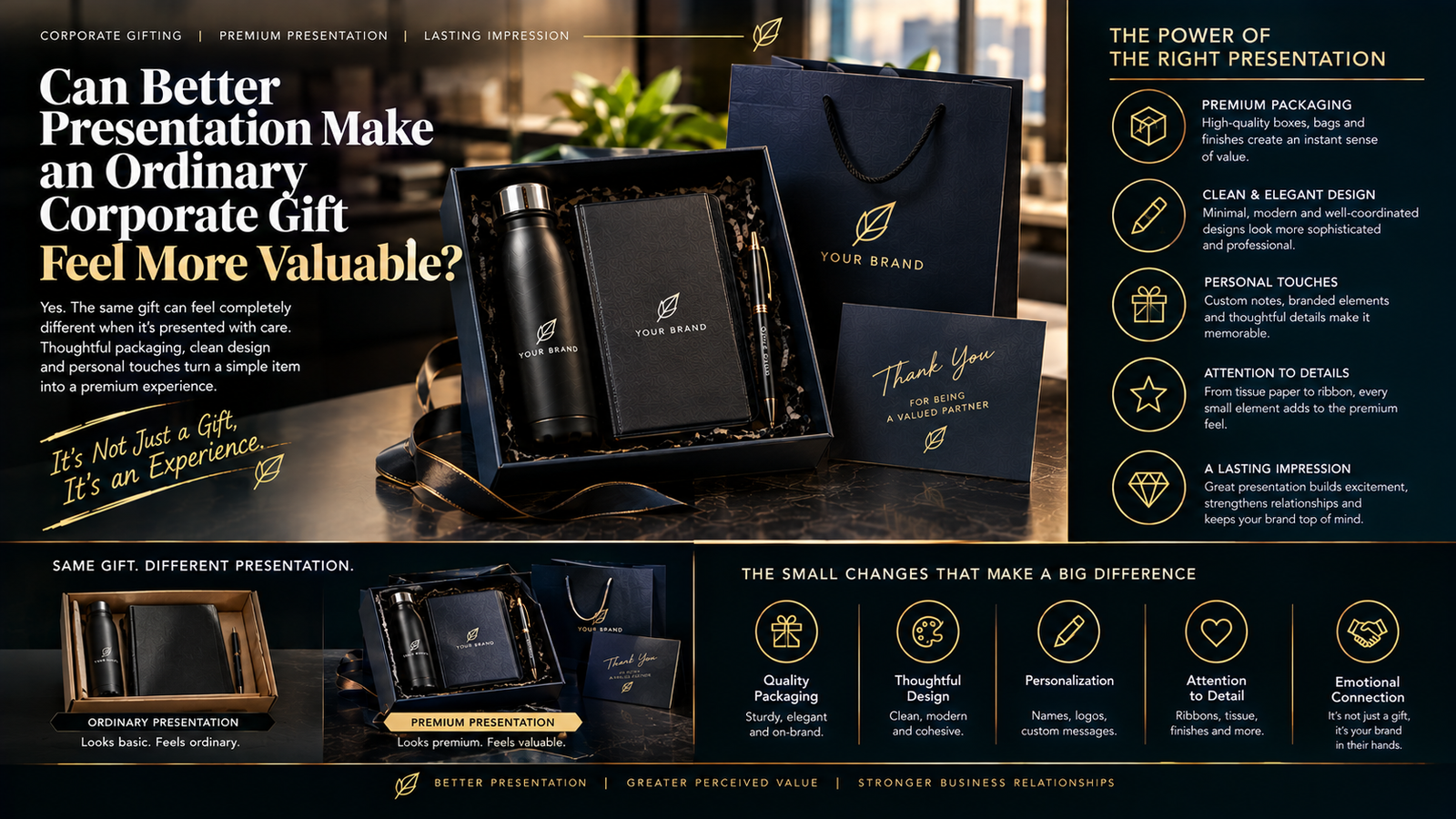
Can Better Presentation Make an Ordinary Corporate Gift Feel More Valuable?
Yes. Better presentation can make an ordinary corporate gift feel more thoughtful, professional, and valuable without significantly increasing the product cost. A practical notebook, reusable bottle, pen, or desk accessory can create a stronger impression when it arrives in coordinated packaging, carries a well-placed brand logo, and includes a meaningful message.
For HR and marketing teams, this matters because corporate gifting is about more than distributing products. It is an opportunity to recognise employees, appreciate clients, welcome new team members, and communicate a company’s values through a tangible experience.
Effective corporate gift presentation brings together product selection, packaging, visual consistency, personalisation, and the way a gift is delivered. When these elements work together, even a modest gift can feel carefully selected rather than purchased in bulk without much thought.
However, presentation cannot compensate indefinitely for poor product quality. The strongest results come from combining useful products with thoughtful design and appropriate packaging.
This guide explains how presentation influences perceived value, which techniques work best for corporate gifting, and how businesses can improve the gifting experience without stretching their budgets.

What Is Corporate Gift Presentation?
Corporate gift presentation is the way a business prepares, packages, brands, and delivers a gift to its recipient. It includes the appearance of the product, the packaging, the arrangement of items, the accompanying message, and the overall unboxing experience.
For example, a standard notebook and pen can be presented in several ways:
- Placed loosely inside a basic plastic bag.
- Packed neatly in a coordinated paper sleeve.
- Arranged inside a gift box with a branded card.
- Presented in a customised box with the recipient’s name and a thoughtful message.
The products may be identical, but the presentation communicates different levels of care and attention.
For HR teams, good presentation can make employee welcome kits and recognition gifts feel more intentional. For marketing teams, it can help corporate gifts reflect brand identity without making every item look like a promotional giveaway.
How Does Better Presentation Make a Gift Feel More Valuable?
A gift’s perceived value is not determined by price alone. Recipients may also consider its usefulness, appearance, condition, relevance, and the effort that appears to have gone into selecting it.
Presentation influences several aspects of that experience.
1. It Creates a Strong First Impression
The packaging is often the first thing a recipient sees. A clean, well-constructed box and neatly arranged contents can signal that the gift was prepared with care.
This is particularly relevant when gifts are presented during client meetings, company events, employee onboarding, or festive celebrations.
A simple gift does not need elaborate packaging to make a good impression. Consistent colours, clean surfaces, and tidy arrangement can create a professional appearance without unnecessary expense.
2. It Makes the Gift Feel Thoughtfully Selected
A collection of unrelated products can feel like a collection of leftover promotional items. A coordinated set, by contrast, suggests that someone considered how the products would work together.
For example, a notebook, pen, and bottle can become a practical employee desk-and-work kit when the colours, packaging, and message are coordinated.
The value comes from the overall composition, not simply from adding more items.
3. It Improves the Unboxing Experience
Opening a gift can be an important part of the recipient’s experience. A tidy arrangement, protective inserts, and a message card can make the process feel organised and pleasant.
For corporate gifting, the goal is not to make unboxing complicated. It is to ensure that the products arrive in good condition and are easy to discover.
A well-arranged box can also prevent products from moving around during transit, reducing the risk of scratches, breakage, or damaged packaging.
4. It Communicates Professionalism
A gift carrying the company’s name represents the organisation. Smudged printing, damaged boxes, inconsistent colours, or misspelled names can undermine the intended message.
Professional presentation helps ensure that the gift looks consistent with the company’s standards.
For marketing teams, this means following brand guidelines. For HR teams, it means checking that employee gifts are complete, appropriate, and presented consistently across departments or locations.
1. Choose Packaging That Complements the Product
Packaging should protect the product while improving its appearance. The right choice depends on the item’s size, weight, fragility, value, and intended recipient.
Some suitable options include:
- Rigid gift boxes: Useful for curated hampers, executive gifts, and premium client presentations.
- Kraft boxes: Suitable for understated, natural-looking corporate gift sets.
- Paper sleeves: An economical way to add branding to notebooks, diaries, or product sets.
- Fabric pouches: Useful for accessories, small products, and reusable gift packaging.
- Protective inserts: Help keep products organised and reduce movement during shipping.
- Reusable bags: Provide practical packaging that recipients may continue using.
Do not choose packaging purely because it looks expensive. A delicate box that cannot protect its contents during delivery is a poor choice for a multi-location campaign.
For bulk orders, request a sample of the complete packaged gift rather than evaluating the box and products separately.
2. Use a Consistent Colour Palette
Colour coordination can make affordable products look more cohesive. A simple palette usually works better than combining too many colours, patterns, and decorative elements.
For corporate gift presentation, consider two or three complementary colours across the product, packaging, ribbon, and card.
| Colour combination | Overall impression | Suitable gifting occasion |
|---|---|---|
| Navy and white | Clean and professional | Employee welcome kits |
| Black and silver | Modern and understated | Executive and client gifts |
| Kraft brown and green | Natural and relaxed | Sustainability-themed gifts |
| Cream and muted gold | Refined and celebratory | Festive gifting |
| Brand colour with neutral tones | Recognisable and consistent | Marketing campaigns and events |
These combinations are design suggestions rather than fixed rules. Your brand identity and the recipient’s preferences should guide the final choice.
Avoid using the company logo colour on every single element if the result looks too busy. Neutral packaging can give the logo room to stand out.
3. Arrange Products Carefully Inside the Gift Box
A well-designed gift box should feel organised rather than overcrowded. Product arrangement is one of the simplest ways to improve presentation without buying more expensive items.
Follow these practical guidelines:
- Place larger or heavier items securely at the base.
- Position smaller products where recipients can see them easily.
- Use dividers or inserts to keep items in place.
- Arrange labels and logos neatly where possible.
- Keep the message card visible and easy to read.
- Check that the lid closes without pressing against the contents.
For example, a welcome kit containing a notebook, pen, bottle, and welcome card can look polished when each item has a defined place. The same products may look less appealing if they are loosely packed together.
For fragile or irregularly shaped items, prioritise protection over decorative arrangement. A gift that arrives intact creates a better experience than one that looks attractive before dispatch but becomes damaged in transit.
4. Add a Personal Message to Make the Gift More Meaningful
Personalisation helps connect a standard product to the person receiving it. A short, relevant message can add value without requiring expensive custom manufacturing.
Examples include:
- A welcome message for a new employee.
- A note recognising a work anniversary.
- A thank-you message for a valued client.
- A message celebrating a successful partnership.
- A festive greeting tailored to the occasion.
The message should be concise, professional, and genuine. Avoid overly promotional language that makes the gift feel like a sales advertisement.
For large orders, printed message cards can offer a consistent and affordable solution. Individual names or customised notes may be suitable for smaller, higher-priority groups.
Always verify names, spellings, titles, and message content before printing. Personalisation errors are particularly noticeable because the gift is intended to feel specific to the recipient.
5. Keep Branding Professional and Understated
Corporate gifts are often intended to strengthen brand recognition, but excessive branding can reduce their appeal.
A recipient may be more comfortable using a bottle, notebook, bag, or desk accessory when the company logo is positioned tastefully.
To improve branded gift presentation:
- Use approved logo files and colours.
- Select a logo size that suits the product.
- Keep placement consistent across a gift set.
- Choose printing or engraving appropriate to the material.
- Avoid excessive slogans and promotional text.
- Check a proof or sample before production.
For example, a small logo on a notebook cover can look more professional than a large logo covering the entire surface. A branded packaging sleeve can also provide visibility while leaving the product itself relatively understated.
The aim is to create a gift that reflects the brand while remaining useful and appealing to the recipient.
6. Select Products That Work Well Together
Presentation begins before the packaging stage. The products themselves should form a coherent set.
A practical gift set usually works best when its items share a purpose, design style, or occasion.
| Gift set | Product combination | Presentation idea |
|---|---|---|
| Employee welcome kit | Notebook, pen, bottle | Branded box with welcome card |
| Client appreciation set | Diary, pen, desk accessory | Neutral packaging with subtle branding |
| Festive hamper | Sweets, snacks, selected accessories | Coordinated colours and protective inserts |
| Work-from-home kit | Mug, notebook, desk organiser | Compact, neatly arranged box |
| Event gift set | Bottle, notebook, tote bag | Consistent event branding and simple packaging |
Do not add unnecessary items merely to make a box appear full. A few well-selected products can create a more refined impression than a larger assortment of unrelated goods.
For HR teams, usefulness should be a priority. For marketing teams, product selection should also consider whether the items reflect the campaign’s purpose and audience.
7. Balance Presentation with Your Corporate Gifting Budget
A polished gift does not require the highest possible spending on packaging. The objective is to decide which improvements will make the greatest difference.
Start by dividing the gift budget into product, packaging, personalisation, fulfilment, delivery, and applicable taxes.
For example, a company with a target budget of ₹1,000 per recipient might choose practical products, coordinated packaging, and a printed message card instead of purchasing a more expensive product with elaborate packaging.
The actual allocation should depend on the occasion, order quantity, product quality, and supplier quotations.
You can control costs by:
- Standardising packaging across compatible products.
- Using one colour palette for multiple gift categories.
- Choosing readily available products.
- Using printed cards instead of individual engraving where suitable.
- Avoiding unnecessary ribbons and decorative fillers.
- Ordering appropriate quantities to reduce repeated setup work.
- Requesting itemised quotations from suppliers.
Remember that presentation should not come at the expense of the product’s usefulness or quality. A beautiful box containing a poorly made item will not create lasting value.
8. Adapt Presentation to the Recipient and Occasion
The most effective presentation is appropriate to the situation. A festive hamper, an employee onboarding kit, and a client appreciation gift do not need identical packaging.
For employee welcome kits, choose practical products, clear branding, and a warm welcome message.
For client gifts, use professional packaging and products that reflect the relationship without appearing excessive.
For executive gifts, focus on material quality, clean design, and restrained branding.
For event giveaways, prioritise durability, portability, and efficient distribution.
For festive hampers, coordinated colours and thoughtful product arrangement can make the presentation feel seasonal without becoming cluttered.
Also consider cultural preferences, dietary requirements for food hampers, accessibility, and company gifting policies. A visually attractive gift is most effective when it is also appropriate for the recipient.
9. Maintain Quality During Bulk Production and Delivery
A presentation concept may look excellent in a sample but lose consistency when hundreds of gifts are produced. HR and marketing teams should plan quality checks before approving the full order.
Ask the supplier to confirm:
- Product specifications and quantities.
- Packaging dimensions and materials.
- Approved artwork and logo placement.
- Personalisation details.
- Assembly and inspection procedures.
- Delivery schedules and tracking arrangements.
- How defects or damaged items will be handled.
For larger orders, inspect a pre-production sample or an assembled gift box before production continues. This provides an opportunity to correct issues before they affect the entire batch.
If gifts are being delivered to multiple offices or employees’ homes, verify address lists, packing labels, and location-wise quantities. Even excellent presentation can be undermined by incorrect delivery or damaged packaging.
10. Work with a Corporate Gifting Supplier That Understands Presentation
A capable corporate gifting supplier should help you select products and packaging that work together within your budget.
Look for a supplier that can provide product samples, branding options, packaging recommendations, personalisation support, bulk-order coordination, and clear delivery timelines.
Arrow Gifter offers corporate gifting solutions for businesses seeking customised corporate gifts, curated hampers, executive gift sets, branded merchandise, and employee gifting options.
For HR and marketing teams, sharing the occasion, recipient profile, target budget, quantity, and brand guidelines helps the supplier recommend suitable combinations. Request an itemised quotation and approve the final sample before confirming a bulk order.
The best supplier is not necessarily the one offering the most elaborate box. It is the one that can deliver a consistent, professional gift experience while meeting your requirements for quality, cost, and timing.
Frequently Asked Questions
1. Can better presentation make an ordinary corporate gift feel more valuable?
Yes. Coordinated packaging, neat arrangement, appropriate branding, and a thoughtful message can improve how a gift is perceived. However, the product must still meet reasonable standards for quality and usefulness.
2. What is the most important part of corporate gift presentation?
There is no single answer for every situation. Product quality, packaging, arrangement, personalisation, and delivery all contribute. Start with a suitable product, then use packaging and personalisation to improve the overall experience.
3. How can companies improve corporate gift presentation on a budget?
Use a consistent colour palette, simple packaging, tidy product arrangement, and a well-written message card. Standardising packaging and avoiding unnecessary decoration can help control costs.
4. Does corporate gift packaging need to be expensive?
No. Clean, sturdy, well-designed packaging can look professional without being elaborate. Choose materials that suit the product, occasion, and delivery conditions.
5. How can marketing teams maintain brand consistency in corporate gifts?
Use approved logo files, consistent brand colours, appropriate logo placement, and clear artwork approval procedures. Inspect a sample before authorising bulk production.
6. What should HR teams check before distributing employee gifts?
Confirm product quality, quantities, packaging, personalisation details, recipient lists, and delivery arrangements. For large orders, approve a sample and establish a process for handling damaged or incorrect items.
Final Thoughts
Better corporate gift presentation can make an ordinary gift feel more thoughtful, professional, and valuable. The difference often comes from small decisions: selecting compatible products, coordinating colours, arranging items neatly, using appropriate packaging, and adding a relevant message.
For HR and marketing teams, the goal is not to make every gift look luxurious. It is to ensure that each gift feels appropriate, useful, and carefully prepared.
By combining good product selection with consistent presentation and sensible budget management, businesses can create a positive gifting experience without unnecessary spending.
Leave a comment