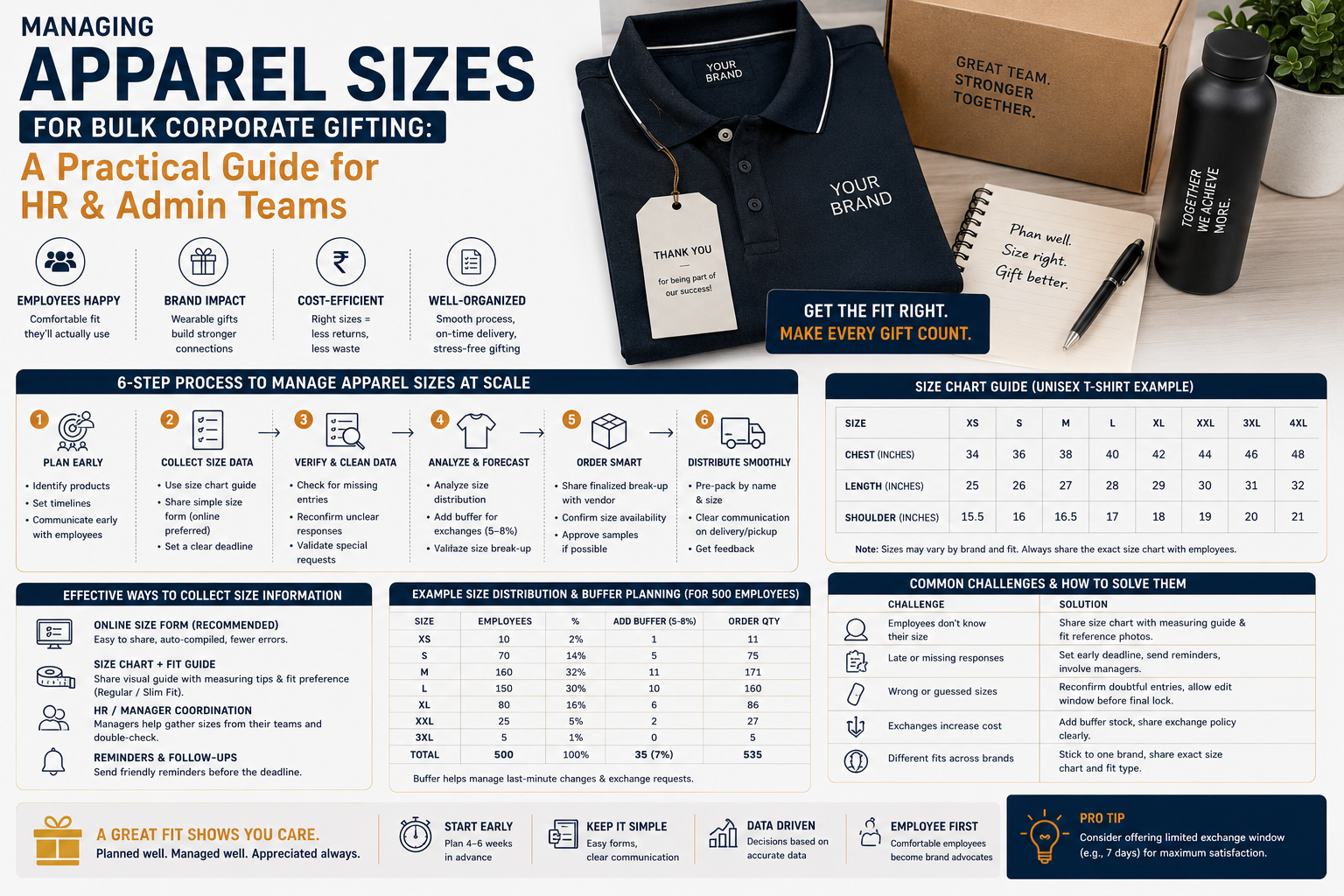
Managing Apparel Sizes for Bulk Corporate Gifting: A Practical Guide for HR & Admin Teams
Corporate apparel can be an excellent gifting option for employees, events, conferences, sales teams, onboarding programs, and company celebrations.
But ordering apparel in bulk comes with one major operational challenge: getting the sizes right.
Ordering 500 T-shirts, jackets, polos, hoodies, or corporate uniforms is very different from purchasing the same number of standard promotional products. A bottle has one size. A notebook has one size. Apparel does not.
If HR or Admin teams estimate sizes incorrectly, the organization can end up with excess inventory in some sizes, shortages in others, expensive exchanges, and employees receiving apparel that does not fit properly.
This is why apparel sizing bulk corporate gifts requires a structured approach.
The objective is not simply to collect size information. It is to create a reliable sizing system that connects employee data, garment specifications, size selection, procurement, production, quality control, and distribution.
This guide explains how HR and Admin teams can manage apparel sizes efficiently when ordering corporate clothing in bulk.
Why Apparel Sizing Is Difficult in Corporate Gifting
One of the biggest mistakes organizations make is assuming that everyone follows the same standard size.
An employee who normally wears a “M” from one brand may require an “L” from another.
Sizing can vary based on:
- Brand
- Manufacturer
- Garment style
- Fabric
- Fit
- Country sizing standards
- Product measurements
- Gender-specific cuts
- Personal preference
A T-shirt labeled Large is not necessarily the same physical size as another T-shirt labeled Large.
Therefore, simply asking employees:
“What is your T-shirt size?”
may not produce sufficiently accurate information for a large corporate order.
1. Start With the Exact Garment
Don’t collect sizes before selecting the actual apparel.
First finalize:
- Product
- Brand/manufacturer
- Garment style
- Fabric
- Fit
- Color
- Size range
Then collect employee measurements based on that specific garment’s size chart.
For example, a regular-fit polo and an oversized T-shirt may have completely different measurements even when both are labeled “L.”
The product-specific size chart should be the source of truth.
2. Share a Clear Size Chart
Once the apparel is selected, provide employees with the manufacturer’s size chart.
A typical chart may include:
| Size | Chest | Length |
|---|---|---|
| S | 38 in | 27 in |
| M | 40 in | 28 in |
| L | 42 in | 29 in |
| XL | 44 in | 30 in |
| XXL | 46 in | 31 in |
These figures are examples only. Actual measurements must come from the selected garment.
Employees should select their size based on measurements rather than relying solely on their usual clothing label.
3. Explain How Employees Should Measure
A size chart is useful only if employees understand how to use it.
HR can provide simple instructions:
Chest Measurement
Measure around the fullest part of the chest while keeping the measuring tape comfortably positioned.
Waist Measurement
Measure around the natural waist without pulling the tape excessively tight.
Length
If relevant, compare the garment length against a well-fitting garment the employee already owns.
The objective is to make the process simple enough that employees can complete it without assistance.
4. Use an Existing Well-Fitting Garment as a Reference
Some employees may not have a measuring tape available.
An alternative is to ask them to measure a garment they already own that fits well.
For example:
Step 1: Lay the existing T-shirt flat.
Step 2: Measure the chest from one side to the other.
Step 3: Compare the measurement with the vendor’s garment chart.
This can be easier than asking employees to measure their bodies directly.
However, the measurement method must match the vendor’s size-chart methodology.
5. Avoid Guessing Employee Sizes
HR teams may have access to historical apparel information, but old records should not automatically be reused.
Employees may have:
- Changed size
- Changed preferred fit
- Changed body measurements
- Changed style preference
For a new gifting campaign, give employees an opportunity to confirm their current size.
The few minutes spent collecting fresh information can prevent substantial replacement and inventory costs later.
6. Create a Centralized Size Collection Form
For large employee gifting campaigns, use a structured form instead of collecting sizes through email or messaging applications.
Useful fields include:
- Employee ID
- Employee name
- Department
- Location
- Apparel type
- Size
- Optional measurement
- Confirmation status
For example:
| Employee ID | Name | Location | Size | Status |
|---|---|---|---|---|
| EMP001 | Rahul Sharma | Delhi | L | Confirmed |
| EMP002 | Priya Mehta | Mumbai | M | Confirmed |
| EMP003 | Arjun Kapoor | Bengaluru | XL | Pending |
This makes the data easier to validate and share with the vendor.
7. Use Employee IDs to Avoid Duplicate Names
Large organizations may have employees with identical names.
For example:
Amit Kumar — EMP102
Amit Kumar — EMP381
The employee ID should connect:
Employee → Size → Product → Package
This becomes particularly important when apparel is individually packed.
A name alone may not be enough to prevent distribution mistakes.
8. Set a Size-Confirmation Deadline
Bulk apparel production requires planning.
Give employees a defined deadline to submit their sizes.
For example:
Size collection closes → Final validation → Production
Avoid leaving size selection open until the day production begins.
Late changes can create:
- Additional production work
- Inventory problems
- Delayed dispatch
- Higher costs
Once the final size list is approved, establish a data-freeze point.
9. Create a Size Distribution Report
After collecting employee sizes, summarize the requirements.
For example:
| Size | Quantity |
|---|---|
| S | 55 |
| M | 180 |
| L | 220 |
| XL | 120 |
| XXL | 35 |
| Total | 610 |
This report helps Procurement and the vendor understand the production requirement.
It also makes unusual patterns easier to identify.
If 90% of employees suddenly select XXL, for example, HR may want to review whether the correct size chart was provided.
10. Check the Distribution Before Production
A size distribution report should be reviewed before the order is finalized.
Look for:
- Unexpectedly high quantities
- Missing sizes
- Unusually low quantities
- Employee records without sizes
- Duplicate entries
- Incorrect product variants
This is an easy opportunity to identify data errors before they become physical inventory problems.
11. Consider a Size Buffer
For bulk apparel gifting, a small additional quantity can sometimes be useful.
However, the buffer should be planned carefully.
For example, if the final requirement is:
500 garments
the organization might order a limited number of additional pieces in commonly requested sizes if the budget and vendor terms make this practical.
The buffer can help with:
- Damaged garments
- Size exchange requests
- Late employee additions
- Manufacturing defects
But excessive buffer stock can create unnecessary costs and leftover inventory.
12. Don’t Assume Everyone Wants the Same Fit
Two employees with identical measurements may prefer different fits.
Some may prefer:
- Regular fit
- Slim fit
- Relaxed fit
- Oversized fit
If the campaign uses one standard garment, clearly communicate its intended fit.
This helps employees make a more informed selection.
If multiple fits are offered, the complexity of procurement increases significantly.
For large organizations, limiting the number of fit variations can make fulfillment easier.
13. Be Careful With Gender-Specific Sizing
Men’s and women’s apparel may use different sizing systems and garment cuts.
A unisex T-shirt, men’s polo, and women’s polo should not necessarily use the same size assumptions.
If gender-specific garments are offered, provide separate size charts.
For example:
Women’s polo size chart
and
Men’s polo size chart
The employee should select the appropriate product and size based on the actual measurements.
14. Choose a Product With an Appropriate Size Range
Before finalizing an apparel product, check whether its available sizes accommodate the intended employee population.
Don’t select a garment simply because it looks attractive or fits the budget.
Confirm:
- Smallest available size
- Largest available size
- Extended sizes
- Stock availability
- Production availability
- Size consistency
Inclusive sizing should be part of product selection—not an afterthought.
15. Confirm Size Availability With the Vendor
An employee may select a size that appears on the catalogue but isn’t available in the required quantity.
Before collecting employee selections, Procurement should confirm that the vendor can supply the complete size range.
Ask:
- Which sizes are currently available?
- What quantity can be produced?
- Are extended sizes available?
- Is there a different price for larger sizes?
- What is the lead time?
- Can replacement sizes be supplied later?
This prevents employees from selecting sizes that cannot be fulfilled.
16. Consider the Cost of Size Exchanges
A wrong size doesn’t necessarily mean the employee receives a free replacement.
There may be costs associated with:
- Reverse shipping
- New packaging
- Replacement apparel
- Rebranding
- Administrative handling
- Reshipping
For personalized apparel, exchanges can become even more complicated.
Before the campaign begins, establish a clear exchange policy with the vendor.
17. Separate Sizing Errors From Manufacturing Errors
Not every fit problem is an employee sizing mistake.
There is a difference between:
Employee selected the wrong size
and
Vendor supplied a garment that doesn’t match the approved size specifications
There is also a difference between:
Employee ordered XL and received XL
versus:
Employee ordered XL and received M
These cases should have different resolution processes.
Clear documentation makes dispute resolution much easier.
18. Label Individual Apparel Correctly
When distributing apparel to hundreds of employees, packaging errors can become a major problem.
Each package should ideally be identifiable through an internal reference such as:
- Employee ID
- Name
- Department
- Location
- Size
For branch-level distribution, organize packages by department or employee ID.
This reduces the risk of employees receiving another person’s apparel.
19. Conduct a Final Size-to-Package Check
Before dispatch, reconcile:
Employee list
with
Size list
with
Packed inventory
For example:
Employee EMP101 → XL → Package 101
This additional verification step is particularly valuable for personalized or individually packed apparel.
20. Plan for Remote Employees Separately
Remote employees introduce additional complexity.
Their apparel may need to be shipped directly to home addresses.
That means the gifting system may need to connect:
Employee ID → Size → Gift → Address → Tracking Number
For large campaigns, HR should maintain separate tracking for apparel size and shipping status.
This becomes especially useful when an employee reports:
“My gift arrived, but the size is incorrect.”
The team can quickly check the original size selection and shipment record.
Apparel Sizing Workflow for 500+ Employees
A practical process can look like this:
Stage 1: Product Selection
Choose the exact apparel style, fit, fabric, and manufacturer.
Stage 2: Size Chart
Obtain the official size chart.
Stage 3: Employee Communication
Explain how employees should measure and select their size.
Stage 4: Data Collection
Collect sizes through a structured form.
Stage 5: Validation
Check missing, duplicate, and unusual entries.
Stage 6: Size Distribution
Create the final size quantity report.
Stage 7: Vendor Confirmation
Confirm availability and production requirements.
Stage 8: Production
Manufacture or source apparel according to the approved size breakdown.
Stage 9: Quality Control
Check size labels, garment quality, branding, and quantities.
Stage 10: Distribution
Pack and ship according to employee and location records.
How HR Can Reduce Size-Related Problems
HR and Admin teams can make the process significantly easier by following a few principles:
Don’t Ask “What’s Your Usual Size?”
Ask employees to use the provided product-specific size chart.
Don’t Collect Sizes Through Multiple Channels
Use one controlled form.
Don’t Keep Changing the Size List
Set a clear deadline.
Don’t Assume One Size Chart Fits Every Product
Use the exact chart for the selected garment.
Don’t Ignore Extended Sizes
Make the campaign inclusive from the beginning.
Don’t Skip the Final Reconciliation
Compare employee selections against the actual packed inventory.
Common Apparel Sizing Mistakes in Corporate Gifting
Using Generic Size Charts
Different manufacturers use different measurements.
Ordering Based on Historical Data
Previous sizes may no longer be accurate.
Ignoring Fit
Regular, slim, relaxed, and oversized fits can produce different sizing experiences.
Offering Too Many Variations
Multiple products, fits, and colors increase operational complexity.
Failing to Confirm Availability
Selected sizes may not be available in the required quantity.
Not Planning for Exchanges
Size-related issues can create additional logistics costs.
Packing Without Employee-Level Identification
This increases the chance of incorrect distribution.
Final Thoughts
Managing apparel sizing bulk corporate gifts successfully requires much more than asking employees to choose S, M, L, XL, or XXL.
For HR and Admin teams, the process should begin with the actual garment and its official size chart. From there, collect employee selections through a structured system, validate the data, create a size distribution report, confirm inventory with the vendor, and establish a clear production and exchange process.
The most important principle is simple:
Never treat the size label as the measurement.
A “Medium” from one manufacturer may fit very differently from a “Medium” from another.
By focusing on actual measurements, standardized data collection, employee IDs, accurate inventory planning, and proper quality checks, organizations can significantly reduce size errors and make bulk corporate apparel gifting much easier to manage.
The goal is not simply to distribute branded clothing.
It is to ensure that every employee receives apparel that fits well, looks professional, represents the company correctly, and creates a positive gifting experience.
For large employee gifting campaigns, good sizing is not a small operational detail—it is a major part of getting the entire corporate gifting experience right.
Leave a comment