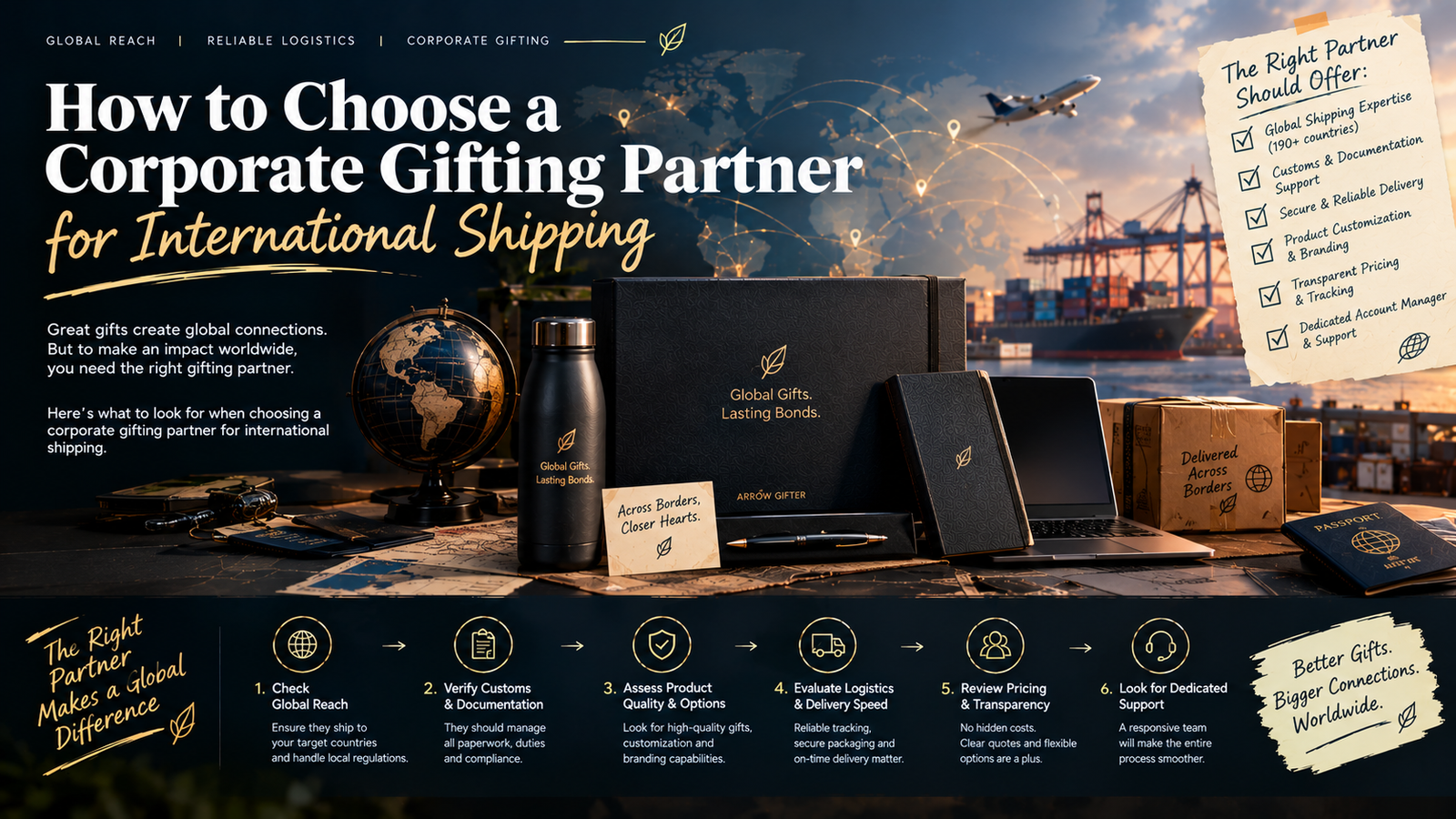
How to Choose a Corporate Gifting Partner for International Shipping
Choosing a corporate gifting vendor is relatively straightforward when every recipient is in the same city. International gifting is a different challenge.
When employees, clients, and business partners are spread across countries, Procurement teams need to evaluate far more than product quality and price. International shipping introduces customs requirements, delivery timelines, country-specific restrictions, address management, taxes, fulfilment options, tracking, and unexpected logistics costs.
That is why selecting the right international corporate gifting partner in India requires a structured procurement process.
The ideal partner should be able to combine premium product sourcing, personalisation, packaging, international fulfilment, documentation support, shipment tracking, quality control, and responsive exception management.
For Global Procurement teams, the objective is not simply to find the cheapest gifting vendor. It is to identify a partner capable of delivering a consistent experience across markets while keeping operational risk under control.

What Is an International Corporate Gifting Partner?
An international corporate gifting partner is a gifting company or fulfilment provider that can support corporate gifting programmes involving recipients in multiple countries.
Depending on the provider, services may include:
- Gift sourcing
- Product customisation
- Branding
- Packaging
- Inventory management
- International shipping
- Local fulfilment
- Employee address collection
- Customs documentation support
- Delivery tracking
- Replacement management
- Reporting
Some vendors specialise in products, while others operate more like end-to-end gifting and fulfilment partners.
Understanding exactly what a vendor manages — and what remains the client’s responsibility — is one of the first procurement questions to ask.
Why International Corporate Gifting Requires a Different Vendor
A domestic gifting supplier may be excellent at bulk orders within India but may not be equipped to manage international deliveries.
International campaigns can involve:
Multiple Countries
Each destination may have different customs, tax, shipping, and product requirements.
Multiple Currencies
Budgets and landed costs can vary by destination.
Customs and Duties
Imported goods may require declarations and may be subject to duties, taxes, or clearance charges.
Remote Recipients
Employees may receive gifts at home rather than a company office.
Delivery Exceptions
International shipments can encounter customs holds, incorrect addresses, failed delivery attempts, or carrier delays.
Product Restrictions
Some food, liquid, cosmetic, electronic, plant-based, or other products may have destination-specific restrictions.
A vendor that understands these variables can significantly reduce the operational burden on Procurement.
10 Factors to Consider When Choosing an International Corporate Gifting Partner in India
1. International Shipping Experience
Start by asking a simple question:
How much experience does the vendor have with international corporate gifting?
Do not rely only on a statement such as “We ship worldwide.”
Ask for specifics:
- Which countries do you regularly serve?
- Do you use international courier networks?
- Do you have regional fulfilment capabilities?
- How are customs issues handled?
- Who coordinates shipment exceptions?
- Can you provide tracking?
- How are returned packages managed?
A vendor that regularly handles international shipments should be able to explain its process clearly.
2. Country Coverage
“Worldwide delivery” can mean very different things from one provider to another.
Create a destination list before evaluating vendors.
For example:
- United States
- United Kingdom
- UAE
- Singapore
- Australia
- Canada
- Germany
- France
- Other priority markets
Then ask the vendor to specify whether each destination is supported through:
Direct shipping, regional fulfilment, local sourcing, or another model.
This distinction matters because the most efficient fulfilment approach can vary by country.
3. Product Selection for International Shipping
A good international gifting partner should understand that not every product is equally suitable for cross-border delivery.
Ask how the vendor evaluates products for international fulfilment.
For example:
| Product Category | Key Consideration |
|---|---|
| Stationery | Generally easy to ship |
| Apparel | Size, material and destination considerations |
| Food | Import and ingredient requirements |
| Cosmetics | Destination regulations |
| Electronics | Battery and product restrictions |
| Glass/Ceramics | Breakage risk |
| Candles | Carrier and destination acceptance |
| Leather goods | Material and destination requirements |
| Sustainable products | Material/source documentation where relevant |
The vendor should be able to identify potential problems before an order is placed.
4. Customs and Documentation Support
Customs documentation is one of the most important evaluation areas.
Ask whether the vendor can assist with:
- Commercial invoices
- Packing lists
- Product descriptions
- Product classifications
- Shipment declarations
- Country-of-origin information
- Courier documentation
- Customs queries
Procurement teams should also establish where the vendor’s responsibility ends.
For example, does the vendor merely prepare documents, or does it coordinate with the courier when customs requests additional information?
A clearly defined responsibility matrix can prevent delays.
5. Transparent Landed Cost
A product’s catalogue price is rarely the full cost of international gifting.
Your procurement model should consider:
Product + personalisation + packaging + shipping + duties/taxes where applicable + clearance charges + replacement costs + other fulfilment fees
Ask vendors to provide a transparent cost structure.
For example:
| Cost | Vendor Should Clarify |
|---|---|
| Gift | Unit price |
| Branding | Included or additional |
| Packaging | Included or additional |
| Shipping | Per shipment or weight-based |
| Customs | Included or recipient-paid |
| Duties/taxes | Treatment by destination |
| Storage | If applicable |
| Returns | Cost and process |
| Replacement | Responsibility and charges |
This makes vendor comparisons much more meaningful.
6. Personalisation at Scale
International gifting is often highly personalised.
A programme might involve:
- Employee names
- Client names
- Company logos
- Different messages
- Different gift selections
- Multiple languages
- Country-specific packaging
Ask the vendor:
- What is the maximum personalisation volume?
- What is the lead time?
- How are names validated?
- What happens when data changes?
- Is there a proofing process?
- How are spelling errors prevented?
A supplier that can process 500 personalised gifts domestically may not automatically have the operational systems required for thousands of globally distributed recipients.
7. Quality Control
International returns are expensive.
If a personalised item arrives with the wrong name or damaged packaging, replacing it can cost considerably more than replacing a domestic shipment.
Ask about the vendor’s quality-control process.
A good system may include:
Order validation → production proof → sample approval → batch QC → packing verification → dispatch
For large programmes, ask whether batch-level inspection or photographic verification is available.
8. Tracking and Reporting
Global Procurement teams should not have to chase vendors for shipment updates.
Ask whether the vendor provides:
- Tracking numbers
- Delivery status
- Exception reports
- Country-level reporting
- Failed-delivery notifications
- Delivered-recipient records
For large campaigns, a central dashboard or structured report can make reconciliation much easier.
Useful statuses include:
Pending → Approved → Processing → Personalised → Dispatched → In Transit → Customs Hold → Delivered → Exception
9. Data Handling and Privacy
International gifting frequently requires employee or client information such as:
- Name
- Address
- Phone number
- Apparel size
- Gift preferences
Procurement teams should understand how vendors collect, store, access, and share this information.
Questions to ask include:
- Who has access to recipient data?
- How long is data retained?
- Is information shared with shipping partners?
- What security controls are used?
- How are data deletion requests handled?
- Does the vendor have documented privacy procedures?
For multinational organisations, the vendor should be able to work within the client’s applicable privacy and security requirements.
10. Scalability
A vendor may perform well for a 50-person campaign but struggle with 5,000 recipients.
Evaluate the vendor based on your future requirements, not just your first order.
Ask about:
- Maximum monthly fulfilment volume
- Inventory capacity
- Multi-country campaigns
- Multiple delivery addresses
- Personalisation volume
- Peak-season capacity
- Emergency orders
- Replacement handling
This is particularly important around high-volume periods such as Diwali, year-end holidays, company anniversaries, and major conferences.
Local Sourcing vs Shipping From India
One of the most important questions for an international gifting programme is whether gifts should physically travel from India.
There are three common approaches.
Ship From India
Best when: Indian origin and craftsmanship are central to the gifting concept.
Advantages:
- Strong India-origin story
- Centralised quality control
- Consistent product selection
Challenges:
- International shipping
- Customs
- Potential duties/taxes
- Longer delivery timelines
Source Locally
Best when: recipient volume is high and delivery speed is important.
Advantages:
- Faster fulfilment
- Reduced cross-border shipping
- Potentially simpler local delivery
Challenges:
- Less direct Indian-origin connection
- Additional supplier management
Hybrid Fulfilment
A company can ship selected Indian-origin products while sourcing other components locally.
For many global programmes, this can provide a useful balance between cultural authenticity and operational efficiency.
Questions to Ask Before Signing a Vendor
Create a standard procurement questionnaire.
Ask:
- Which countries do you support regularly?
- Do you provide local fulfilment?
- How are customs issues managed?
- Who pays duties and taxes?
- Can you provide landed-cost estimates?
- How do you handle failed deliveries?
- What is your replacement policy?
- How do you protect recipient data?
- What personalisation capacity do you have?
- What are your peak-season lead times?
- Can you provide shipment tracking?
- How do you manage damaged products?
- Can you support multiple currencies?
- What reporting will Procurement receive?
- Can you provide references or relevant case examples?
The answers should be documented rather than relying solely on verbal assurances.
Create a Vendor Scorecard
A weighted scorecard makes vendor selection more objective.
| Evaluation Area | Suggested Priority |
|---|---|
| International fulfilment | Very High |
| Product quality | Very High |
| Customs support | High |
| Pricing transparency | High |
| Personalisation | High |
| Data protection | High |
| Tracking/reporting | High |
| Scalability | High |
| Customer support | High |
| Sustainability | Medium |
| Product variety | Medium |
Procurement can assign its own weightings based on business priorities.
The cheapest vendor should not automatically win if its international fulfilment capability creates higher downstream costs.
Red Flags When Choosing an International Gifting Partner
Be cautious when a vendor:
- Cannot clearly explain its international shipping process
- Gives vague answers about customs
- Cannot provide shipment tracking
- Offers unusually low pricing without explaining landed costs
- Has no clear replacement policy
- Cannot explain how recipient data is handled
- Has no contingency plan for delivery failures
- Promises every product can ship everywhere
- Cannot scale beyond small campaigns
- Provides inconsistent product specifications
- Avoids documenting responsibilities
A strong vendor should be comfortable discussing operational risks rather than simply promising that everything will be “handled.”
How to Run a Vendor Pilot
Before awarding a large global gifting programme, consider conducting a controlled pilot.
Choose a small group of recipients across several priority countries.
Test:
- Product quality
- Personalisation
- Packaging
- Shipping speed
- Customs handling
- Tracking
- Delivery experience
- Customer support
- Exception resolution
Then evaluate the results before scaling.
A pilot can reveal problems that are difficult to identify from a proposal or vendor presentation.
Build an SLA for International Gifting
Once a vendor is selected, define measurable service expectations.
An SLA can cover:
- Order processing time
- Personalisation turnaround
- Dispatch timeline
- Tracking availability
- Customer-support response
- Exception escalation
- Replacement timeline
- Reporting frequency
- Data-handling requirements
The more countries involved, the more important clearly documented service expectations become.
FAQs About Choosing an International Corporate Gifting Partner in India
What should I look for in an international corporate gifting partner in India?
Look for international shipping experience, country coverage, customs and documentation support, transparent landed costs, personalisation capability, quality control, tracking, data protection, scalability, and responsive customer support.
Is an Indian gifting company suitable for international corporate gifting?
It can be, particularly when the company has established international fulfilment capabilities and understands the operational requirements of cross-border shipments. Procurement teams should evaluate actual destination coverage rather than relying on general claims of worldwide delivery.
Should corporate gifts be shipped from India or sourced locally?
It depends on the programme. Shipping from India can strengthen the India-origin story, while local sourcing can simplify logistics. A hybrid model can combine both advantages.
How can Procurement compare international gifting vendors?
Use a weighted scorecard covering fulfilment, product quality, customs support, pricing, personalisation, data handling, tracking, scalability, and service. Evaluate total landed cost rather than product price alone.
What is the biggest mistake when selecting an international gifting vendor?
Choosing a vendor primarily on product price without evaluating international fulfilment capability. Customs issues, delivery failures, replacements, and unclear charges can quickly outweigh an initially low product price.
Final Thoughts
Choosing an international corporate gifting partner in India is fundamentally a risk-management and experience-management decision.
Global Procurement teams need a partner that can do more than supply attractive products. The right provider should understand international fulfilment, product suitability, documentation, customs processes, personalisation, packaging, recipient data, tracking, and exception management.
Before signing a long-term agreement, evaluate the vendor’s actual international capabilities, test the service through a pilot, compare landed costs, and document service expectations through a clear SLA.
The strongest partnership is not necessarily the one offering the lowest unit price. It is the one that can consistently deliver the right gift, to the right recipient, in the right country, at the right time, with predictable costs and minimal operational friction.
For organisations managing global teams and international clients, that reliability can make the difference between a gifting programme that creates administrative headaches and one that becomes a scalable part of the company’s relationship and employee-experience strategy.
Leave a comment