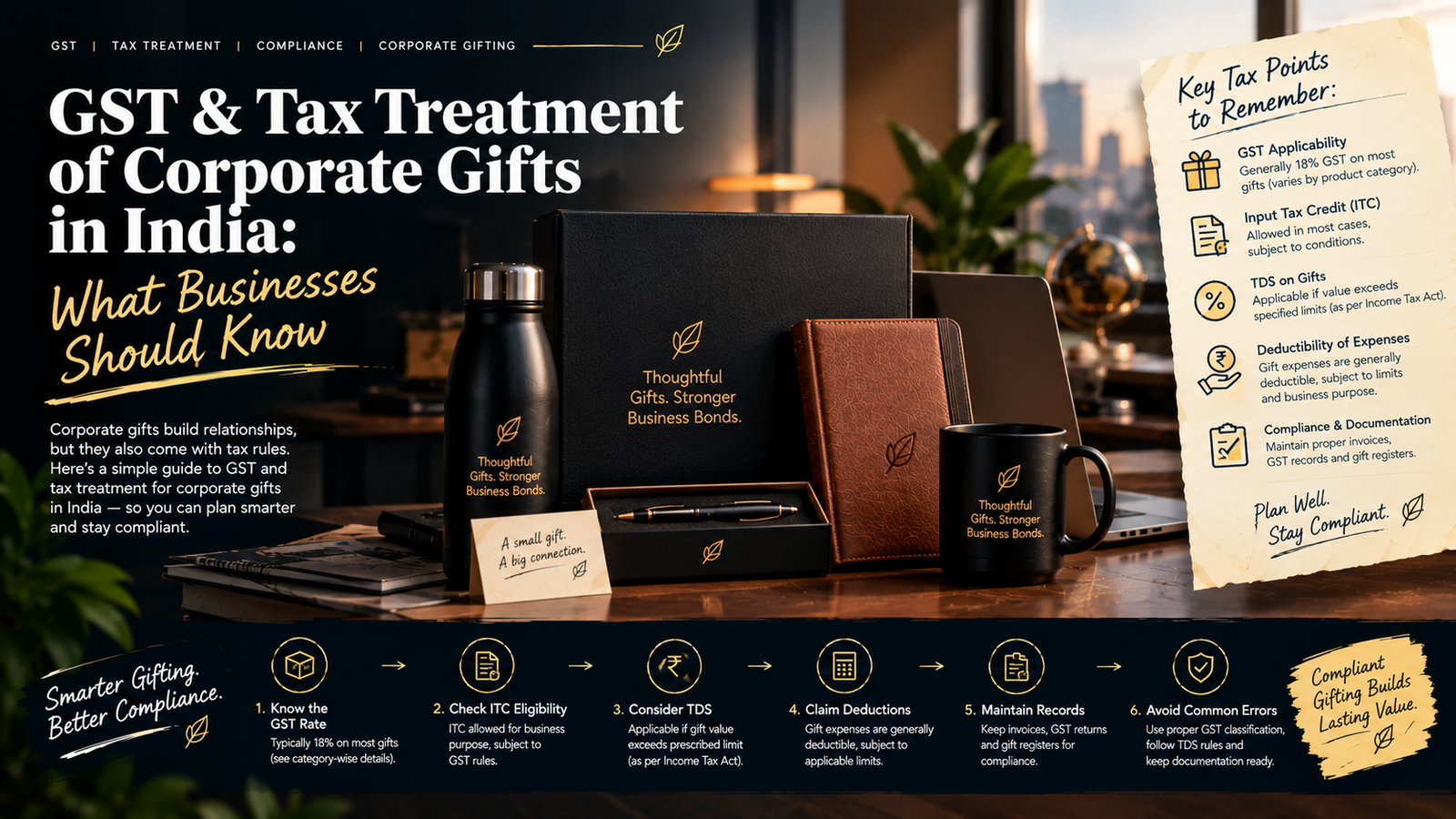
GST & Tax Treatment of Corporate Gifts in India: What Businesses Should Know
Corporate gifting is a common business expense in India. Companies purchase gifts for employees, customers, distributors, business partners and other stakeholders during festivals, milestones, conferences and special occasions.
But from a Finance or Tax/Compliance perspective, buying a corporate gift is not simply a matter of recording the invoice as an expense. Businesses need to consider GST on corporate gifts in India, input tax credit (ITC), income-tax deductibility, employee taxation and documentation.
The treatment can also differ depending on who receives the gift, why it is given, how it is purchased and whether any consideration is involved.
This guide explains the key tax considerations businesses should review before and after purchasing corporate gifts.
Important: Tax treatment can depend on the facts of a particular transaction, the nature of the product and the applicable law. Businesses should have their tax adviser confirm the treatment for material or unusual transactions.

Is GST Applicable on Corporate Gifts in India?
There is no single GST rule that says every corporate gift is automatically subject to GST.
Under the GST framework, a supply generally involves consideration, subject to specified exceptions under Schedule I. CBIC has also clarified that goods supplied free of cost without consideration generally do not constitute a supply unless they fall within Schedule I.
This distinction is important.
For example, if a company purchases 100 gift hampers from a supplier, the supplier normally makes a taxable supply to the company and charges GST according to the applicable classification and rate for the products or services supplied.
The company’s subsequent distribution of those items as free gifts needs to be considered separately.
GST on Corporate Gifts: The ITC Question
One of the most important issues for Finance teams is input tax credit on gifts.
Section 17(5)(h) of the CGST Act restricts ITC on goods or services used for goods disposed of by way of gift or free samples. CBIC’s clarification specifically states that ITC is not available to the extent inputs, input services or capital goods are used in relation to gifts or free samples distributed without consideration.
In practical terms, businesses should not assume:
“The vendor charged GST, therefore our company can claim the GST as ITC.”
The GST appearing on the purchase invoice and the company’s eligibility to claim ITC are two different questions.
Example
Suppose a company purchases corporate gift products for:
- Product value: ₹1,00,000
- GST: ₹18,000
- Invoice value: ₹1,18,000
If those products are subsequently distributed as free gifts, the Finance team needs to examine the ITC restriction under Section 17(5)(h).
The GST paid to the vendor does not automatically become recoverable as ITC merely because the company possesses a valid tax invoice.
Does the ₹50,000 Employee Gift Limit Mean No GST?
This is an area where businesses often misunderstand two separate provisions.
Schedule I of the CGST Act provides that gifts up to ₹50,000 in value in a financial year by an employer to an employee are not treated as a supply. CBIC’s GST FAQs also confirm this treatment.
Therefore, the ₹50,000 threshold is relevant when considering whether an employee gift is treated as a supply under Schedule I.
However, it should not be interpreted as a general rule that companies can claim ITC on employee gifts below ₹50,000.
The ITC restriction for goods or services disposed of by way of gift needs to be considered separately.
A simple way to remember the distinction
₹50,000 threshold → GST supply treatment for employer-to-employee gifts under Schedule I.
Section 17(5)(h) → ITC restriction for goods/services disposed of by way of gift or free samples.
Finance teams should therefore avoid treating the two rules as interchangeable.
What About Corporate Gifts Given to Clients?
Client gifts require a slightly different analysis.
If a company purchases a gift and gives it to a client without consideration, the free distribution generally needs to be evaluated under the GST supply provisions and Schedule I.
CBIC has clarified that supplies without consideration generally do not constitute supply unless they fall within Schedule I.
However, the ITC restriction relating to gifts remains important.
This means Finance teams should not automatically claim ITC simply because the gift was purchased for a genuine business purpose such as:
- Client appreciation
- Festival gifting
- Business anniversary
- Customer relationship management
- Distributor appreciation
- Sales relationship development
The business purpose of the expenditure does not by itself override the specific ITC restriction.
What About Promotional Items?
Not every item distributed free of cost should automatically be treated in exactly the same way.
Businesses sometimes distribute:
- Samples
- Promotional merchandise
- Branded pens
- Notebooks
- Calendars
- Product samples
- Event merchandise
The tax treatment depends on the facts and how the items are distributed.
CBIC has specifically clarified that free samples without consideration generally are not treated as supply, except where Schedule I applies. At the same time, Section 17(5)(h) restricts ITC relating to goods disposed of by way of gift or free samples.
Therefore, companies should document the commercial purpose and nature of the distribution rather than applying a blanket “marketing expense” label to every free item.
Is Corporate Gifting Expense Deductible Under Income Tax?
GST and income tax should be analysed separately.
For the current income-tax framework, the Income-tax Act, 2025 came into force from 1 April 2026.
Section 34 of the Income-tax Act, 2025 provides the general rule that business expenditure that is not capital or personal expenditure and is laid out wholly and exclusively for business or profession can be allowed in computing taxable business income, subject to the provisions and restrictions of the Act.
Therefore, a genuine corporate gifting expense may potentially qualify as a business deduction when it has a clear business purpose and satisfies the applicable requirements.
However, “corporate gift” does not automatically mean “tax deductible.”
The company should be able to demonstrate the commercial purpose and maintain appropriate supporting records.
What Documentation Should Finance Teams Maintain?
Documentation is one of the most important controls for corporate gifting.
For every significant gifting campaign, businesses should consider maintaining:
- Vendor tax invoice
- Purchase order
- Approval documentation
- Recipient list
- Purpose of gifting
- Occasion or business reason
- Gift quantity
- Per-unit value
- Total campaign cost
- GST charged
- Accounting treatment
- Payment records
- Delivery confirmation
- Internal gifting policy approval
For personalised gifts, records of the production or personalisation order can also be useful.
A properly documented transaction is easier to explain during an internal audit, tax review or statutory audit.
Corporate Gifts and Employee Perquisites
Employee gifts have another tax dimension: the tax treatment in the employee’s hands.
The Income Tax Department states that gifts, vouchers or tokens provided by an employer to an employee or the employee’s family members on ceremonial occasions or otherwise are treated as a perquisite when the applicable aggregate value reaches the prescribed threshold. The department currently states that gifts with an aggregate value up to ₹5,000 during the previous year are not taxable as a perquisite; amounts beyond the applicable threshold are subject to the relevant perquisite rules.
This is different from the ₹50,000 GST threshold discussed earlier.
That distinction is critical.
₹5,000 vs ₹50,000: Don’t Confuse Them
| Issue | Threshold | What It Relates To |
|---|---|---|
| Employee gift under GST | ₹50,000 per employee per financial year | Whether certain employer-to-employee gifts are treated as supply under Schedule I |
| Employee gift under income tax | ₹5,000 aggregate per year | Perquisite tax treatment for the employee |
| ITC on gifts | No general ₹50,000 ITC exemption | Section 17(5)(h) restriction needs to be considered |
These thresholds belong to different tax provisions and should not be combined into one corporate gifting rule.
Does GST Rate Depend on the Type of Gift?
Yes.
There is no universal GST rate for “corporate gifts.”
The applicable GST treatment can depend on what is actually being purchased.
For example, a corporate gifting order may contain several categories such as:
- Apparel
- Stationery
- Bags
- Electronics
- Food products
- Packaging
- Printing
- Personalisation services
Each item or service may have its own GST classification and applicable rate.
This is why Finance teams should review the vendor’s tax invoice rather than assuming that an entire hamper automatically carries one standard GST rate.
Mixed Gift Hampers Need Particular Attention
Suppose a company orders a hamper containing multiple products.
The tax treatment can depend on whether the transaction is treated as a supply of individual products, a composite supply, a mixed supply or involves separate supplies/services, depending on the actual arrangement.
For large corporate orders, Finance teams should review the invoice structure and tax classification rather than relying solely on the phrase “corporate hamper.”
What About Gift Vouchers and Coupons?
Gift cards, vouchers and coupons require separate consideration.
Their GST and income-tax treatment can depend on how the instrument is structured, what it represents and when the underlying goods or services are supplied.
Similarly, employee gift vouchers can have income-tax implications because the Income Tax Department specifically includes vouchers or tokens within its guidance on employee gifts and perquisites.
Companies should therefore avoid assuming that replacing a physical gift with a voucher automatically eliminates tax considerations.
Corporate Gifting for Clients vs Employees: A Practical Comparison
| Factor | Client Gifts | Employee Gifts |
|---|---|---|
| GST supply analysis | Required based on GST provisions | ₹50,000 Schedule I threshold is relevant |
| ITC | Section 17(5)(h) needs consideration | Section 17(5)(h) needs consideration |
| Income tax | Business-purpose deduction subject to applicable rules | Business expense plus employee perquisite considerations |
| Documentation | Recipient and business purpose | Employee records and value tracking |
| Policy checks | Client/company gifting policy | Internal HR/gifting policy |
| Taxability to recipient | Depends on recipient and circumstances | Employee perquisite rules may apply |
Common GST and Tax Mistakes in Corporate Gifting
1. Assuming every GST invoice gives automatic ITC
A valid GST invoice is necessary in many ITC situations, but it does not override blocked-credit provisions.
2. Treating ₹50,000 as an ITC limit
The ₹50,000 employee gift provision relates to GST supply treatment under Schedule I. It is not a blanket ITC allowance.
3. Assuming all corporate gifts have the same GST rate
The applicable rate depends on the goods or services involved.
4. Recording every gift as advertising
A gift’s accounting and tax treatment should reflect the actual nature and purpose of the expenditure.
5. Ignoring employee perquisite rules
Employee gifts need to be reviewed separately for income-tax implications.
6. Keeping poor recipient records
A large gifting campaign without a reliable recipient and approval trail can become difficult to defend during an audit.
7. Ignoring compliance policies
A gift given to a customer or business contact may create compliance concerns if the recipient is subject to restrictions on accepting benefits.
The Income-tax Act, 2025 also excludes certain expenditure involving benefits or perquisites where acceptance violates applicable law, rules, regulations or guidelines.
A Finance Team Checklist for Corporate Gifts
Before approving a corporate gifting campaign, Finance or Tax/Compliance teams can ask:
1. What is the purpose of the gift?
Client appreciation, employee recognition, marketing, festival gifting or another purpose?
2. Who is receiving it?
Employee, customer, distributor, vendor, prospect or another stakeholder?
3. What exactly is being purchased?
Identify every product or service included in the order.
4. What GST has the vendor charged?
Check the tax invoice and relevant classification.
5. Is ITC available?
Review Section 17(5), particularly the restriction relating to gifts and free samples.
6. Does the employee gift trigger a perquisite?
Where employees are recipients, review the applicable income-tax rules.
7. Is the expenditure genuinely business-related?
Maintain evidence showing the business purpose.
8. Has the campaign been approved?
Follow internal procurement, finance and gifting policies.
9. Is the recipient subject to a gifting restriction?
This is particularly important for regulated businesses and procurement relationships.
10. Are the records complete?
Maintain invoices, approvals, recipient information, payment records and delivery evidence.
Frequently Asked Questions
Is GST charged on corporate gifts in India?
GST may be charged by the supplier when a company purchases taxable goods or services. However, the GST treatment when the company subsequently distributes those items as gifts must be considered separately under the GST supply rules.
Can a company claim ITC on GST paid for corporate gifts?
Generally, businesses should carefully examine the ITC restriction under Section 17(5)(h) for goods or services disposed of by way of gift or free samples. CBIC has specifically clarified that ITC is not available to the extent inputs, input services or capital goods are used in relation to such gifts or free samples.
Is a gift below ₹50,000 GST-free for employees?
The ₹50,000 threshold under Schedule I concerns whether an employer’s gift to an employee is treated as a supply. It should not be interpreted as a general exemption from all GST-related or ITC considerations.
Is a corporate gift tax deductible?
A genuine business expenditure may be deductible where it satisfies the applicable conditions for business expenditure. Under the Income-tax Act, 2025, Section 34 provides the general rule for expenditure laid out wholly and exclusively for business or profession, subject to the Act’s restrictions.
Are employee gifts taxable?
Employee gifts can have perquisite implications. The Income Tax Department currently states that gifts, vouchers or tokens up to an aggregate value of ₹5,000 during the previous year are not taxable as a perquisite; gifts above the applicable threshold require review under the perquisite rules.
Final Takeaway
The tax treatment of corporate gifts in India cannot be reduced to a single GST rate or one monetary threshold.
For Finance and Tax/Compliance teams, the key is to analyse GST supply treatment, ITC eligibility, income-tax deductibility and employee perquisite taxation separately.
The most important controls are straightforward:
- Identify the recipient.
- Document the business purpose.
- Check the exact products and applicable GST.
- Review ITC restrictions before claiming credit.
- Track employee gifts separately.
- Maintain invoices and approval records.
- Review gifting policies and compliance restrictions.
- Keep the accounting and tax treatment consistent with the actual transaction.
For large corporate gifting programmes, involving the Finance or tax team at the planning stage can prevent incorrect ITC claims, incomplete documentation and unexpected tax adjustments later.
Corporate gifting can be a legitimate business activity, but the tax treatment should follow the transaction—not assumptions about what qualifies as a “gift.”
Leave a comment