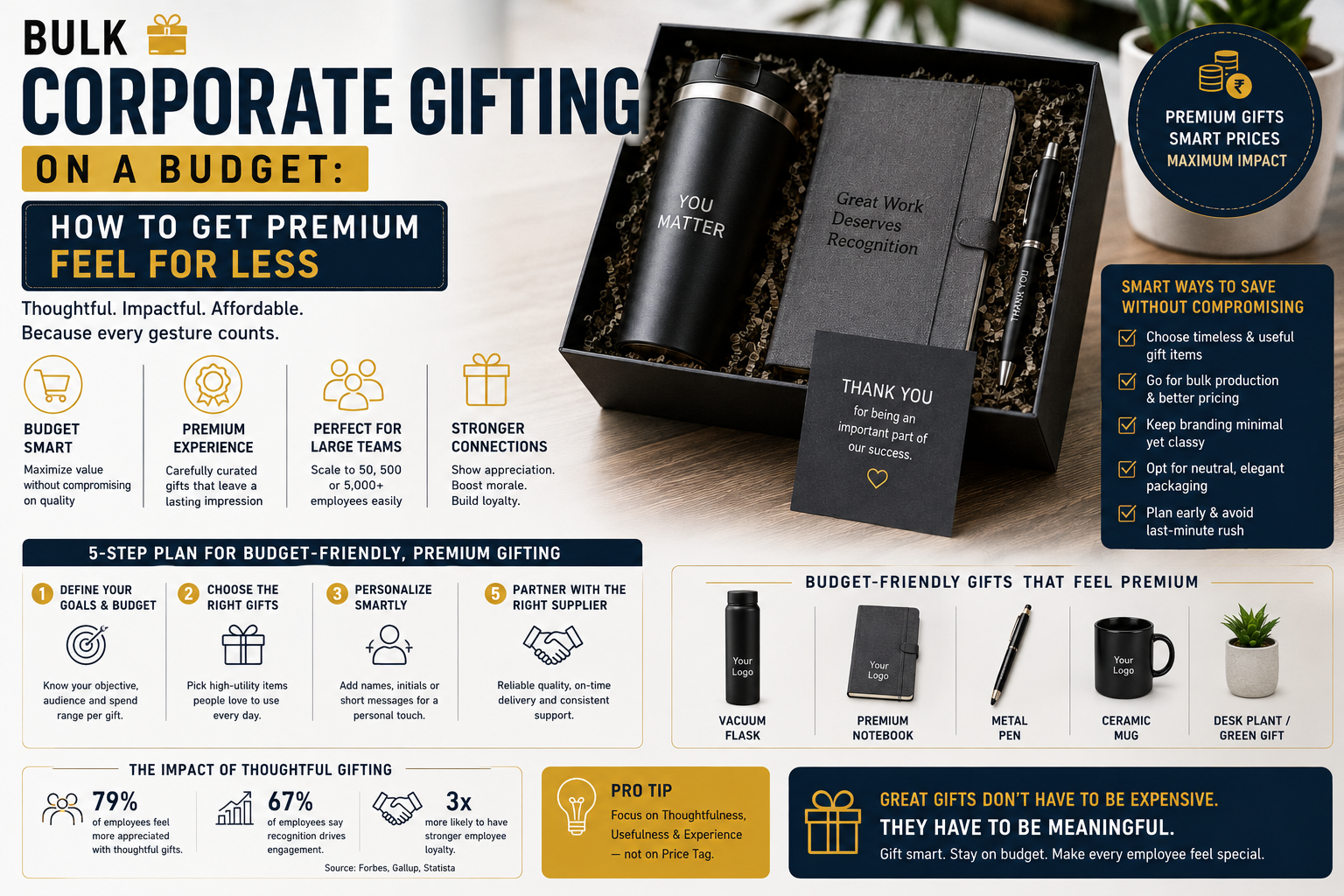
Bulk Corporate Gifting on a Budget: How to Get a Premium Feel for Less
Buying corporate gifts in bulk should create an opportunity to control costs—not force your organization to compromise on quality.
For large companies, even a small difference in the per-unit price can have a significant impact on the overall gifting budget. A ₹50 saving across 1,000 gifts represents ₹50,000, while a poor product choice can create an even bigger problem if the gifts look inexpensive or fail to deliver the intended brand experience.
This is why bulk corporate gifts budget planning requires more than simply searching for the lowest-priced product.
Procurement and HR teams need to balance quantity, quality, branding, packaging, customization, logistics, and recipient expectations while staying within a defined budget.
The good news is that premium gifting does not always require a premium price.
With the right product strategy, packaging decisions, bulk negotiations, and fulfillment process, organizations can create gifts that look and feel significantly more expensive than their actual per-unit cost.
This guide explains how large organizations can control bulk corporate gifting costs without making the final gift look cheap.

Why Bulk Corporate Gifting Gets Expensive
At first glance, bulk gifting appears straightforward:
Number of gifts × Cost per gift = Budget
In reality, the final cost can include many additional components:
- Product
- Branding
- Personalization
- Packaging
- Assembly
- Inserts or cards
- Shipping
- Regional delivery
- Taxes
- Rush charges
- Replacement costs
For example, a gift advertised at ₹400 may not actually cost ₹400 per recipient after customization, packaging, and delivery are included.
Procurement teams should therefore evaluate the total landed cost, not just the catalogue price.
Total Gifting Cost
Product + Branding + Packaging + Fulfillment + Shipping + Applicable Taxes = Total Cost
This calculation should be completed before comparing vendors.
1. Start With a Clear Per-Unit Budget
Before approaching vendors, establish a realistic target.
For example:
1,000 employees
Target budget: ₹600 per gift
Total product budget: ₹6,00,000
This gives the Procurement team a clear framework for evaluating options.
However, don’t allocate the entire budget to the product.
A better approach might be:
- Product: ₹450
- Branding: ₹30
- Packaging: ₹70
- Logistics: ₹50
This creates a controlled budget while protecting the overall presentation.
The exact allocation will vary depending on the campaign, product, location, and vendor.
2. Buy in Larger Quantities
Volume is one of the strongest advantages large organizations have.
A vendor may price a product differently at:
100 units
500 units
1,000 units
5,000 units
Ask for quantity-based pricing rather than accepting a standard catalogue price.
For example, instead of asking:
“What is the price for this product?”
ask:
“What is your best delivered price for 1,000 units with branding and packaging?”
The second question gives the vendor a clearer picture of the actual business opportunity.
3. Negotiate the Complete Package
Procurement teams sometimes negotiate only the product price.
That can be a mistake.
Suppose a vendor offers:
Product: ₹400
but charges separately for:
- Branding
- Packaging
- Assembly
- Delivery
Another vendor may quote:
₹470 all-inclusive
The second vendor could actually be more cost-effective.
Negotiate the complete package:
Product + Branding + Packaging + Fulfillment + Delivery
This makes vendor comparison much more accurate.
4. Choose Products That Look Premium Naturally
The cheapest product is rarely the best budget option.
Instead, look for products where a relatively modest price still delivers a premium appearance.
Factors that influence perceived value include:
- Material
- Weight
- Finish
- Design
- Functionality
- Packaging
- Color
- Presentation
A simple, well-designed product can look more premium than a complicated product made with low-quality materials.
For example, a clean executive notebook with quality finishing may create a better impression than a low-cost gift box containing several mediocre products.
5. Use One Strong Product Instead of Many Cheap Products
One of the most effective ways to control a bulk corporate gifts budget is to avoid unnecessary product quantity.
Instead of:
Five inexpensive products
consider:
One or two useful premium-looking products
For example:
Premium notebook + pen
may create a stronger impression than:
Notebook + keychain + cheap bottle + miscellaneous accessories
The recipient usually remembers the overall quality—not how many items were inside the box.
6. Invest in Packaging Strategically
Packaging has a significant effect on perceived value.
A relatively affordable product can feel substantially more premium when presented properly.
Consider:
- Rigid boxes
- Branded sleeves
- Custom inserts
- Quality paper
- Clean product arrangement
- Premium message cards
However, expensive packaging isn’t always necessary.
A simple:
Premium-looking box + branded sleeve + well-designed card
can create a sophisticated presentation without dramatically increasing the budget.
The goal is perceived value, not unnecessary packaging expense.
7. Use Branding Carefully
More branding does not automatically make a corporate gift better.
In fact, excessive branding can make a product feel promotional rather than premium.
For budget-conscious premium gifting, consider:
- Subtle logo placement
- Small engraving
- Minimal printing
- Branded packaging
- Personalized message cards
A restrained branding approach can make the gift feel more like a premium lifestyle product.
8. Reduce Expensive Customization
Personalization can add significant costs to large orders.
If the budget is tight, consider whether individual customization is actually necessary.
Instead of personalizing every product, use:
Standard product + company branding + personalized message card
or:
Standard product + premium branded packaging
This preserves a degree of personalization while reducing production complexity.
For large employee campaigns, this can be especially useful.
9. Select Products With Low Customization Costs
Different products have different branding costs.
Before selecting a product, ask vendors:
- What branding method is available?
- Is setup charged separately?
- Is there a minimum order quantity?
- Does personalization increase production time?
- Is packaging included?
The ideal budget product is not simply inexpensive to buy.
It is inexpensive to brand, package, and fulfill at scale.
10. Consider Seasonal and Ready-Stock Products
Ready-stock products can help control both price and timeline.
Products already available in inventory may reduce:
- Production time
- Custom manufacturing costs
- Urgent sourcing charges
This can be particularly useful for festive gifting campaigns where demand is high.
However, Procurement should confirm actual stock before finalizing the order.
A catalogue showing a product does not necessarily mean the required quantity is immediately available.
11. Use a Limited Product Selection
Large organizations often have multiple recipient groups.
Instead of creating separate gifts for every department, consider a common core product with limited variations.
For example:
All employees → Premium bottle
Managers → Premium bottle + notebook
Leadership → Separate executive gift
This simplifies:
- Procurement
- Inventory
- Branding
- Packaging
- Quality control
- Delivery
It can also improve negotiating power because larger quantities are concentrated around fewer products.
12. Negotiate Through Volume Consolidation
If your company has multiple offices or departments ordering independently, consolidate purchasing where possible.
For example:
Delhi office: 300 units
Mumbai office: 250 units
Bengaluru office: 400 units
Instead of negotiating three separate orders, Procurement may be able to negotiate based on:
950 total units
This gives the vendor greater volume visibility and may improve pricing.
The logistics strategy can still remain location-specific.
13. Plan Early to Avoid Rush Charges
Last-minute orders often cost more.
Urgent requirements can create additional charges for:
- Express production
- Priority branding
- Expedited packaging
- Air shipping
- Local delivery
- Overtime fulfillment
Planning ahead allows Procurement teams to negotiate standard rates and select more economical logistics options.
Even a few extra days can sometimes make a meaningful difference.
14. Optimize Delivery Costs
Shipping can become a major part of large gifting campaigns.
Instead of automatically sending individual packages, evaluate:
Branch Consolidation
Send multiple gifts to one office for internal distribution.
Direct-to-Employee Shipping
Useful for remote employees.
Regional Fulfillment
Use appropriate fulfillment points for different regions where practical.
Scheduled Bulk Dispatch
Group shipments where timing allows.
The cheapest delivery method depends on the recipient structure, geography, urgency, and package size.
15. Avoid Oversized Packaging
Packaging isn’t just about appearance.
Large boxes increase:
- Material usage
- Storage requirements
- Shipping volume
- Handling complexity
Choose packaging that fits the product appropriately.
A compact, well-designed box can look more premium while reducing logistics costs.
This is particularly valuable when sending thousands of gifts.
16. Use a Cost-Per-Recipient Model
Procurement teams should calculate the real cost per recipient.
For example:
| Cost Component | Per Gift |
|---|---|
| Product | ₹420 |
| Branding | ₹25 |
| Packaging | ₹60 |
| Logistics | ₹45 |
| Total | ₹550 |
This provides a much more accurate view of the campaign.
It also makes vendor comparisons easier.
Instead of asking:
“Which vendor has the cheapest product?”
ask:
“Which vendor provides the best complete gifting experience within our target cost per recipient?”
17. Compare Vendors on Value, Not Just Price
A low quote can hide important differences.
When comparing vendors, evaluate:
- Product quality
- Customization
- Packaging
- Delivery capability
- Lead time
- Replacement policy
- Quality control
- Communication
- Previous corporate experience
A slightly higher per-unit cost may be justified if it significantly reduces delivery problems or quality issues.
18. Ask for Samples Before a Large Order
Budget control does not mean skipping quality checks.
Before placing a large order, request a sample whenever practical.
Evaluate:
- Product quality
- Branding
- Packaging
- Material
- Finish
- Overall presentation
A ₹20 saving per unit is not useful if the final product creates dissatisfaction among 2,000 employees.
19. Build a Tiered Gifting Strategy
Not every recipient needs the same gift.
A tiered approach can optimize the budget.
For example:
Tier 1 — Employees
₹400–₹600
Tier 2 — Managers
₹700–₹1,000
Tier 3 — Leadership or VIP Clients
₹1,500+
This allows HR and Procurement to maintain an overall gifting budget while allocating more resources to strategically important recipients.
20. Focus on Utility
One of the easiest ways to make affordable gifts feel valuable is to choose products recipients can actually use.
Useful categories may include:
- Premium bottles
- Notebooks
- Pens
- Desk accessories
- Travel organizers
- Tech accessories
- Bags
- Lifestyle products
A useful product can create ongoing brand exposure without requiring an expensive price tag.
How to Make a ₹500 Corporate Gift Feel More Premium
Imagine your target budget is ₹500.
Instead of purchasing five low-cost products, consider:
₹350–₹400 quality product
₹50–₹75 premium packaging
₹25–₹50 branding/message
The result can feel substantially more premium than a collection of inexpensive items.
The important principle is:
Spend on what the recipient sees, touches, and uses.
A Practical Bulk Gifting Budget Strategy
For a large organization, use the following process.
Step 1: Define the Budget
Set the maximum cost per recipient.
Step 2: Define the Recipient
Employee, client, partner, manager, or executive.
Step 3: Shortlist Products
Select three to five suitable options.
Step 4: Calculate Landed Cost
Include product, branding, packaging, shipping, and taxes.
Step 5: Request Bulk Pricing
Ask for pricing at different quantity levels.
Step 6: Compare Vendors
Evaluate total value rather than product price alone.
Step 7: Approve a Sample
Check quality and presentation.
Step 8: Finalize Data and Packaging
Avoid late changes.
Step 9: Execute in Batches
Use controlled fulfillment and delivery.
Step 10: Review the Campaign
Compare actual spending against the planned budget.
Budget-Friendly Premium Corporate Gift Ideas
Depending on the target price range, organizations can explore:
Under ₹300
- Branded notebooks
- Quality pens
- Compact desk accessories
- Simple lifestyle products
₹300–₹500
- Premium notebooks
- Insulated bottles
- Executive stationery sets
- Curated mini gift sets
₹500–₹1,000
- Premium drinkware
- Executive organizers
- Quality bags
- Curated gift boxes
₹1,000+
- Premium executive sets
- Luxury lifestyle products
- High-quality travel accessories
- Bespoke corporate hampers
Actual pricing varies based on quantity, material, branding, packaging, customization, taxes, and delivery requirements.
Common Bulk Gifting Budget Mistakes
Choosing Based Only on Catalogue Price
The lowest product price doesn’t necessarily produce the lowest delivered cost.
Overcomplicating the Gift
Too many products can increase packaging and logistics costs.
Overspending on Packaging
Premium packaging should enhance the gift without consuming an unreasonable portion of the budget.
Ignoring Shipping
A low-cost product can become expensive when shipping thousands of individual packages.
Making Too Many Product Variations
Multiple variants increase complexity and can reduce bulk purchasing efficiency.
Waiting Until the Last Minute
Urgency frequently creates avoidable costs.
Skipping Quality Control
A budget-friendly gift still needs to meet an acceptable quality standard.
Final Thoughts
Managing a bulk corporate gifts budget is not about finding the cheapest gift available.
It is about maximizing perceived value per rupee.
Procurement and HR teams can achieve a premium gifting experience by selecting products with strong utility and quality, negotiating based on volume, consolidating purchasing, simplifying customization, investing strategically in packaging, and controlling delivery costs.
The most important calculation is not:
“How cheaply can we buy this?”
It is:
“How much recipient value can we create within our cost per recipient?”
A well-designed ₹500 corporate gift can feel considerably more valuable than its price when the product, branding, packaging, and presentation work together.
For large organizations, the winning strategy is therefore simple:
Buy smarter, not merely cheaper.
With careful planning and the right corporate gifting partner, organizations can manage thousands of gifts while maintaining quality, controlling costs, and delivering a premium experience at scale.
Leave a comment