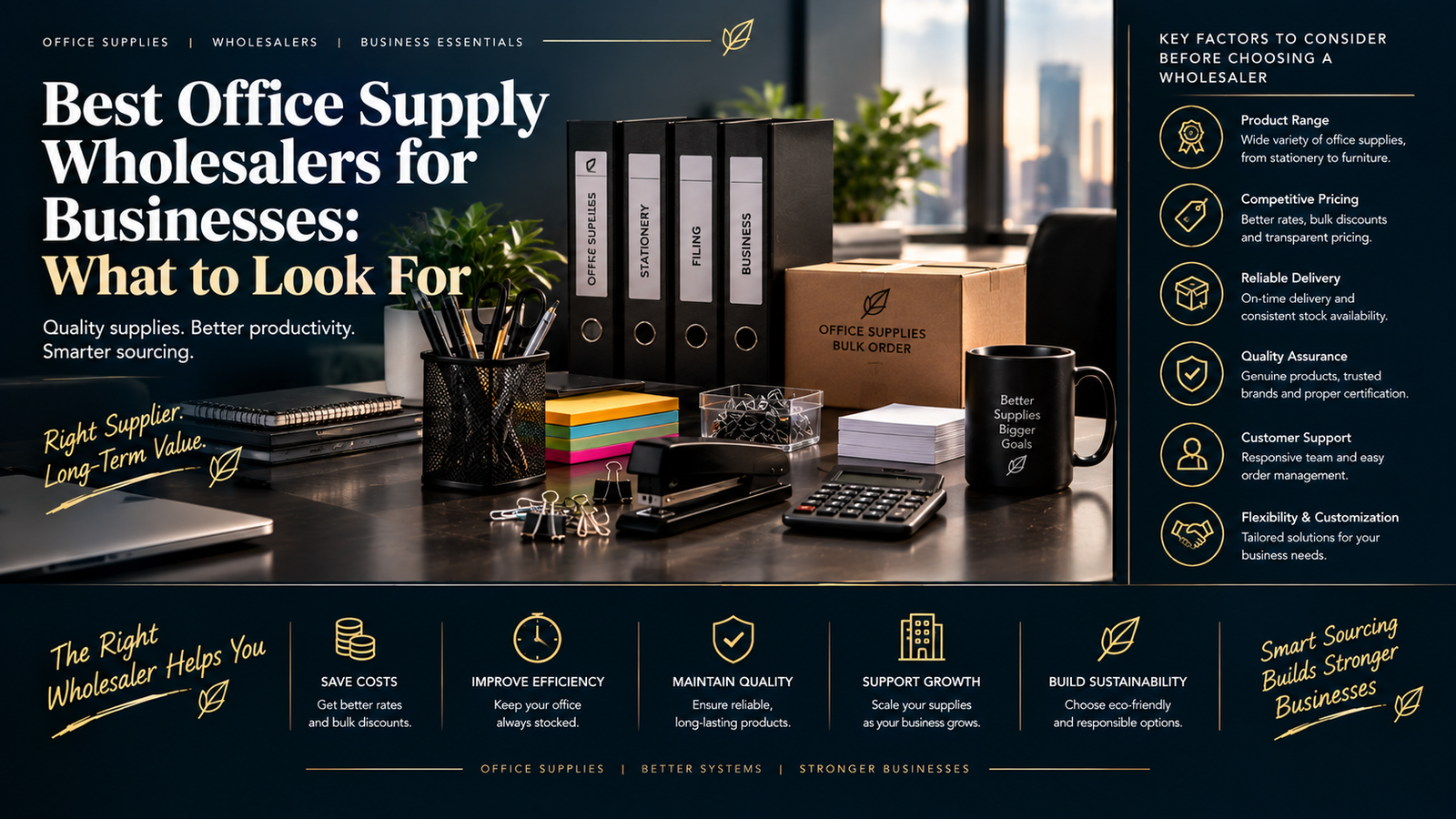
Best Office Supply Wholesalers for Businesses: What to Look For
Running an office smoothly depends on having the right supplies available when employees need them. From notebooks, pens, printer paper, and filing products to desk accessories and everyday workplace essentials, businesses require a dependable supply process to avoid unnecessary delays and spending.
Choosing the right office supply wholesaler can help organisations simplify purchasing, maintain consistent product quality, and manage recurring expenses. However, the cheapest supplier is not always the best choice. Product availability, delivery reliability, transparent pricing, invoice accuracy, and customer support all influence the overall value a wholesaler provides.
For office managers and procurement teams, the goal is to find a supplier that meets daily operational needs while supporting long-term cost control.
This guide explains what to look for when comparing office supply wholesalers, how to evaluate quotations, which questions to ask before placing an order, and how to build a more efficient procurement process.

What Is an Office Supply Wholesaler?
An office supply wholesaler sells workplace products in bulk or at business-oriented prices. These products may include stationery, writing instruments, paper products, filing accessories, desk organisers, printer consumables, and other office essentials.
Unlike a retailer that primarily serves individual customers, a wholesaler may offer volume-based pricing, bulk order processing, recurring supply arrangements, and account support for business buyers.
Depending on the supplier, businesses may also be able to source customised stationery, branded merchandise, office accessories, and selected employee welcome-kit products.
A suitable wholesaler can be particularly useful for organisations that purchase office essentials regularly across one or more locations.
Why Choosing the Right Office Supply Wholesaler Matters
Office supplies may appear to be small purchases, but frequent orders can add up over time. Managing multiple suppliers, chasing delayed deliveries, and repeatedly correcting invoices can also create unnecessary administrative work.
The right supplier can help your organisation:
- Control purchasing costs: Compare competitive prices and suitable bulk discounts.
- Maintain availability: Reduce the risk of essential items running out.
- Simplify procurement: Consolidate compatible purchases through fewer suppliers.
- Improve consistency: Standardise commonly used products across departments.
- Reduce administrative work: Establish repeat-order processes and clear invoicing.
- Support business growth: Handle changing quantities as your workforce expands.
The value of a wholesaler should therefore be assessed through its overall performance, not just its advertised prices.
1. Evaluate the Range of Products Available
Start by checking whether the supplier stocks the products your organisation uses most frequently.
Common office supply categories include:
| Category | Examples | Typical Business Use |
|---|---|---|
| Writing supplies | Pens, pencils, markers, highlighters | Daily office work |
| Paper products | Printer paper, notebooks, notepads | Documentation and meetings |
| Filing and storage | Folders, binders, document holders | Record management |
| Desk accessories | Organisers, staplers, paper clips | Workplace organisation |
| Printing essentials | Compatible consumables and related accessories | Office printing |
| Meeting supplies | Whiteboard markers, sticky notes, presentation materials | Meetings and collaboration |
| Office accessories | Desk mats, pen stands, selected workspace products | Employee workstations |
A broad catalogue can reduce the need to purchase from several suppliers. However, a large product range is useful only if the wholesaler can maintain suitable quality and availability.
Ask whether frequently ordered products are normally kept in stock and whether alternatives can be supplied when an item becomes unavailable.
2. Compare Wholesale Pricing and Total Purchasing Costs
Price is an important consideration for procurement teams, particularly when supplies are purchased every month.
However, comparing only the unit price can produce misleading results. One wholesaler may offer a lower product price but charge more for delivery, while another may include delivery above a minimum order value.
Request quotations that clearly identify:
- Unit prices
- Minimum order quantities
- Bulk discount thresholds
- Delivery and handling charges
- Applicable taxes
- Payment terms
- Price validity periods
- Additional charges for special orders
For recurring purchases, compare the total cost of ownership over a realistic period.
For example, consider two suppliers offering the same type of notebook. Supplier A has a lower unit price but requires a large minimum order. Supplier B charges slightly more but allows smaller deliveries and more flexible replenishment.
The better option depends on your consumption rate, storage capacity, cash-flow requirements, and risk of excess inventory.
Practical tip: Compare suppliers using the same product specifications, quantities, delivery locations, and payment assumptions.
3. Check Product Quality and Consistency
Office supplies are used repeatedly, so inconsistent quality can become frustrating and expensive.
A pen that leaks, paper that jams in printers, or folders that tear easily may create problems beyond the original purchase cost.
Before committing to a large order, evaluate product quality through samples or a small trial order where practical.
Consider the following:
- Materials: Are products durable enough for their intended use?
- Functionality: Do the products perform reliably?
- Consistency: Are repeat orders likely to match the approved specifications?
- Compatibility: Are printer-related products suitable for your equipment?
- Packaging: Will products arrive in usable condition?
- Replacement process: How are defective or incorrect items handled?
For high-volume purchases, document the preferred brand, model, size, material, and other specifications. This helps prevent unexpected substitutions during repeat orders.
If a supplier proposes an alternative product, ask for approval before the substitution is made.
4. Assess Stock Availability and Order Fulfilment
A competitive quotation is of limited value if the supplier cannot deliver essential supplies when required.
Ask potential wholesalers how they manage stock, replenishment, and backorders.
Useful questions include:
- Which products are regularly stocked?
- How often are stock levels updated?
- What happens when an item is unavailable?
- Can recurring orders be scheduled?
- Are partial deliveries permitted?
- How are backorders communicated?
- Can urgent requirements be accommodated?
For everyday essentials such as paper, pens, and printer consumables, consider maintaining a list of critical products that should never run out.
A wholesaler that communicates stock shortages early gives procurement teams more time to arrange alternatives.
Avoid assuming that an item is available simply because it appears in an online catalogue. Confirm availability for important or high-volume orders.
5. Evaluate Delivery Speed and Reliability
Reliable delivery is particularly important for organisations with several departments, branches, or operational locations.
Before choosing an office supply wholesaler, clarify its delivery coverage, normal lead times, dispatch process, and arrangements for urgent orders.
Check whether the supplier can manage:
- Regular deliveries to a central office
- Deliveries to multiple branches
- Scheduled replenishment
- Bulk deliveries
- Smaller repeat orders
- Shipment tracking where available
- Delivery confirmations
- Resolution of missing or damaged items
For businesses operating across India, verify service coverage for every required location rather than assuming that nationwide delivery is available for all products.
Also establish what happens if a delivery is delayed. A clear escalation process can help office managers resolve supply shortages without repeatedly contacting different departments.
6. Review Minimum Order Quantities and Storage Requirements
Wholesale pricing often encourages larger orders, but bulk purchasing is not always economical.
Ordering too much can tie up working capital, occupy valuable storage space, and increase the risk of waste when product requirements change.
Before agreeing to minimum order quantities, review your actual consumption.
For example, an office that uses a predictable quantity of printer paper each month may benefit from scheduled bulk replenishment. A smaller team with limited storage may be better served by frequent, smaller deliveries.
Consider:
- Monthly consumption
- Available storage
- Product shelf life, where applicable
- Changes in employee headcount
- Seasonal requirements
- Minimum order values
- Delivery frequency
The objective is to balance wholesale savings with practical inventory management.
7. Check Invoicing, Payment Terms, and Business Documentation
Procurement teams need suppliers that can support clear purchasing records and straightforward accounts payable processes.
Before placing a recurring order, confirm that the wholesaler can provide the documentation your organisation requires.
Depending on your company’s procedures, this may include:
- Formal quotations
- Purchase order references
- Itemised invoices
- Applicable tax details
- Delivery notes
- Credit terms, if offered
- Payment receipts
- Records of returns or credit notes
Indian businesses should verify relevant GST and invoicing details according to their own accounting requirements.
Also clarify payment expectations. Some suppliers require advance payment, while others may offer approved credit arrangements to eligible business customers.
Do not assume credit terms will be available automatically. Confirm them in writing before building them into your procurement plan.
8. Look for Reliable Customer Service
Good customer service matters when orders are incorrect, supplies are unavailable, or delivery dates change.
Evaluate how the wholesaler handles enquiries before you commit to a long-term relationship.
A dependable supplier should provide clear answers about product specifications, pricing, stock availability, and delivery schedules.
Check whether you will have access to:
- A dedicated account contact, where available
- Clear order confirmations
- Timely updates about delays
- A defined process for returns and replacements
- Support for invoice corrections
- Assistance with repeat orders
You can learn a great deal from the initial purchasing experience. If basic questions remain unanswered or quotations repeatedly contain errors, managing larger orders may become difficult.
9. Consider Online Ordering and Repeat-Purchase Features
Digital ordering tools can make office procurement more efficient, especially for teams that purchase the same products regularly.
Depending on the wholesaler, useful features may include online catalogues, saved order lists, downloadable quotations, order history, invoice access, and shipment updates.
These features can help office managers reduce manual work and maintain more consistent purchasing records.
However, technology should support reliable service rather than replace it. A convenient ordering platform is not enough if the products are frequently unavailable or the delivery process is unreliable.
Ask whether the supplier can accommodate your organisation’s purchase approval process and whether authorised employees can access the information they need.
10. Check Sustainability and Responsible Purchasing Options
Many organisations are reviewing how everyday procurement affects waste, resource use, and corporate sustainability goals.
If sustainability is important to your business, ask wholesalers about relevant product options and supporting information.
Possible considerations include:
- Recycled-content paper
- Reusable desk accessories
- Durable products designed for longer use
- Reduced packaging
- Refillable writing instruments
- Products with credible environmental certifications, where applicable
Avoid relying on broad claims such as “eco-friendly” without checking what they mean. Look for specific product information and credible supporting documentation.
The goal is to select suitable products that meet workplace needs while aligning with your organisation’s purchasing priorities and budget.
11. Watch for Warning Signs Before Choosing a Wholesaler
Not every supplier will be suitable for a long-term business relationship.
Pay attention to warning signs such as:
- Vague or incomplete quotations
- Unclear product specifications
- Repeated changes to confirmed prices
- Unexplained substitutions
- Unrealistic delivery promises
- Inconsistent invoicing
- No clear process for damaged or incorrect goods
- Reluctance to provide relevant business documentation
A single issue may be resolvable, but repeated problems can indicate that the supplier’s processes are not suitable for your organisation.
For significant orders, consider testing a new wholesaler with a smaller purchase before transferring a large share of your procurement spend.
12. Create a Supplier Evaluation Scorecard
A consistent scorecard makes it easier to compare shortlisted wholesalers objectively.
You can score each supplier from 1 to 5 against the following criteria.
| Evaluation Criteria | Suggested Weight |
|---|---|
| Product quality and consistency | 25% |
| Total purchasing cost | 20% |
| Stock availability | 15% |
| Delivery reliability | 15% |
| Customer service | 10% |
| Invoicing and documentation | 10% |
| Ordering convenience | 5% |
These weights are illustrative. Adjust them to reflect your organisation’s priorities.
For example, a business with strict operational deadlines may place greater weight on delivery reliability. A cost-sensitive organisation with predictable consumption may prioritise total cost and product consistency.
Use the same scorecard for each supplier, and support your scores with evidence from quotations, samples, trial orders, and service records.
13. Build a Long-Term Relationship With Your Supplier
Once you have selected a suitable office supply wholesaler, clear communication can improve the purchasing process over time.
Share your preferred product specifications, ordering schedule, delivery locations, and approval requirements. Keep a record of frequently ordered items so that repeat purchases are easier to prepare.
It is also helpful to review supplier performance periodically.
Track practical measures such as:
- Percentage of orders delivered on time
- Frequency of incorrect or damaged items
- Price changes
- Order fulfilment accuracy
- Response times
- Invoice correction requests
Regular reviews help you identify problems early and determine whether the supplier continues to meet your requirements.
Frequently Asked Questions
What should businesses look for in an office supply wholesaler?
Businesses should evaluate product quality, pricing, stock availability, delivery reliability, minimum order quantities, invoicing, customer service, and the supplier’s ability to handle recurring requirements.
Is buying office supplies wholesale always cheaper?
Not always. Bulk purchasing may reduce unit costs, but minimum quantities, storage costs, excess inventory, delivery charges, and product waste can reduce the savings. Compare the total cost rather than the unit price alone.
Can one wholesaler supply all office essentials?
Some wholesalers offer a broad selection of stationery, paper products, desk accessories, and related supplies. Others specialise in specific categories. Choose based on product availability, quality, and fulfilment capabilities rather than catalogue size alone.
How can procurement teams reduce office supply costs?
Standardise frequently used products, consolidate suitable orders, monitor consumption, compare itemised quotations, avoid unnecessary stock, and review supplier performance regularly.
Should a business sign a long-term supply agreement?
A long-term agreement may be useful when product requirements and consumption are predictable. Before committing, review pricing conditions, delivery commitments, minimum quantities, termination terms, and how product substitutions will be handled.
Final Thoughts
Choosing the right office supply wholesaler helps office managers and procurement teams maintain essential supplies while keeping purchasing organised and costs under control.
The best approach is to define your requirements, compare complete quotations, test product quality, confirm stock and delivery capabilities, and verify the supplier’s invoicing and support processes. A consistent evaluation method also makes it easier to justify purchasing decisions and identify opportunities for improvement.
For businesses that regularly purchase stationery, workplace accessories, or branded office products, supplier reliability matters just as much as competitive pricing. A well-managed supplier relationship can simplify routine procurement and leave teams with more time to focus on core business operations.
Leave a comment