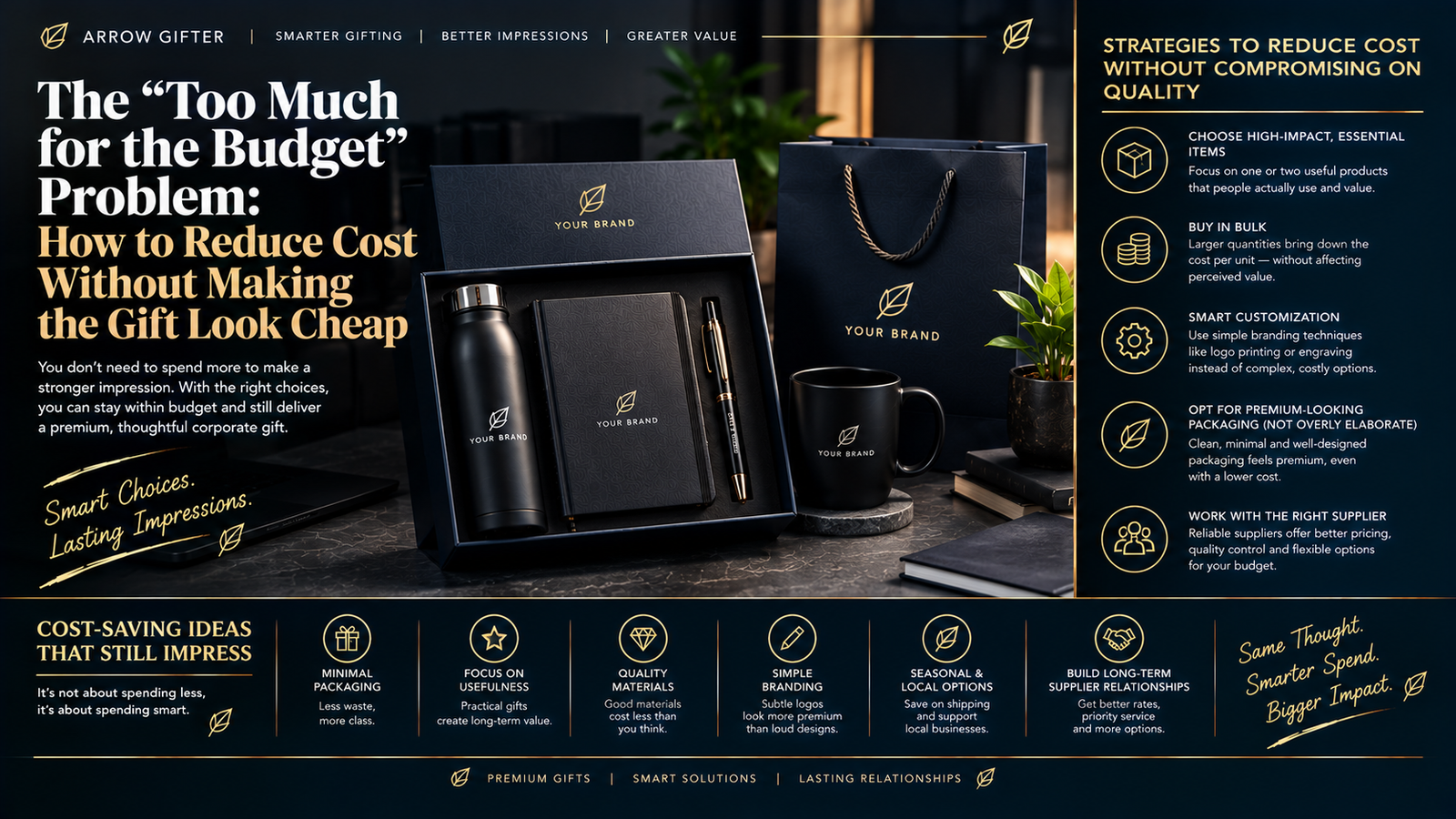
The “Too Much for the Budget” Problem: How to Reduce Cost Without Making the Gift Look Cheap
Corporate gifting budgets can become difficult to manage when expectations are high but the available spend is limited. Procurement teams are often expected to deliver gifts that look professional, reflect the company’s brand, and leave a positive impression on employees or clients—all without exceeding the approved budget.
The challenge is that reducing costs in the wrong places can make a gift look ordinary, poorly finished, or hastily assembled. Choosing cheaper products, cutting packaging quality, or adding several low-value items may reduce the initial quotation but weaken the overall presentation.
The smarter approach is to focus on affordable premium corporate gifts: thoughtfully selected products that combine practical value, coordinated design, restrained branding, and attractive packaging at a controlled cost.
For Procurement teams, the objective is not simply to spend less. It is to make every rupee contribute to the recipient’s experience.

What Are Affordable Premium Corporate Gifts?
Affordable premium corporate gifts are products or gift sets that offer a refined appearance and useful functionality without requiring a luxury-level budget. Their perceived quality comes from thoughtful selection, consistent presentation, suitable materials, and attention to detail—not necessarily from a high price tag.
For example, a quality notebook paired with a well-finished pen and a personalised message card may feel more considered than a larger box containing several unrelated promotional products.
Affordable premium gifting can work for employee welcome kits, client appreciation gifts, work anniversaries, corporate events, festive hampers, and business partner gifting.
The key is to decide what makes the gift valuable to its recipient before deciding how much to spend.
Why Corporate Gifts Can Look Cheap After Budget Cuts
When a gifting budget is reduced, teams may focus on the unit price rather than the complete presentation. This can create several avoidable problems.
1. Product quality becomes inconsistent
Combining one good product with several visibly inferior items can make the entire gift feel less cohesive. Materials, finishes, and durability should be reasonably consistent across the set.
2. Packaging is treated as an unnecessary expense
Packaging protects products and creates the first impression. A poorly sized box, loose items, excessive filler, or damaged corners can make a gift look less professional, even when the contents are useful.
3. Too many products are included
Adding inexpensive items to make a box appear full often increases costs without improving the experience. Recipients may value three useful products more than eight items they rarely use.
4. Branding becomes excessive
Large logos on every item can make a gift resemble a promotional giveaway. Restrained branding, consistent placement, and suitable colours often create a more polished result.
5. Last-minute purchasing limits the options
Urgent orders can restrict product availability, packaging choices, and customisation methods. They may also introduce rush charges or require compromises that could have been avoided with earlier planning.
10 Ways to Reduce Corporate Gifting Costs Without Losing the Premium Feel
Procurement teams can use these strategies to control spending while maintaining a professional gifting experience.
1. Reduce the number of items, not the quality of the main product
Start by identifying the most important item in the gift set. Build the rest of the selection around it rather than treating every product as equally necessary.
For example, a client appreciation gift might feature a quality notebook, a refined pen, and a personalised card. Removing an unrelated low-cost accessory could free up budget without weakening the overall presentation.
For employee gifting, a durable bottle or useful desk accessory may provide more lasting value than several novelty products.
Procurement tip: Ask whether each item contributes to usefulness, personalisation, the occasion, or the presentation. If it does none of these, remove it.
2. Choose products with a premium finish at a practical price
A product does not need to be expensive to look well made. Consider material quality, colour consistency, construction, weight, usability, and finishing when comparing options.
A cleanly finished metal pen, a notebook with a durable cover, or a reusable bottle with a coordinated design may provide a professional appearance without requiring a luxury brand.
However, do not judge products by photographs alone. Request samples where practical and compare the actual finish before approving the order.
3. Use simple, coordinated packaging
Premium packaging does not always require elaborate boxes, multiple ribbons, magnetic closures, and decorative layers.
A sturdy, appropriately sized box with a clean insert, coordinated colours, and a well-designed message card can look polished while limiting material and assembly costs.
To improve packaging efficiency:
- Select box dimensions that fit the chosen products.
- Use inserts that keep items organised and secure.
- Avoid unnecessary decorative fillers.
- Choose a limited colour palette.
- Consider reusable or recyclable materials where appropriate.
- Check that packaging protects products during shipping.
The goal is to make the gift feel intentional, not excessively decorated.
4. Standardise products across bulk orders
Procurement teams can often simplify sourcing by choosing a common product combination for a large group of recipients.
Standardisation may help consolidate purchasing, reduce the number of product specifications, simplify assembly, and make quality checks easier. It can also make it simpler to negotiate pricing for larger quantities.
For example, a company may use the same notebook, bottle, and packaging format for several employee groups while varying the message card or adding a small role-specific item where needed.
Standardisation should not mean ignoring recipient needs. Use a consistent base kit with limited, purposeful variations.
5. Personalise selectively
Personalisation can add meaning without requiring a large increase in product count. A recipient’s name, initials, a short message, or a carefully placed company logo can make a standard product feel more considered.
However, customisation costs vary by method, quantity, material, and production setup. Engraving individual names, for instance, may have different cost and timing implications from printing a common logo.
Compare personalisation options before finalising the design. Sometimes one personalised item and a tailored message card are enough to create a more individual experience.
6. Plan ahead to avoid rush charges
Late decisions can reduce the range of available products and packaging options. They can also increase the likelihood of expedited production, fragmented purchasing, or costly last-minute substitutions.
Create a simple procurement timeline that includes:
- Budget approval.
- Supplier shortlisting.
- Product and sample review.
- Artwork and personalisation approval.
- Production and quality checks.
- Packaging and dispatch.
- Delivery confirmation.
For recurring occasions such as festivals, employee milestones, and annual events, use previous order records to begin planning earlier.
7. Compare complete quotations, not just unit prices
A low product price does not necessarily mean a low final cost. The quotation may exclude branding, packaging, assembly, freight, taxes where applicable, or individual-address delivery.
Ask shortlisted suppliers to quote against the same specification. Compare the full cost per delivered kit, including the services required to complete the order.
| Cost component | What Procurement should verify |
|---|---|
| Products | Material, specifications, quantity, and quality |
| Branding | Printing, engraving, artwork setup, and personalisation |
| Packaging | Box, inserts, cards, and assembly |
| Quality control | Sample approval and inspection arrangements |
| Shipping | Freight, multi-location delivery, and handling |
| Contingency | Replacement units and reasonable allowance for issues |
This approach makes cost comparisons more meaningful and reduces the risk of unexpected charges.
8. Choose versatile products recipients can actually use
Products with everyday utility can help a gift feel worthwhile long after the occasion. Examples include quality stationery, reusable drinkware, desk accessories, practical bags, and selected corporate apparel.
The right product depends on the audience. A desk accessory may suit office-based employees, while a portable bottle or bag may be more useful for people who travel or work across locations.
Avoid selecting products merely because they are inexpensive or widely available. A useful item that matches the recipient’s needs is more likely to be appreciated than a generic product with little practical purpose.
9. Use colour and design to improve perceived value
Visual consistency can make a modestly priced gift feel more polished. Coordinate product colours, packaging, branding, and the message card instead of combining unrelated styles.
A restrained palette, readable typography, neat product placement, and consistent finishes help create a coherent presentation.
This does not require custom manufacturing. Procurement teams can often achieve a coordinated look by selecting available products that complement one another and using packaging to bring the collection together.
10. Negotiate around the specification, not just the price
When a supplier’s quotation exceeds the budget, ask which elements can be adjusted without compromising the main experience.
Potential options include simplifying the packaging, selecting an alternative material, consolidating product variants, adjusting quantities, or choosing a more efficient branding method.
Instead of asking for an across-the-board price reduction, identify the components that drive cost. A supplier may be able to propose a practical alternative while preserving the quality standards that matter most.
Always confirm that any proposed substitution meets the agreed specification before approving production.
How to Allocate a Limited Corporate Gifting Budget
A simple budget framework can help Procurement teams decide where to spend and where to simplify.
Consider four areas:
- Product quality: Prioritise the item or items that recipients will use most.
- Packaging and presentation: Spend enough to protect the products and create a cohesive experience.
- Branding and personalisation: Use the methods that best suit the product and occasion.
- Logistics and contingency: Account for delivery, handling, and foreseeable operational costs.
There is no universal percentage allocation because product type, quantity, location, and customisation requirements differ. Instead, establish the total budget per delivered gift and assess each cost against the programme’s objectives.
For a large employee gifting campaign, reliable delivery and consistent quality may be more important than elaborate packaging. For a small executive gift set, a premium finish and thoughtful personalisation may deserve a greater share of the budget.
Common Budget-Cutting Mistakes to Avoid
Choosing the cheapest available product: A low price may come with poor finishing, limited durability, or inconsistent quality. Compare samples and specifications before deciding.
Using oversized packaging: Large boxes can require more materials and make a small selection look poorly arranged. Match the packaging to the contents.
Adding filler products: Extra items can increase purchasing and assembly costs without improving the recipient’s experience.
Ignoring delivery costs: A budget that covers products but not fulfilment can create pressure to compromise elsewhere later.
Over-customising every item: Individual branding across an entire kit can increase cost and complexity. Prioritise the items where personalisation adds the most value.
Making unapproved substitutions: Changing materials or products to meet a price target can damage consistency. Document and approve changes before production.
A Procurement Checklist for Affordable Premium Corporate Gifts
Before placing a bulk order, confirm the following:
-
The purpose and recipient group are clearly defined.
-
Every product has a useful or meaningful role.
-
The selected products meet agreed quality standards.
-
Packaging is coordinated, appropriately sized, and protective.
-
Branding and personalisation costs are understood.
-
Samples and artwork have been approved where practical.
-
Quotations include the required services and delivery costs.
-
Production and dispatch timelines are confirmed.
-
Substitutions require approval.
-
There is a documented process for quality issues and damaged items.
A clear checklist helps teams control costs without making rushed decisions that undermine the final result.
Frequently Asked Questions
How can corporate gifts look premium on a limited budget?
Focus on a few useful, well-finished products, coordinated colours, restrained branding, and properly fitted packaging. A thoughtful selection often creates a stronger impression than a larger collection of low-cost items.
What are some affordable premium corporate gift ideas?
Options include quality notebooks and pens, reusable bottles, practical desk accessories, well-finished bags, curated snack boxes, and personalised gift sets. The most suitable choice depends on the recipient, occasion, and budget.
How can Procurement reduce bulk corporate gifting costs?
Consolidate product choices, compare complete supplier quotations, plan early, negotiate specifications, and remove unnecessary items. Review the cost per delivered kit rather than focusing only on the unit price of each product.
Is premium packaging necessary for corporate gifts?
Packaging should suit the gift and protect its contents. It does not need to be elaborate or expensive. A clean, coordinated, appropriately sized box can provide a professional presentation without unnecessary material costs.
Should businesses personalise every corporate gift?
Not necessarily. Personalising one key item or including an individual message may be sufficient. Choose a method that suits the product, order volume, budget, and production timeline.
Conclusion: Make Every Rupee Count
Reducing corporate gifting costs does not have to mean settling for gifts that look cheap. The most effective approach is to identify what creates value for the recipient, protect those elements, and simplify everything else.
For Procurement teams, this means choosing useful products, coordinating the design, controlling packaging costs, comparing complete quotations, and planning production early. A smaller, well-executed gift can be more effective than a crowded box assembled to meet an item-count target.
Arrow Gifter offers premium corporate gifting solutions, including customised corporate gifts, curated hampers, executive gift sets, branded merchandise, and corporate gift packaging for businesses across India.
If you are planning an employee gifting programme, client appreciation campaign, or bulk corporate gift order, explore Arrow Gifter to discuss a gift selection that balances presentation, practicality, and budget.
Leave a comment