Power Banks as Corporate Gifts: Capacity, BIS Safety & What to Avoid
Power Banks as Corporate Gifts: Capacity, Safety Certifications and What to Avoid
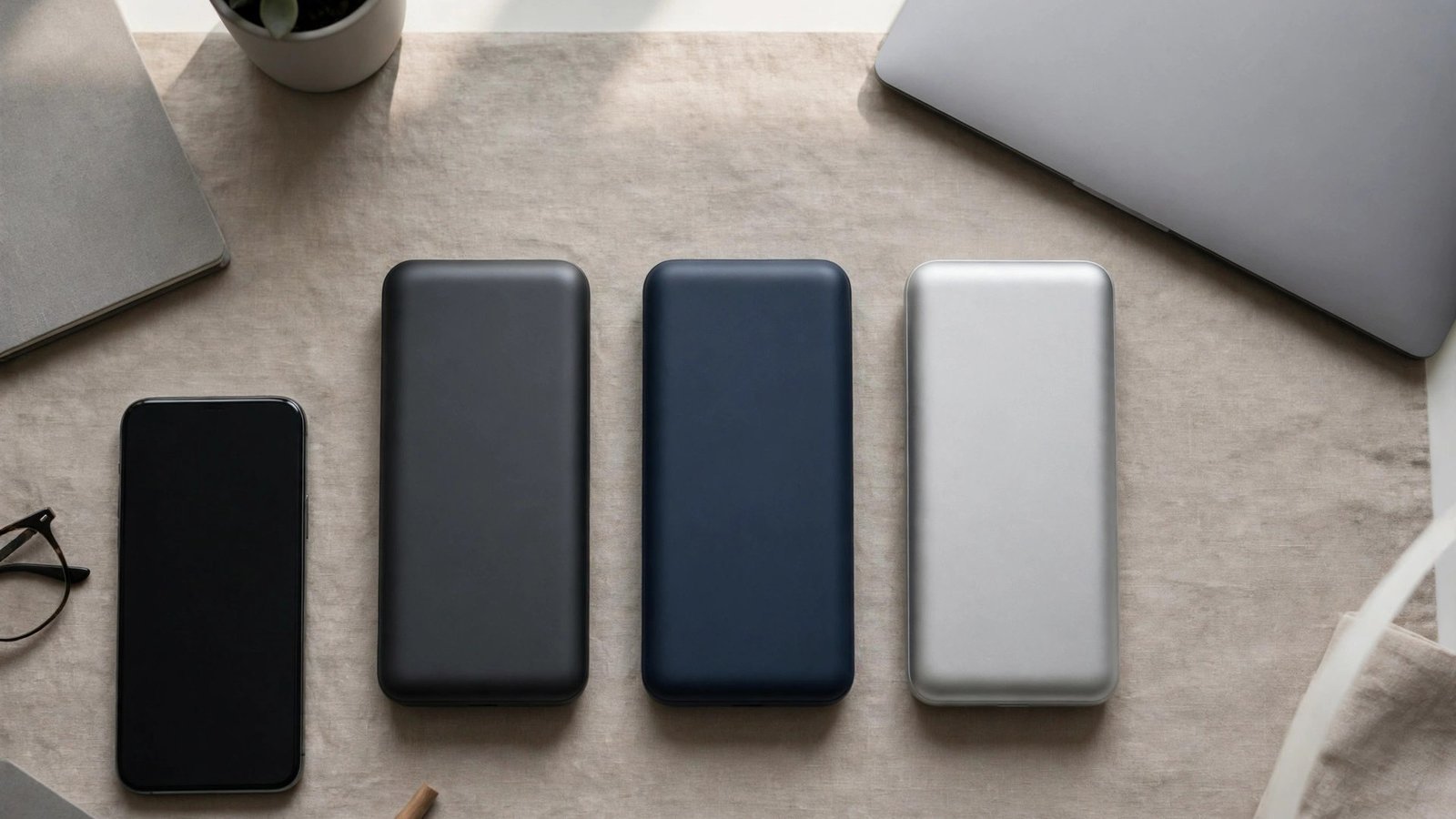
A power bank is one of the most practical corporate gifts a company can order — and one of the riskiest. A steel bottle that leaks is an annoyance. A power bank that is badly made is a safety problem: it sits in a laptop bag next to a laptop, it is used on flights, and it is left charging overnight. When a gifted power bank swells, overheats or simply never delivers the capacity printed on its box, the recipient does not blame the anonymous factory. They blame the company whose logo is printed on it.
That is why this guide focuses on specification, not inspiration. If you want the broader picture — when to choose a power bank over earbuds, a charging stand or a Bluetooth speaker, and how tech gifts fit into welcome kits, festive hampers and event giveaways — start with Arrow Gifter’s tech gadgets guide. This article picks up where that guide stops: the capacity numbers, charging speeds, battery cells, safety certifications and travel rules that decide whether a power bank is a gift people rely on daily or a gift that ends up in a drawer — or worse, confiscated at an airport.
Everything below is written for buyers ordering in bulk in India — typically 50 to 5,000 units — who need to compare supplier quotes on equal terms and check a sample properly before production runs.
Why Power Banks Keep Working as Corporate Gifts
Power banks earn their place in corporate gifting for four practical reasons. First, they solve a problem every working person recognises: a phone dying during a commute, a client meeting, a conference or a flight delay. Second, they are used daily and in public — on trains, in airports, at events — which keeps a brand visible far more often than a desk accessory that never leaves the office. Third, they suit almost every recipient group — new joiners, field teams, clients, event attendees — with only the specification changing. Fourth, they are one of the few gifts where a higher budget produces a measurably better product: faster charging, more real capacity and a safer battery.
But those advantages only hold if the specification is right. A power bank that takes eight hours to recharge itself, that charges a phone once instead of the promised three times, or that has no valid safety certification does the opposite of what the gift was meant to do. The sections below give you the checks that prevent that.
What mAh Actually Means — and What It Does Not
Every power bank is sold on one number: its capacity in milliamp-hours, or mAh. The number is real, but it is widely misunderstood, and that misunderstanding is where most bad orders begin.
Capacity in mAh describes how much charge the battery cells inside the power bank can store, measured at the cells’ own voltage — usually 3.7 volts for a lithium-ion or lithium-polymer cell. A 10,000 mAh power bank stores roughly 10,000 mAh at 3.7 V, which is 37 watt-hours of energy. Your phone, however, charges at 5 volts (or higher, with fast charging). Converting the stored energy up to 5 V, and losing energy to heat and to the conversion circuitry itself, means the power bank delivers considerably less than its headline number at the USB port.
As a rough rule of thumb — useful for comparing products, not a laboratory measurement — a power bank delivers about 65–75% of its rated capacity as usable charge at the phone’s end. So a 10,000 mAh power bank delivers roughly 6,500–7,000 mAh of actual charging. That is the number that matters, and it is the number no catalogue prints.
Two consequences follow. First, never compare power banks on headline mAh alone: two 10,000 mAh units can deliver different amounts of real charging if one has better cells and better conversion circuitry. Second, always translate mAh into “how many full phone charges” for the phones your recipients actually carry, because that is the question your recipients will ask themselves.
Real-world charges: what each capacity band actually delivers
The table below uses a typical modern smartphone battery of around 4,000–4,500 mAh and the 65–75% usable-charge rule of thumb. Older phones with smaller batteries will get more charges; newer large phones and tablets will get fewer. Treat the figures as planning guidance for comparing options, not as a promise about any specific model.
| Rated capacity | Stored energy (at 3.7 V) | Usable charge (approx.) | Full phone charges (approx.) | Typical weight | Best for |
|---|---|---|---|---|---|
| 5,000 mAh | ~18.5 Wh | ~3,500 mAh | 0.7–0.9 (one top-up, not a full charge) | 120–150 g | Event handouts, slim add-on in a gift hamper, emergency top-up |
| 10,000 mAh | ~37 Wh | ~6,500–7,000 mAh | 1.5–1.7 full charges | 180–250 g | The everyday standard: employees, onboarding kits, client gifts |
| 20,000 mAh | ~74 Wh | ~13,000–14,000 mAh | 3–3.5 full charges | 350–450 g | Field sales, frequent travellers, conference and event teams |
| 30,000 mAh | ~111 Wh | ~20,000 mAh | 4.5–5 full charges | 550–650 g | Heavy travellers and multi-device users only — and note the airline limit below |
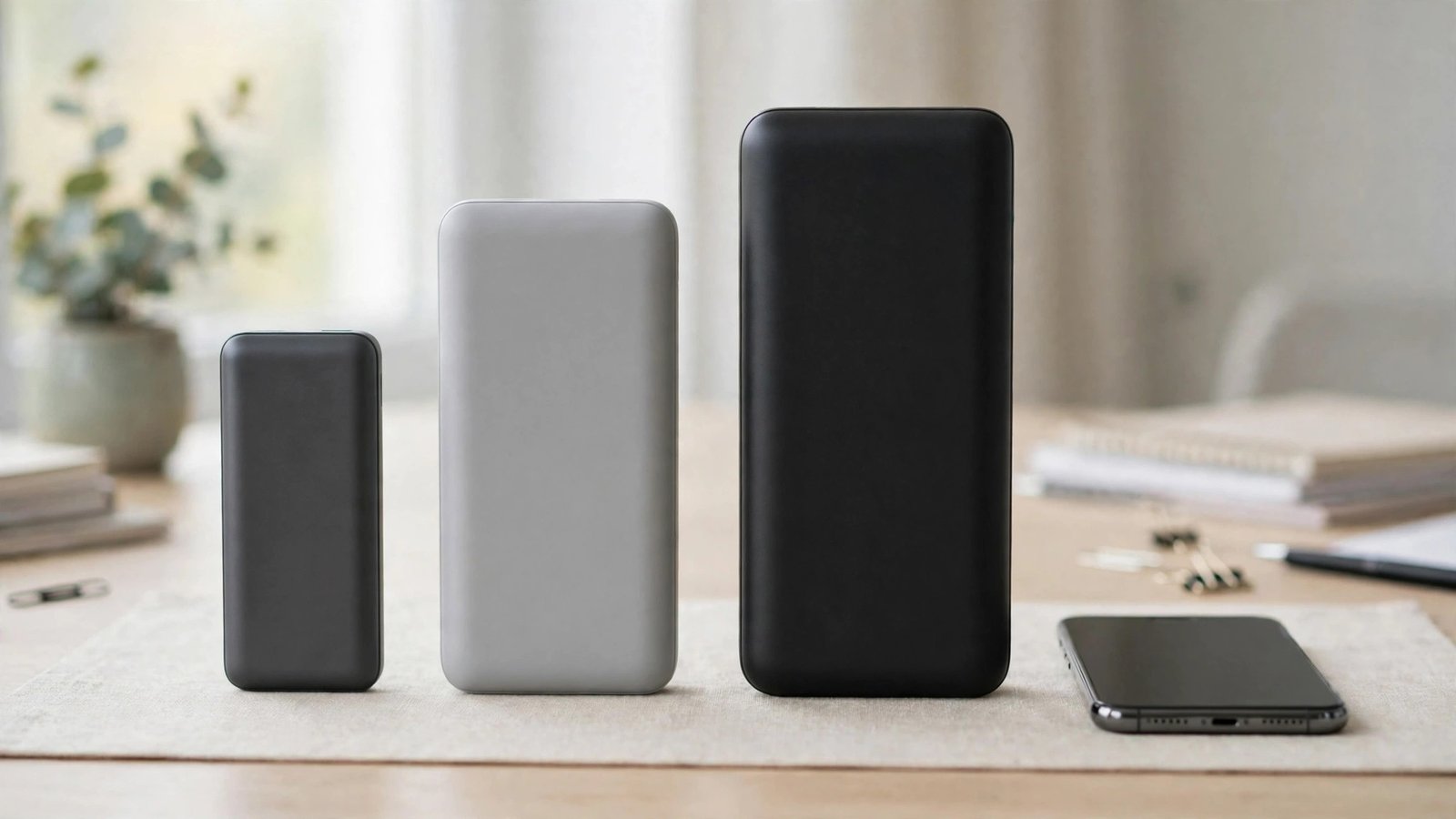
Two practical notes. First, a power bank’s own weight rises steeply with capacity: a 20,000 mAh unit is roughly twice the weight of a 10,000 mAh one, and recipients who carry it daily will notice. A heavier gift is not automatically a better gift. Second, the 30,000 mAh band crosses an important line: at 3.7 V it stores about 111 Wh, which is above the 100 Wh limit airlines allow without prior approval. That is covered in the airline section below — but it is the single most common specification mistake in corporate power-bank orders.
Wattage, PD and PPS: Charging Speed Explained
Capacity decides how many times a phone can be charged. Wattage decides how fast each charge happens — and this is where supplier listings are at their most misleading.
A power bank’s wattage is the maximum power it can deliver through a port, measured in watts (W). A 5 W output (the old USB standard, 5 V at 1 A) will charge a modern phone very slowly. A 10 W or 12 W output is usable but unremarkable. A 22.5 W output charges a phone noticeably faster. A 65 W output can charge a laptop. Suppliers quote the highest number on the box, so you need to know what it actually means.
USB Power Delivery (PD) is the fast-charging standard most modern phones and laptops use over USB-C. A power bank that supports PD can negotiate a higher voltage with the device — 9 V, 12 V or 20 V instead of 5 V — and deliver far more power through the same cable. If your recipients use recent Android phones or iPhones with USB-C, PD support is what makes a power bank feel fast rather than merely functional. Check the PD wattage, not just whether PD is “supported”: a bank that offers 18 W PD will charge a phone well; one that offers 65 W PD can also charge a laptop.
PPS (Programmable Power Supply) is an extension of PD that lets the charger adjust its voltage in small steps to match what the phone’s battery wants at each moment. It is the protocol Samsung’s Super Fast Charging and several other fast-charging systems use. A power bank with PPS will charge a compatible Samsung phone at full speed; one without PPS will charge the same phone noticeably more slowly, even if the wattage number on the box looks the same. If your recipient base is largely Samsung users, PPS is worth specifying.
Quick Charge (QC) is Qualcomm’s fast-charging protocol, common on many Android phones. A power bank that lists both PD and QC covers the widest range of devices.
What to specify in practice:
- For a general employee gift: 22.5 W output with PD is the sensible baseline. It charges a phone from near-empty to around half in roughly 30 minutes on most modern phones, which is fast enough that recipients notice the difference.
- For field and travel teams: 22.5–30 W PD with PPS, so both Samsung and other Android phones charge at full speed on the move.
- For executives and laptop users: 45–65 W PD over USB-C, so the same power bank can top up a laptop as well as a phone. Confirm the laptop’s charging requirement first — some laptops need 65 W and will not charge at all from a 30 W bank.
- Do not chase the headline wattage alone. A 100 W power bank is heavier, more expensive, and of no benefit to a recipient whose phone can only accept 25 W. Match the wattage to the devices your recipients actually carry.
There is one more number to check: the power bank’s input wattage — how fast the power bank itself recharges. A 20,000 mAh bank with a 10 W input takes most of a night to refill; the same capacity with an 18 W or 22.5 W input is ready in a few hours. Recipients who use the bank daily will feel the difference every morning. Ask for the input wattage in the quotation, and test it on the sample: time a full recharge from empty.
Ports, Cables and Pass-Through Charging
The ports on a power bank decide whether it works with the devices your recipients already own — and whether it is still working in two years’ time.
USB-C is now the standard to insist on. It is the port on nearly all new Android phones, on iPhones from the iPhone 15 onwards, on most laptops and on wireless earbuds cases. A power bank with a USB-C port that supports both input and output (so the same port charges the bank and charges the phone) is the most future-proof choice. Avoid ordering banks with only USB-A output for a 2026–27 gifting programme: they will still work, but they signal an older design, charge more slowly, and will feel dated to recipients within a year.
Two output ports are the practical minimum for a gift meant to be used daily — one for the phone, one for earbuds or a second device. A single-port bank forces the recipient to choose. Three ports are useful for travellers, but add cost and weight; specify them only for the travel tier.
Built-in cables are a genuine convenience — a short USB-C cable attached to the bank means the recipient never hunts for a cable — but they are also a failure point: a frayed built-in cable cannot be replaced, and it turns the whole bank into waste. If you choose a built-in cable, check its strain relief on the sample (bend it firmly at both ends) and confirm the cable is USB-C, not the older Micro-USB.
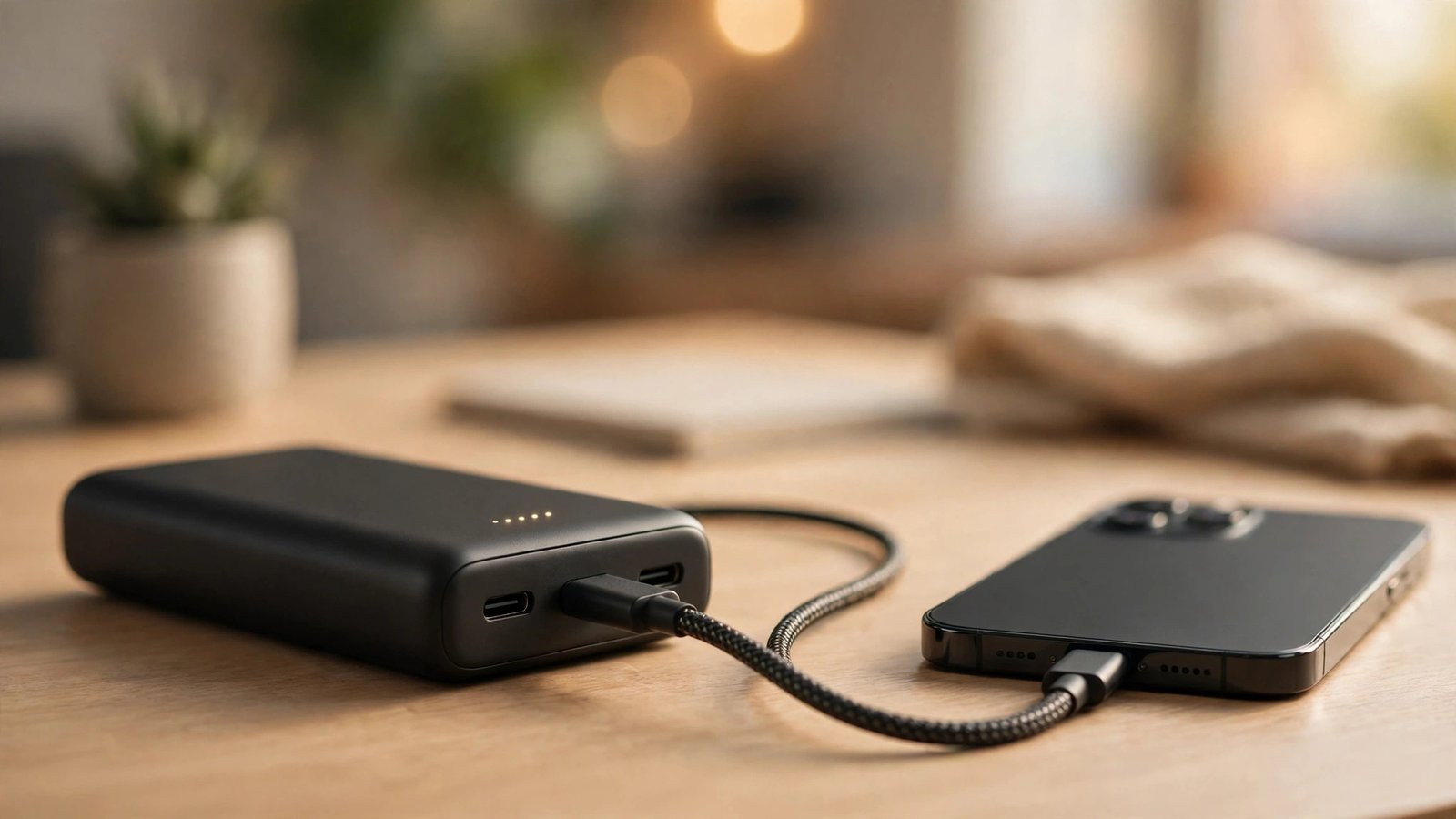
Pass-through charging means the power bank can charge a phone while the bank itself is plugged in and charging. It sounds like a small feature, but it matters for desk and bedside use: without it, the recipient must wait for the bank to finish charging before they can use it to charge their phone. Confirm it on the sample — plug the bank into a wall charger, plug a phone into the bank, and check that the phone is actually charging.
Wireless charging (a Qi pad built into the bank) is a nice-to-have, not a requirement. It charges more slowly than a cable and adds weight. It suits a premium tier where the recipient will value the convenience, but it should never be chosen instead of a good wired output.
Battery Cells: Lithium-Ion vs Lithium-Polymer
Inside every power bank is a set of battery cells, and the cell type affects weight, shape, safety and lifespan.
Lithium-ion (Li-ion) cells are the cylindrical cells (the common 18650 size) used in most mid-range power banks. They are well understood, cheap to produce and reliable when made by a reputable cell manufacturer. Their drawback is shape: a bank built from cylindrical cells is usually thicker and heavier for the same capacity.
Lithium-polymer (Li-Po) cells are flat pouches. They let manufacturers make slim, light power banks in a wider range of shapes, which is why most premium slim banks use them. They are also more sensitive to physical damage and to poor manufacturing — a punctured or badly made Li-Po pouch is a greater fire risk than a damaged cylindrical cell.
What this means for a buyer:
- Ask which cell type the bank uses and who makes the cells. Reputable cell manufacturers are a quality signal; a supplier that cannot name the cell maker is a warning sign. This is worth asking in writing for any order above 500 units.
- Prefer Li-Po for slim gifts and Li-ion for rugged, high-capacity ones. Neither is automatically better; the right choice depends on the form factor and the recipient.
- Check the cycle life. A quality power bank should still hold around 80% of its original capacity after 300–500 full charge cycles. Ask the supplier for the cycle-life figure and the cell datasheet on larger orders.
- Weight is a useful cross-check. If two 10,000 mAh banks differ sharply in weight, the lighter one may have smaller cells than claimed, or lower-density cells. Weight alone proves nothing, but a suspiciously light bank deserves a closer look — see the fake-capacity section below.
BIS Certification: The Check That Matters Most in India
This is the section that separates a safe corporate order from a liability. Power banks sold in India must be registered under the Bureau of Indian Standards (BIS) Compulsory Registration Scheme (CRS). This is not a voluntary quality mark and not a marketing claim — it is a legal requirement for power banks notified under the Electronics and IT Goods (Requirement for Compulsory Registration) Order.
What the certification is
Power banks for portable applications are covered by the Indian Standard IS 13252 (Part 1):2010, the safety standard for information-technology equipment, and the standard is being migrated to IS/IEC 62368-1:2023 under a Ministry of Electronics and Information Technology (MeitY) notification of 29 October 2025. Under the CRS, the manufacturer has the product tested at a BIS-recognised laboratory and obtains a BIS registration, which carries a unique R-number. The power bank must carry the BIS Standard Mark with that R-number on the product itself.
What to ask the supplier
- “Share the BIS registration certificate and the R-number for this exact model.” Not a certificate for a different model, and not a promise that certification is “in process”. The R-number belongs to a specific model; a certificate for another model does not cover the one you are buying.
- “Is the R-number printed on the product and the packaging?” It should be. If the sample has no R-number on it, the units you receive may not either.
- “Who is the registered manufacturer?” The registration belongs to the manufacturer, not to the trading company that sold you the bank. If the supplier is a trader, ask who the actual manufacturer is and verify that the registration covers the model you are ordering.
How to verify it yourself
The R-number can be checked in the BIS Care app, which lets anyone look up registration details and lodge a complaint about misuse of the mark. Before approving a large order, check the R-number on the sample in the app. It takes a few minutes and it is the single most reliable check in this guide. A supplier that hesitates when you say you will verify the R-number has told you something important.
A note on what BIS certification does and does not guarantee: it confirms the product passed the safety tests in the applicable standard at the time of testing. It does not guarantee the capacity printed on the box, the charging speed, or the build quality. That is why the rest of this guide — the charge-count test, the weight check, the sample QC checklist — still matters. Certification is the floor, not the ceiling.
For the authoritative position on which products are covered and how the scheme works, see the Bureau of Indian Standards at bis.gov.in. The guidance in this article is general information, not professional compliance advice; for a large or unusual order, confirm the current requirements with the supplier’s compliance team or a certification consultant.
Airline and Travel Rules: What Your Recipients Can Actually Carry
A power bank is a gift for people who travel — which makes the airline rules part of the specification, not an afterthought. Getting this wrong means the gift is confiscated at security, which is a memorable experience for the recipient and not in a good way.
The rules, in brief, for flights from Indian airports:
- Power banks go in cabin baggage only — never in checked baggage. Lithium-ion batteries are treated as dangerous goods in the cargo hold, where a fire cannot be reached quickly. This applies on all domestic and international flights from Indian airports.
- They must stay with the passenger, not in the overhead bin. The Directorate General of Civil Aviation (DGCA) issued a Dangerous Goods Advisory Circular on 11 November 2025 on minimising the risks of lithium batteries carried by passengers, which asks passengers to keep power banks in hand baggage and in the seat pocket or under the seat in front of them, where they can be seen — not in overhead bins, where overheating could go unnoticed.
- Do not use or charge a power bank during the flight. The same DGCA guidance says power banks must not be used to charge devices in flight and must not be recharged from the aircraft’s seat power outlet. They should stay switched off for the whole flight.
- Capacity limits are measured in watt-hours (Wh), not mAh. Up to 100 Wh may be carried in the cabin without airline approval. Between 100 Wh and 160 Wh needs prior airline approval. Above 160 Wh, the power bank cannot travel as passenger baggage at all. Some airlines also cap the number a passenger may carry — Air India, for example, allows a maximum of two power banks per passenger.
- The Wh figure is easy to work out: Wh = (mAh × V) ÷ 1,000. Most power banks use 3.7 V cells, so a 10,000 mAh bank is about 37 Wh and a 20,000 mAh bank is about 74 Wh — both comfortably under the 100 Wh limit. A 27,000 mAh bank is roughly 100 Wh, right at the boundary. A 30,000 mAh bank is about 111 Wh, which needs airline approval and will be refused on some carriers. This is why the capacity table above matters: the biggest number is not the best gift for a travelling recipient.
What this means for your order: for any gift aimed at travellers, field teams or conference attendees, stay at or below 20,000 mAh. It keeps the gift safely under the 100 Wh limit, keeps the weight manageable, and avoids the situation where a recipient packs the gift for a flight and loses it at security. If you are considering a 30,000 mAh premium tier, say so in the gift note and warn recipients that airline approval is needed — or better, reserve that capacity for desk-based recipients who will not fly with it.
Check the current rules with the airline before a travel-heavy campaign, and point recipients to the DGCA at dgca.gov.in for the authoritative guidance. Rules are tightened from time to time — the November 2025 circular is a recent example — and the airline’s own baggage page is the final word for a specific flight. This article gives general guidance, not professional advice on aviation rules.
Spotting Fake Capacity: The Checks Before You Pay
Fake capacity is the most common fraud in the power-bank market, and it is the hardest to spot from a catalogue. A bank labelled 20,000 mAh may contain cells totalling 10,000 mAh, or cells of such poor quality that they deliver far less. The supplier’s margin comes from the cells you cannot see. These checks, run on the sample before you approve production, are how you protect the order.
- The weight check. A genuine 10,000 mAh bank typically weighs 180–250 g; a genuine 20,000 mAh bank typically 350–450 g. If a 20,000 mAh sample weighs 200 g, the cells inside cannot be what the label claims. Weigh the sample on a kitchen scale and compare it with the capacity table above. A large shortfall is not a minor discrepancy — it is the test.
- The charge-count test. Fully charge the sample, then use it to charge a phone from near-empty and count how many full charges you get. A genuine 10,000 mAh bank should deliver about 1.5 full charges to a typical 4,000–4,500 mAh phone. If it delivers one charge and then dies, the capacity is overstated. Run this test twice — a single test can be skewed by a phone that was not fully drained.
- The recharge-time test. Time how long the bank takes to recharge itself from empty. A 10,000 mAh bank with an 18 W input should take roughly 3–4 hours. If it is full in 90 minutes, the cells are smaller than claimed — a small battery fills quickly. If it takes 10 hours, the input circuitry is poor.
- The price test. If one supplier’s quote for a 20,000 mAh PD bank is half the price of every other quote, the saving has to come from somewhere: smaller cells, unbranded cells, no BIS registration, or all three. Normalise every quote to the same capacity, wattage, cell type and certification before comparing prices.
- The label check. The sample should state the capacity in both mAh and Wh, the input and output ratings, the cell type, and the BIS Standard Mark with an R-number. Vague labelling — a big “20000mAh” and nothing else — is a warning sign. Also check that the Wh figure on the label matches the mAh figure using the formula above; a mismatch means the label was written by marketing, not by engineering.
- The heat check. During the charge-count test, feel the bank. Warm is normal; hot to the touch is not. Excessive heat means poor conversion efficiency, which also means the delivered capacity will be lower than expected — and it is a safety concern.
- The swelling check. Look at the sample’s casing closely. Any bulge, gap or soft spot in the casing suggests a swollen cell. Reject the sample outright — a swollen cell is a damaged cell.
If a sample fails any of these checks, do not negotiate the price down and proceed. Change supplier. A power bank that fails the charge-count test at sample stage will fail in the hands of 500 recipients at once.
Branding Methods Compared: Printing, Engraving and Packaging
A power bank is a small, often dark, often textured object. The branding method must suit the material — and the supplier should confirm the combination, not just quote a method.
| Method | How it works | Best for | Limitations |
|---|---|---|---|
| UV printing | UV-cured ink printed directly on the surface | Full-colour logos, gradients, detailed artwork, most plastic and coated-metal banks | Can scratch with heavy use; check scratch resistance on the sample; white ink underlay quality decides how colours look on dark banks |
| Laser engraving | A laser marks the metal surface | Premium feel, permanent mark, single-colour logos, aluminium-bodied banks | One colour only (the metal beneath); fine detail can be lost on small logos; not suitable for plastic bodies |
| Screen printing | Ink pushed through a mesh stencil | Simple one- or two-colour logos at large volumes, lowest unit branding cost | Limited detail and colour range; setup cost per colour makes small runs expensive |
| Sleeve / packaging branding | Branding on a sleeve, box or carry pouch instead of the device | Premium presentation, multicolour designs without touching the device, protecting a slim bank | The branding leaves when the packaging is discarded; only works as the primary branding for display-led gifts |
For most corporate orders, the decision is between UV printing and laser engraving. Engraving is the safer choice when the logo is a single colour and the bank has an aluminium body — it cannot peel or fade, and it reads as premium. UV printing is the right choice when the logo needs its brand colours or fine detail. If your logo is full-colour and your bank is dark, ask the supplier to show you a printed sample: the white ink underlay is what makes or breaks colour printing on dark surfaces.
Two rules apply regardless of method. First, approve branding on a physical branded sample, never on a digital mock-up alone — the logo’s size, position and legibility on a small, curved or textured surface cannot be judged on a flat screen. Second, keep the artwork restrained: a clean logo and nothing else. A power bank covered in a website address, a tagline and a hashtag reads as advertising, and recipients treat advertising as disposable. For a full comparison of branding methods across gift types, see our guide to engraving, printing and embossing — Topic 67 in this series will cover it in depth once published; until then, the method-by-method table above is the working reference.
The Sample QC Checklist: 12 Things to Check Before Production
Do not approve a power bank order from a catalogue photo. Order a sample — ideally a branded sample, not a blank — and run these twelve checks. Our general sample approval checklist for bulk corporate gifts covers the same discipline across product types; the list below is the power-bank-specific version.
- BIS verification. The R-number on the sample is checked in the BIS Care app and matches the model and manufacturer in the quotation.
- Weight check. The sample’s weight matches the capacity band in the table above (10,000 mAh ≈ 180–250 g; 20,000 mAh ≈ 350–450 g).
- Charge-count test. The sample delivers the expected number of full phone charges — about 1.5 for a 10,000 mAh bank — tested twice.
- Recharge time. Time a full recharge of the bank from empty and compare it with the stated input wattage. Too fast suggests smaller cells; too slow suggests poor input circuitry.
- Wattage test. Charge a compatible phone and check the phone actually reports fast charging. If the box promises 22.5 W PD and the phone charges slowly, the protocol is not working.
- Port and cable check. Confirm the USB-C port handles both input and output, both ports work simultaneously, and any built-in cable survives firm bending at both ends.
- Pass-through test. Plug the bank into a wall charger, plug a phone into the bank, and confirm the phone charges while the bank charges.
- Heat check. During charging, the bank should feel warm, not hot to the touch.
- Casing inspection. No bulge, gap or soft spot in the casing; no loose ports; the buttons have a firm, consistent action.
- Branding durability. Rub the logo firmly with a damp cloth 20 times. Any fading, scratching or peeling on the sample will happen faster in daily use.
- Wh labelling. The label states capacity in mAh and Wh, and the Wh figure matches the formula (mAh × 3.7 ÷ 1,000). The Wh figure is what airport security reads.
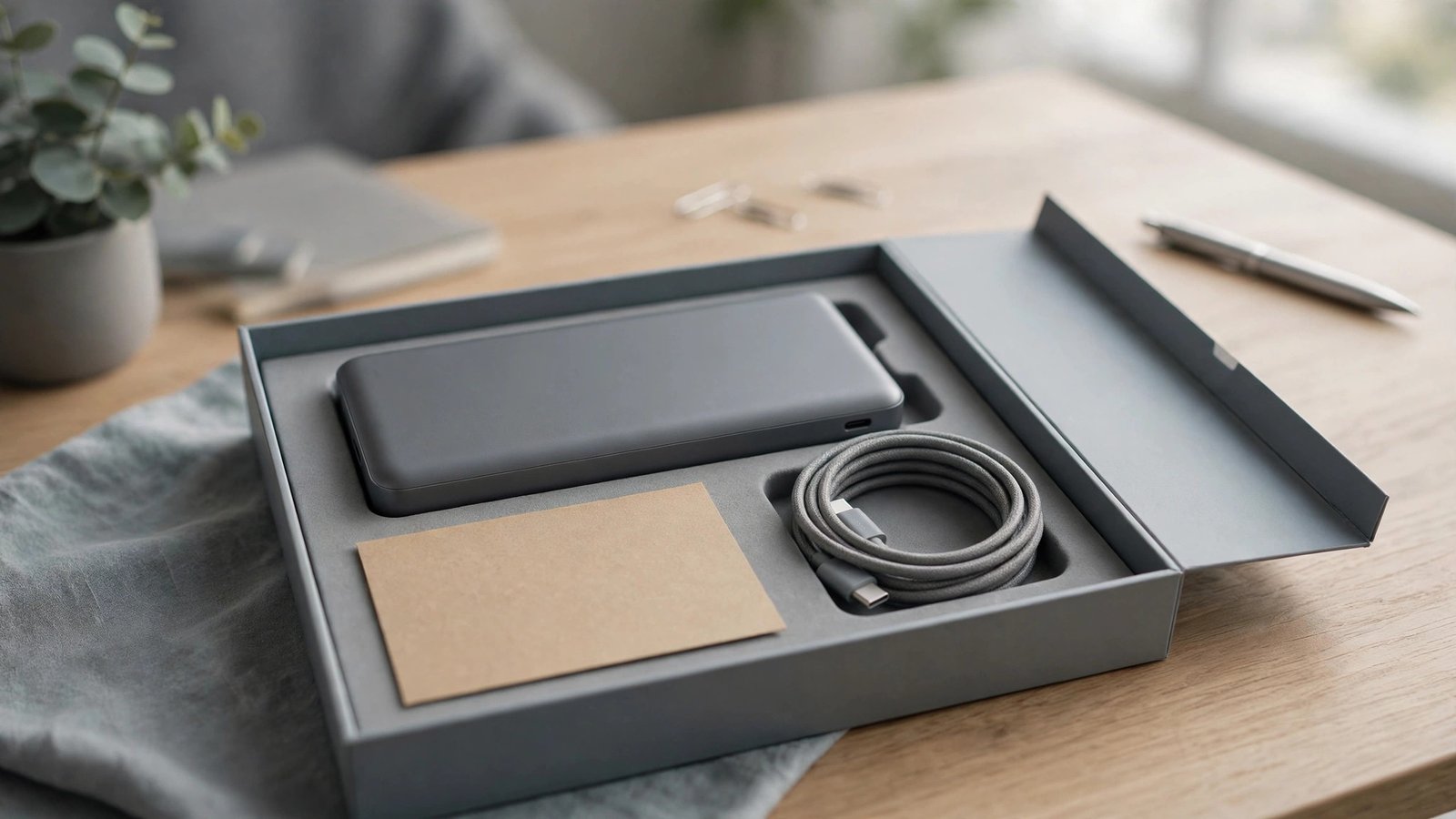
- Packaging and paperwork. The box states the BIS mark and R-number, the input/output ratings and the cell type; the packaging protects the bank and cable; and the supplier’s warranty and replacement terms are in writing.
Record the results with photos, and keep one approved sample sealed and labelled as the reference. When the bulk delivery arrives, compare a random sample against it — weight, charging behaviour, logo placement, labelling. If you find a problem late, our playbook on what to do when a corporate gift order goes wrong sets out the damage, delay and wrong-branding steps in order.
Common Mistakes When Ordering Power Banks
- Ordering on headline mAh alone. The number on the box is stored capacity at 3.7 V, not delivered charge. Compare usable charge and charge counts, not the headline.
- Skipping the BIS check. A power bank without a verifiable R-number is a compliance risk and a safety risk, and it can be seized or delisted. Verify the number in the BIS Care app before approving production.
- Choosing 30,000 mAh for travellers. Above 100 Wh it needs airline approval and may be refused. Keep travel gifts at or below 20,000 mAh.
- Ignoring input wattage. A bank that takes all night to recharge itself will frustrate daily users, whatever its output wattage says.
- Accepting a single USB-A port. For a 2026–27 programme, USB-C with PD is the baseline. An old-spec bank will feel dated within a year.
- Ordering by catalogue photo. Weight, heat, charge count and branding durability cannot be judged from a render. Always sample — and run the seven fake-capacity checks on it.
- Over-branding the device. A logo, a URL, a tagline and a hashtag turn a premium tech gift into a flyer. One clean mark, well placed, does more.
- Forgetting the total delivered cost. Unit price is only one line. Branding setup, packaging, GST, freight, warranty replacements and the cost of a failed batch all belong in the comparison — and in the budget.
Budgeting, MOQ and Lead Time
Power-bank pricing is driven by five variables: capacity, wattage and protocols, cell type and maker, BIS certification, and branding method. A 5,000 mAh single-port bank with unbranded cells sits at the low end; a 20,000 mAh 65 W PD/PPS bank with branded Li-Po cells, a valid R-number and laser engraving sits at the high end. Quotes that do not itemise those variables cannot be compared — and the cheapest quote is usually the one that has quietly dropped one of them.
On quantities, power-bank MOQs are usually modest — many suppliers work from 50 or 100 units for standard models, with better unit pricing at 250, 500 and 1,000. Custom colours, custom casings and custom packaging raise the MOQ, sometimes sharply. Before you negotiate, read our guide to minimum order quantities for corporate gifts in India so you know what is genuinely a volume constraint and what is a negotiating position.
On timing, allow two to four weeks from artwork approval for a standard branded order, longer for custom colours, custom packaging or orders above 1,000 units. Add a week of buffer if the banks are being shipped to multiple offices or to individual home addresses — lithium batteries have packaging and labelling requirements for shipment, and couriers may need extra documentation. Confirm dispatch dates in writing before you announce the gifting date internally, and read our lead-time guide for the full ordering timeline.
Matching the Power Bank to the Team and the Occasion
- New joiners and onboarding kits: 10,000 mAh, 22.5 W PD, USB-C in/out, UV-printed or engraved logo. Pairs well with a notebook and a pen — and it is the one gift in the kit the new joiner will use on day one.
- Field sales and travel teams: 20,000 mAh, 22.5–30 W PD with PPS, two ports, slim enough for a laptop bag. For the wider kit this fits into, see our guide to gifts for field sales teams.
- Clients and partners: 10,000 mAh, slim Li-Po body, matte finish, laser engraving or clean UV print, presented in a gift box. The bank should look considered, not bulk-bought.
- CXOs and long-service awards: 20,000 mAh, 45–65 W PD so it charges a laptop as well as a phone, premium aluminium body, engraving, and a presentation box — the bank is part of a larger recognition moment, not the whole of it.
- Conferences and expos: 5,000–10,000 mAh, slim, single or dual port, screen print. Light, cheap to ship, easy to carry home — and under the airline limit for attendees flying home.
- IT and hybrid teams: 10,000 mAh, 22.5 W PD with PPS, USB-C in/out, since the bank moves between home, office and commute. For the broader kit, see our guide to corporate gifts for IT and SaaS companies.
- Wellness and remote-work campaigns: 10,000 mAh with a built-in cable, so the recipient never hunts for one — but check the cable’s strain relief on the sample first.
Frequently Asked Questions
How many mAh power bank is best for a corporate gift?
For most corporate orders, 10,000 mAh is the right default: it delivers about 1.5 full charges to a typical phone, weighs 180–250 g, and sits well under the 100 Wh airline limit. Choose 5,000 mAh only for event handouts and hamper add-ons, and 20,000 mAh for field teams and frequent travellers who need three full charges. Avoid 30,000 mAh for anyone who flies with the gift — at about 111 Wh it needs airline approval.
Is BIS certification mandatory for power banks in India?
Yes. Power banks for portable applications are notified under the BIS Compulsory Registration Scheme and must be registered against IS 13252 (Part 1):2010, which is migrating to IS/IEC 62368-1:2023. The product must carry the BIS Standard Mark with a unique R-number. Ask the supplier for the registration certificate and the R-number for the exact model you are ordering, and verify the number in the BIS Care app before approving production. This is general guidance, not professional compliance advice.
Can employees carry a gifted power bank on a flight in India?
Yes, in cabin baggage only — never in checked baggage. Under DGCA guidance, power banks must be kept in hand baggage, in the seat pocket or under the seat, not in overhead bins, and must not be used or charged during the flight. Up to 100 Wh needs no airline approval; 100–160 Wh needs prior approval; above 160 Wh it cannot travel as passenger baggage. A 20,000 mAh bank is about 74 Wh, so it is fine; a 30,000 mAh bank is about 111 Wh, so it needs approval. Check the airline’s own baggage page before a travel-heavy campaign.
How do I check whether a power bank’s capacity is real before ordering in bulk?
Run three tests on the sample: weigh it (a genuine 10,000 mAh bank is typically 180–250 g; a 20,000 mAh bank 350–450 g), count full phone charges (a genuine 10,000 mAh bank should deliver about 1.5 full charges to a typical phone), and time its own recharge (too fast suggests smaller cells than claimed). Also check the label states both mAh and Wh, and that the Wh figure matches the formula mAh × 3.7 ÷ 1,000. If a sample fails any of these, change supplier rather than negotiating the price down.
What wattage should a corporate gift power bank have?
22.5 W output with USB Power Delivery is the sensible baseline for a general employee gift — it charges most modern phones from near-empty to around half in roughly 30 minutes. Specify PD with PPS if your recipients are largely Samsung users, and 45–65 W PD if the bank should also charge a laptop. Also check the input wattage, which decides how fast the bank itself recharges: a 20,000 mAh bank with a 10 W input takes most of a night to refill.
Is USB-C necessary, or is USB-A enough?
For a 2026–27 programme, USB-C is the standard to insist on. It is the port on nearly all new Android phones, on iPhones from the iPhone 15 onwards, and on most laptops and earbuds cases — and it is what enables USB Power Delivery fast charging. A power bank with a USB-C port that handles both input and output is the most future-proof choice. A USB-A-only bank still works, but it charges more slowly and will feel dated to recipients within a year.
What is the minimum order quantity for branded power banks in India?
It varies by supplier, model and branding method, but many suppliers work from 50–100 units for standard models with standard branding, with better unit pricing at 250, 500 and 1,000 units. Custom colours, custom casings and custom packaging raise the MOQ. Read our guide to minimum order quantities for corporate gifts in India before negotiating, and always compare quotes at the same quantity, capacity, wattage, cell type and certification.
Conclusion
A power bank is a good corporate gift precisely because it is used every day, in public, when it matters most — and that is also why its specification matters more than its catalogue photo. Get the capacity right (10,000 mAh as the default, 20,000 mAh for travellers, never 30,000 mAh for anyone who flies), specify the wattage and protocols for the phones your recipients actually carry, insist on USB-C with Power Delivery, and treat BIS certification as non-negotiable — verified in the BIS Care app, in writing, for the exact model. Run the fake-capacity checks on the sample, approve the branding on a physical unit, and compare quotes on identical specifications.
Do that, and the power bank in your employee’s bag or your client’s travel kit is a quiet, daily reminder of a company that pays attention to detail — and to safety. Skip it, and the same gift is a daily reminder of the opposite, or a confiscated item at airport security.
A Natural Next Step
If you are planning a power bank order and want help turning this guide into a specification your suppliers can quote against, talk to the Arrow Gifter team. Bring your recipient list, the phones your teams actually carry, your budget per person and your delivery date, and we will help you narrow the capacity, wattage, cell type and certification to a shortlist you can sample with confidence — and check the samples against the checklist above before you commit to production.
Leave a comment