
Corporate Gifts for Real Estate Companies: Broker, Channel Partner & Home-Buyer Gifting
A home is the largest purchase most Indians will ever make. It takes months of site visits, years of savings, and a decision that carries more emotion than almost any other transaction a family will sign. And yet, for many developers, the relationship with the buyer ends the moment the cheque clears — and the relationship with the broker who brought that buyer ends the moment the commission is paid.
That is a missed opportunity, and an expensive one. In Indian real estate, the next sale almost always comes from someone you already know: a broker who remembers which developer treated them well, a home buyer who recommends you to their brother-in-law, a channel partner who puts your project first when a walk-in asks for options. Corporate gifting for real estate companies is how you stay in that memory — not with a grand gesture once a year, but with the right gift, to the right person, at the moment it matters most.
This guide covers all three audiences a developer needs to gift well: brokers and channel partners who bring the business, home buyers who are the business, and the internal teams who hold both relationships together. It covers the tier-wise frameworks that keep partner gifting fair, the three moments in a buyer’s journey when a gift lands hardest, the budget bands that work in the Indian market, the compliance and etiquette lines you should not cross, and the logistics of delivering gifts to site offices and new homes across cities.
1. Why Real Estate Gifting Is a Different Game
Most corporate gifting is aimed at one audience — employees, or clients. Real estate gifting has three, and they want completely different things.
Brokers and channel partners are your salesforce, and you do not employ them. A broker in Mumbai or Gurugram may work with ten developers at once. When a walk-in customer asks “which project should I look at?”, the broker’s answer is shaped by many things — the project’s merits, the commission, the ease of dealing with your sales team — and, honestly, by how valued they feel by you. A thoughtful gift does not buy a broker’s loyalty, and it should never be framed as doing so. But it does keep your name at the front of their mind in a week when ten developers are all asking for their time.
Home buyers are not repeat customers in the usual sense — most will buy one home from you, once. So the gift is not about the next purchase. It is about the referral, the review, the family member who asks “who did you buy from?” at a wedding six months later. A buyer who felt cared for at possession tells people. A buyer who felt forgotten tells people too.
Internal sales and CRM teams are the third audience, and the one most developers forget. Your site sales team works weekends, festivals and late evenings. Your CRM team absorbs the buyer’s frustration when a handover slips. Gifting them is not a real estate problem — it is an employee recognition problem — but it belongs in this guide because the same procurement process and the same vendor can serve all three audiences, which saves time and money.
The second thing that makes real estate gifting different is timing. A software company’s client relationship is continuous; a developer’s relationship with a buyer has a few sharp moments — booking, construction milestones, possession, housewarming — and long silences in between. Gifts that arrive at those moments feel personal. Gifts that arrive at random feel like marketing.
The third difference is geography. Your brokers are spread across a city, your buyers move into homes across projects and sometimes across states, and your site offices are not your head office. A gifting programme that only works when everyone is in one building will fail here. Plan for delivery to many addresses from the start.
2. The Three Audiences — and What Each One Actually Wants
Before choosing a single gift, be clear about who it is for and what it is supposed to do. A gift that delights a home buyer will bore a broker, and a gift that motivates a broker will confuse a buyer.
Brokers and channel partners want recognition and usefulness. They are on the road all day, on the phone all evening, and they measure a developer by how easy you make their work. Gifts that help them do their job — a quality leather organiser, a premium power bank, a well-made laptop bag — land better than decorative objects. And they notice tiers: a broker who closed twenty units this year should not receive the same gift as a broker who closed one. Fairness is not sameness; it is proportionality.
Home buyers want warmth and a sense of arrival. The gift should say “welcome home”, not “thank you for the money”. Practical gifts for the new home — a brass diya and candle set, a quality dinner set, a plant, a curated hamper of things the family will actually use in the first week — work because they belong in the house the buyer has just moved into. Avoid anything that looks like an advertisement for your next project. The buyer has already bought; the gift should celebrate that, not sell the next tower.
Internal teams want to feel seen. Site sales staff and CRM executives do the emotional labour of your business. A festive hamper is fine, but a personal note from the director, a gift chosen for the individual rather than the role, and a programme that remembers birthdays and work anniversaries will do more than a generic year-end box.
Keep the three audiences in separate budgets and separate lists. When they get mixed up — a broker’s tier gift accidentally sent to a buyer, or a buyer’s housewarming hamper sent to a site office — the mistake is visible, and it undermines the thought the gift was meant to carry.
3. Broker and Channel Partner Gifting: A Tier-Wise Framework
Broker gifting without tiers creates two problems. Give everyone the same gift and your top performers feel undervalued. Give gifts by gut feel and everyone else suspects favouritism. A published tier framework — shared internally, not with the brokers — solves both.
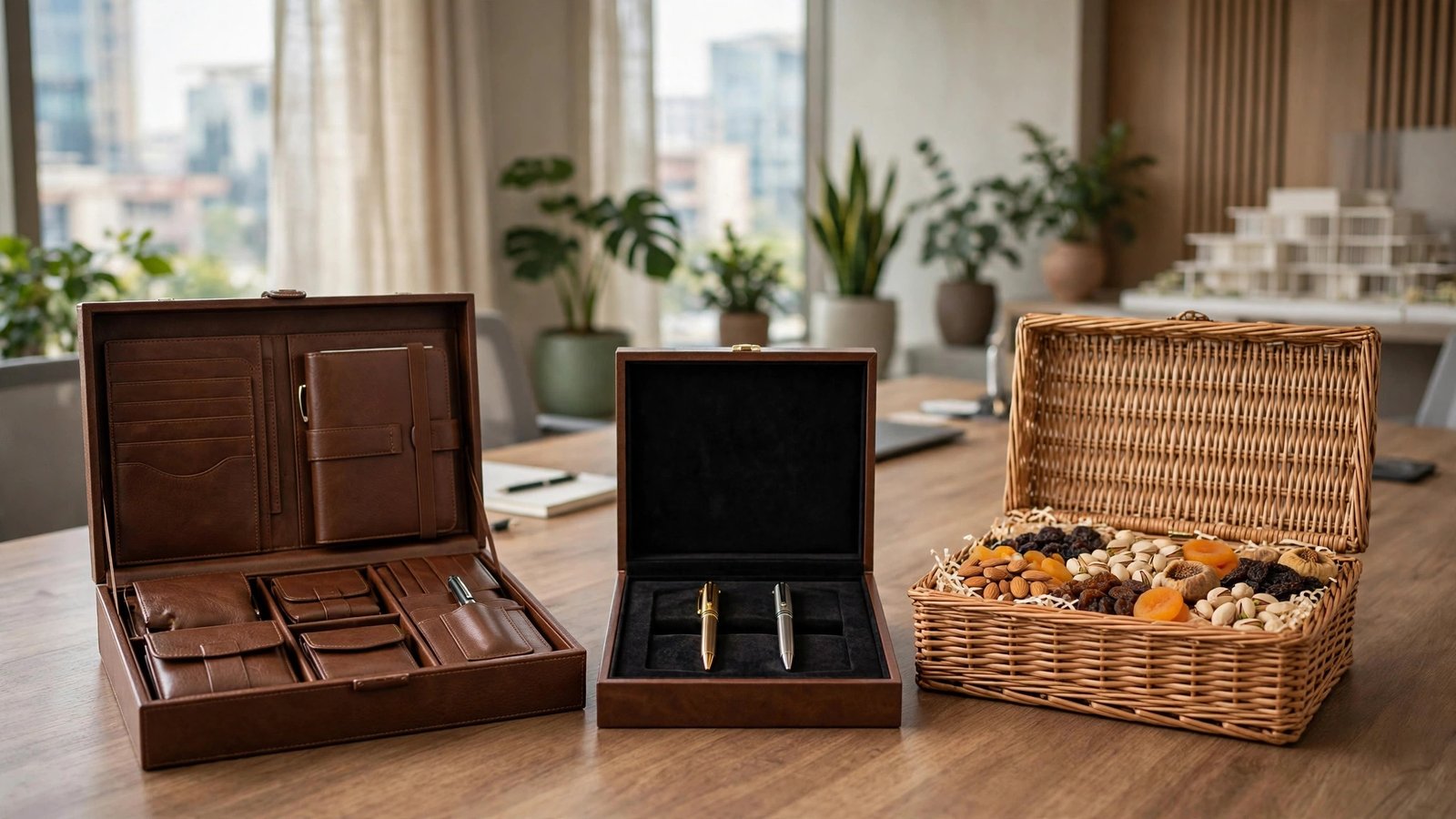
Tier 1 — Top partners (roughly the top 10–15% by closed business): ₹3,000–₹7,500 per occasion. Premium executive gifts: a leather goods set, a high-quality backpack or laptop bag, a premium hamper with branded packaging, or an experience-led gift such as a fine-dining voucher. These are the partners who move your inventory; the gift should reflect that, and it should arrive with a personal note from a director, not a printed card.
Tier 2 — Active partners (regular closures, consistent site visits): ₹1,000–₹3,000 per occasion. Good-quality drinkware sets, executive pen sets, curated dry-fruit hampers, a premium diary and organiser combo. The quality bar matters more than the price: a ₹1,500 gift that feels premium beats a ₹3,000 gift that feels generic.
Tier 3 — Emerging and new partners: ₹500–₹1,000 per occasion. A branded welcome kit when they register with you — a notebook, a pen, a bottle, a small hamper — plus a festive gift. The point here is not the value; it is that the partner is in your system from day one and feels like a partner, not a stranger.
Occasions to gift brokers: Diwali and the festive season (the big one), the financial year-end or your annual partner meet, a milestone (their 10th closure with you, a record month, a project sell-out), and their firm’s anniversary if you track it. Avoid gifting immediately after a single large closure in a way that could look like a quid pro quo — space the gift from the transaction, and keep the note about the relationship, not the deal.
For a deeper tier-wise approach that applies across industries, see our guide on gifts for channel partners, which explains how to build partner tiers without overspending. And if your partners are also distributors in the wider sense, the tier logic in our year-end gifts for distributors and dealers guide applies here too — the products differ, but the principle of proportionality is the same.
4. Home-Buyer Gifting: The Three Moments That Matter
A buyer’s journey with a developer has three gifting moments, and each one calls for a different kind of gift.
Moment 1 — Booking. The buyer has just signed and paid the booking amount. They are excited and, very often, slightly anxious: is this the right decision, is the money safe, did we choose the right flat? A small, immediate welcome gift says “you made a good choice, and we are glad you are here”. Keep it modest — ₹500–₹1,500 — because a lavish gift at booking can feel like pressure. A welcome kit works well: a branded folder with the project documents presented beautifully, a small plant, a box of premium sweets, a handwritten note from the CRM team. The point is the welcome, not the value.
Moment 2 — Possession. This is the biggest moment. The buyer has waited — sometimes years — and now holds the keys. The gift should match the emotion. Budget ₹1,500–₹5,000 depending on the segment: a premium home hamper, a brass diya and candle set, a quality dinner set, a smart-home starter (a smart speaker or a set of smart bulbs), or a curated housewarming hamper. Present it at the handover, not by courier a week later — the moment matters as much as the gift. If you run a formal key-handover ceremony, the gift is part of that ceremony, photographed and remembered.
Moment 3 — Housewarming and the first festival. The buyer has moved in. A housewarming gift in the first month — a plant, a gourmet hamper, a premium bed linen set — says you are still thinking of them after the sale is complete. And the first Diwali or Christmas in the new home is a natural moment for a festive gift. This is also the moment when the referral ask becomes natural: a buyer who has just received a thoughtful housewarming gift is far more likely to bring their cousin to your next site visit.
What not to gift home buyers: anything that advertises your next project, anything with a large logo on the front, anything that feels like a sales incentive, and — most importantly — anything that could be read as an inducement to buy. Gifts should celebrate a decision already made, never sweeten a decision still being made. Keep that line bright, and keep a note of it in your gifting policy. For guidance on the compliance side, the central RERA portal is the official starting point for understanding the regulatory framework around real estate transactions in India, and any gift policy should be reviewed against it and your legal team’s advice — the guidance in this article is general information, not professional legal advice.
For the onboarding side of the buyer relationship — the emails, the welcome sequence, the first-90-days experience — our new client onboarding gifting playbook maps the same logic to a 90-day framework, and it translates well to a buyer’s first three months with a developer.

5. Budget Bands That Work in Indian Real Estate
Budgets vary enormously by segment — an affordable-housing developer and a luxury developer are playing different games — but the structure is the same. Plan in bands, and plan the total before the per-person figure.
- Broker welcome kits (new partner registration): ₹500–₹1,000 per partner. A notebook, a pen, a bottle, a small hamper, and a well-designed partner welcome note.
- Broker festive gifts: Tier 1 ₹3,000–₹7,500; Tier 2 ₹1,000–₹3,000; Tier 3 ₹500–₹1,000. This is the largest broker budget line of the year, and the one most worth getting right.
- Broker milestone gifts: ₹1,500–₹5,000 per milestone (10th closure, record month, project sell-out).
- Home-buyer booking gifts: ₹500–₹1,500 per buyer. Modest, warm, immediate.
- Home-buyer possession gifts: ₹1,500–₹5,000 per buyer, scaled to the segment. Affordable housing at the lower end, premium and luxury at the higher end — but the presentation should feel premium at every level.
- Home-buyer housewarming / first-festival gifts: ₹750–₹2,000 per buyer.
- Internal team festive gifts: ₹750–₹2,500 per person, with a personal note.
- Launch event and site-visit gifts: ₹300–₹1,000 per attendee, depending on the event.
Two cost realities developers often miss. First, delivery is a real cost line — gifts go to site offices, broker offices across a city, and buyers’ new homes, often in multiple cities. Budget 15–20% on top of the gift cost for packaging, branding and delivery, and more if you are delivering to individual home addresses rather than a single office. Second, minimum order quantities matter: customised gifts are priced for bulk, and a 20-unit broker order costs far more per unit than a 500-unit buyer order. Plan your quantities early, and read our guide on minimum order quantity for corporate gifts in India before you commit to a customised item — it explains MOQ by product type and how to plan quantities across audiences.
6. Gift Ideas by Audience and Occasion
Use this as a shortlist, not a catalogue. The right gift is the one that fits the person, the moment and the budget — in that order.
For brokers and channel partners:
- Leather organiser or premium diary set — useful daily, visible daily.
- Executive pen set in a presentation box — a classic for a reason, and it photographs well at partner meets.
- Premium dry-fruit and gourmet hampers — the safe festive choice, and easy to scale across tiers by changing the contents, not the box.
- High-quality laptop bag or backpack — brokers travel; a bag that lasts is remembered.
- Power bank (10,000–20,000 mAh) with subtle branding — genuinely useful on site visits.
- A curated experience: a fine-dining voucher or a premium stay voucher for top-tier partners.
For home buyers:
- Brass diya and scented candle set — warm, traditional, and made for a new home.
- Premium dinner set or serveware — used from the first week in the house.
- A potted plant with a care card — symbolic, and it grows with the home.
- Smart-home starter kit — a smart speaker or smart bulbs, for premium and tech-forward projects.
- Curated housewarming hamper — gourmet food, a candle, a small plant, a handwritten note.
- Premium bed linen or a throw — practical, and it belongs in the bedroom, not in a drawer.
For launch events and site visits:
- A branded welcome kit: notebook, pen, bottle, and a small snack box — given at registration, not at the exit.
- A premium umbrella or a travel kit for monsoon-season launches.
- A small plant or a desk accessory as a takeaway — something that survives the drive home.
For internal teams:
- A personal note from a director with a festive hamper — the note is the gift; the hamper is the vehicle.
- A quality backpack or laptop bag for site sales staff who are on their feet all day.
- A team experience: a dinner or an outing, gifted as a group, to mark a project sell-out.
On branding: a small, tasteful logo on a quality item is fine. A large logo on a cheap item is not — it turns a gift into a flyer. For home buyers especially, keep branding minimal or absent; the gift should feel like a welcome, not an advertisement. And on message cards, the wording matters more than the paper. Our corporate gift message card examples give 25 wordings for employees, clients and festivals that you can adapt for buyers and brokers — including thank-you notes that sound human rather than corporate.
7. Launch Events and Site-Visit Gifting
Property launches are the one moment when all three audiences are in the same room: prospective buyers, brokers, and your own team. The gifting at a launch should be planned like the event itself — in advance, with quantities confirmed, and with a clear purpose for each item.
Registration gifts set the tone. A welcome kit at the registration desk — a notebook, a pen, a bottle, a snack box — tells a walk-in that this developer is organised. Keep it light enough to carry around a site visit and useful enough not to be left behind.
Broker-specific gifts at launches are worth separating from walk-in gifts. A broker who brings five families to a launch is not a walk-in; a small additional recognition — a premium hamper or a gift card — given privately, not publicly, is appropriate. Public tiering at an event creates awkwardness; private recognition creates loyalty.
Site-visit gifts are smaller and more frequent: a bottle of water is not a gift, but a branded bottle, a snack box, or a small plant given at the end of a visit is a gesture that makes the visit memorable. Track these in your CRM so the same family does not receive the same gift on their third visit.
The follow-up matters more than the gift. A launch gift without a follow-up call is a souvenir. A launch gift with a call the next day — “how did you find the project, can I help with anything?” — is a relationship. Budget the follow-up time alongside the gift cost.
For the event side of this — speaker gifts, guest etiquette, and how to run gifting at a corporate event without it looking transactional — our guide on speaker and guest gifts for conferences and events covers the framework, and it applies directly to launches and channel-partner meets.

8. Branding: When Your Logo Helps and When It Hurts
Real estate is a brand-heavy business, and the temptation is to put the logo on everything. Resist it — selectively.
When branding helps: broker welcome kits, launch event kits, site-visit merchandise, internal team gifts. Brokers are partners, and a quality branded item reinforces the partnership. Your team wears your brand every day anyway. At events, branding is expected and appropriate.
When branding hurts: home-buyer gifts, almost always. A buyer has just moved into their home. A dinner set with your logo on every plate is not a gift; it is a billboard in their kitchen. Keep buyer gifts unbranded or, at most, with a small mark on the packaging — never on the gift itself. The exception is a genuinely premium item where the brand is part of the value (a well-known brand’s product, for example), and even then the developer’s logo should stay off it.
The packaging rule: if the gift itself is unbranded, the packaging can carry your brand — a beautiful box, a ribbon, a card with your name. That way the gift feels personal when it is used, and the brand is present when it is opened. This is the right balance for buyers, and it works for top-tier brokers too.
9. Compliance and Etiquette: The Lines You Should Not Cross
Real estate gifting sits closer to regulation than most corporate gifting, and the stakes are higher because the transaction values are so large. Three lines to keep bright.
First, gifts are not inducements. A gift should never be offered to influence a purchase decision, a broker’s recommendation, or a regulatory outcome. Gift after a decision is made — after booking, after possession, after a closure — not before it. If a gift’s timing could be read as an attempt to sway a decision, move the timing.
Second, know your RERA context. The Real Estate (Regulation and Development) Act, 2016 governs how developers market and sell, and state RERA authorities enforce it. The central RERA portal at rera.gov.in links to each state’s authority, and it is the right starting point for understanding the framework your gifting policy sits inside. Your legal team should review any gifting policy that touches buyers or brokers, and the guidance in this article is general information, not professional legal advice.
Third, mind the tax and accounting treatment. Corporate gifts have GST and income-tax implications in India, and the treatment depends on the value, the recipient and the nature of the gift. Keep proper records — who received what, when, and at what value — and let your finance team, not your marketing team, decide the accounting treatment. Good record-keeping also protects you: if anyone ever asks why a broker received a gift, a clean register with a clear tier policy is the answer.
Etiquette basics that still matter: respect dietary and cultural preferences (a dry-fruit hamper is safer than a sweets hamper for a mixed audience; a non-alcoholic hamper is the default); be careful with religious items — a diya is a warm housewarming gift for many families but not a universal one, so offer a choice where you can; never gift cash or cash equivalents to buyers; and always include a handwritten or personally signed note, because a gift without a note is a delivery, and a gift with a note is a relationship.
For the wider etiquette of gifting — modesty, appropriateness, and why clear policies protect everyone — SHRM’s guidance on workplace gift-giving is a useful reference, and its core test is a good one for real estate too: if you would be uncomfortable explaining the gift in public, do not give it.
10. Logistics: Getting Gifts to Site Offices, Broker Offices and New Homes
A real estate gifting programme fails on logistics more often than on taste. Plan the delivery before you plan the gift.
One vendor, one register. Use a single gifting vendor for all three audiences where possible, with a single register that records recipient, gift, value, date and delivery status. This is what makes the programme auditable, and it is what stops the same broker receiving three festive hampers from three different teams.
Delivery to many addresses. Brokers work from their own offices; buyers live in their new homes; site offices are often under construction. Confirm addresses before dispatch, use a delivery partner who handles individual addresses, and build in a confirmation step — a call or a message when the gift is delivered. For buyers, never deliver a possession gift to an old address; confirm the new address at handover.
Address collection, done properly. Collecting buyer and broker addresses is a data-protection matter, not just an admin task. Collect only what you need, store it securely, and use it only for the purpose it was given. Our guide on collecting employee addresses for gift delivery covers the process and the consent principles, and the same discipline applies to buyer and broker addresses.
Timing buffers. Order festive gifts at least four to six weeks ahead; possession gifts should be ordered in step with your handover schedule, not in a single year-end bulk buy. A gift that arrives a month after possession is a reminder that you forgot, not a celebration. For lead-time planning, our guide on how early to order corporate gifts gives a practical timeline by order size.
Scaling up. A developer with one project and fifty buyers can hand-deliver gifts. A developer with ten projects and five thousand buyers cannot. As you scale, the programme needs a CRM field for gifting status, a standard kit per audience, and a vendor who can deliver to multiple cities. Our comparison of corporate gifting for 50 employees vs 5,000 is written about employees, but the scaling logic — standardisation, vendor management, and per-person cost control — applies exactly to buyer and broker volumes.
11. Common Mistakes Developers Make
- Gifting only at Diwali. One festival a year is a calendar, not a relationship. Brokers and buyers need touchpoints at booking, possession, milestones and the first festival — not a single hamper in October.
- The same gift for everyone. A top broker, a first-time buyer and a site engineer are not the same audience. One gift for all three tells each of them that you did not think about them.
- Branding the buyer’s gift. A logo on a dinner set or a bedsheet turns a welcome into an advertisement. Keep buyer gifts unbranded.
- Gifting before the decision. A lavish gift offered while a buyer is still deciding, or a broker is still recommending, is an inducement — and it looks like one to everyone watching.
- Forgetting the internal team. The site sales team and the CRM team carry the relationship. If they feel ungifted while brokers receive premium hampers, the resentment shows up in how they treat buyers.
- No register, no policy. Without a written tier policy and a delivery register, gifting becomes ad hoc, unfair, and impossible to defend. Write the policy before you buy the first gift.
- Ordering too late. Festive gifts ordered in the last week of October arrive in November. Possession gifts ordered after handover arrive as an apology. Build the calendar in advance.
- Choosing price over quality. A ₹1,500 gift that feels premium is remembered; a ₹3,000 gift that feels cheap is remembered too, for the wrong reason. Quality per rupee matters more than the headline figure.
12. A 90-Day Gifting Calendar for Developers
If you are starting from scratch, here is a simple calendar to run for the next quarter.
Weeks 1–2: Set up. Write the tier policy for brokers, the three-moment framework for buyers, and the festive plan for internal teams. Choose one vendor, build the register, and confirm the festive order quantities. Send the partner welcome kit to every newly registered broker.
Weeks 3–6: Run the buyer moments. For every booking, send the welcome kit within a week. For every possession, deliver the gift at handover. For every housewarming in the period, send the housewarming gift within the first month. Log everything in the register.
Weeks 7–10: Broker touchpoints. Send milestone gifts to brokers who hit a closure milestone in the quarter. Send a personal note from a director to your top ten partners — no gift attached, just recognition. Plan the next launch’s gifting.
Weeks 11–13: Review and plan the festival. Review the register: who received what, what was delivered on time, what was not. Fix the gaps. Place the festive order with a four-week buffer. Announce the festive gifting plan to your team so nobody is surprised.
For announcing any gifting programme to your own teams, our corporate gifting email templates give five ready-to-use formats that adapt easily to a developer’s internal audience. And if your buyers include corporate clients — companies buying homes for executives, or banks and financial partners in the home-loan chain — our guide on corporate gifts for banks and financial services covers gifting within compliance norms, which is directly relevant to your home-loan partners.
Frequently Asked Questions
1. What are the best corporate gifts for real estate companies in India?
The best gifts depend on the audience. For brokers and channel partners, useful premium items work best — leather organisers, executive pen sets, quality laptop bags, and tiered festive hampers. For home buyers, warm, practical gifts for the new home — a brass diya and candle set, a dinner set, a plant, or a curated housewarming hamper. For launch events, branded welcome kits. The common thread is quality: a gift that feels premium at its price point, chosen for the person and the moment.
2. What gifts do builders give home buyers on possession?
Most developers give a housewarming-style gift at possession, typically in the ₹1,500–₹5,000 range depending on the segment: a premium hamper, a brass diya and candle set, a dinner set, a smart-home starter kit, or a curated gift box. The gift is usually presented at the key-handover ceremony rather than sent later, because the moment is part of the gift. Keep it unbranded or minimally branded, and include a personal note.
3. How much should a developer spend on channel partner gifts?
A practical structure is tiered: top partners ₹3,000–₹7,500 per festive occasion, active partners ₹1,000–₹3,000, and new or emerging partners ₹500–₹1,000. Milestone gifts sit in the ₹1,500–₹5,000 range. The exact figures depend on your segment and volumes, but the principle is proportionality — partners who bring more business should receive a gift that reflects that, and the tiers should be written down so the policy is fair and defensible.
4. Are corporate gifts to home buyers allowed under RERA?
Gifts given after a purchase decision — at booking, possession or housewarming — are a normal part of customer experience, but a gift should never be used to influence a buying decision or a broker’s recommendation. The Real Estate (Regulation and Development) Act, 2016 and your state’s RERA authority set the regulatory framework, and your legal team should review your gifting policy. This article is general guidance, not professional legal advice.
5. What is a good housewarming gift from a real estate company?
A good housewarming gift belongs in the new home: a brass diya and candle set, a quality dinner set or serveware, a potted plant with a care card, a gourmet hamper, or premium bed linen. Avoid anything with a large logo, anything that advertises your next project, and anything the family cannot use in the first week. A handwritten note from the CRM team makes a modest gift feel personal.
6. Should real estate companies gift brokers at Diwali only?
No — Diwali is the biggest broker gifting moment, but a once-a-year gift is a calendar, not a relationship. Add milestone gifts when a broker hits a closure target, a welcome kit when a new partner registers, and recognition at your annual partner meet. Spacing gifts across the year keeps your name in front of brokers in the months when they are recommending projects to walk-in customers.
7. How do developers handle gift delivery to many buyers and brokers?
Use one vendor and one register that records recipient, gift, value, date and delivery status. Confirm addresses before dispatch — especially buyers’ new addresses at handover — and use a delivery partner that handles individual addresses across cities. Order festive gifts four to six weeks ahead, and order possession gifts in step with your handover schedule rather than in a single bulk buy. Budget 15–20% on top of gift costs for packaging, branding and delivery.
Conclusion
Corporate gifting for real estate companies is not about the gift. It is about the relationship the gift represents — with the broker who brings you business, with the buyer who trusted you with their life’s savings, and with the team that holds both relationships together.
Get the structure right and the rest follows: three audiences, three buyer moments, tiered budgets, unbranded gifts for buyers, branded quality for partners, a written policy, a clean register, and delivery planned before the gift is chosen. Keep the compliance lines bright — gifts celebrate decisions already made, they never sway decisions still being made — and keep the personal note, because in a business built on trust, a handwritten line is worth more than a bigger box.
Start with the next possession on your calendar, and the next broker who closes a deal this month. Gift them well, log it, and repeat it. Over a year, that consistency is what turns a developer into the one brokers recommend first and buyers recommend to their families.
If you are planning broker, channel-partner or home-buyer gifting for your projects, Arrow Gifter can help you put the programme together — tiered partner kits, possession and housewarming hampers, launch-event welcome kits and delivery across cities, all built around your budgets and your brand. Share your audience list and your handover calendar, and we will suggest a gifting plan that fits it. You can also start with a single occasion — your next possession handover or your next partner meet — and build from there.
Leave a comment