
Corporate Gifting for 50 Employees vs 5,000: What Changes in Price, Planning and Process
A founder with 50 employees can walk into a gifting vendor’s showroom, pick a hamper, approve a sample in an afternoon, and have the gifts delivered to one office the same week. A company with 5,000 employees cannot. Its gifts have to be produced in batches, branded on a production line, packed in a warehouse, despatched to a dozen cities, and delivered to home addresses that change every month — and the whole exercise has to start months before the occasion, not weeks.
Yet most gifting advice treats the two as the same job with a bigger number attached. They are not. Scale changes almost everything about corporate gifting: what a gift costs per person, which products are even available, how much time you need, who has to be involved, what can go wrong, and what the gift says about the company. A 50-person order rewards taste and personalisation. A 5,000-person order rewards process, consistency and logistics. Get the approach wrong at either end and the money is wasted — the small company overpays for process it does not need, and the large company discovers too late that its beautiful gift cannot be produced, packed or delivered in time.
This guide compares corporate gifting at 50 employees and at 5,000 employees across the six things that actually change with scale — price, product choice, branding, planning time, logistics and risk — and then gives you a practical framework for the sizes in between, so you can plan for the headcount you actually have.
1. Price: What a Gift Really Costs at 50 vs 5,000
The most visible difference between a small and a large gifting order is the per-gift price, and it works in the large company’s favour — but not in the way most people assume. Volume discounts are real, but they are not the whole story. The true cost of a corporate gift is the landed cost per recipient: the product, the branding, the packaging, the delivery, and the tax treatment, divided by the number of people who actually receive it.
The unit price falls — but not evenly
At 50 units, you are buying close to retail. A decent gift hamper that retails at ₹800 might cost you ₹700–₹750 in a 50-piece order, because the vendor is assembling a small batch by hand and cannot spread the cost of sourcing, packing and branding across many units. At 5,000 units, the same category of hamper might cost ₹450–₹550 per unit, because the vendor buys the contents in bulk, packs on a line, and amortises the fixed costs across thousands of gifts. The discount is real — typically 25–40% between the smallest and largest orders — but it is not linear. The biggest price drop usually happens between 50 and 500 units, as you cross the thresholds where bulk sourcing and line packing become possible. Between 1,000 and 5,000 units, the per-unit price keeps falling, but more slowly, and at some point the vendor’s capacity, not your volume, sets the price.
Fixed costs matter more at 50 than at 5,000
Every branded gift carries fixed costs that do not depend on quantity: the branding setup (a printing plate, an engraving die, a screen for a logo), the sample, the design of the packaging, and the artwork preparation. Spread across 50 gifts, a ₹5,000 branding setup adds ₹100 to every gift. Spread across 5,000 gifts, it adds ₹1. That is why a small order should favour gifts where the branding is cheap to set up — a printed card, a sticker, a ribbon, a digital print — while a large order can absorb the cost of engraving, embossing or custom-moulded packaging and still come out cheaper per unit. It is also why a small company should be suspicious of a vendor who quotes a low per-unit price but a high setup fee: the setup fee is the real price at 50 units.
Packaging and delivery change the maths
Packaging is where small orders quietly become expensive. A premium rigid box that costs ₹60 per unit in a 5,000-piece run might cost ₹120 in a 50-piece run, because the box itself has a minimum order quantity and a setup cost. Delivery is the same story in reverse: delivering 50 gifts to one office costs almost nothing per gift, while delivering 5,000 gifts to homes across 15 cities can add ₹80–₹150 per gift in courier and handling charges — enough to erase the volume discount on the product itself. The honest comparison is always the landed cost per recipient, not the catalogue price. If you are comparing vendors, ask each one for the landed cost per delivered gift, including branding, packaging and delivery to your actual locations, before you compare anything else.
The budget bands that work at each scale
At 50 employees, a total festive budget of ₹25,000–₹50,000 buys genuinely premium gifts, because you can spend ₹500–₹1,000 per person and still keep the total manageable. At 5,000 employees, the same per-person spend means a ₹25–₹50 lakh budget, which needs a business case, a procurement process and usually a finance sign-off — and that alone changes who decides and how long the decision takes. Most large companies therefore work to a per-person band of ₹300–₹750 for festive gifting, and reserve ₹1,000-plus gifts for a smaller group — senior leaders, key clients, top performers — where the headcount is small and the spend is visible. Our guide to Christmas gifts for office staff under ₹1,000 sets out bulk ideas in the most common band, and the tier-wise approach for senior and high-value recipients is covered in our guide to year-end gifts for top-performing employees.
2. Product Choice: What You Can Actually Buy at Each Scale

Scale does not just change the price of a gift. It changes which gifts exist for you at all, because every product has a minimum order quantity, a production capacity and a supply chain behind it — and those limits bite at different sizes.
At 50, choice is wide and personalisation is cheap
A 50-person order can use almost anything: a handcrafted hamper, a locally made candle, a premium notebook with individual names, a curated food box from a small producer, a plant in a ceramic pot. Vendors will happily assemble 50 bespoke kits, because the work is small and the margin per unit is high. Personalisation is also cheap at this scale: printing 50 individual names on cards or notebooks is a small job, and it is often included in the price. This is the scale where the gift can carry the founder’s taste — and where it should, because the gift is one of the few things a 50-person company can do that a 5,000-person company cannot: make every recipient feel individually chosen. The risk at this scale is the opposite of the large company’s risk — not that you cannot produce the gift, but that you choose something so bespoke that it cannot be repeated next year, or that one item in the kit is unavailable when you reorder.
At 5,000, availability and consistency decide everything
At 5,000 units, the product list shrinks to what can be produced, branded and packed in quantity, on time, with consistent quality. A handmade candle from a single artisan cannot supply 5,000 units. A hamper with eight different items needs eight separate supply chains, and if one item runs short, the whole kit is delayed. Large orders therefore favour products with deep stock and reliable production: branded drinkware, notebooks and diaries, backpacks and laptop bags, tech accessories, dry-fruit and snack hampers assembled from standard components, and gift sets built around two or three hero items rather than eight small ones. Consistency matters as much as availability — at 5,000 units, the 4,999th gift has to look like the first, and that means a product whose quality does not vary from batch to batch. Before you fall in love with a product at this scale, ask the vendor three questions: how many units can you produce in the time we have, what is your buffer stock if some units fail quality checks, and can you show me samples from two different production batches? Our guide to minimum order quantities for corporate gifts in India explains how MOQs work by product type, and why they matter most at the large end of the scale.
The middle sizes: 100, 500 and 1,000
Most companies are neither 50 nor 5,000. At 100 employees, you can still personalise — individual names, a handwritten card, a choice of two or three gift options — but you should start standardising the packaging and the branding, because hand-assembly begins to get expensive. At 500, personalisation usually narrows to the message card and a choice between two gift sets, and the product list should be limited to items with reliable stock. At 1,000, you are running a small version of the 5,000-person operation: a single hero gift or a two-item set, one branding method, one packaging design, and a delivery plan that assumes not everyone is in one office. The rule of thumb: as headcount rises, reduce the number of different items in the gift, and put the personal touch into the message rather than the product.
3. Branding: When a Logo Helps and When It Gets in the Way
Branding is the part of gifting where small and large companies make opposite mistakes. Small companies under-brand, because the setup cost feels disproportionate. Large companies over-brand, because the setup cost is trivial and the temptation is to put the logo on everything. Both are wrong, for different reasons.
At 50 units, the branding decision is about cost per gift. A ₹5,000 engraving setup on 50 gifts is ₹100 per gift — often a fifth of the gift’s value. At that scale, the smarter choice is usually a low-setup branding method: a printed belly band or sleeve on the box, a foil-printed message card, a ribbon in the brand colour, or a single-colour print on a notebook or bottle. These look premium, cost little to set up, and can be produced quickly. Save engraving and embossing for the year your headcount — or your budget — justifies it.
At 5,000 units, the branding decision is about consistency and capacity. The setup cost is negligible per unit, but the branding has to survive a production line: a logo that looks fine on one sample has to print identically 5,000 times, on a surface that may be curved, textured or dark. That means the artwork file matters more than the branding method. Send one artwork pack, once, with the correct vector files and colour references, and get a written confirmation of receipt from the vendor before production starts. Then approve a physical sample — not a photograph of a sample — and check the logo, the spelling, the colour and the placement against the artwork file. At 5,000 units, a branding error discovered after production is a 5,000-unit problem, and a reprint of that size is expensive and slow. Our guide on logo file formats for gift branding explains which formats to send and what to ask the vendor to confirm, and the discipline of approving the physical sample is set out step by step in our sample approval checklist for bulk corporate gifts.
One branding rule holds at every scale: the logo should be visible but not dominant. A gift that looks like an advertisement is remembered as an advertisement, and the recipient’s feeling about it changes accordingly. At 50 units, a tasteful card and a ribbon will do more for your brand than a logo printed across the whole box. At 5,000 units, the same restraint applies — and it is harder to hold, because the production line makes it easy to brand everything.
4. Planning Time: The Calendar That Actually Decides Whether Gifts Arrive
This is the difference that catches most teams out. A 50-person order can be planned in a week. A 5,000-person order needs months — and the work that takes the time is not choosing the gift, but everything around it.
The 50-employee timeline
For 50 gifts, a realistic timeline is one to two weeks: a day or two to choose the gift and the vendor, a day to approve a sample, three to five days for production and branding, and a day for delivery to a single office. The whole job can be owned by one person — usually an HR manager or an office admin — and it can start three weeks before the occasion and still arrive on time. The main risk is not time but indecision: at this scale, the gift is often chosen by one person whose taste decides everything, and if that person is unavailable, the order stalls.
The 5,000-employee timeline
For 5,000 gifts, a realistic timeline is eight to twelve weeks for a festive order, and longer if the gift is custom-made. The stages are: budget approval and procurement (one to two weeks, because a multi-lakh spend needs sign-offs); vendor selection and quotation (one week, usually with two or three vendors compared); sample approval (one week, including a physical sample and a second round if the first is wrong); production and branding (two to four weeks, depending on the product); packing and quality checks (one week); and despatch and delivery (one to two weeks across multiple cities). The stages that surprise first-time large-order planners are the ones that look administrative: collecting and verifying 5,000 addresses, getting the artwork approved by brand and legal teams, and aligning the delivery with office closures and regional holidays. None of these is hard on its own. Together, they are the reason a 5,000-person order that starts six weeks before Diwali is already late. Our guide on how early to order corporate gifts sets out the lead time each stage actually needs, and the city-wise festive cut-offs are in our guide to Christmas corporate gift delivery deadlines in India.
Who owns the order at each scale
At 50 employees, one person owns the whole order, from choosing the gift to handing it out. At 5,000, the order needs a small team: an HR or engagement lead who owns the decision, a procurement lead who owns the vendor and the commercial terms, a logistics coordinator who owns the address list and the delivery, and a finance contact who owns the budget and the tax treatment. The most common failure in large orders is not a bad gift but an unclear owner — everyone assumes someone else is tracking the delivery, and nobody is. Name one owner, in writing, with responsibility from sample approval to the last delivery, and give that person the authority to make decisions without waiting for a committee. If your company is growing through the middle sizes, the transition point is usually around 300–500 employees: below that, one person can still own it; above it, the order needs a named owner plus at least one helper, and a written plan with dates.
5. Logistics: Delivery Is the Real Project at Scale
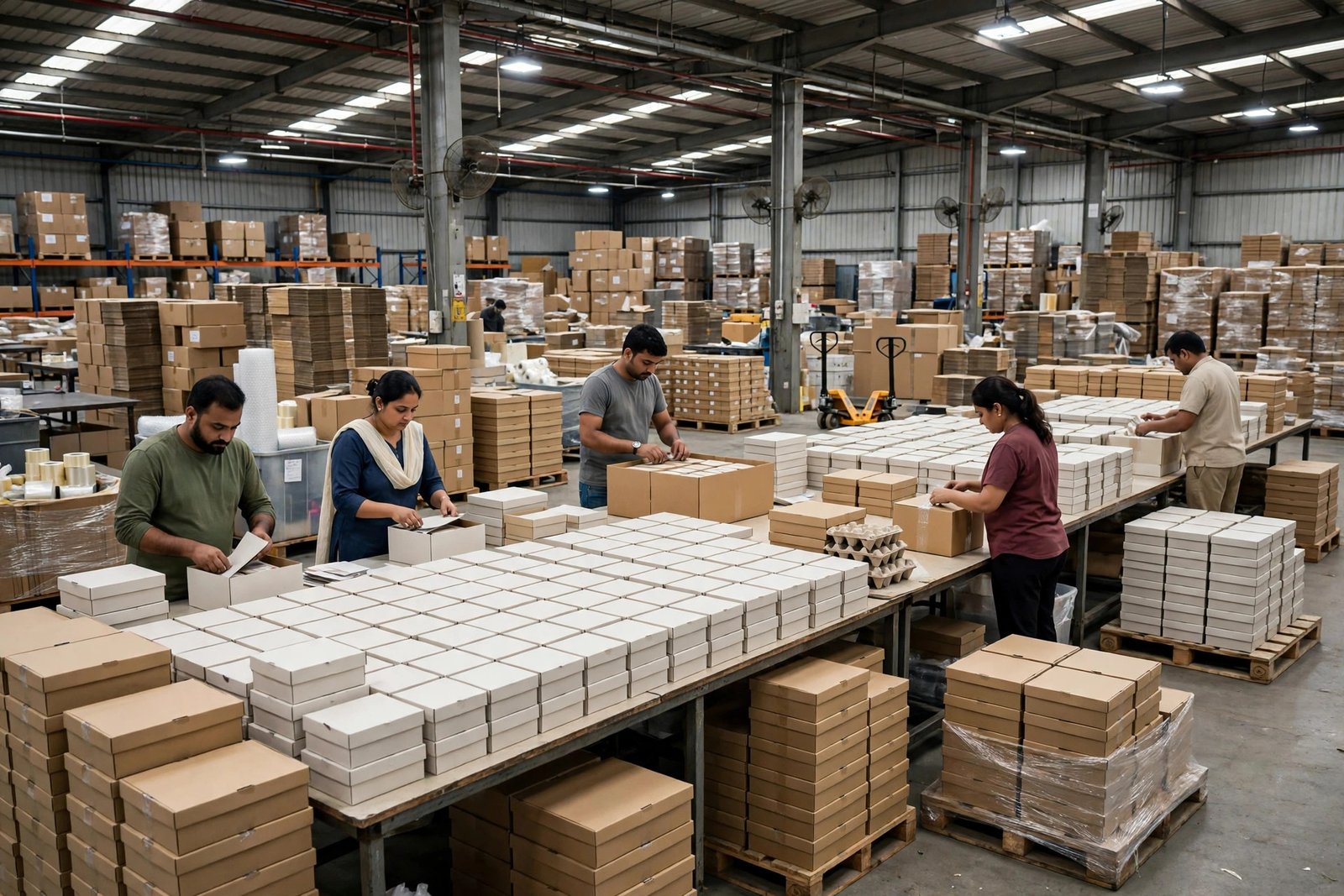
At 50 employees, delivery is a footnote: the gifts arrive at one office, and someone hands them out or leaves them on desks. At 5,000 employees, delivery is the project — and it is where most large gifting programmes actually fail.
One office vs many locations
A 50-person company usually has one office, and often one floor. The vendor delivers to a single address, and distribution takes an hour. A 5,000-person company has multiple offices, often in several cities, plus remote and hybrid employees whose home addresses are the delivery point. Each location adds a despatch, a courier handover, a tracking number and a failure point. The practical answer is to split the order into batches by location, with a delivery date per batch, and to confirm the headcount per location before production — not after — because a location that grows from 200 to 240 people after the order is placed creates 40 gifts that do not exist.
Address collection: the hidden work
Collecting addresses is the single most underestimated task in large-scale gifting, and it is the one most likely to delay delivery. At 50 employees, you know everyone’s address, or you can ask in a group message and get the answers in a day. At 5,000, the address list comes from HR systems that may be out of date, from employees who have moved, from people on leave, and from new joiners who are not yet in the system. The list needs to be collected, deduplicated, verified against a cut-off date, and frozen — because an address list that keeps changing after despatch starts is a list that generates failed deliveries. Our guide on how to collect employee addresses for gift delivery sets out the process and a template for doing this without chaos, and it is worth reading before you start a large order, not after the courier starts returning parcels.
Remote and hybrid employees
A 50-person startup with a hybrid team can still hand gifts out in person at an office day, or courier 10 or 15 parcels to home addresses without much effort. A 5,000-person company with a large remote workforce cannot rely on office distribution at all — the gifts have to go to homes, and home delivery means more failed attempts, more address errors and more re-delivery cost. Budget for a failed-delivery rate of 3–5% on home deliveries, and agree with the vendor in advance who pays for re-delivery and how many attempts the courier makes before returning the parcel. Also plan the timing: a gift that arrives at a home address two days after the festival is a different message from one that arrives on the day, so the despatch schedule has to work backwards from the occasion date, city by city.
Buffer stock and quality checks
At 50 units, a damaged gift is a nuisance — you replace it from the one or two spares you ordered, or you send a different gift to that one person. At 5,000 units, a 2% damage rate is 100 gifts, and you need a buffer. Order 3–5% extra for a large order, and hold the buffer centrally rather than sending it out with the main despatch, so replacements can be sent quickly when damage is reported. Quality checks also change with scale: at 50 units, you can open and check every gift. At 5,000, you check a sample from each batch — usually 5–10% — and you check it against the approved sample, not against your memory of it. Agree the quality-check process and the buffer stock with the vendor before the order is placed, not when the first damaged carton arrives.
6. Risk: What Can Go Wrong — and What It Costs at Each Scale
Every gifting order can go wrong, but the failures are different at each scale, and so is the cost of fixing them.
At 50 employees, the most common failures are small and fixable: the vendor runs out of one item in the hamper, the branding is slightly off, the delivery is a day late. The cost of fixing them is low, because the numbers are small and the vendor can usually replace or reprint 50 units quickly. The most expensive failure at this scale is choosing the wrong gift — something the recipients do not want or cannot use — because there is no process to catch it before the order is placed, and the whole budget is spent on one choice.
At 5,000 employees, the most common failures are systemic: the address list is wrong, the production run is short, the courier loses a batch, the branding is wrong on the whole run, or the delivery misses the occasion in one city. The cost of fixing them is high, because a reprint of 5,000 units is a new production run, and a re-delivery to 5,000 homes is a second logistics exercise. The most expensive failure at this scale is a late start — discovering in the last two weeks that the gifts cannot be produced and delivered in time, when the only options are a substitute gift, a partial delivery, or a message telling recipients the gifts are coming late. The prevention for all of these is the same: start earlier than feels necessary, freeze the address list, approve a physical sample, and agree the replacement and reprint terms in writing before you pay. If something does go wrong, the playbook for each failure type — damage, delay and wrong branding — is set out in our guide to what to do when a corporate gift order goes wrong.
7. Tax and Budget Treatment: A Note for Finance
Gifting at scale also changes the finance conversation. Under Indian GST rules, gifts from an employer to an employee up to ₹50,000 per employee in a financial year are not treated as a supply, so no output GST is charged on them — but input tax credit on goods given away as gifts is generally blocked under Section 17(5)(h) of the CGST Act, which means the GST paid on the gifts usually stays with the company as a cost rather than being recoverable. At 50 employees, that cost is small enough that finance may not notice it. At 5,000 employees, the blocked credit on a multi-lakh order is a real number, and it should be in the budget from the start — not discovered after the order is placed. The official GST portal is the reference point for the current position, and this is general guidance, not professional tax advice: confirm the treatment with your chartered accountant or tax adviser before you commit a budget, because the position turns on the facts of each case and the rules change. For the people side of the decision — why recognition spending matters and how to structure it — SHRM’s guidance on managing employee recognition programmes is a useful reference for HR teams building the business case.
8. A Planning Framework for Your Headcount

The comparison above gives you the two ends of the scale. Most teams need a plan for where they actually are. Use this framework as a starting point, and adjust it to your company’s locations, budget process and occasion.
| Decision | 50 employees | 100–500 employees | 1,000–5,000 employees |
|---|---|---|---|
| Per-person budget | ₹500–₹1,000, premium feel affordable | ₹400–₹800, standardise the hero gift | ₹300–₹750, reserve ₹1,000+ for a smaller senior group |
| Gift structure | Bespoke kit, 4–6 items, personal touch | One hero gift + 2–3 supporting items, or a choice of two sets | One hero gift or a 2-item set, consistent across all recipients |
| Personalisation | Individual names, handwritten cards | Message card personalised, gift standardised | Standard gift, personalised message card; names only for the senior tier |
| Branding | Low-setup methods: card, sleeve, ribbon, single-colour print | One branding method, one artwork pack, physical sample approved | One branding method, production-line approval, batch quality checks |
| Lead time | 1–2 weeks | 4–6 weeks | 8–12 weeks |
| Owner | One person | One owner + a helper | Named owner + procurement + logistics + finance |
| Delivery | One office, hand distribution | One or two offices, some home delivery | Multi-city batches, home delivery for remote staff, buffer stock 3–5% |
| Address list | Known, or a group message | HR system export, verified once | Collected, deduplicated, frozen by a cut-off date |
| Biggest risk | Choosing the wrong gift | Address and headcount changes after ordering | Late start, production shortfall, delivery missing the occasion |
Whatever your size, three rules hold. First, budget the landed cost per recipient, not the catalogue price — branding, packaging, delivery and blocked input tax credit are all part of the real cost. Second, freeze the decisions that are expensive to change — the gift, the artwork and the address list — and leave the cheap decisions, like the message wording, until later. Third, start earlier than feels necessary: the cost of starting a week early is nothing; the cost of starting a week late is the whole occasion.
Common Mistakes at Each Scale
Treating a 5,000-person order like a 50-person order. Choosing a bespoke, handcrafted gift that cannot be produced in quantity, approving a sample by photograph, and starting six weeks before the festival. At scale, the gift has to be producible, the sample has to be physical, and the calendar has to start months out.
Treating a 50-person order like a 5,000-person order. Running a procurement process, three vendor quotations and a committee approval for a ₹30,000 order. At this scale, speed and taste matter more than process, and over-processing the decision costs more in time than it saves in money.
Budgeting the catalogue price, not the landed cost. Forgetting the branding setup, the packaging, the delivery to multiple cities and the blocked input tax credit — and then discovering the real cost is 20–30% higher than the budget.
Letting the address list move after despatch. Every address change after the gifts leave the warehouse is a failed delivery, a re-delivery cost, or a gift that never arrives. Freeze the list, and set a cut-off date that everyone knows.
Branding everything, or branding nothing. A gift that looks like an advertisement is remembered as one, and a gift with no brand at all is remembered as nobody’s. One visible, tasteful brand mark and a personal message card is the right balance at every scale.
No buffer stock on a large order. Ordering exactly 5,000 gifts for 5,000 people, and then discovering that 2% are damaged in transit. Order 3–5% extra and hold it centrally for replacements.
Announcing the gift before the delivery is confirmed. Telling employees or clients the gifts are coming, and then missing the date. Confirm the despatch with the vendor first, then tell recipients. Our corporate gifting announcement email templates give you wording you can adapt, and the message itself should follow the examples in our guide to corporate gift message wording.
Frequently Asked Questions
1. How much does corporate gifting cost per employee in India?
It depends on scale. At 50 employees, a premium festive gift typically lands at ₹500–₹1,000 per person, because you are buying close to retail and the branding setup is spread across few units. At 5,000 employees, the same category of gift typically lands at ₹300–₹750 per person, because volume discounts and bulk sourcing bring the unit price down — but delivery to multiple cities and home addresses can add ₹80–₹150 per gift, so always compare the landed cost per delivered recipient, not the catalogue price.
2. What changes when you gift 5,000 employees instead of 50?
Almost everything except the intention. The per-unit price falls, but the product choice narrows to what can be produced in quantity with consistent quality; branding setup costs become negligible per unit but consistency across a production run becomes critical; the planning time grows from one or two weeks to eight to twelve weeks; delivery changes from one office to multi-city batches and home addresses; and the order needs a named owner plus procurement, logistics and finance involvement, rather than one person. The biggest single change is time — a large order that starts six weeks before the occasion is already late.
3. What is a good corporate gift for a small company of 50 employees?
At 50 employees, the advantage is personalisation: a curated hamper, a premium notebook or drinkware set with individual names, a handwritten card, or a locally made item that reflects the founder’s taste. Keep the kit to four to six items, use low-setup branding such as a printed sleeve or message card, and choose something you can repeat next year. The risk at this scale is choosing a gift so bespoke it cannot be reordered, so check availability before you commit.
4. How do you deliver corporate gifts to 5,000 employees across multiple cities?
Split the order into batches by location, confirm the headcount per location before production, and work backwards from the occasion date city by city. Collect the address list from HR systems, deduplicate and verify it, and freeze it by a cut-off date. Budget for a 3–5% failed-delivery rate on home addresses, agree re-delivery terms with the vendor in advance, and hold 3–5% buffer stock centrally for replacements. Confirm despatch with the vendor before telling recipients the gifts are coming.
5. What is the minimum order quantity for corporate gifts in India?
It varies by product. Many standard items — notebooks, bottles, mugs, t-shirts — have MOQs of 50–100 units, while custom-made or heavily branded items can require 200–500 units, and some premium or imported items need more. At 50 employees, MOQ rarely constrains you, because most standard products start at or below your headcount. At 5,000, MOQ is not a constraint either — but production capacity is, so the question changes from “can I order this few?” to “can the vendor make this many in time?”
6. How early should you start planning corporate gifting for a large company?
For 5,000 employees, start eight to twelve weeks before the occasion for a festive order, and longer if the gift is custom-made. The stages are budget approval and procurement, vendor selection, sample approval, production and branding, packing and quality checks, and despatch and delivery — and the administrative stages, address collection and artwork approval, are the ones that most often run late. For 50 employees, one to two weeks is realistic. The cost of starting a week early is nothing; the cost of starting a week late can be the whole occasion.
7. Is GST charged on corporate gifts to employees in India?
Gifts from an employer to an employee up to ₹50,000 per employee in a financial year are not treated as a supply under GST, so no output GST is charged on them — but input tax credit on goods given away as gifts is generally blocked under Section 17(5)(h) of the CGST Act, so the GST paid on the gifts usually stays with the company as a cost. At 5,000 employees this is a material number and should be in the budget from the start. This is general guidance, not professional tax advice — confirm the treatment with your chartered accountant or tax adviser before committing a budget.
Conclusion
Corporate gifting for 50 employees and for 5,000 employees are the same gesture at different scales — and almost everything about the execution changes between them. At 50, the gift rewards taste, personalisation and speed: a curated kit, a handwritten card, a decision made in a week. At 5,000, the gift rewards process, consistency and logistics: a producible hero gift, one artwork pack approved against a physical sample, an address list frozen by a cut-off date, and a calendar that starts months before the occasion. The companies that get gifting right at either scale are the ones that plan for the headcount they actually have — budgeting the landed cost per recipient, choosing a gift that can be produced and delivered at their size, and starting early enough that the occasion is never in doubt.
The question to ask before your next order is not “what should we gift?” but “what does our headcount change about this order?” Answer that first, and the gift, the budget and the timeline will follow.
Whether you are gifting 50 people or 5,000, the planning starts with the same conversation: your headcount, your locations, your budget per person and your delivery date. Arrow Gifter helps HR, procurement and marketing teams across India plan corporate gifting at every scale — from a curated kit for a 50-person startup to a multi-city programme for thousands of employees — with clear sample approval, agreed delivery dates and replacement terms set out before production starts. Tell us your headcount and your occasion, and we will help you build a plan that fits it. Start with our guides on how early to order corporate gifts and minimum order quantities for corporate gifts in India, or get in touch to plan your next order.
4 Comments