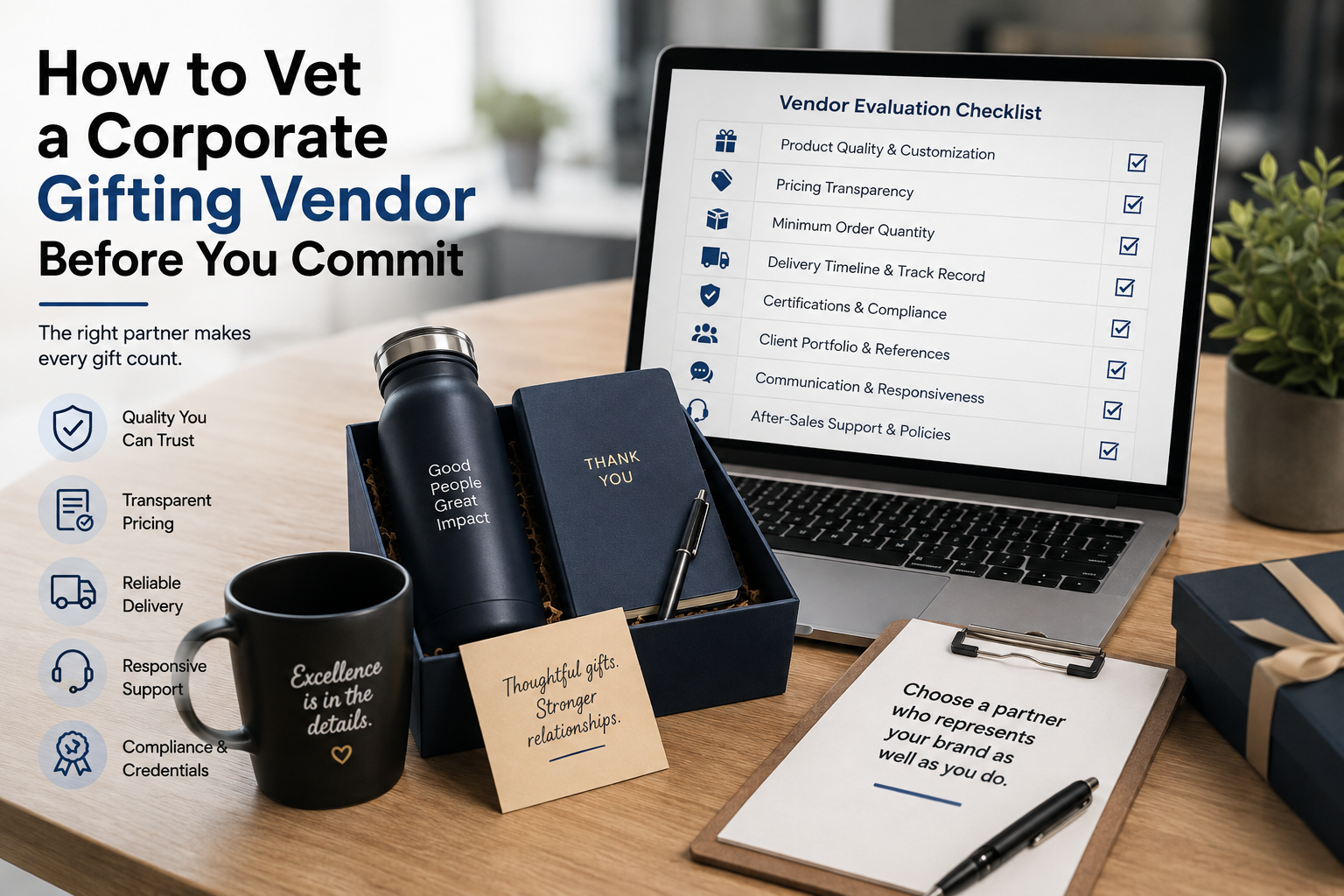
How to Vet a Corporate Gifting Vendor Before You Commit
Choosing a corporate gifting vendor is easy when the order is small.
You can compare a few products, check the price, place the order, and move on.
But when Procurement or Admin teams are responsible for hundreds or thousands of corporate gifts, the decision becomes much more important.
The wrong vendor can create problems with product quality, customization, delivery timelines, packaging, billing, inventory, and customer support. A vendor may offer an attractive price during the quotation stage but struggle when it comes to executing a large, time-sensitive order.
That is why businesses need a structured process to vet a corporate gifting vendor before committing to a purchase.
Vendor evaluation should go beyond the catalogue and quoted price. Procurement teams need to assess the supplier’s capabilities, production process, customization quality, logistics network, communication standards, commercial terms, and ability to handle exceptions.
The objective is simple:
Choose a gifting partner that can deliver the promised product, quality, quantity, customization, and timeline without creating unnecessary operational headaches.
This guide provides a practical framework for Procurement and Admin teams evaluating corporate gifting vendors in India.

Why Vendor Vetting Matters in Corporate Gifting
Corporate gifting often operates under strict deadlines.
A Diwali campaign may need to reach employees before the festival. An employee welcome kit may need to be delivered before joining. Client gifts may need to arrive before a business meeting or important milestone.
This means a vendor failure can affect more than the gifting budget.
It can affect:
- Employee experience
- Client relationships
- Brand perception
- Internal team workload
- Event execution
- Procurement timelines
A vendor that looks good on paper isn’t necessarily capable of managing a complex bulk gifting program.
Proper vetting reduces that risk.
1. Start With Your Own Requirements
Before evaluating vendors, document what you actually need.
Define:
- Number of recipients
- Product category
- Budget per gift
- Required customization
- Packaging requirements
- Delivery locations
- Required delivery date
- Quantity
- Tax requirements
- Branding requirements
- Personalization requirements
For example:
1,000 premium bottles + logo + employee names + customized packaging + Pan-India delivery
is very different from:
100 standard notebooks delivered to one office.
The vendor should be evaluated against your actual requirements.
2. Check the Vendor’s Experience With Corporate Orders
Ask how long the vendor has been handling corporate gifting.
More importantly, ask:
What size orders have they successfully executed?
A vendor may be excellent at fulfilling 50-unit orders but struggle with 5,000 units.
Look for evidence of experience with:
- Bulk orders
- Employee gifting
- Client gifting
- Event gifting
- Personalized gifts
- Multi-location delivery
- Time-sensitive campaigns
Relevant experience is more useful than a generic claim of being a “corporate gifting company.”
3. Ask for Relevant Case Studies
Case studies can reveal how a vendor handles real projects.
Ask for examples involving similar:
- Order quantities
- Products
- Customization
- Delivery locations
- Timelines
You don’t necessarily need confidential client information.
Instead, ask for an overview such as:
Order size: 2,000 units
Customization: Individual names
Locations: Multiple cities
Timeline: 20 days
Packaging: Custom boxes
This helps Procurement understand whether the vendor has handled comparable operational complexity.
4. Evaluate Product Quality, Not Just Product Photos
Online product photographs can be misleading.
Lighting, editing, angles, and presentation can make an average product look premium.
Before placing a large order, request a physical sample whenever practical.
Inspect:
- Material quality
- Finish
- Weight
- Functionality
- Durability
- Branding
- Packaging
- Overall appearance
A physical sample gives Procurement a much better understanding of what recipients will actually receive.
5. Request a Customized Sample
If customization is part of the order, don’t evaluate only the blank product.
Request a sample showing:
Actual product + Actual logo + Actual personalization + Actual packaging
This allows you to check:
- Logo placement
- Engraving quality
- Printing quality
- Font
- Name positioning
- Color accuracy
- Packaging finish
A vendor’s ability to customize the actual product is more important than a generic product sample.
6. Evaluate Customization Capabilities
Large corporate gifting campaigns may require:
- Logo printing
- Laser engraving
- UV printing
- Embroidery
- Screen printing
- Personalized names
- Custom packaging
- Individual messages
Ask the vendor:
Is customization handled internally or through another supplier?
If multiple suppliers are involved, understand how the vendor manages quality control and timelines.
Also ask about maximum daily or weekly production capacity for customized orders.
7. Understand Their Data-Handling Process
If gifts are personalized, the vendor may receive employee or client information.
Procurement and Admin teams should understand:
- What data is required?
- How is it transferred?
- Who has access?
- How is it used?
- How long is it retained?
- How are files handled after production?
Only provide the information required to execute the order.
For personalized gifts, establish a clear process:
Data received → Validation → Approval → Production → Quality check → Fulfillment
A vendor should be comfortable working with structured production files rather than relying on scattered email instructions.
8. Verify Production Capacity
One of the most important questions is:
Can the vendor actually produce the required quantity within the required timeline?
Don’t accept vague answers such as:
“We should be able to manage it.”
Ask for specifics.
For example:
- Current production capacity
- Lead time
- Customization capacity
- Peak-season capacity
- Production schedule
- Expected dispatch date
This is especially important during Diwali, New Year, employee appreciation campaigns, and major corporate events when gifting demand increases significantly.
9. Ask About Lead Times
Understand the complete production timeline.
A typical workflow may include:
Order confirmation
↓
Artwork approval
↓
Sample approval
↓
Production
↓
Customization
↓
Quality control
↓
Packaging
↓
Dispatch
↓
Delivery
Ask how many working days each stage requires.
This helps Procurement identify unrealistic promises before committing.
10. Examine Their Logistics Capability
Product quality is only one part of corporate gifting.
The vendor also needs to deliver the gifts correctly.
For multi-location or Pan-India campaigns, ask:
- Which cities can you deliver to?
- Do you use courier partners?
- Do you support individual employee addresses?
- Can you provide tracking?
- How are failed deliveries handled?
- How are remote locations handled?
- Can shipments be split by location?
A vendor may offer excellent products but lack the logistics infrastructure needed for your campaign.
11. Ask How They Handle Delivery Exceptions
No large shipping campaign is completely free of exceptions.
Potential issues include:
- Incorrect address
- Recipient unavailable
- Damaged package
- Wrong product
- Lost shipment
- Delivery delay
- Address change
Before placing the order, ask:
What happens when something goes wrong?
You want a clearly defined escalation process rather than discovering the answer after a problem occurs.
12. Review Their Quality-Control Process
Ask how products are inspected before dispatch.
Quality control may cover:
- Product defects
- Logo accuracy
- Personalization
- Packaging
- Quantity
- Product-to-recipient matching
For personalized employee gifts, quality control becomes especially important.
A single spelling mistake may seem minor.
But 100 incorrect personalized products can become a major operational and financial problem.
13. Understand Replacement Policies
Ask what happens if:
- Products arrive damaged
- Customization is incorrect
- Items are missing
- The wrong product is shipped
- Products fail quality expectations
Clarify:
Who bears the replacement cost?
Also ask:
How quickly will replacements be produced and dispatched?
Replacement policies should be understood before the purchase order is finalized.
14. Compare the Complete Commercial Quote
Don’t compare vendors using only the product price.
A quote should ideally identify:
- Product cost
- Customization
- Packaging
- Artwork/setup charges
- Shipping
- GST
- Minimum order quantity
- Additional charges
- Replacement terms
For example:
Vendor A: ₹850 product price
Vendor B: ₹790 product price
Vendor B initially looks cheaper.
But if Vendor B charges separately for customization, packaging, and shipping, the final cost may be higher.
Compare the total landed cost, not just the headline product price.
15. Check Minimum Order Quantities
Some vendors may have minimum order quantities for:
- Products
- Customization
- Packaging
- Special colors
- Custom boxes
If you need only 200 units but the vendor requires 500 units for customized production, this could affect your budget and inventory.
Ask about MOQ before approving the product.
16. Evaluate Communication Quality
Communication is often overlooked during vendor selection.
But if the vendor is slow to respond before receiving your order, communication may become even more difficult during execution.
Evaluate:
- Response time
- Clarity
- Professionalism
- Point of contact
- Escalation process
- Order updates
A strong vendor should make it easy for Procurement and Admin teams to understand what is happening at every stage.
17. Look for a Dedicated Account Manager
Large corporate orders should ideally have a defined point of contact.
A dedicated account manager can coordinate:
- Product selection
- Quotations
- Artwork
- Samples
- Production
- Packaging
- Shipping
- Escalations
This reduces the need for Procurement teams to repeatedly explain the same project details to different people.
18. Check Billing and Documentation
Corporate procurement often requires proper documentation.
Confirm whether the vendor can provide:
- GST invoice
- Quotation
- Purchase-order documentation
- Delivery documentation
- Shipment reports
- Payment receipts
- Credit terms, where applicable
If your organization has vendor onboarding requirements, complete them before production begins.
Documentation problems can create unnecessary payment delays.
19. Verify Branding Accuracy
Marketing and Brand teams may have strict requirements around logo usage.
Confirm that the vendor can follow:
- Logo guidelines
- Brand colors
- Approved artwork
- Placement requirements
- Minimum logo size
- Typography requirements
Never assume the vendor will automatically follow your brand guidelines.
Provide approved artwork and obtain confirmation before production.
20. Ask About Scalability
A vendor may execute your current order successfully.
But can they support future campaigns?
Consider whether the vendor can scale from:
300 units → 1,000 units → 5,000 units
without a major decline in quality or service.
Scalability matters if corporate gifting is part of your recurring employee engagement or client relationship strategy.
21. Evaluate Flexibility Without Losing Process Control
Good vendors should be able to accommodate reasonable changes.
But excessive flexibility can sometimes indicate weak processes.
Ask how they handle:
- Quantity changes
- Artwork changes
- Recipient changes
- Address corrections
- Product substitutions
There should be a defined change-management process.
The goal is not a vendor who says yes to everything.
It is a vendor who can explain what can change, when it can change, and what the impact will be.
22. Review Vendor Reputation
Look beyond the vendor’s own marketing material.
Where available, examine:
- Customer reviews
- Business references
- Industry presence
- Client testimonials
- Professional reputation
- Repeat-client evidence
Don’t rely on a single review.
Look for recurring patterns.
If multiple customers mention delivery delays or poor customization, Procurement should investigate before committing.
23. Start With a Pilot Order When Possible
If you’re unsure about a new vendor, don’t immediately place your largest order.
A smaller pilot can help evaluate:
- Product quality
- Communication
- Customization
- Packaging
- Delivery
- Documentation
- Problem resolution
A successful pilot doesn’t guarantee a perfect large-scale execution, but it provides useful evidence.
24. Create a Vendor Evaluation Scorecard
A structured scorecard helps prevent price from dominating the decision.
For example:
| Evaluation Area | Weight |
|---|---|
| Product Quality | 20% |
| Pricing | 15% |
| Customization Capability | 15% |
| Production Capacity | 15% |
| Logistics | 15% |
| Quality Control | 10% |
| Communication | 5% |
| Commercial Documentation | 5% |
Your organization can adjust the weightings according to the campaign.
For a highly customized employee gifting program, customization and quality may deserve more weight.
For an event with an extremely tight deadline, production and logistics may become more important.
Corporate Gifting Vendor Vetting Checklist
Before signing off on a vendor, confirm:
Company Capability
- Relevant corporate gifting experience
- Comparable bulk-order experience
- References or case studies
- Production capacity
Product
- Physical sample evaluated
- Product quality approved
- Product availability confirmed
- MOQ understood
Customization
- Printing/engraving method confirmed
- Customized sample approved
- Artwork process established
- Personalization capacity confirmed
Logistics
- Delivery locations confirmed
- Dispatch timeline confirmed
- Tracking available
- Failed-delivery process defined
- Replacement process established
Commercials
- Product price confirmed
- Customization cost confirmed
- Packaging cost confirmed
- Shipping cost confirmed
- GST confirmed
- Payment terms confirmed
Operations
- Account manager assigned
- Communication process established
- Quality-control process confirmed
- Data-handling process understood
- Change-management process defined
Questions to Ask Before You Commit
Procurement and Admin teams can use these questions during vendor evaluation:
- Have you handled an order of this size before?
- What is your production lead time?
- What is your customization capacity?
- Can you provide a physical customized sample?
- Who handles printing or engraving?
- How do you verify personalized data?
- How do you conduct quality checks?
- How do you handle damaged products?
- What is your replacement policy?
- Can you ship to multiple locations?
- Is shipment tracking available?
- What are all additional charges?
- What are your minimum order quantities?
- What happens if requirements change after approval?
- Who will be our primary account manager?
The quality of the vendor’s answers can tell you almost as much as the product itself.
Red Flags When Vetting a Corporate Gifting Vendor
Be cautious if a vendor:
- Refuses to provide samples
- Gives unrealistic delivery promises
- Cannot explain production capacity
- Avoids providing a complete quote
- Has unclear replacement terms
- Changes pricing frequently
- Provides vague answers about customization
- Has no clear escalation process
- Cannot provide tracking for large shipments
- Pushes for immediate payment without clear documentation
One red flag may not automatically disqualify a vendor.
But several together should trigger additional due diligence.
Final Thoughts
To vet a corporate gifting vendor effectively, Procurement and Admin teams need to look beyond product catalogues and attractive pricing.
A reliable corporate gifting partner should demonstrate capability across the entire process:
Product sourcing → Customization → Quality control → Packaging → Logistics → Tracking → Support
The cheapest quotation isn’t necessarily the most economical choice if it creates rework, replacements, delays, or additional internal workload.
Likewise, the most expensive vendor isn’t automatically the best.
The right vendor is the one that can consistently deliver the required quality, quantity, customization, timeline, and service level within your organization’s budget.
Before committing to a large corporate gifting order, evaluate the vendor with the same discipline you would apply to any important supplier.
Request samples. Verify capacity. Check references. Understand the complete cost. Test communication. Define quality standards. Clarify replacement and delivery policies.
Most importantly, don’t wait until something goes wrong to discover how the vendor handles problems.
The best time to vet a corporate gifting vendor is before the purchase order—not after the first delivery fails.
Leave a comment