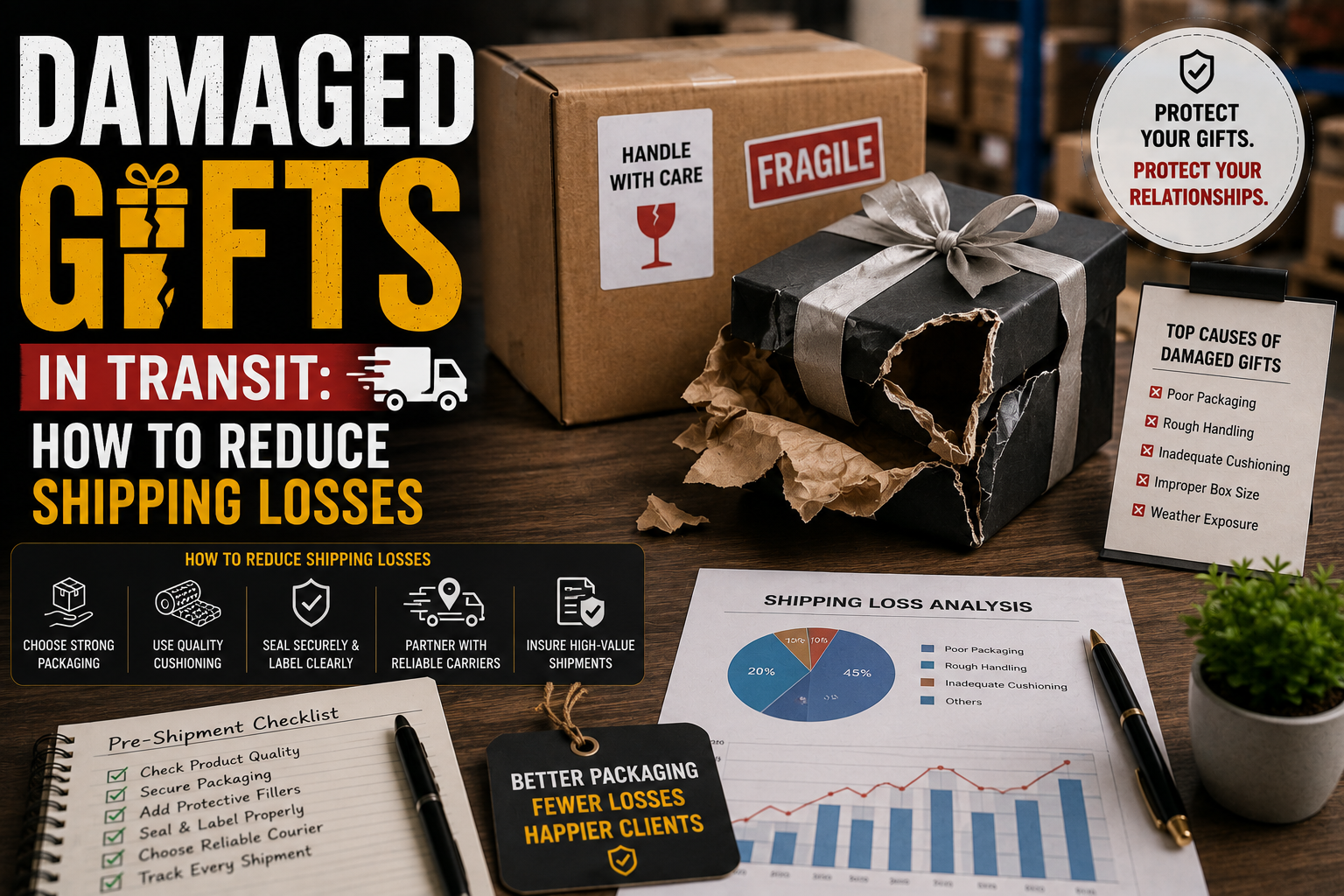
Damaged Gifts in Transit: How to Reduce Shipping Losses
Corporate gifting is often planned around product quality, personalization, and presentation. But there is another factor that can significantly affect the recipient experience: what happens to the gift during transportation.
A premium gift that leaves a warehouse in perfect condition can arrive scratched, broken, dented, leaking, or otherwise damaged. For Admin and Procurement teams, these incidents can create replacement costs, delivery delays, additional logistics expenses, vendor disputes, and unnecessary administrative work.
The challenge becomes even greater when hundreds or thousands of gifts are being shipped across multiple cities.
Managing damaged corporate gifts shipping therefore requires a proactive approach. The objective should not simply be to replace damaged products after delivery. It should be to reduce the probability of damage from the moment the product is selected until it reaches the recipient.
This guide explains the major causes of transit damage and practical strategies Admin and Procurement teams can use to reduce shipping losses while maintaining control over corporate gifting costs.

Why Corporate Gifts Get Damaged During Shipping
Transit damage can happen at several stages.
A package may experience:
- Handling during pickup
- Sorting-center movement
- Loading and unloading
- Stacking pressure
- Vehicle vibration
- Long-distance transportation
- Weather exposure
- Last-mile handling
- Incorrect packaging
- Repeated delivery attempts
The risk also depends heavily on the product.
A notebook and a ceramic mug may have completely different packaging requirements.
Similarly, a premium gift box containing multiple products may require more protection than a single packaged item.
The first step in reducing damage is understanding the specific risks associated with each product.
1. Evaluate Shipping Risk Before Selecting the Gift
Procurement teams often select products based on price, appearance, and usefulness.
Shipping risk should also be part of the evaluation.
Before finalizing a product, ask:
- Is it fragile?
- Can it withstand stacking?
- Is it sensitive to moisture?
- Can individual components move inside the package?
- Does it have sharp edges?
- Can the product scratch easily?
- Does it require temperature-sensitive handling?
- Is the original packaging strong enough for courier transportation?
For example, a beautiful ceramic mug may look excellent in a showroom but require significantly more protective packaging than a stainless-steel bottle.
A product that costs slightly less but has a high breakage rate may ultimately be more expensive.
2. Match Packaging to the Product
One of the biggest mistakes in corporate gifting is using the same packaging approach for every product.
Packaging should be designed around the product’s physical characteristics.
Fragile Products
Ceramic, glass, acrylic, and other breakable products need protective cushioning and sufficient internal separation.
Electronics
Electronic products require protection against impact and, where relevant, moisture and other environmental conditions.
Apparel
Clothing usually has lower breakage risk but can be affected by moisture, compression, or poor packaging.
Gift Hampers
Hampers need internal organization so that products do not collide or shift during transportation.
The packaging should protect both the product and the presentation.
3. Prevent Movement Inside the Box
A product that moves freely inside a shipping box is more vulnerable to impact.
When the package is dropped or moved abruptly, the product can hit:
- Another product
- The box walls
- Packaging accessories
- Internal dividers
Use suitable internal cushioning or dividers to minimize unnecessary movement.
The objective is simple:
The product should remain stable throughout transportation.
For multi-item corporate hampers, individual products should also be secured so they don’t collide with each other.
4. Use the Right Outer Shipping Box
A premium gift box is not necessarily a suitable shipping box.
Many corporate gifts have two packaging layers:
Presentation packaging → Protective shipping packaging
The presentation box creates the gifting experience.
The outer shipping carton protects that experience during transportation.
For bulk gifting campaigns, Procurement teams should confirm that the outer carton is appropriate for stacking, handling, and long-distance transportation.
A beautiful gift box without adequate external protection can still arrive damaged.
5. Don’t Leave Excess Space
Oversized shipping boxes can increase the risk of damage.
If there is too much empty space, the contents may move around during transportation.
This can also increase shipping costs because larger packaging may contribute to dimensional weight.
At the same time, the box should not be so tight that pressure is transferred directly to fragile products.
The ideal packaging provides:
Product stability + Appropriate cushioning + Efficient space utilization
This balance can reduce both damage and unnecessary shipping expenses.
6. Avoid Excessive Compression
The opposite problem can also occur.
If products are packed too tightly or too many items are placed in one carton, excessive pressure can cause:
- Cracked packaging
- Dented boxes
- Damaged gift products
- Deformed products
- Broken components
This is particularly important when cartons will be stacked during transportation.
Packaging decisions should therefore account for both impact protection and compression resistance.
7. Conduct Packaging Drop Tests
For high-volume or high-value corporate gifting orders, consider testing the packaging before mass production.
A sample package can be subjected to practical handling simulations.
The purpose is not to replicate every possible logistics condition. It is to identify obvious weaknesses before hundreds of packages are shipped.
Test whether:
- The product moves inside the box
- The gift box remains intact
- Internal cushioning stays in place
- Fragile components remain protected
- External packaging provides sufficient protection
A small investment in packaging testing can prevent a much larger replacement cost later.
8. Ship a Sample Before the Full Order
Before approving a large production run, request a completed sample that represents the final shipment.
Don’t inspect only the product.
Inspect the complete package:
Product + Branding + Gift Box + Protective Packaging + Shipping Carton
If possible, evaluate how the finished package performs during handling.
This gives Procurement teams an opportunity to identify weaknesses before the entire order enters the logistics network.
9. Separate Fragile Products From Heavy Products
When multiple products are packed together, weight distribution matters.
A heavy product placed directly next to a fragile product can increase damage risk.
For example, a heavy bottle should not be allowed to move freely against a delicate ceramic accessory.
Use internal partitions or separate packaging where appropriate.
For curated hampers, think about the physical interaction between every item.
10. Protect Against Moisture
Long-distance shipping can expose packages to changing environmental conditions.
Moisture can damage:
- Paper products
- Notebooks
- Packaging
- Apparel
- Wooden products
- Certain electronic accessories
- Food packaging
Depending on the product, suitable moisture-resistant outer packaging or protective layers may be necessary.
The objective is particularly important during periods of heavy rain or when packages may be exposed during loading and unloading.
11. Protect the Gift Box, Not Just the Product
Corporate gifting is different from ordinary e-commerce shipping because presentation is part of the product.
A gift may technically be usable but still feel damaged if:
- The box is crushed
- The ribbon is torn
- The sleeve is scratched
- Branding is damaged
- The packaging is stained
For premium corporate gifts, the packaging should therefore be treated as a deliverable.
The recipient should ideally receive the gift in the condition expected by the brand.
12. Label Packages Correctly
Clear shipping labels can help reduce handling errors.
Depending on the product and logistics requirements, labels may communicate information such as:
- Fragile
- This side up
- Handle with care
- Keep dry
Labels alone cannot guarantee careful handling, but they can support appropriate package management.
More importantly, the package should have accurate shipping information.
Incorrect addresses can lead to additional delivery attempts, increasing the amount of handling and therefore the potential for damage.
13. Select Logistics Partners Based on Damage Performance
Procurement teams should evaluate courier partners using more than delivery price and speed.
Ask vendors or logistics partners about:
- Damage rates
- Delivery success rates
- Return rates
- Tracking capabilities
- Claims process
- Replacement procedures
- Geographic coverage
- Customer support
A low shipping price is not necessarily economical if the carrier regularly causes damage and the company must pay for replacements.
The better metric is total delivered cost.
14. Track Damage Rates by Product
Not every product will experience the same level of shipping loss.
Maintain records showing:
Product → Quantity Shipped → Quantity Damaged → Damage Rate → Replacement Cost
For example:
| Product | Shipped | Damaged | Damage Rate |
|---|---|---|---|
| Ceramic Mugs | 1,000 | 25 | 2.5% |
| Bottles | 1,000 | 8 | 0.8% |
| Notebooks | 1,000 | 3 | 0.3% |
This information can influence future procurement decisions.
If one product consistently experiences higher damage, the team can investigate packaging, supplier quality, or courier handling.
15. Create a Damage Reporting Process
Recipients and internal teams need a simple way to report damaged gifts.
The process can include:
- Recipient reports damage.
- Admin records shipment details.
- Photos are collected where appropriate.
- Vendor or courier is notified.
- Replacement eligibility is determined.
- Replacement is dispatched.
- Incident is recorded for future analysis.
A standardized process prevents every damage incident from becoming a separate investigation.
16. Photograph Bulk Orders Before Dispatch
For larger corporate gifting campaigns, documenting the condition of products before shipment can be useful.
Photographs or quality-control records can establish that products were inspected before dispatch.
This can help when investigating whether damage occurred during:
- Manufacturing
- Packaging
- Warehouse handling
- Transportation
- Last-mile delivery
Documentation is particularly useful when discussing claims or recurring damage with vendors.
17. Maintain Replacement Inventory
Even with excellent packaging, some transit damage may still occur.
For time-sensitive corporate gifting campaigns, keeping a small replacement quantity can help resolve issues quickly.
The appropriate buffer depends on:
- Order volume
- Product fragility
- Product value
- Delivery deadline
- Replacement lead time
The purpose is not to overstock.
It is to ensure that a small number of damaged shipments do not disrupt the entire gifting campaign.
18. Calculate the Real Cost of Shipping Damage
Damage costs are not limited to the product price.
Consider:
Product replacement + Repackaging + Rebranding + Reshipping + Administrative time + Customer-service effort
For example, if a ₹700 corporate gift is damaged, replacing it may involve another ₹700 product cost plus packaging and another delivery charge.
For 50 damaged shipments, the total financial impact can become substantial.
This is why reducing damage by even a small percentage can improve overall procurement efficiency.
19. Review Damage Claims With Vendors
If the same type of damage occurs repeatedly, don’t simply replace the products.
Investigate the root cause.
Ask:
- Is the product itself too fragile?
- Is the packaging insufficient?
- Are products moving inside the carton?
- Is the outer box too weak?
- Is the courier handling causing repeated issues?
- Are multiple products being packed incorrectly?
The objective should be root-cause correction, not repeated replacement.
20. Build Damage Prevention Into the Procurement Process
Damage prevention should be discussed before the purchase order is finalized.
Procurement teams can include packaging and damage-related requirements in vendor discussions.
For example:
- Required packaging specifications
- Sample approval
- Quality inspection
- Packaging test
- Replacement terms
- Damage reporting process
- Responsibility for transit damage
This creates clearer expectations and reduces disputes later.
A Practical Corporate Gift Shipping Quality Checklist
Before a bulk shipment leaves the warehouse, confirm:
Product Quality
- Product inspected
- Branding correct
- Personalization verified
- No visible defects
Packaging
- Product secured
- Internal cushioning adequate
- No unnecessary movement
- Outer carton strong enough
- Moisture protection considered where necessary
Logistics
- Address validated
- Shipping label correct
- Courier confirmed
- Tracking generated
- Delivery timeline confirmed
Contingency
- Replacement stock considered
- Damage reporting process established
- Vendor escalation contact available
- Claims process understood
This simple checklist can significantly improve consistency across large gifting campaigns.
How Admin and Procurement Teams Can Reduce Shipping Losses
A successful strategy can be summarized in five steps:
1. Select products based on both quality and shipping risk.
2. Design packaging specifically for transportation.
3. Test the complete package before mass dispatch.
4. Track damage and replacement rates by product and courier.
5. Use the data to improve future procurement decisions.
This creates a continuous improvement cycle rather than treating every gifting campaign as a one-time project.
Final Thoughts
Damaged corporate gifts shipping problems can quickly turn a well-planned gifting campaign into an expensive operational challenge.
The good news is that many transit-damage problems are preventable.
The process begins with product selection and continues through packaging, quality control, courier selection, tracking, and replacement management.
For Admin and Procurement teams, the most important mindset shift is to stop viewing packaging as an afterthought.
Packaging is part of the corporate gifting experience.
A gift should not simply survive transportation. It should arrive looking the way the brand intended it to look.
By selecting shipping-friendly products, using appropriate protective packaging, testing samples, validating logistics partners, tracking damage rates, and maintaining a clear replacement process, businesses can reduce shipping losses while protecting both their gifting budget and recipient experience.
Ultimately, the goal is simple: fewer damaged packages, fewer replacements, lower logistics waste, and more corporate gifts arriving exactly as intended.
Leave a comment