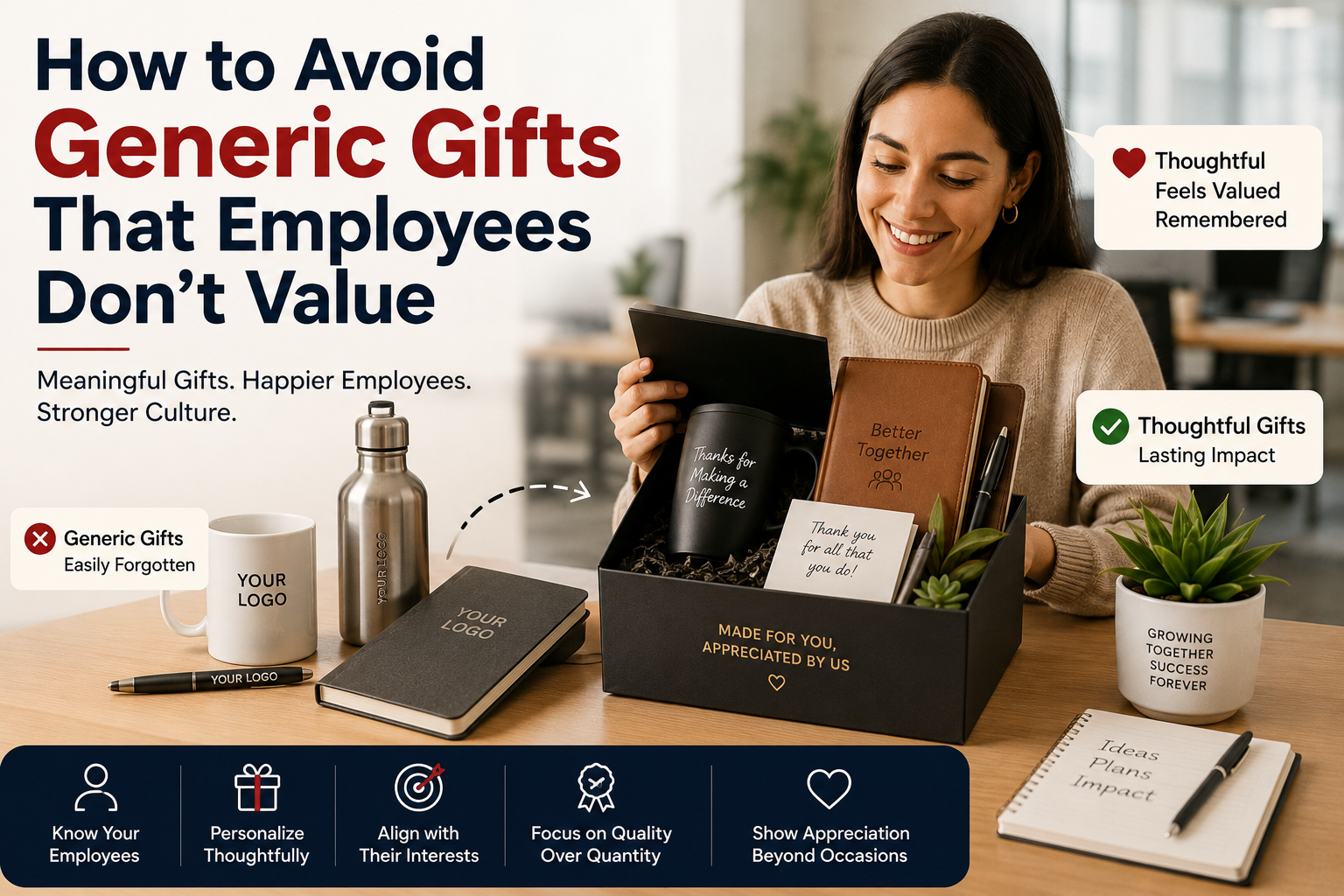
How to Avoid Generic Gifts That Employees Don’t Value
Corporate gifting is supposed to make employees feel appreciated.
But sometimes, the opposite happens.
A company spends a significant amount on employee gifts, distributes them across the organization, and expects excitement. Instead, employees receive another generic mug, basic pen, ordinary diary, or branded item that ends up in a drawer.
The problem isn’t necessarily that the company didn’t spend enough.
It is often that the gift wasn’t relevant enough, useful enough, or thoughtfully selected.
This is the generic corporate gifts problem that HR and People Ops teams increasingly need to address when planning employee gifting programs.
A successful employee gift doesn’t have to be expensive. It needs to demonstrate that the organization understands the recipient and has made a deliberate choice.
For companies gifting hundreds or thousands of employees, achieving that balance requires more than selecting a product from a catalogue.
It requires understanding employee preferences, occasion, utility, personalization, presentation, and overall experience.
This guide explains how HR and People Ops teams can move away from generic corporate gifts and create employee gifting programs that people actually appreciate and use.

What Is the Generic Corporate Gifts Problem?
A generic corporate gift is usually a product selected primarily because it is:
- Easy to source
- Cheap in bulk
- Available immediately
- Simple to brand
- Convenient to distribute
Typical examples might include:
- Basic mugs
- Low-cost pens
- Generic notebooks
- Standard keychains
- Promotional bags
- Mass-produced desk accessories
None of these products are automatically bad.
The problem occurs when the gift is selected without considering the recipient.
A useful corporate gift should answer at least one question:
Will the employee use it?
Will they enjoy receiving it?
Does it feel relevant to the occasion?
Does it communicate genuine appreciation?
If the answer to all four is no, the organization may be spending money without creating much employee value.
1. Start With the Employee, Not the Catalogue
One of the biggest mistakes HR teams make is starting the gifting process by browsing vendor catalogues.
Instead, start with the employee.
Ask:
- Who are we gifting?
- What is their age range?
- Are they office-based, hybrid, or remote?
- What kind of work do they perform?
- What occasion are we celebrating?
- What would be genuinely useful?
- What type of gift fits our company culture?
Once these questions are answered, product selection becomes much easier.
The goal is to match:
Employee + Occasion + Utility + Budget
2. Choose Utility Over Novelty
Novel products may look exciting in a catalogue.
But novelty doesn’t necessarily create long-term value.
A useful product can remain part of an employee’s daily routine.
Consider categories such as:
- Quality drinkware
- Work-from-home accessories
- Premium notebooks
- Desk organizers
- Travel accessories
- Tech-related accessories
- Wellness products
- Lifestyle products
The best choice depends on the workforce.
A software company with a large remote workforce may have different gifting requirements from a manufacturing company with employees working primarily on-site.
3. Don’t Confuse Branding With Personalization
Putting a company logo on a product doesn’t automatically make it a meaningful employee gift.
There is a difference between:
Branded merchandise
and
Employee appreciation gifting
A large logo can make an item feel promotional.
A subtle logo combined with a thoughtful message may feel much more personal.
For example:
Company logo + employee name + appreciation message
can create a stronger emotional connection than:
Large company logo printed across the product
The objective should be to make employees feel appreciated—not turn the gift into advertising.
4. Match the Gift to the Occasion
The same product may not work equally well for every occasion.
Diwali or Festive Gifting
Consider premium lifestyle products, curated hampers, or festive collections.
Employee Anniversary
Personalized or milestone-focused gifts can feel more meaningful.
Joining/Onboarding
Useful work and lifestyle products may create a strong first impression.
Performance Recognition
A more premium or personalized gift may communicate achievement.
Wellness Campaign
Health, relaxation, or lifestyle-focused products may be appropriate.
The occasion provides context.
Use it.
5. Use Employee Segmentation
A workforce is rarely completely homogeneous.
Employees may differ by:
- Role
- Location
- Seniority
- Lifestyle
- Work arrangement
- Preferences
HR doesn’t necessarily need a different gift for every employee.
Instead, use practical segmentation.
For example:
All Employees
One useful core gift.
Managers
A slightly upgraded version.
Leadership
A premium executive option.
This can create differentiation without making procurement unnecessarily complicated.
6. Ask Employees What They Want
When the budget and timeline allow, employee input can dramatically improve gifting decisions.
A short survey can ask:
Which would you prefer?
- Premium bottle
- Travel accessory
- Desk accessory
- Wellness gift
- Lifestyle product
Or:
Which gift category would you find most useful?
This creates a more recipient-focused approach.
However, avoid creating an overly complicated survey.
The goal is to gather useful information—not turn gifting into a research project.
7. Give Employees Limited Choice
Choice can be particularly effective for large organizations.
Instead of giving every employee the exact same product, offer two or three approved options.
For example:
Option A — Premium bottle
Option B — Work desk kit
Option C — Travel organizer
This allows personalization without creating hundreds of different SKUs.
The company still controls:
- Budget
- Product quality
- Branding
- Packaging
- Procurement
Employees gain some autonomy.
8. Personalize Where It Matters
Personalization doesn’t need to be expensive.
Simple options include:
- Employee name
- Initials
- Personalized message
- Department
- Joining year
- Milestone year
A standard product can feel significantly more thoughtful when the recipient’s name is included.
However, large-scale personalization requires accurate employee data and strong production controls.
For 500+ employees, HR should establish a data-freeze date and validate names before production
9. Focus on Perceived Value
The actual price of a gift and the perceived value of a gift are not always the same.
A ₹700 gift can feel more premium than a ₹1,000 gift if it has:
- Better design
- Better materials
- Better packaging
- Better personalization
- Better presentation
- Greater utility
This is why HR should evaluate the complete experience rather than focusing exclusively on product price.
10. Packaging Can Change the Experience
The first impression often comes from the packaging.
A basic product inside a premium box may feel considerably more thoughtful.
Consider:
- Quality boxes
- Branded sleeves
- Personalized cards
- Tissue or protective wrapping
- Product arrangement
- Minimal but elegant branding
The objective isn’t to spend excessively on packaging.
It’s to make the unboxing experience feel intentional.
11. Avoid Over-Branding
Corporate gifting can easily become promotional merchandise.
Too much branding can reduce the perceived personal value of the gift.
Instead, consider:
Small logo + employee name + elegant packaging
rather than:
Large logo + multiple branding elements + promotional messaging
A premium employee gift should feel like something the employee would be happy to own.
12. Choose Quality Over Quantity
Employees don’t necessarily need five products.
In many cases:
One excellent product
is better than:
Five average products
For example, a high-quality bottle may be more appreciated than a box containing several inexpensive accessories.
A smaller number of useful products also simplifies:
- Procurement
- Packaging
- Inventory
- Quality control
- Distribution
13. Consider Different Employee Lifestyles
A gift that works for an office employee may not be ideal for a remote employee.
Similarly, a gift suitable for a field sales team may not work for a desk-based technology team.
Consider:
Remote Employees
Home-office or lifestyle products.
Office Employees
Desk, travel, or workplace accessories.
Field Employees
Durable and portable products.
Leadership
Premium executive products.
The more closely the gift matches the recipient’s lifestyle, the less generic it feels.
14. Don’t Ignore Remote and Hybrid Employees
Remote employees can easily receive gifts designed around office life.
This is a common source of the generic corporate gifts problem.
A desk accessory may have limited value to someone who works from a home office that already contains similar products.
For distributed teams, consider gifts that are useful regardless of work location.
Also plan delivery carefully.
A remote employee’s gift may require:
- Home address confirmation
- Individual shipping
- Contact verification
- Tracking
- Delivery exception management
The gifting experience doesn’t end when the package leaves the warehouse.
15. Consider Sustainability and Employee Values
Many employees increasingly notice how products are sourced, packaged, and used.
Depending on the organization’s culture, consider:
- Reusable products
- Durable products
- Responsible packaging
- Reduced plastic
- Sustainable materials
- Long-lasting products
But sustainability should be genuine.
Simply adding the word “eco-friendly” to a product description does not make it meaningful.
Choose products that demonstrate practical sustainability.
16. Don’t Make Every Gift a Promotional Item
Employees are not customers at a trade show.
Promotional merchandise may be appropriate for:
- Events
- Conferences
- Sales kits
- Brand campaigns
Employee appreciation gifting is different.
Ask:
Would the employee want this if the company logo wasn’t on it?
If the answer is yes, you’re probably closer to a good employee gift.
17. Create a Feedback Loop
After distributing gifts, ask employees what they thought.
A short survey can ask:
How useful was the gift?
How would you rate the quality?
Would you use it regularly?
What type of gift would you prefer next time?
Keep the survey short enough that employees actually complete it.
Over time, HR can build a gifting preference database that improves future campaigns.
18. Track Gift Utilization Where Practical
Not every gift needs formal measurement.
But HR can identify obvious signals.
For example:
- Employee feedback
- Replacement requests
- Exchange rates
- Survey responses
- Social engagement
- Internal comments
- Repeat usage
If a particular product consistently receives poor feedback, don’t reorder it simply because it was inexpensive.
19. Avoid Buying Based Only on Vendor Availability
A vendor may recommend a product because it is readily available.
That doesn’t necessarily mean it’s right for your employees.
Procurement should ask:
Why is this product suitable for our workforce?
not just:
How quickly can you deliver it?
Availability matters, especially for time-sensitive campaigns, but relevance should come first.
20. Balance Personalization With Operational Simplicity
Personalization is valuable, but excessive customization can make gifting difficult to manage.
For large organizations, a practical model is:
Standard premium product
Subtle company branding
Employee name or personalized card
Premium packaging
This creates personalization without turning the campaign into hundreds of unique production projects.
A Simple Framework for Choosing Better Employee Gifts
HR and People Ops teams can use the following five-question framework.
1. Is It Useful?
Will employees actually use it?
2. Is It Relevant?
Does it fit the occasion and workforce?
3. Does It Feel Personal?
Does it communicate appreciation rather than promotion?
4. Does It Look Premium?
Does the quality match the company’s intended message?
5. Can We Deliver It Reliably?
Can the product be customized, packed, and shipped at scale?
If the answer to all five is yes, the gift is far less likely to feel generic.
Example: Turning a Generic Gift Into a Better Experience
Consider a basic corporate notebook.
On its own:
Standard notebook + large company logo
This may feel like promotional merchandise.
Now consider:
Premium notebook + subtle logo + employee name + personalized appreciation card + quality gift box
The product itself may not be dramatically different.
But the experience is.
This is an important lesson for HR teams:
You don’t always need a more expensive product. Sometimes you need a more thoughtful presentation.
Employee Gift Ideas That Feel Less Generic
Depending on budget and workforce preferences, HR teams can explore:
Useful Workplace Gifts
- Premium notebooks
- Executive pens
- Desk organizers
- Quality laptop accessories
Lifestyle Gifts
- Premium drinkware
- Travel accessories
- Personal organizers
- Lifestyle products
Wellness Gifts
- Wellness kits
- Relaxation products
- Self-care accessories
Personalized Gifts
- Engraved bottles
- Personalized notebooks
- Name-printed accessories
- Customized gift boxes
Experience-Oriented Gifting
Where appropriate, companies can also consider experiences or employee choice-based rewards rather than physical products.
Common Employee Gifting Mistakes
Choosing the Cheapest Product
Low price does not necessarily mean good value.
Putting a Large Logo on Everything
This can make employee gifts feel like advertising.
Ignoring Employee Preferences
A gift that looks good to Procurement may not be useful to employees.
Giving Too Many Items
Quantity doesn’t automatically create value.
Using the Same Gift Every Year
Repeated gifting can reduce excitement and perceived thoughtfulness.
Ignoring Packaging
Presentation influences the recipient’s first impression.
Not Collecting Feedback
Without feedback, HR may continue repeating ineffective choices.
A Practical Employee Gifting Workflow
Step 1: Understand the Workforce
Identify employee demographics, work patterns, and preferences.
Step 2: Define the Occasion
Determine what the gifting campaign is trying to achieve.
Step 3: Set the Budget
Establish a realistic cost per recipient.
Step 4: Shortlist Products
Focus on quality, utility, and relevance.
Step 5: Gather Employee Input
Use surveys or limited-choice gifting when appropriate.
Step 6: Add Meaningful Personalization
Use names, messages, or thoughtful packaging where useful.
Step 7: Test the Product
Approve a physical sample before bulk production.
Step 8: Plan Fulfillment
Consider packaging, locations, and delivery requirements.
Step 9: Gather Feedback
Measure employee response after the campaign.
Step 10: Improve the Next Campaign
Use the feedback to refine future gifting decisions.
Final Thoughts
The generic corporate gifts problem isn’t really about mugs, notebooks, pens, bottles, or any particular product category.
It is about choosing gifts without sufficiently considering the people receiving them.
A useful employee gift doesn’t have to be luxurious or expensive. It needs to feel relevant, useful, thoughtful, and appropriate.
HR and People Ops teams can move away from generic gifting by understanding employee preferences, matching gifts to occasions, limiting unnecessary branding, using personalization strategically, improving packaging, offering controlled choices, and learning from employee feedback.
The most important question to ask before approving any employee gift is:
“Would our employees genuinely want to receive this?”
If the answer is yes, you’re already moving beyond generic corporate gifting.
Because the best employee gifts don’t simply carry the company’s logo.
They communicate that the company thought about the person receiving them.
Leave a comment