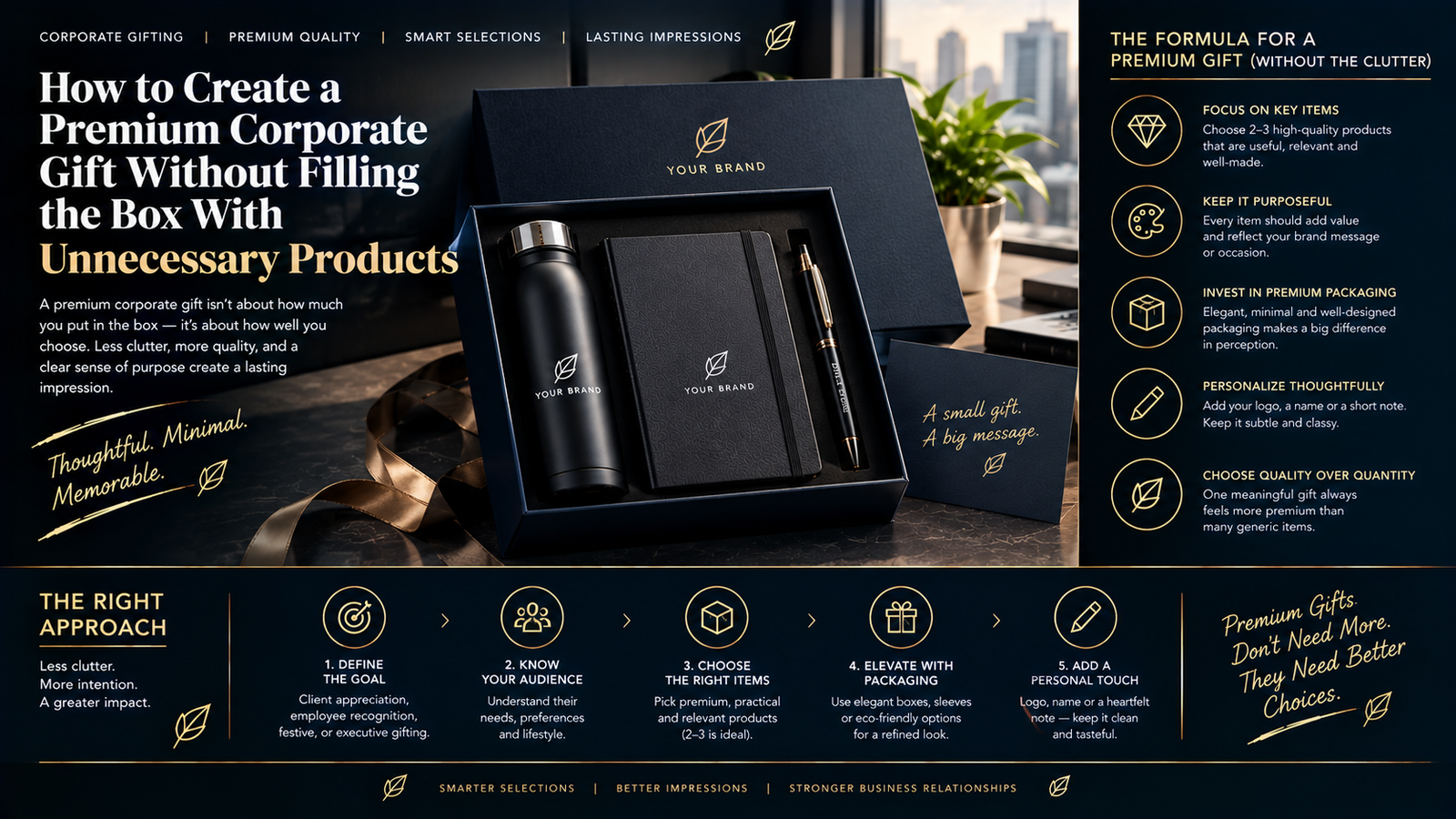
How to Create a Premium Corporate Gift Without Filling the Box With Unnecessary Products
A premium corporate gift does not need to contain a dozen products to make a lasting impression. Sometimes, a carefully selected notebook, a quality bottle, and a personalised message can communicate more thought and professionalism than a large hamper filled with unrelated accessories.
For HR and Procurement teams, the challenge is to create gifts that feel valuable while keeping spending, product quality, and fulfilment under control. Whether the occasion is employee onboarding, a festive celebration, client appreciation, or an executive meeting, every product should contribute to the recipient’s experience.
This is where curated corporate gifting makes a difference. Instead of starting with a box size or a target number of products, businesses begin with the recipient, occasion, and purpose. They then select a small collection of relevant items, coordinate the presentation, and allocate the budget where it matters most.
In this guide, we explain how to create premium corporate gifts without unnecessary products, how to balance quality and cost, and how HR and Procurement teams can build a repeatable gifting process.

What Is Curated Corporate Gifting?
Curated corporate gifting is the process of selecting products that work together to create a purposeful, cohesive gift. Each item is chosen for its usefulness, quality, relevance, or contribution to the overall presentation.
Traditional bulk gifting can sometimes prioritise quantity, particularly when businesses want every box to look substantial. Curated gifting takes a different approach: it prioritises the recipient’s needs and the message the organisation wants to communicate.
For example, an employee welcome kit might contain a durable bottle, a well-made notebook, and a welcome card. A client appreciation gift could include a premium desk accessory, a complementary item, and personalised packaging.
Neither gift needs unnecessary fillers to feel complete.
Effective curated corporate gifting typically considers five factors:
- Relevance: Does the gift suit the recipient and occasion?
- Quality: Are the products well made and suitable for regular use?
- Coherence: Do the items work together as a collection?
- Presentation: Are the products arranged and packaged thoughtfully?
- Value: Does the complete gift justify its cost?
The objective is not simply to give fewer products. It is to make each product count.
1. Start With the Purpose of the Gift
Before selecting products, define what the gift should achieve. A clear purpose prevents the selection process from becoming a search for as many attractive products as possible.
HR and Procurement teams may organise gifts for several reasons, including:
- Welcoming new employees.
- Recognising work anniversaries and achievements.
- Appreciating clients and business partners.
- Supporting conferences and corporate events.
- Celebrating festivals and annual milestones.
- Strengthening relationships with senior stakeholders.
Each purpose requires a different approach.
A welcome kit should help employees settle into the workplace. A client gift should reflect the relationship and the organisation’s professional standards. An event giveaway should be useful, easy to distribute, and appropriate for the audience.
Write a one-sentence brief before contacting suppliers. For example: “Create a practical welcome gift for new employees that feels professional, useful, and consistent with our brand.”
This simple step helps teams evaluate every proposed item against a specific objective.
2. Identify the Recipient Before Choosing Products
A gift that works well for one audience may be unsuitable for another. Procurement teams should therefore assess recipient needs before comparing product catalogues.
For employees
Practical items such as bottles, notebooks, desk accessories, bags, or welcome cards can work well when they suit the employee’s role and work environment.
For clients
Client appreciation gifts should reflect the relationship, occasion, and recipient’s preferences where known. Quality, restrained branding, and thoughtful presentation may be more appropriate than a large collection of promotional items.
For senior executives
A compact set with a strong hero product and carefully selected accessories can create a polished impression. Materials, finishing, packaging, and personalisation deserve particular attention.
For large employee programmes
Consistency matters. A standard product selection makes procurement and quality control easier, while appropriate personalisation can add a more individual touch.
The key question is not, “What else can we add?” It is, “What would make this gift genuinely useful or meaningful to this recipient?”
3. Choose One Hero Product
A hero product is the main item that establishes the identity and perceived value of the gift. The remaining products should complement it rather than compete for attention.
For example, a professional desk-themed gift could centre on a quality notebook. A reusable bottle might be the hero product for an employee welcome kit, while a refined organiser could anchor a client appreciation set.
Once the hero product is selected, consider whether any supporting items improve its usefulness.
A notebook may pair naturally with a pen. A travel organiser might work with a luggage tag. A premium bottle could be accompanied by a compact carrying pouch if it genuinely adds convenience.
However, adding a keychain, coaster, stress toy, and unrelated stationery simply because they fit in the box may dilute the concept.
A useful selection rule is to identify the main product first, then justify each additional item individually.
4. Apply the “Purpose, Quality, and Fit” Test
Before approving the contents, assess every product against three questions.
Does it serve a purpose?
The item should solve a practical need, enhance the occasion, or contribute to the gift’s theme. If its only role is to increase the item count, reconsider it.
Does it meet the quality standard?
A premium gift can lose its appeal when a low-quality product sits beside a well-made item. Check the materials, finishing, durability, and consistency of every component.
Does it fit the collection?
Products should complement one another in function, style, and presentation. A coherent set usually looks more intentional than a mixture of unrelated items.
Consider a hypothetical client gift containing a quality notebook, a branded pen, and a generic plastic accessory of uncertain usefulness. Removing the accessory may improve the set by giving the primary products more visual space and allowing the packaging to feel less crowded.
The best product selection is not necessarily the smallest. It is the one in which each component contributes something worthwhile.
5. Use Packaging to Create a Premium Experience
Packaging can influence how recipients perceive a gift before they even examine the products. Good packaging protects the contents, organises the presentation, and reinforces the intended message.
However, premium packaging does not require excessive layers or an oversized box.
Choose the right box size
A box should fit its contents comfortably. Too much empty space can make the gift feel incomplete, while an overcrowded box can make the products difficult to appreciate.
Use suitable inserts or dividers to keep items secure during transit. Avoid fillers that serve no practical purpose.
Coordinate colours and finishes
Choose packaging colours that work with the product selection and corporate identity. Neutral colours, restrained accents, and consistent finishes can create a refined appearance without relying on elaborate decoration.
Arrange products deliberately
Place the hero product where it is easy to see. Arrange supporting products neatly, and include the message card where it can be noticed without disrupting the layout.
Make the unboxing experience simple
The recipient should be able to open the gift easily and understand the collection. Unnecessary wrapping layers may increase cost and waste without improving the experience.
For bulk orders, request a sample of the fully assembled gift. Reviewing the complete presentation is more useful than evaluating individual products separately.
6. Personalisation Can Add More Meaning Than Extra Products
Personalisation can make a gift feel more considered without increasing the number of items.
Depending on the product and budget, businesses can explore:
- The recipient’s name on a notebook or bottle.
- A discreet company logo.
- A message card acknowledging an achievement.
- A welcome note for a new employee.
- A campaign-specific sleeve or gift tag.
- Packaging that reflects the occasion.
The level of personalisation should suit the recipient and context. For executive gifts and client appreciation, subtle branding may feel more appropriate than placing a large logo on every product.
For employee gifting, a personalised message can make a standard gift set feel more relevant. For example, a welcome note that acknowledges the employee’s arrival may add more meaning than another generic accessory.
Procurement teams should also account for the operational implications. Names and other personal details need accurate records, approved artwork, and sufficient production time. Always confirm the final personalisation list before authorising production.
7. Allocate the Budget Around Value, Not Quantity
A fixed budget does not have to be divided equally among every product. The allocation should reflect what matters most to the recipient and the purpose of the gift.
Suppose a company has a hypothetical budget of ₹1,500 per recipient. It could purchase several inexpensive products, or it could prioritise one higher-quality item, a complementary product, and coordinated packaging.
The second option may produce a more premium result if the products are useful and the presentation is well executed. The final outcome still depends on the actual product specifications and supplier pricing.
When preparing a quotation, include all relevant costs:
| Cost component | What to evaluate |
|---|---|
| Main product | Materials, durability, finish, and usability |
| Supporting products | Whether each item adds genuine value |
| Branding | Printing, engraving, embroidery, or personalisation |
| Packaging | Box, inserts, cards, and assembly |
| Delivery | Freight, individual packing, and distribution |
| Taxes and other charges | Applicable taxes and any setup or handling fees |
Compare complete quotations rather than product prices alone. A supplier offering a lower unit price may charge more for customisation, packaging, or delivery.
The goal is to spend more deliberately, not automatically to choose the most expensive product.
8. How HR Teams Can Build Better Gift Sets
HR teams often manage recurring gifting programmes with different occasions, budgets, and recipient groups. A consistent framework can simplify planning without making every gift feel identical.
Employee welcome kits
Focus on useful products employees can incorporate into their work routine. A notebook, bottle, and welcome message may be sufficient if the products are well selected and presented.
Recognition and milestone gifts
Match the gift to the significance of the occasion. For an important milestone, a single quality product accompanied by a personalised note may feel more meaningful than a large assortment of generic items.
Festival gifting
Festive hampers can contain multiple products, but the contents should still have a clear theme. Food items, useful accessories, or compatible lifestyle products should be selected with recipient preferences and company policies in mind.
Remote employee gifting
Consider portability, durability, delivery packaging, and usefulness at home or in a hybrid workplace. Avoid adding bulky items that increase shipping costs without improving the recipient’s experience.
HR teams should establish approved product standards, budget ranges, and review procedures so that gifts remain consistent across departments and locations.
9. How Procurement Teams Can Control Quality and Reduce Waste
Procurement plays a critical role in turning a gift concept into a reliable bulk order.
Start by preparing a clear brief that includes the target audience, occasion, budget per recipient, quantity, branding requirements, delivery locations, and required date.
Then follow a structured process:
- Request comparable proposals. Ask shortlisted suppliers to quote against the same product specifications and quantities.
- Review product samples. Check the quality and finish of the hero product and any supporting items.
- Approve the complete gift. Evaluate the packaging, product arrangement, branding, and message card together.
- Confirm production milestones. Agree on artwork approval, personalisation, assembly, and delivery dates.
- Set quality-control requirements. Specify acceptable product standards, quantity checks, and how defects or incorrect personalisation will be handled.
- Review the final cost. Confirm taxes, packaging, delivery, and other charges before issuing the purchase order.
This process reduces the risk of unnecessary extras being added late in the selection process and helps teams focus on measurable quality rather than the size of the hamper.
10. Common Mistakes to Avoid in Curated Corporate Gifting
Several common decisions can weaken an otherwise strong gift concept.
Adding products to fill empty space: Empty space is not automatically a problem. Use a properly sized box or suitable insert instead of purchasing unnecessary products.
Choosing items before defining the purpose: Starting with a catalogue can lead to an assortment without a clear theme. Begin with the recipient and occasion.
Prioritising quantity over quality: A large collection of inconsistent products can create a less polished impression than a smaller, coordinated set.
Overbranding every item: Repeated logos may make the gift feel overly promotional. Choose branding placements that suit the audience.
Ignoring the complete cost: Product prices alone do not reflect packaging, personalisation, assembly, taxes, and delivery.
Ordering without reviewing a sample: A digital mock-up may not reveal material quality, fit, or packaging problems. Review a physical sample when practical, especially for large orders.
Avoiding these mistakes allows HR and Procurement teams to build gifts that are thoughtful, practical, and easier to manage at scale.
Frequently Asked Questions
1. What is curated corporate gifting?
Curated corporate gifting is the thoughtful selection of products that complement one another and suit a specific recipient, occasion, and budget. It focuses on relevance, quality, presentation, and usefulness rather than simply increasing the number of products.
2. How many products should a premium corporate gift contain?
There is no fixed number. A compact gift may contain two or three products, while a festive hamper may include more. The right selection depends on the occasion and whether each item contributes to a coherent experience.
3. How can HR teams create premium employee gifts on a budget?
Choose a useful hero product, add only relevant supporting items, coordinate the packaging, and include a thoughtful message. Compare complete supplier quotations and avoid spending on unnecessary fillers.
4. What should Procurement check before ordering corporate gift hampers?
Procurement should review product specifications, samples, branding, packaging, minimum order quantities, taxes, delivery costs, production timelines, and quality-control arrangements. For personalised orders, the final name list and artwork should be approved before production.
5. Does premium corporate gifting always require luxury products?
No. A gift can feel premium when the products are well made, useful, relevant, and presented thoughtfully. Premium gifting is about the complete experience rather than the price tag alone.
6. How can businesses make corporate gifts more personal without adding products?
Use personalised message cards, discreet name personalisation, occasion-specific packaging, or a relevant note from the organisation. These details can strengthen the recipient experience without adding unnecessary physical items.
Final Thoughts
Creating a premium corporate gift is a matter of making deliberate choices. A clear purpose, a strong hero product, useful supporting items, coordinated packaging, and thoughtful personalisation can make a gift feel complete without filling the box with unnecessary products.
For HR teams, this approach can make employee gifting more meaningful and consistent. For Procurement teams, it offers a practical way to control costs, compare suppliers, and maintain quality across bulk orders.
Arrow Gifter supports businesses looking for customised corporate gifts, curated hampers, executive gift sets, and branded merchandise. When planning your next gifting programme, focus on what the recipient will value and how each product contributes to the overall experience. A well-curated gift communicates care and professionalism without needing to contain more than necessary.
Leave a comment