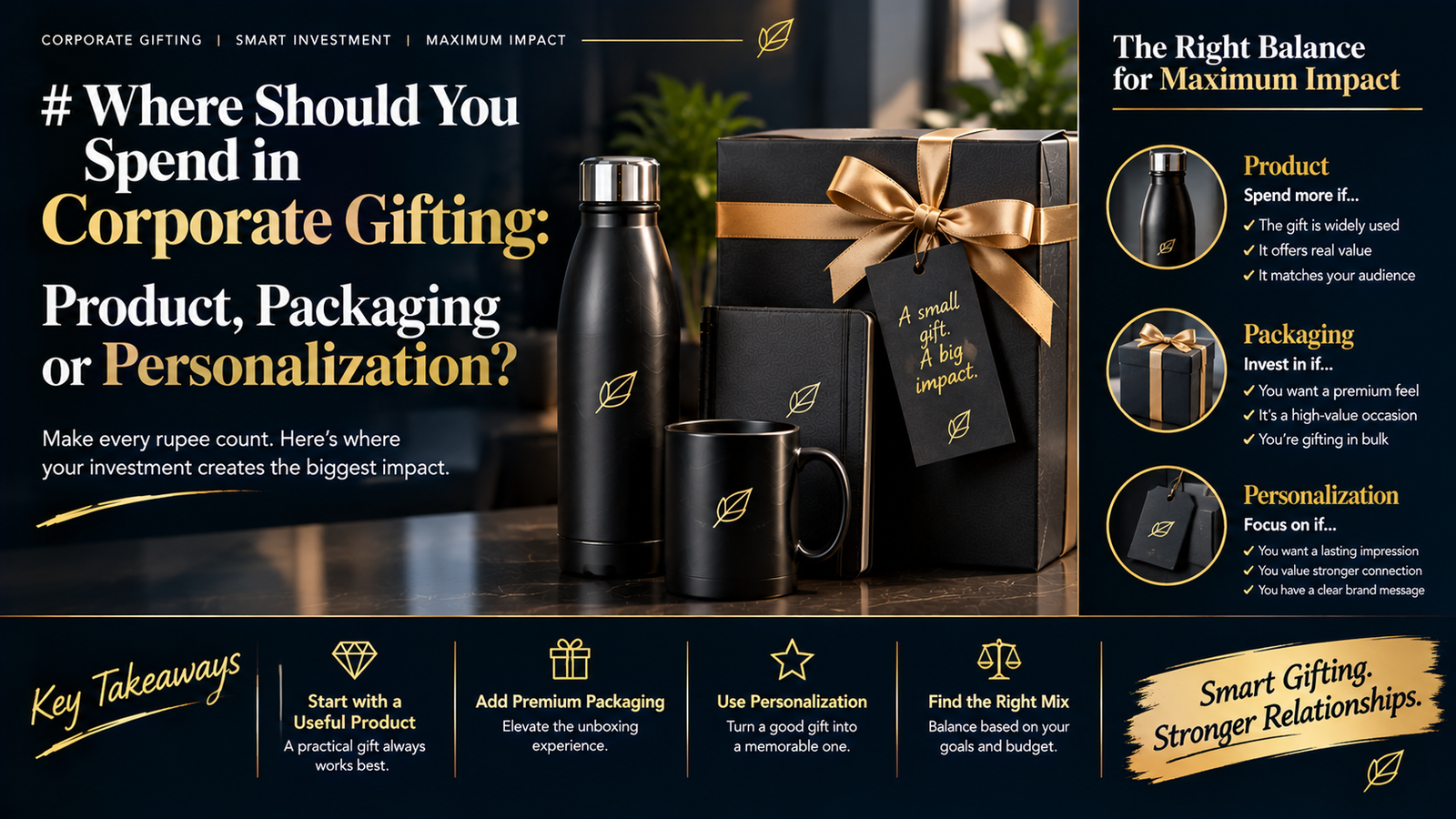
Where Should You Spend in Corporate Gifting: Product, Packaging or Personalization?
When planning a corporate gifting programme, one of the biggest challenges for procurement and HR teams is deciding where the budget will make the most difference. Should you invest in a better-quality product, upgrade the packaging, or personalise each gift with the recipient’s name and a thoughtful message?
The answer depends on the purpose of the gift, the recipient, the occasion, and the experience you want to create. Spending more on the product may be worthwhile for an executive gift, while thoughtful personalisation can make an employee welcome kit feel special without increasing the product cost significantly. For festive hampers, attractive packaging may be essential to the overall presentation.
Effective corporate gifting cost allocation means distributing the available budget according to what recipients will value most, rather than automatically spending the same amount on every component.
For procurement teams, this approach supports cost control, supplier evaluation, and better purchasing decisions. For HR teams, it helps create thoughtful gifting experiences that suit employees, clients, and business partners.
This guide explains how to allocate your corporate gifting budget across products, packaging, and personalisation, with practical examples and a framework for making informed decisions.

Why Corporate Gifting Cost Allocation Matters
A corporate gift consists of more than the item inside the box. Product quality, presentation, branding, personalisation, and delivery all contribute to the recipient’s experience.
If most of the budget goes towards packaging, the product itself may feel disappointing. If the entire amount is spent on an expensive product, there may be little left for protective packaging or the personal touch that makes the gift meaningful.
A balanced allocation helps businesses:
- Maintain product quality without overspending.
- Create professional and consistent gift presentation.
- Personalise gifts where it adds genuine value.
- Compare supplier quotations more accurately.
- Reduce unnecessary decorative or branding expenses.
- Meet procurement requirements and approved budgets.
- Align gifting expenditure with the occasion and recipient.
The goal is not to divide the budget equally between product, packaging, and personalisation. It is to invest in the elements that matter most for each gifting programme.
Product vs Packaging vs Personalization: What Should You Prioritise?
Each component serves a different purpose. Understanding these differences makes it easier to decide where additional spending is justified.
| Budget component | What it contributes | When to prioritise it |
|---|---|---|
| Product | Usefulness, durability, quality, and perceived value | Everyday gifts, executive gifts, employee kits |
| Packaging | Presentation, protection, and the unboxing experience | Festive hampers, premium gifts, client appreciation |
| Personalisation | Relevance, recognition, and individual attention | Employee milestones, welcome kits, VIP client gifts |
| Fulfilment and delivery | Timely arrival and condition on delivery | Bulk orders, remote teams, multi-location campaigns |
Although this article focuses on three main components, procurement teams should also account for fulfilment, shipping, taxes, and other applicable charges. A gift budget that ignores these costs can quickly exceed the approved amount.
1. When Should You Spend More on the Product?
The product is usually the foundation of the gifting experience. If it is poorly made, uncomfortable to use, or unlikely to meet the recipient’s needs, attractive packaging cannot fully compensate for it.
Prioritise product quality when the gift is intended for regular use, represents an important business relationship, or needs to last beyond a single occasion.
Situations where product investment makes sense
Employee welcome kits: Employees may use notebooks, bottles, bags, and desk accessories regularly. Durable and practical items can be more valuable than a large number of inexpensive products.
Executive and VIP gifting: Senior clients or business partners may appreciate a carefully selected product with good materials, a refined finish, and useful features.
Branded merchandise: Items such as apparel, bags, drinkware, and stationery represent your organisation whenever recipients use them. Product quality should match the intended brand image.
Employee recognition: A milestone gift should feel appropriate to the achievement. Choosing one well-made item may be better than assembling several low-quality products.
How to assess product value
Do not judge a product only by its price or appearance in a catalogue. Evaluate:
- Material and finish.
- Functionality and durability.
- Relevance to the recipient.
- Product consistency across the order.
- Suitability for branding.
- Availability in the required quantity.
For example, if you are choosing between a low-cost bottle with questionable finishing and a moderately priced bottle with a reliable lid and better surface quality, the second option may be the stronger choice for a company-wide employee kit.
Procurement tip: Request samples and confirm specifications before placing a large order. A small difference in unit cost can be worthwhile when it improves quality across hundreds of gifts.
2. When Is Premium Packaging Worth the Extra Cost?
Packaging influences the first impression. It can make a gift feel organised, considered, and appropriate for the occasion. It also protects the contents during handling and transportation.
However, premium packaging is not always necessary. A simple, well-finished box may be sufficient for an internal employee giveaway, while a carefully curated client hamper may benefit from more refined presentation.
Prioritise packaging for these occasions
- Diwali and other festive gifting campaigns.
- Client appreciation and relationship milestones.
- Executive gift sets.
- Corporate event gifts.
- Multi-product welcome kits.
- Gifts presented during formal meetings or ceremonies.
Packaging can include gift boxes, sleeves, inserts, tissue paper, ribbons, printed cards, and protective materials. The right combination depends on the product and the impression you want to create.
How to avoid overspending on packaging
Choose packaging that complements the product rather than competing with it. A notebook and pen set may need a structured box and a simple insert, not multiple decorative layers.
Consider these cost-control measures:
- Use one standard box size for compatible products.
- Select coordinated packaging for several gift categories.
- Use printed sleeves instead of fully customised boxes where suitable.
- Avoid unnecessary plastic wrapping and decorative fillers.
- Choose protective inserts that also improve presentation.
- Standardise packaging for repeat orders.
For bulk corporate gifting, standardisation can reduce complexity and make it easier to maintain a consistent appearance.
The important distinction is between packaging that adds value and packaging that simply adds cost.
3. How Much Should You Spend on Personalisation?
Personalisation can make a gift feel more relevant to the individual recipient. A name, a short appreciation message, or a customised welcome card can transform a standard gift into a more thoughtful gesture.
However, personalisation can also increase costs and production time, particularly when hundreds of names or different designs are involved.
When personalisation delivers the most value
Employee onboarding: A welcome card with the employee’s name and a message from the organisation can create a more personal first impression.
Work anniversaries: A short message recognising the milestone can make the gift feel connected to the employee’s contribution.
Client appreciation: A note that refers to a business milestone or successful collaboration may feel more meaningful than generic promotional text.
Executive gifts: Discreet engraving or tasteful initials may add a personal touch when appropriate for the recipient and product.
Personalisation options at different cost levels
| Personalisation method | Relative cost consideration | Best use |
|---|---|---|
| Standard printed message card | Usually lower complexity | Large employee or client orders |
| Branded insert or sleeve | Depends on design and quantity | Consistent corporate gifting |
| Individual name labels | Requires accurate data and handling | Employee welcome kits |
| Engraving or individual printing | Often involves higher setup or unit costs | Premium and milestone gifts |
| Handwritten notes | Requires additional staff time | Small, high-priority client lists |
Actual costs vary by supplier, material, order quantity, and production method. Ask for an itemised quotation before selecting an approach.
For large orders, personalisation should be supported by a reliable data process. Verify spellings, names, titles, and recipient details before production begins. An incorrectly personalised gift can undermine the intended effect.
If individual engraving is too expensive, a personalised card may offer a practical alternative.
4. A Practical Corporate Gifting Cost Allocation Framework
There is no universal percentage split that works for every gifting programme. However, procurement and HR teams can use a starting framework to compare options and make budget decisions.
For an initial planning exercise, consider this illustrative allocation of the gift-related budget, excluding separately calculated taxes and delivery charges:
- 60% product
- 25% packaging
- 15% personalisation
This is an example, not an industry standard or a required formula. It may suit some curated gift sets, but it should be adjusted according to the occasion and recipient.
For instance, an employee welcome kit built around practical products may need a higher product allocation and simpler packaging. A festive hamper intended for formal client presentation may justify more investment in packaging. A work-anniversary gift may benefit from a personalised message or engraving.
Use this process to establish the right allocation:
- Define the purpose of the gifting programme.
- Set the total approved budget and maximum cost per recipient.
- Identify the product quality required.
- Decide whether packaging needs to be functional, premium, or both.
- Determine whether personalisation will add meaningful value.
- Add fulfilment, shipping, taxes, and other applicable costs.
- Compare supplier quotations against the complete budget.
- Adjust the allocation before approving the purchase.
This framework helps teams make deliberate decisions instead of allowing packaging upgrades or last-minute personalisation requests to consume the available budget.
5. Example: Allocating a ₹1,000 Corporate Gift Budget
Suppose your organisation has an illustrative budget of ₹1,000 per recipient for a corporate gift. The following examples show how the allocation could change according to the purpose of the gift.
| Budget component | Employee welcome kit | Premium client gift | Personalised milestone gift |
|---|---|---|---|
| Product | ₹650 | ₹700 | ₹600 |
| Packaging | ₹200 | ₹200 | ₹150 |
| Personalisation | ₹150 | ₹100 | ₹250 |
| Total | ₹1,000 | ₹1,000 | ₹1,000 |
These figures are hypothetical examples intended to demonstrate the trade-offs. They are not supplier quotations, and they exclude any costs that your company may need to budget separately, such as delivery and applicable taxes.
In the welcome kit, the largest share goes to practical products. In the client gift, the product receives a greater allocation while packaging remains professional. In the milestone gift, more budget is directed towards personalisation.
The right allocation depends on your objectives. Procurement teams should validate the figures with actual supplier quotations before making commitments.
6. Common Budget Allocation Mistakes to Avoid
Even well-planned gifting programmes can become unnecessarily expensive when the budget is not managed carefully.
Spending too much on the box
Elaborate packaging can look impressive, but it should not come at the expense of product quality. Choose presentation that supports the gift rather than dominating it.
Choosing the cheapest product
A low unit price may be attractive for bulk purchasing, but poor quality can lead to complaints, replacements, or unused gifts. Compare durability and usefulness, not just price.
Personalising everything
Individual engraving, different product combinations, and custom packaging can create additional costs and production complexity. Personalise only where it improves the recipient experience.
Ignoring shipping and fulfilment
The cost of getting gifts to recipients is part of the overall programme. Account for packing, handling, shipping, and any relevant taxes before finalising the budget.
Making last-minute changes
Changes to artwork, quantities, names, or packaging after approval can cause rework and delays. Establish clear approval deadlines and assign one person to confirm the final specifications.
7. How Procurement and HR Can Work Together
Product, packaging, and personalisation decisions are more effective when procurement and HR agree on the objective before sourcing begins.
Procurement can evaluate supplier quotations, pricing structures, payment terms, production capacity, and quality-control processes. HR can clarify the recipient group, occasion, employee preferences, and desired experience.
A shared process might include:
- HR prepares the gifting brief and recipient requirements.
- Procurement sets the approved budget and sourcing criteria.
- Suppliers provide comparable product and packaging options.
- Both teams review samples and branding.
- The budget is checked against complete costs.
- The final specification and delivery schedule are approved.
- The team reviews feedback and supplier performance after delivery.
For recurring gifting programmes, record actual spending, quality issues, delivery performance, and recipient feedback. These records can help teams improve future allocations and negotiate more effectively with suppliers.
8. Choosing a Corporate Gifting Supplier That Supports Your Budget
A good supplier should help you understand the trade-offs between product quality, packaging, and personalisation rather than simply recommending the most expensive option.
Ask potential suppliers whether they can:
- Offer alternatives at different budget levels.
- Provide product and packaging samples.
- Quote product, branding, packaging, and fulfilment separately.
- Explain minimum quantities and customisation charges.
- Maintain consistent quality across bulk orders.
- Support delivery to multiple locations.
- Confirm timelines and quality-control arrangements.
Arrow Gifter provides corporate gifting solutions for businesses seeking customised corporate gifts, curated hampers, executive gift sets, branded merchandise, and employee gifting options.
For HR and procurement teams, sharing the target cost per recipient, quantity, occasion, and branding requirements helps a supplier recommend suitable combinations. Request an itemised quotation and approve the product and packaging specifications before confirming a bulk order.
Frequently Asked Questions
1. What is corporate gifting cost allocation?
Corporate gifting cost allocation is the process of distributing a gifting budget across products, packaging, personalisation, and related expenses. It helps businesses control spending while meeting their gifting objectives.
2. Should companies spend more on products or packaging?
Products should meet the required quality and usefulness standards first. Packaging deserves additional investment when presentation is central to the occasion, such as a premium client gift or festive hamper. The ideal balance depends on the programme.
3. Is personalisation worth the additional cost?
Personalisation can be worthwhile when it makes a gift more relevant, such as for onboarding, employee milestones, or important client relationships. For large orders, printed message cards or branded inserts may offer a practical alternative to individual engraving.
4. How can procurement teams reduce corporate gifting costs?
Compare itemised quotations, standardise compatible products and packaging, confirm specifications early, order suitable quantities, and avoid unnecessary customisation. Always assess the complete cost, including fulfilment and delivery.
5. What percentage of the budget should go to packaging?
There is no universal percentage. A practical starting allocation can be tested against supplier quotations and adjusted according to the product, occasion, packaging requirements, and delivery conditions.
Final Thoughts
Effective corporate gifting cost allocation is about spending with purpose. Product quality gives the gift its usefulness, packaging creates the first impression, and personalisation helps make the gesture more meaningful.
For procurement and HR teams, the best approach is to begin with the recipient and the occasion, then distribute the budget according to the value each component adds. Avoid spending equally across every category simply for the sake of balance.
By comparing complete costs, approving samples, standardising where appropriate, and coordinating decisions early, businesses can create thoughtful, professional corporate gifts without exceeding their budgets.
Leave a comment