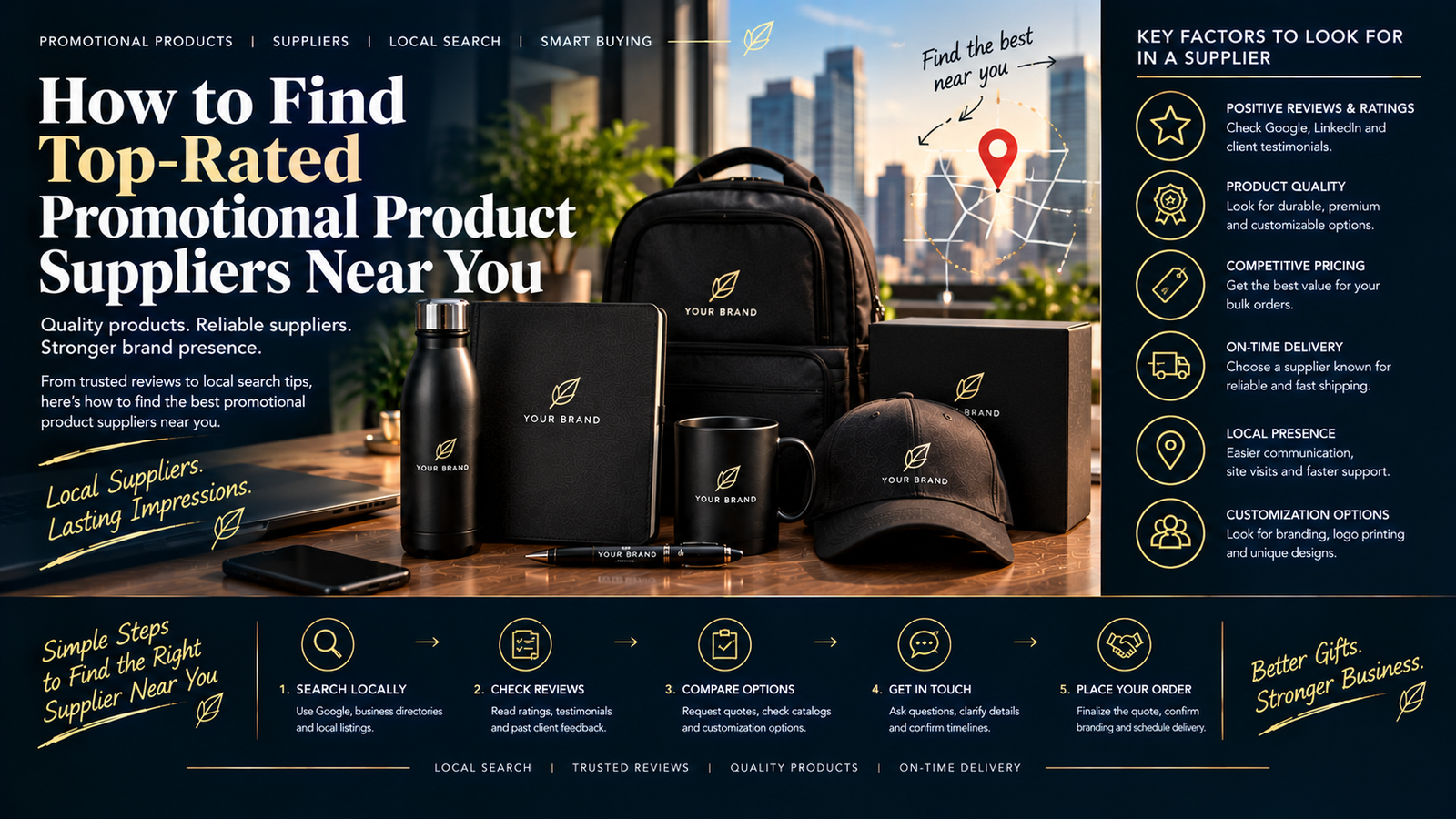
How to Find Top-Rated Promotional Product Suppliers Near You
Promotional products remain a practical way for businesses to increase brand visibility, support marketing campaigns, and build stronger relationships with customers, employees, and business partners. From branded bottles and notebooks to corporate apparel, tote bags, pens, and event merchandise, the right products can keep your brand visible long after a campaign ends.
However, finding a reliable supplier can be challenging. Marketing managers need products that reflect their brand identity, while business owners must balance quality, pricing, order quantities, and delivery deadlines.
If you have searched online for “who are the top-rated promotional products suppliers near me?”, the best choice is not necessarily the supplier with the most reviews or the closest office. You need a partner that understands your campaign objectives, offers suitable products, delivers consistent branding, and can fulfil your order within budget.
This guide explains how to find, compare, and evaluate promotional product suppliers so you can make an informed decision for your next marketing campaign.
What Are Promotional Product Suppliers?
Promotional product suppliers provide merchandise that businesses use to promote their brands, communicate with audiences, and support marketing activities. These products can carry a company logo, campaign message, brand colours, or other customised details.
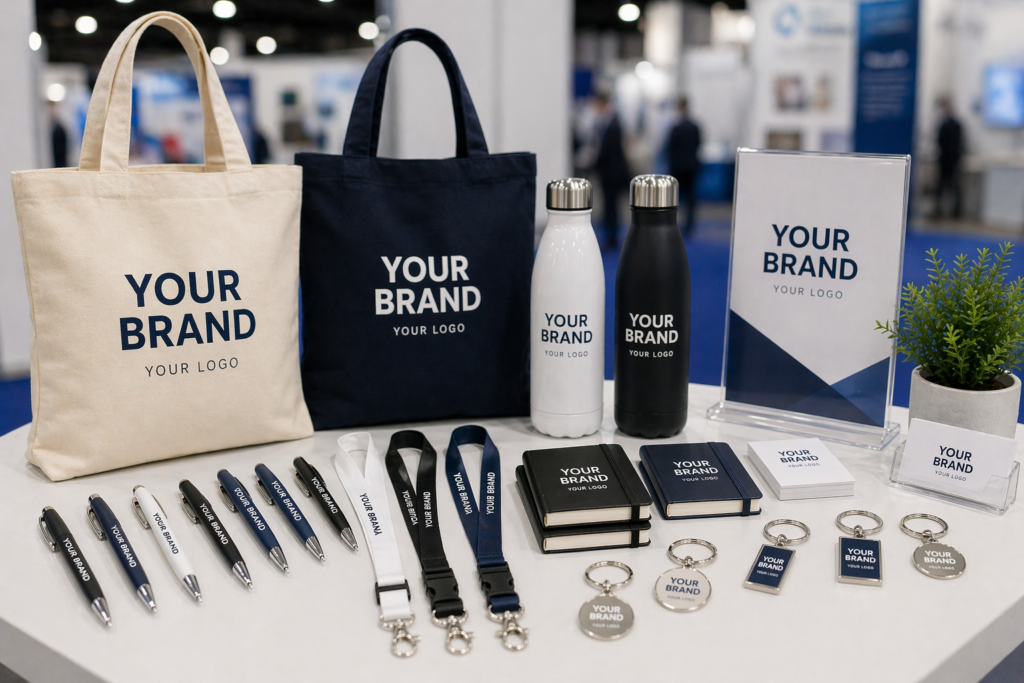
Common promotional products include:
- Branded pens, notebooks, and stationery.
- Customised bottles, mugs, and drinkware.
- Tote bags, backpacks, and corporate bags.
- T-shirts, caps, jackets, and other branded apparel.
- Desk accessories and office essentials.
- Welcome kits and employee merchandise.
- Trade show giveaways and event merchandise.
- Corporate gift boxes and promotional hampers.
Some suppliers specialise in individual product categories, while others coordinate sourcing, branding, packaging, and delivery across multiple product types.
For businesses planning larger campaigns, a supplier that can manage several product categories may simplify purchasing and reduce the need to coordinate multiple vendors.
Who Are the Top-Rated Promotional Products Suppliers Near Me?
The top-rated promotional products suppliers near you are those that consistently meet your requirements for product quality, customisation, pricing, communication, and delivery.
Online ratings can help you build an initial shortlist, but they should not be your only selection criteria. A supplier with positive reviews may still be unsuitable for your particular order if it lacks the required printing method, stock availability, or bulk fulfilment capacity.
To identify suitable suppliers, follow these steps:
- Search for promotional product suppliers in your city or business area.
- Review ratings, recent customer feedback, and business information.
- Check product catalogues and customisation options.
- Request quotations from at least two or three suitable vendors.
- Ask for samples or approved product proofs.
- Compare total costs, production schedules, and delivery terms.
- Confirm specifications and commercial terms in writing.
A nearby supplier may be especially useful if you need to inspect samples, discuss branding in person, or collect products directly. However, suppliers operating from other locations may also be suitable if they offer reliable shipping and can handle your order efficiently.
The aim is to find a supplier that fits your campaign, not simply the one closest to your office.
1. Define Your Promotional Campaign Requirements
Before contacting suppliers, establish what your campaign needs to achieve. Promotional products work best when the product choice supports a clear business objective.
For example, a trade show giveaway should be easy to distribute and relevant to attendees. An employee welcome kit should contain useful items that support the onboarding experience. A customer appreciation gift may require more thoughtful product selection and better presentation.
Prepare a brief that includes:
- Campaign objective: Brand awareness, lead generation, event promotion, employee onboarding, or customer appreciation.
- Target audience: Customers, prospects, employees, channel partners, or event attendees.
- Order quantity: Expected number of units and any additional stock required.
- Budget: Target cost per item and total campaign expenditure.
- Branding requirements: Logo placement, artwork, colours, slogans, or individual names.
- Delivery requirements: Locations, event dates, and final delivery deadline.
- Product preferences: Apparel, stationery, bags, drinkware, accessories, or gift sets.
A clear brief allows suppliers to suggest appropriate products and prepare comparable quotations. It also reduces the risk of receiving recommendations that look attractive but do not suit your audience or budget.
2. Evaluate Product Range and Customisation Options
Not every promotional products supplier offers the same level of choice. Some focus on low-cost giveaways, while others specialise in premium merchandise, customised apparel, or coordinated corporate kits.
Choose a supplier whose product range matches your campaign requirements.
| Promotional product category | Best suited for | What to evaluate |
|---|---|---|
| Pens and stationery | Conferences, seminars, everyday brand visibility | Writing quality, finish, print clarity |
| Bottles and mugs | Employee merchandise, customer gifts | Material, durability, branding quality |
| Tote bags and backpacks | Events, onboarding kits, daily use | Fabric, stitching, capacity, print placement |
| T-shirts and caps | Brand activations, team events | Fabric, fit, sizing, printing or embroidery |
| Desk accessories | Office gifting and client appreciation | Functionality, finish, presentation |
| Welcome kits | New employees and business programmes | Product coordination, packaging, personalisation |
| Gift hampers | Festivals, milestones, customer appreciation | Product selection, assembly, protective packaging |
Ask whether the supplier can provide the required branding technique. Screen printing, digital printing, embroidery, laser engraving, and other methods have different applications depending on the product material and design.
Request a sample or digital proof to verify how your branding will appear before production begins.
3. Check Ratings, Reviews, and Supplier Reputation
Customer feedback can help you understand how a supplier performs after an order is placed. However, a star rating alone cannot tell you whether a vendor can handle a large, customised campaign.
When evaluating online reviews, look for specific comments about:
- Product quality and consistency.
- Accuracy of logo printing or engraving.
- Timely delivery.
- Responsiveness during order processing.
- Handling of damaged or incorrect products.
- Communication when delays occur.
- Resolution of customer complaints.
Give more weight to detailed, recent reviews that describe experiences relevant to your requirements. For example, feedback about a supplier’s ability to deliver 500 branded kits may be more useful for a bulk campaign than a review about a single purchase.
You can also request relevant project examples, references, or photographs of completed work. Where possible, verify that the examples represent the supplier’s actual capabilities.
Avoid relying exclusively on promotional testimonials published by the supplier. Combine available reviews with samples, quotations, and direct conversations before making a decision.
4. Compare Pricing and Understand the Total Cost
Promotional product prices can vary according to materials, order quantity, branding technique, packaging, and delivery requirements. The lowest advertised price may not represent the lowest final cost.
Ask each shortlisted supplier for an itemised quotation.
Your quotation should identify:
- Product cost per unit.
- Printing, engraving, or embroidery charges.
- Artwork preparation or setup fees, if applicable.
- Packaging and assembly costs.
- Sample charges, where applicable.
- Shipping and delivery charges.
- Applicable taxes.
- Minimum order quantities.
- Payment terms and quotation validity.
For example, a supplier may quote a low price for a plain bottle, while another includes logo printing and individual packaging. Comparing only the base product prices would not give you a fair picture of the total expenditure.
Calculate the full campaign cost before seeking approval. If the campaign has a fixed budget, ask suppliers to suggest alternatives that preserve the intended quality while reducing unnecessary costs.
Ordering in suitable quantities, choosing readily available products, and standardising packaging can sometimes provide savings without compromising the campaign.
5. Request Samples and Inspect Product Quality
Product quality affects how recipients perceive your brand. A poorly printed logo, weak stitching, damaged packaging, or unreliable product can undermine an otherwise well-planned marketing campaign.
Before confirming a large order, request a physical sample whenever practical. If a physical sample is unavailable, review a detailed product specification and approve a digital branding proof. For important or complex orders, consider requesting a pre-production sample.
Inspect the following:
Materials and construction: Check fabric quality, seams, surface finish, closures, and other relevant features.
Functionality: Test whether the product performs as expected. Bottles should close properly, pens should write consistently, and bags should be suitable for their intended use.
Branding accuracy: Confirm logo proportions, colours, placement, spelling, and print quality.
Packaging: Ensure products are protected during storage, handling, and delivery.
Consistency: Clarify how the supplier checks quality across the full production run.
Document the approved specifications so both parties understand what will be delivered. Do not assume that a catalogue image or an earlier sample guarantees the same finish for every bulk order.
6. Confirm Production Capacity and Delivery Timelines
A promotional product supplier must be able to deliver the correct products in the required quantity by your campaign deadline.
This is especially important for trade shows, product launches, conferences, seasonal promotions, and company events where late delivery may reduce the usefulness of the merchandise.
Ask the supplier to explain the complete order timeline, including:
- Product selection and availability confirmation.
- Sample review and artwork approval.
- Procurement or manufacturing.
- Printing, engraving, or embroidery.
- Quality checks and packaging.
- Dispatch and final delivery.
For multi-location campaigns, confirm whether the supplier can prepare separate shipments and provide tracking details.
Discuss possible delays involving stock shortages, artwork changes, production capacity, courier schedules, and high-demand periods. Establish a final approval deadline and leave a reasonable buffer before the campaign date.
If a supplier promises an unusually fast turnaround, ask how it will be achieved and whether the timeline includes customisation, packing, and shipping.
7. Look for Reliable Communication and Customer Support
Good communication is an important indicator of how smoothly a bulk order may proceed. Your supplier should be able to answer questions clearly, explain limitations, and provide updates when milestones are reached.
Before placing an order, check whether the supplier:
- Responds promptly to enquiries.
- Provides clear product specifications.
- Explains pricing and delivery terms.
- Assigns a contact person for your order.
- Shares artwork proofs for approval.
- Provides updates during production.
- Has a defined process for handling issues.
A dedicated point of contact can be particularly valuable when a campaign includes several product categories, multiple branding requirements, or deliveries to different offices.
Avoid suppliers who are vague about stock availability, refuse to document key commitments, or repeatedly change delivery promises without explanation.
8. Check Invoicing, Order Terms, and Business Documentation
Marketing managers and business owners should ensure that the commercial arrangement is clear before making payments.
Confirm the supplier’s business details and review the quotation, purchase order, invoice arrangements, payment terms, and delivery conditions.
Your order documentation should include product descriptions, quantities, branding specifications, approved artwork, packaging requirements, delivery dates, and the agreed price.
Also clarify the process for dealing with:
- Shortages or incorrect quantities.
- Defective products.
- Incorrect branding or personalisation.
- Delayed deliveries.
- Cancellations or changes after production begins.
- Replacement, repair, or refund requests, where applicable.
For Indian businesses, confirm that the supplier can issue the required invoice and applicable tax details for your transaction. If your organisation has vendor onboarding or procurement approval procedures, complete those checks before confirming the order.
Written documentation protects both parties by reducing misunderstandings about what was agreed.
9. Choose Between a Local Supplier and a Pan-India Partner
The best supplier depends on the scale and geography of your campaign.
| Consideration | Local supplier | Pan-India supplier |
|---|---|---|
| In-person sample review | Often convenient | May require shipping samples |
| Local collection | May be practical | Depends on location and arrangement |
| Multi-city fulfilment | Depends on capabilities | May offer coordinated shipping |
| Product selection | Varies by vendor | Varies by vendor |
| Bulk-order capacity | Must be verified | Must be verified |
| Delivery cost | Depends on distance and order size | Depends on shipment destinations |
Neither option is automatically better. A local vendor may provide convenient access and close coordination, while a supplier with broader delivery capabilities may be better suited to campaigns spanning several cities.
Evaluate actual fulfilment capacity, product quality, pricing, and service rather than assuming that location alone guarantees reliability.
10. Common Red Flags to Watch For
Be cautious if a supplier:
- Offers prices that appear unusually low without explaining the specifications.
- Cannot provide clear product details or samples.
- Avoids confirming delivery dates in writing.
- Requests payment without providing appropriate business documentation.
- Makes unrealistic promises about customisation or turnaround.
- Cannot explain how it checks bulk production quality.
- Gives vague answers about defective or incorrect products.
- Uses pressure tactics to rush your decision.
One warning sign does not automatically prove that a supplier is unreliable, but several unresolved concerns should prompt further checks before you commit.
Frequently Asked Questions
1. Who are the top-rated promotional products suppliers near me?
Start by searching for local promotional merchandise and corporate gifting suppliers. Compare recent reviews, relevant product experience, customisation options, sample quality, itemised quotations, and delivery capabilities. The most suitable supplier is the one that meets your campaign requirements—not necessarily the one with the highest rating.
2. What should I look for in a promotional product supplier?
Prioritise consistent product quality, accurate branding, transparent pricing, dependable delivery, responsive communication, and clear commercial terms. For bulk orders, also confirm production capacity and quality-control procedures.
3. Can promotional product suppliers customise items with my company logo?
Many suppliers offer logo printing, engraving, embroidery, or branded packaging. Available methods depend on the product material and design. Always approve the artwork and, where practical, a sample before full production.
4. Is buying promotional products in bulk cheaper?
Bulk orders may reduce the per-unit cost, but savings depend on product availability, quantity, branding method, packaging, and shipping. Compare complete quotations rather than assuming every supplier offers the same volume discounts.
5. How early should I order promotional products for an event?
Allow time for product selection, sample approval, customisation, quality checks, packaging, and delivery. Complex or highly customised orders generally require more lead time than readily available products. Confirm the schedule directly with the supplier and include a buffer before the event.
6. Can one supplier handle promotional merchandise and corporate gifts?
Some suppliers coordinate both branded merchandise and corporate gifting, including apparel, drinkware, stationery, welcome kits, and curated gift boxes. Confirm the range and fulfilment capabilities before choosing a single vendor for multiple categories.
Final Thoughts
Finding the right promotional product supplier requires more than a quick online search. Marketing managers and business owners should evaluate product quality, customisation, pricing, reviews, delivery capacity, and commercial terms before making a commitment.
Start with a clear campaign brief, shortlist suitable suppliers, compare itemised quotations, and approve samples before production. For bulk orders, pay particular attention to branding accuracy, quality control, and delivery planning.
For businesses seeking customised corporate merchandise and gifting solutions, Arrow Gifter offers options such as branded merchandise, corporate apparel, office accessories, curated hampers, and customised corporate gifts. Share your quantity, budget, branding requirements, and delivery timeline to explore suitable options for your campaign.
The right supplier helps turn promotional merchandise into a consistent, practical representation of your brand—while keeping your campaign organised and your spending under control.
Leave a comment