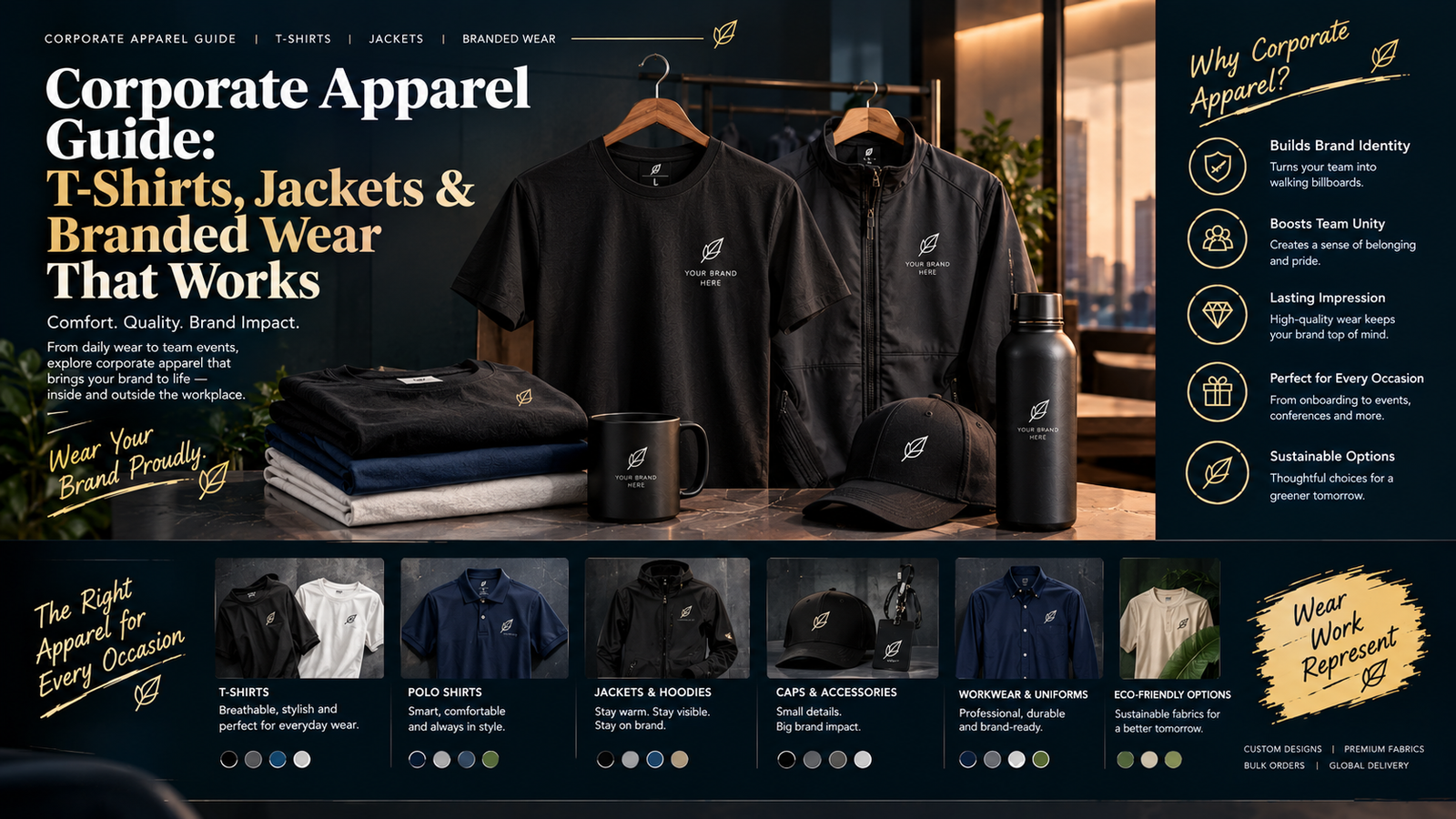
Corporate Apparel Guide: T-Shirts, Jackets & Branded Wear That Works
Corporate apparel has become a practical part of how businesses present their identity, bring teams together and create consistent brand experiences. From branded T-shirts at company events to premium jackets for employees and personalised polo shirts for client-facing teams, the right apparel can combine everyday usefulness with professional presentation.
For Marketing, HR and Events teams, choosing corporate branded apparel involves more than adding a logo to a garment. Fabric quality, comfort, fit, colour consistency, printing methods, budget and delivery timelines all influence the final result.
A T-shirt that looks great in a product catalogue may not feel comfortable during a full-day event. A jacket with the wrong logo placement may not match the company’s visual identity. And a bulk order with poorly managed sizes can lead to unused stock and unnecessary expense.
This guide explains how to choose corporate apparel that works for employees, events, promotional campaigns and business gifting programmes in India.

What Is Corporate Branded Apparel?
Corporate branded apparel refers to clothing customised with a company’s logo, name, colours, slogan or other approved brand elements. It can be used for employee uniforms, internal events, conferences, exhibitions, promotional campaigns, onboarding kits and corporate gifting.
Common options include:
- Branded T-shirts and polo shirts
- Corporate jackets and sweatshirts
- Hoodies and casual teamwear
- Formal shirts
- Caps and other branded accessories
- Event-specific apparel
- Personalised employee clothing
The objective is to create clothing that people can comfortably wear while representing the organisation.
Effective apparel programmes balance brand visibility, comfort, durability and relevance to the wearer. If employees find the clothing useful and comfortable, they are more likely to wear it beyond the event for which it was originally purchased.
Why Corporate Apparel Matters for Businesses
1. Creates a Consistent Brand Identity
When employees wear coordinated apparel at exhibitions, conferences or customer-facing events, the team can appear more organised and recognisable.
Consistent colours, logo placement and garment styles help connect the apparel with the wider brand identity. This is particularly useful when several teams represent the same business at different locations.
2. Supports Employee Belonging
Branded clothing can help establish a shared identity during onboarding, team gatherings and company celebrations.
For example, a welcome kit containing a comfortable T-shirt or hoodie can help introduce a new employee to the company’s culture. However, apparel should complement broader employee experience initiatives rather than be treated as a substitute for them.
3. Makes Events Easier to Coordinate
For conferences, trade shows, product launches and corporate celebrations, apparel can help attendees identify staff members and event teams.
Different colours or garment styles can distinguish organisers, support staff and representatives without requiring complicated visual systems.
4. Offers Repeated Brand Exposure
Unlike disposable promotional materials, a durable garment can be worn repeatedly. This gives the brand opportunities for visibility in everyday settings.
The result depends on the product’s usefulness and quality. Excessively prominent branding or uncomfortable clothing may discourage people from wearing it.
Best Types of Corporate Branded Apparel
Different garment types suit different occasions. The following options can help Marketing, HR and Events teams build a suitable apparel programme.
1. Branded T-Shirts
<AsyncImage query=”premium plain cotton crew neck corporate branded t shirts neatly folded navy white grey minimalist apparel product photography” aspectRatio=”5:4″ width=”100%” />
T-shirts are among the most versatile options for corporate apparel. They can be distributed in bulk and adapted to a wide range of events and employee programmes.
Best for: Team-building activities, employee welcome kits, promotional campaigns, exhibitions and informal company events.
When selecting T-shirts, consider fabric composition, weight, breathability, stitching and fit. Cotton can offer a familiar, soft feel, while suitable cotton-polyester blends may provide different durability and maintenance characteristics.
Branding options: Screen printing, direct-to-film printing, embroidery on selected designs and heat-transfer applications.
For large orders, approve a physical sample to assess fabric feel, print quality and colour accuracy before production.
2. Corporate Polo Shirts
<AsyncImage query=”premium corporate polo shirts in navy blue white and charcoal neatly arranged minimalist business apparel photography” aspectRatio=”5:4″ width=”100%” />
Polo shirts offer a smart-casual appearance that works well when standard T-shirts feel too informal.
They are suitable for staff who interact with customers, sales teams, reception personnel and employees representing the company at exhibitions.
Best for: Client-facing teams, office events, retail environments and corporate conferences.
Look for a comfortable collar, quality stitching, a suitable fit and fabric that maintains its shape after washing. Embroidered logos can create a polished appearance on compatible fabrics.
3. Corporate Jackets
<AsyncImage query=”premium lightweight corporate jackets in black navy and grey with subtle chest logo minimalist product photography” aspectRatio=”5:4″ width=”100%” />
Jackets are useful for outdoor events, business travel, winter gifting and employee recognition programmes.
Options include lightweight zip-up jackets, softshell jackets, fleece jackets and insulated outerwear. The right choice depends on the climate, work environment and expected frequency of use.
Best for: Outdoor teams, travelling employees, winter gifting, leadership programmes and premium event merchandise.
Check the garment’s weight, lining, zipper quality, pockets and comfort over other clothing. For India-wide distribution, consider whether the same jacket will be practical across regions with different weather conditions.
4. Hoodies and Sweatshirts
<AsyncImage query=”premium minimalist corporate hoodies and crewneck sweatshirts folded in charcoal grey navy and beige studio apparel photography” aspectRatio=”5:4″ width=”100%” />
Hoodies and sweatshirts offer a relaxed alternative to formal workwear. They can be useful for technology teams, creative departments, casual workplace programmes and internal events.
Best for: Employee appreciation, startup merchandise, team offsites and winter welcome kits.
Fabric thickness, softness, shrinkage and cuff construction are important selection factors. Choose branding that complements the garment rather than making it difficult to wear outside the office.
5. Formal Shirts
<AsyncImage query=”premium formal corporate shirts in white pale blue and navy neatly arranged business apparel studio photography” aspectRatio=”5:4″ width=”100%” />
Formal shirts are suitable for businesses that require a more traditional professional appearance.
They can be used for customer-facing employees, hospitality teams, formal corporate events and certain uniform programmes.
Best for: Sales teams, client meetings, front-office staff and formal corporate functions.
Prioritise fit, fabric comfort, ease of ironing and consistency across sizes. Embroidery can be appropriate for discreet branding, depending on the fabric and garment construction.
How to Choose the Right Apparel for Each Occasion
A successful corporate apparel programme starts with its purpose.
| Occasion | Recommended Apparel | Main Priority |
|---|---|---|
| Employee onboarding | T-shirts, polos, hoodies | Comfort and everyday use |
| Trade shows and exhibitions | T-shirts, polo shirts | Visibility and identification |
| Client-facing teams | Polos, formal shirts | Professional appearance |
| Outdoor events | Breathable T-shirts, suitable jackets | Comfort and weather suitability |
| Employee recognition | Premium hoodies, jackets | Quality and perceived value |
| Corporate gifting | Premium polos, jackets, curated apparel sets | Presentation and recipient relevance |
| Company celebrations | T-shirts, sweatshirts | Consistent team identity |
Avoid choosing garments solely because they are inexpensive or easy to customise. The product should suit the activity, audience and environment in which it will be worn.
Choosing the Right Fabric and Quality
Fabric affects comfort, appearance, durability and the way branding performs over time.
Cotton
Cotton is often chosen for T-shirts and casual apparel because of its familiar feel and breathability. However, performance varies by fabric construction, weight and finishing.
Polyester
Polyester can be useful for activewear and certain event garments. It can offer durability and moisture-management properties when designed for that purpose.
Cotton-polyester blends
Blended fabrics combine characteristics of different fibres. They may be suitable for corporate programmes that require a balance of comfort, maintenance and durability.
Fleece and heavier fabrics
Fleece and other heavier materials can work well for sweatshirts and jackets intended for cooler conditions.
When evaluating samples, check stitching, seams, colour consistency, shrinkage information and washing instructions. A low-cost garment may become more expensive if it wears out quickly or needs frequent replacement.
Corporate Apparel Branding: Printing vs Embroidery
The branding method should match the garment, design and intended use.
| Method | Best Suited For | Considerations |
|---|---|---|
| Screen printing | Larger T-shirt orders and suitable designs | Cost efficiency depends on design and quantity |
| Direct-to-film printing | Detailed, multicolour artwork on compatible garments | Finish and durability depend on materials and application |
| Embroidery | Polos, jackets and selected formal apparel | Provides a textured finish; fine details may need simplification |
| Heat transfer | Names, numbers and certain designs | Application quality and wash durability matter |
Before approving production, confirm the logo’s size, placement, colours and artwork file. Request a sample using the actual garment and branding method.
For premium corporate wear, subtle branding on the chest, sleeve or another suitable position can preserve a clean, professional look.
Managing Sizes for Bulk Corporate Apparel Orders
Sizing is one of the biggest operational challenges in corporate clothing programmes. A garment that fits one employee well may be uncomfortable for another, even when both select the same labelled size.
To reduce problems:
- Request the supplier’s size chart, including garment measurements.
- Confirm whether the sizing follows Indian, international or brand-specific standards.
- Collect size preferences through a secure, clearly explained process.
- Offer a size-sampling session for larger employee programmes where practical.
- Check whether the chosen garment has a regular, slim or oversized fit.
- Build a small, planned buffer only when justified by the programme.
- Confirm the supplier’s replacement policy before ordering.
For distributed teams, share clear measurement instructions and a deadline for submissions.
Do not assume every supplier’s medium or large size will fit identically. The actual garment measurements matter more than the label alone.
How to Plan a Corporate Apparel Budget
Corporate apparel costs depend on garment quality, order quantity, branding complexity, packaging and delivery arrangements. Rather than comparing only the price per garment, calculate the complete cost of the programme.
Include:
- Garment purchase price
- Printing or embroidery
- Sample and artwork costs, where applicable
- Individual packaging
- Taxes
- Shipping to one or multiple locations
- Replacement or defect allowance
- Storage and distribution
For example, a simple event T-shirt may need only basic branding and bulk packing. A premium employee gift set may require a better-quality garment, individual packaging and a personalised note.
Request quotations based on the same specifications so suppliers can be compared fairly. Confirm minimum order quantities, production lead times and charges for size or artwork changes.
Sustainable Corporate Apparel: What Should Businesses Check?
Businesses looking to make more responsible purchasing decisions can explore durable garments, recycled-material options and products made with clearly documented material claims.
Consider:
- Fabric composition and supporting supplier information
- Expected garment lifespan
- Quality and repairability
- Packaging quantity and material
- Whether the design encourages repeated use
- Supplier transparency about environmental claims
A garment labelled “eco-friendly” is not automatically a more sustainable choice. Material sourcing, manufacturing, durability and actual use all affect its overall impact.
Ordering appropriate quantities can also reduce waste. Avoid producing excessive branded apparel that recipients are unlikely to wear.
Common Mistakes to Avoid
Choosing price over comfort: Uncomfortable apparel may go unused, reducing the value of the order.
Skipping samples: The final garment may differ from the catalogue image or digital mock-up.
Using oversized logos: Heavy branding can make garments less versatile for everyday wear.
Collecting sizes too late: Delays in size confirmation can disrupt production schedules.
Ignoring regional needs: Jackets suitable for one climate may not work for teams in other parts of India.
Ordering without quality checks: Inconsistent colours, stitching or logo placement can affect the entire batch.
Underestimating delivery time: Customisation and size sorting require time, particularly for large campaigns.
A documented approval process helps Marketing, HR and Events teams avoid these issues.
How a Corporate Gifting Partner Can Help
Managing branded apparel internally can involve coordinating garment sourcing, artwork, samples, size data, production, quality checks, packaging and delivery.
A corporate gifting partner can help bring these activities together under one process. This is especially useful for businesses planning employee welcome kits, branded merchandise, conference apparel or multi-location campaigns.
Arrow Gifter offers premium corporate gifting solutions, including customised corporate gifts and branded merchandise. For a corporate apparel programme, businesses should confirm the available garment styles, customisation methods, minimum quantities, lead times and delivery options before placing an order.
The right partner should provide clear specifications, transparent pricing and a reliable process for handling defects or changes.
Frequently Asked Questions
What is the best corporate branded apparel for employees?
T-shirts, polo shirts, hoodies and laptop-friendly travel apparel can all work well, depending on the workplace and occasion. Comfort, fabric quality and fit should guide the decision.
Which apparel is best for corporate events?
T-shirts and polo shirts are common choices for conferences, exhibitions and team events. Select breathable garments and ensure the branding is easy to recognise without overwhelming the design.
Is embroidery better than printing for corporate apparel?
Neither method is universally better. Embroidery often suits polos and selected jackets, while printing may be more suitable for larger designs or multicolour T-shirts. The garment and artwork should determine the method.
How can companies reduce sizing problems?
Use accurate garment measurements, share the supplier’s size chart, collect preferences early and approve physical samples where possible.
How early should businesses order branded apparel?
Start early enough to accommodate artwork approval, sampling, size collection, production, quality checks and delivery. The required lead time depends on order quantity and customisation complexity, so confirm it with the supplier.
Final Thoughts
Effective corporate branded apparel combines comfort, quality, useful design and consistent branding. T-shirts can support large events, polos can suit client-facing teams, and jackets or premium sweatshirts can work well for employee recognition and corporate gifting.
For Marketing, HR and Events teams, the best approach is to define the purpose first, select garments for the intended audience, approve samples and manage sizes and delivery carefully.
When apparel is genuinely comfortable and well made, it can become a useful part of employees’ wardrobes and a practical representation of the company’s identity.
Leave a comment