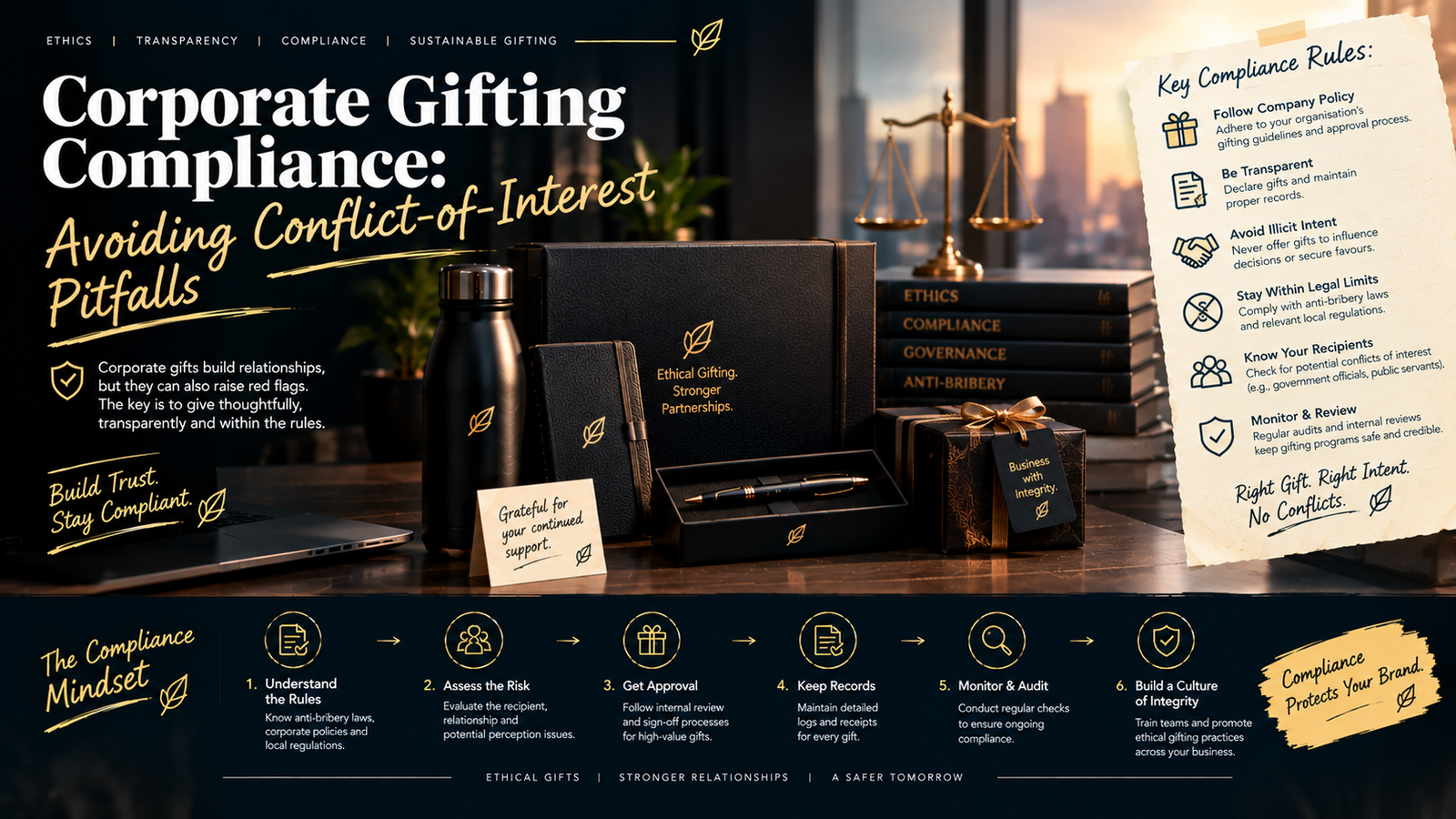
Corporate Gifting Compliance: Avoiding Conflict-of-Interest Pitfalls
Corporate gifting can be an effective way to recognise employees, appreciate clients, strengthen business relationships and celebrate important milestones. But from a Legal and Compliance perspective, a gift is never simply a gift.
The circumstances surrounding it matter.
Who is giving the gift? Who is receiving it? What is its value? Why is it being given? Is a contract, tender, regulatory decision or business negotiation underway? Could the gift influence a decision—or create the appearance that it might?
These questions make corporate gifting compliance an important part of an organisation’s broader ethics, anti-bribery, procurement and conflict-of-interest framework.
A well-designed corporate gifting policy does not necessarily prohibit all gifts. Instead, it establishes reasonable boundaries that allow legitimate business courtesy while preventing gifts from becoming improper incentives.
For Legal and Compliance officers, the goal is to create a system that is clear enough for employees to follow and strong enough to withstand scrutiny during an internal audit, investigation or regulatory review.

What Is Corporate Gifting Compliance?
Corporate gifting compliance refers to the policies, controls and processes a company uses to ensure that gifts, hospitality and related benefits are given and received appropriately.
A comprehensive framework can address:
- Gifts to clients
- Gifts from vendors
- Gifts to suppliers
- Employee gifts
- Business hospitality
- Festival hampers
- Promotional merchandise
- Gift cards and vouchers
- Invitations and entertainment
- Travel-related benefits
- Charitable contributions connected to business relationships
The objective is not simply to control the monetary value of a gift.
It is to prevent gifts from being used to obtain an improper business advantage or create an inappropriate obligation.
Why Conflict of Interest Matters in Corporate Gifting
A conflict of interest can arise when an individual’s personal interests interfere—or appear to interfere—with their professional responsibilities.
Consider a procurement manager evaluating three suppliers.
One supplier sends the manager an expensive personal gift immediately before the contract is awarded.
Even if the manager makes an objective decision, the situation creates a reasonable question:
Could the gift have influenced the decision?
That is why Compliance teams need to consider not only actual misconduct but also perceived conflicts of interest.
A strong corporate gifting programme should be designed so that employees can confidently explain their gifting decisions to management, auditors or regulators.
Actual, Potential and Perceived Conflicts
Legal and Compliance teams should distinguish between three common categories.
Actual conflict
The gift genuinely influences an employee’s professional decision.
For example, an employee selects a supplier because the supplier provided a personal benefit.
Potential conflict
The circumstances could influence a future decision.
For example, a sales employee receives an expensive gift from a customer who is about to negotiate a major renewal.
Perceived conflict
There may be no improper influence, but an independent observer could reasonably believe that the gift created an obligation.
This third category is particularly important.
A company’s reputation can be damaged even when no employee intended to behave improperly.
The Five Questions Every Corporate Gift Should Pass
Before approving or accepting a gift, employees can apply five basic questions:
1. Who is giving or receiving the gift?
Is it an employee, customer, vendor, government official, prospect or business partner?
2. Why is the gift being given?
Is it a legitimate festival, milestone or appreciation gesture?
3. What is the value?
Does the value fall within the company’s permitted threshold?
4. What is happening commercially right now?
Is there a tender, negotiation, contract renewal, audit, inspection or regulatory decision underway?
5. Would the gift look appropriate if publicly disclosed?
If the answer to the last question is uncomfortable, the gift deserves additional review.
High-Risk Situations for Corporate Gifting
Not every gift carries the same level of risk.
Compliance teams should pay particular attention when gifts involve:
Procurement decisions
Gifts to employees responsible for vendor selection, tender evaluation or contract negotiations can create conflicts.
Contract negotiations
A gift given immediately before or during negotiations can appear to be an attempt to influence the outcome.
Regulatory interactions
Benefits involving government officials or individuals exercising public authority require heightened caution and may be subject to specific laws and organisational controls.
Audits or inspections
Gifts given to individuals responsible for reviewing or approving a company’s activities can create significant compliance concerns.
Sales incentives
A supplier or customer offering a personal benefit in exchange for preferential treatment should be treated as a serious warning sign.
Business referrals
Gifts connected to referrals, introductions or commercial opportunities may create questions about improper inducement.
Not All Gifts Are Equally Risky
A useful corporate gifting policy should distinguish between ordinary business courtesy and higher-risk benefits.
| Gift Type | Typical Compliance Risk | Recommended Control |
|---|---|---|
| Greeting card | Low | Generally permitted |
| Modest branded merchandise | Low | Value/policy limit |
| Modest festive hamper | Low–Medium | Disclosure where required |
| Restaurant invitation | Medium | Hospitality policy |
| Expensive electronics | High | Approval/restriction |
| Luxury personal items | High | Generally prohibit/restrict |
| Cash | Very high | Prohibit |
| Cash-equivalent vouchers | High | Strictly control |
| Travel/accommodation | High | Advance approval |
| Gift during tender | High | Restrict/prohibit |
The exact classification should be tailored to the organisation and industry.
Set Clear Gift Value Limits
A monetary threshold is one of the simplest controls, but it should not be the only control.
For example, a company might establish:
- Maximum value for gifts employees can accept
- Annual aggregate value from one business relationship
- Approval requirement above a specified threshold
- Mandatory disclosure above a lower threshold
- Absolute prohibition on certain categories
However, Compliance teams should make it clear that a gift below the threshold is not automatically acceptable in every circumstance.
A ₹2,000 gift offered during a sensitive tender can present more risk than a ₹5,000 gift received as a general festive courtesy when there is no pending business decision.
Context matters.
Create a Corporate Gifting Approval Matrix
A structured approval matrix can make decisions more consistent.
For example:
| Situation | Suggested Control |
|---|---|
| Low-value promotional item | Permitted under policy |
| Modest festive gift | Disclosure if required |
| Gift above threshold | Prior approval |
| Gift during procurement | Compliance review |
| Gift involving government official | Legal/Compliance review |
| Cash or cash equivalent | Prohibited |
| Travel or accommodation | Advance approval |
| Gift linked to business decision | Prohibit/escalate |
The actual limits should be determined by the company’s risk profile and applicable requirements.
Maintain a Corporate Gift Register
A gift register is one of the most practical compliance controls.
It creates an auditable record of gifts given and received.
The register can include:
- Date
- Sender
- Recipient
- Organisation
- Gift description
- Estimated value
- Business purpose
- Occasion
- Department
- Current procurement status
- Approval status
- Action taken
For example:
Date: 15 October
Vendor: ABC Technologies
Recipient: Procurement Manager
Gift: Festive hamper
Estimated value: ₹2,000
Active tender: Yes
Action: Declined and recorded
This type of documentation helps demonstrate that the organisation has functioning controls rather than merely having a policy document on paper.
Corporate Gifting and Anti-Bribery Controls
A corporate gift becomes particularly sensitive when it is intended to influence a business decision.
Warning signs include:
- “Accept this and help us win the contract.”
- “We will send you something if you approve the invoice.”
- “Please don’t record this gift.”
- “This is only for you, not the company.”
- “Keep this separate from the procurement process.”
These situations should be escalated.
Compliance teams should also look beyond obvious cash payments.
A benefit does not necessarily become acceptable simply because it is presented as a gift, hospitality invitation or promotional item.
The substance and purpose of the benefit matter.
Government Officials Require Additional Caution
Corporate gifting involving government officials or public-sector decision-makers deserves particular attention.
A company’s general employee gifting policy should not automatically be applied to public officials.
Depending on the circumstances, additional laws, service rules, organisational policies and anti-corruption requirements may apply.
Compliance teams should therefore establish a separate process for gifts or hospitality involving:
- Government officials
- Public-sector employees
- Regulators
- Individuals exercising public authority
- Government procurement personnel
When there is uncertainty, obtain Legal or Compliance approval before offering or accepting anything of value.
Gifts During Procurement Processes
One of the clearest conflict-of-interest controls is to restrict gifts during active procurement processes.
Consider prohibiting gifts while:
- A tender is open
- Supplier bids are being evaluated
- Contract terms are being negotiated
- A supplier is being selected
- A contract is being renewed
- A supplier performance dispute is active
This creates a simple rule that employees can understand:
No personal benefits while a commercial decision involving the giver is active.
Such timing-based controls can be more effective than relying only on monetary limits.
Separate Corporate Gifts From Personal Benefits
A useful distinction is whether a gift benefits the organisation or an individual.
For example:
Lower-risk approach:
A modest festive hamper addressed to the company or department, where policy permits it.
Higher-risk approach:
An expensive personal watch sent directly to the employee responsible for renewing the supplier’s contract.
Personal benefits deserve significantly greater scrutiny.
What Should Employees Do When They Receive an Unclear Gift?
Employees should have a simple escalation process.
Step 1: Don’t hide it
Transparency should be encouraged.
Step 2: Check the policy
Determine whether the gift is permitted.
Step 3: Consider the timing
Is there an active business decision involving the sender?
Step 4: Declare it
Record it where disclosure is required.
Step 5: Ask Compliance
If the answer isn’t obvious, escalate rather than making assumptions.
Step 6: Follow the prescribed action
The company may require the employee to return, share, surrender or otherwise dispose of the gift.
Train Employees Before Major Gifting Seasons
Compliance training is particularly important before periods when corporate gifting increases.
For Indian businesses, this may include:
- Diwali
- New Year
- Christmas
- Company anniversaries
- Major industry events
- Annual conferences
- Client appreciation campaigns
Employees should understand the policy before gifts start arriving.
A short annual training module can cover:
- Permitted gifts
- Prohibited gifts
- Value limits
- Disclosure requirements
- Conflict-of-interest examples
- Procurement restrictions
- Government-official rules
- Escalation procedures
Real-world examples are usually more useful than abstract policy language.
Communicate the Policy to Vendors and Customers
Compliance should not stop with employees.
Businesses can include gifting requirements in:
- Vendor codes of conduct
- Supplier onboarding documentation
- Procurement terms
- Customer-facing policies
- Contracts
- Business partner communications
For example, a supplier can be informed that employees are prohibited from accepting personal gifts above a specified threshold or that gifts during active procurement processes are not permitted.
This reduces ambiguity and gives employees a legitimate reason to decline inappropriate offers.
How Legal and Compliance Teams Can Audit Gifting Controls
A periodic review can reveal whether the policy actually works.
Consider checking:
- Number of gifts declared
- Number of gifts rejected
- Gifts above the permitted threshold
- Gifts involving procurement employees
- Gifts involving government officials
- Repeated gifts from the same vendor
- Exceptions granted
- Undisclosed gifts discovered through audits
- Employee training completion
- Vendor acknowledgement of the policy
The goal is not simply to count gifts.
The goal is to identify patterns.
For example, repeated gifts from one supplier to the same decision-making team may warrant further review even when each individual gift appears modest.
Corporate Gifting Compliance Checklist
Before approving a gifting programme, Compliance teams should ask:
Recipient
- Who is receiving the gift?
- Are they involved in a business decision?
Purpose
- Why is the gift being provided?
- Is the purpose legitimate and documented?
Value
- Is it within the company’s threshold?
- Is the value reasonable for the relationship?
Timing
- Is there an active tender, negotiation, audit or regulatory process?
Nature
- Is it cash, a voucher, luxury item, travel or another high-risk benefit?
Transparency
- Can the gift be recorded openly?
Approval
- Is Legal, Compliance or management approval required?
Documentation
- Is there sufficient evidence of the decision?
If these questions cannot be answered confidently, the gift should be escalated before proceeding.
Frequently Asked Questions
What is corporate gifting compliance?
Corporate gifting compliance refers to the policies and controls used to ensure gifts and related benefits are exchanged appropriately without creating bribery, conflict-of-interest, procurement or other ethical risks.
Can companies completely ban corporate gifts?
Yes. An organisation can establish stricter rules than the minimum requirements that might otherwise apply to a particular situation. Many companies choose to prohibit certain categories or restrict gifts involving employees in sensitive roles.
Is a gift below the company’s monetary limit always acceptable?
No. A value threshold is only one factor. Timing, recipient, purpose and business context can make even a low-value gift inappropriate.
Should companies have a gift register?
A gift register is a useful compliance control because it provides transparency and creates an audit trail for gifts received or given.
Can vendors give Diwali gifts to employees?
This depends on the company’s gifting policy. A modest festive gift may be permitted in some organisations, while others may prohibit vendor gifts altogether. Active procurement processes can create additional restrictions.
Are gift cards safer than physical gifts?
Not necessarily. Gift cards and other cash-equivalent benefits can create greater compliance concerns because they provide direct personal value. Companies should address them explicitly in their gifting policy.
Final Thoughts
Effective corporate gifting compliance is not about eliminating every gesture of appreciation. It is about creating boundaries that protect employees, business relationships and the organisation itself.
The strongest programmes combine:
- Clear gift-value limits
- Prohibited-item rules
- Conflict-of-interest controls
- Timing restrictions
- Approval workflows
- Gift registers
- Employee training
- Vendor communication
- Special controls for government interactions
- Periodic monitoring and review
The most useful test is simple:
Would the gift still look appropriate if the recipient’s manager, Compliance team, auditor or the public knew about it?
If the answer is yes—and the gift complies with the company’s policies and applicable requirements—it is far more likely to represent legitimate business courtesy rather than an inappropriate influence.
For Legal and Compliance officers, transparency should remain the foundation. When employees know what is permitted, vendors understand the rules and questionable situations can be escalated early, businesses can maintain professional relationships without compromising procurement integrity or ethical standards.
Leave a comment