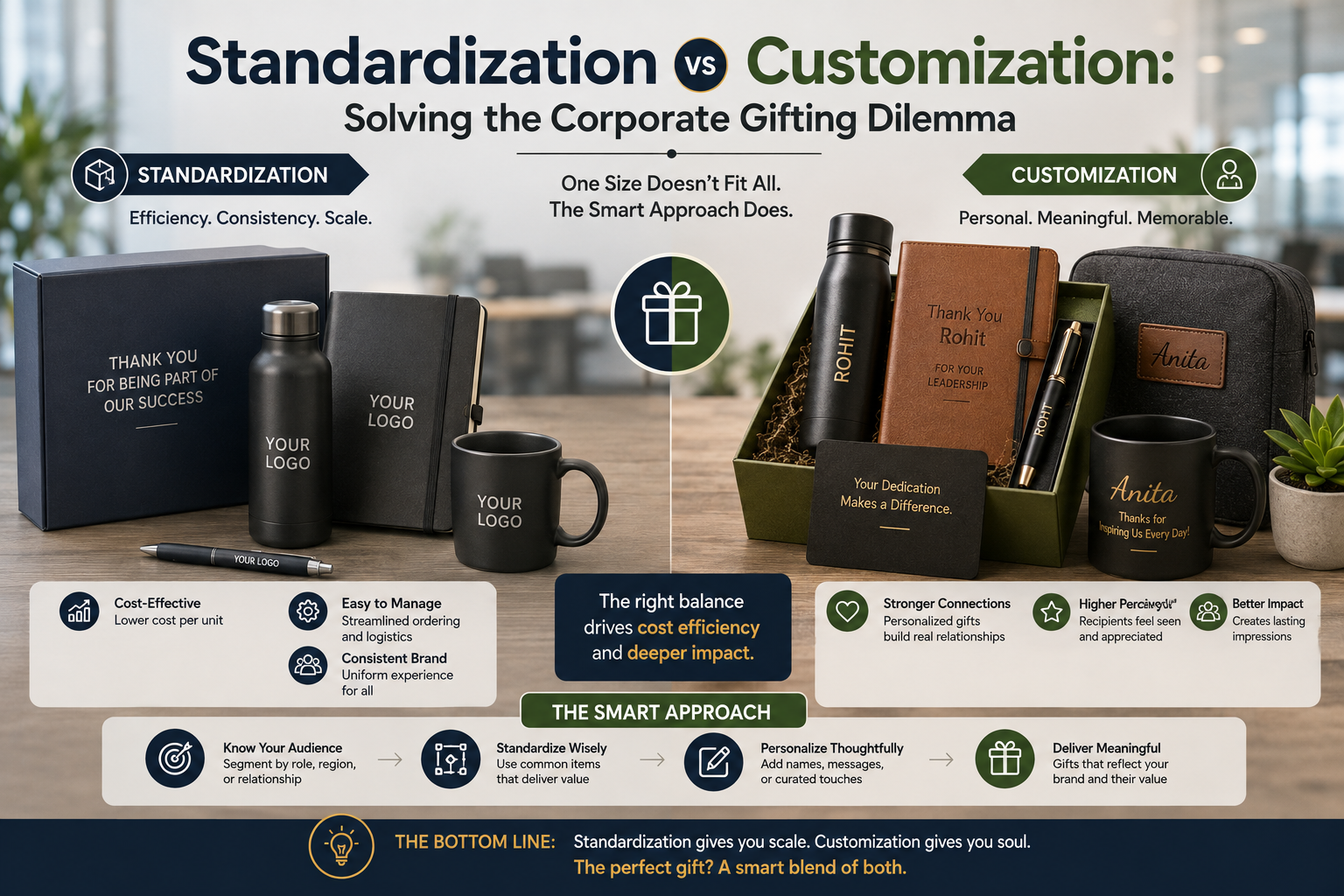
Standardization vs Customization: Solving the Corporate Gifting Dilemma
Corporate gifting looks simple from the outside.
Choose a product, add the company logo, place the order, and distribute it.
But HR and Procurement teams managing gifts for hundreds or thousands of employees quickly discover that the real challenge is much more complicated:
Should everyone receive the same gift, or should gifts be customized for different people?
Standardization makes procurement easier, reduces operational complexity, and can improve bulk pricing. Customization creates a more personal experience and can make recipients feel more valued.
This is the core standardized vs customized gifts dilemma.
Neither approach is automatically better.
The right decision depends on the purpose of the gifting campaign, recipient group, budget, timeline, personalization requirements, and the organization’s ability to manage production and distribution at scale.
The smartest corporate gifting strategy often isn’t choosing one side completely. It is finding the right balance between operational efficiency and recipient relevance.
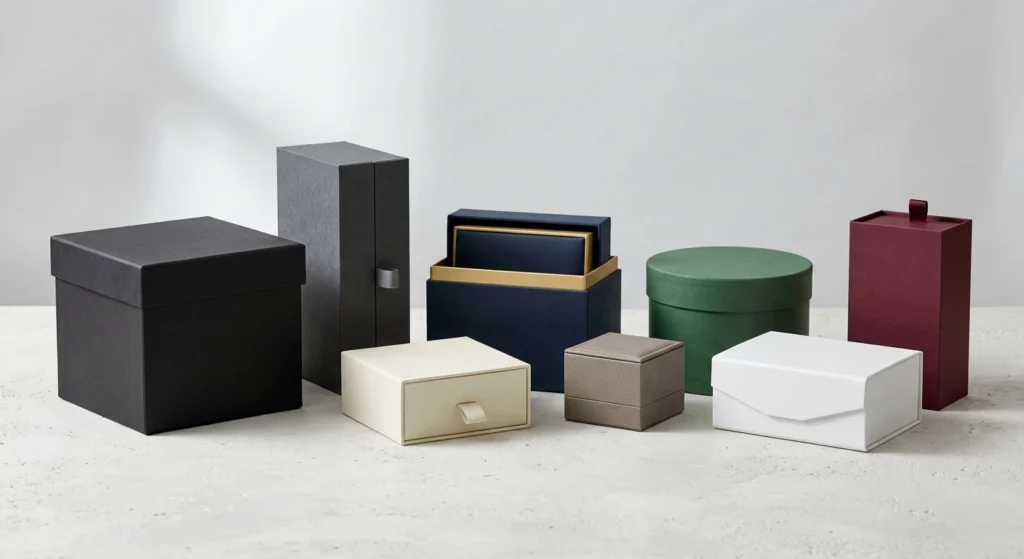
What Are Standardized Corporate Gifts?
Standardized gifts use the same product, design, packaging, and branding approach for most or all recipients.
For example:
1,000 employees → Same premium bottle → Same company branding → Same packaging
The recipient may be different, but the gift remains essentially the same.
Standardization is particularly useful when the organization wants:
- Simple procurement
- Predictable costs
- Faster production
- Consistent branding
- Easier inventory management
- Simplified distribution
For large organizations, these advantages can be significant.
What Are Customized Corporate Gifts?
Customized gifting introduces differences based on the recipient, department, occasion, or business relationship.
Customization can include:
- Employee names
- Client names
- Initials
- Department
- Personalized messages
- Different products
- Different colors
- Different packaging
- Different gift values
- Occasion-specific designs
For example:
500 employees → Same product → Individual employee names
Or:
VIP clients → Different premium gifts based on relationship
Customization increases complexity, but it can also increase perceived thoughtfulness.
Standardized vs Customized Gifts: The Core Difference
| Factor | Standardized Gifts | Customized Gifts |
|---|---|---|
| Procurement | Easier | More complex |
| Bulk pricing | Usually easier to negotiate | Can vary |
| Production | Faster | Requires more coordination |
| Personalization | Limited | High |
| Inventory | Easier to manage | More complex |
| Branding | Highly consistent | Requires controls |
| Recipient experience | Consistent | More personal |
| Data requirements | Lower | Higher |
| Risk of production errors | Lower | Higher |
| Best for | Large-scale campaigns | Relationship-focused gifting |
The important point is that standardization optimizes operations, while customization optimizes personalization.
1. Start With the Objective
Before choosing between standardization and customization, define what the gifting campaign needs to accomplish.
Ask:
What is the purpose of this gift?
If the objective is broad employee appreciation, standardization may be effective.
If the objective is recognizing individual milestones, customization may create more value.
If the objective is strengthening VIP client relationships, a more personalized approach may be appropriate.
The gifting objective should drive the procurement strategy.
2. Consider the Number of Recipients
Scale has a major influence on the decision.
A company gifting:
50 employees
can manage individual customization relatively easily.
A company gifting:
10,000 employees
needs significantly stronger systems if every gift is different.
At larger volumes, even a small data or production error can become expensive.
For example:
5,000 personalized products
could mean:
- 5,000 names
- 5,000 data records
- 5,000 personalization checks
- 5,000 packaging assignments
Standardization dramatically reduces this complexity.
3. Standardization Improves Procurement Efficiency
Procurement teams often prefer standardized products because they simplify purchasing.
Instead of sourcing several products, the team can negotiate around one larger volume.
For example:
2,000 identical bottles
may provide stronger negotiating leverage than:
500 bottles + 500 notebooks + 500 bags + 500 accessories
Standardization can help with:
- Volume discounts
- Vendor negotiations
- Production planning
- Quality control
- Inventory forecasting
However, this doesn’t mean Procurement should always choose the cheapest standardized product.
Quality still matters.
4. Customization Can Increase Perceived Value
A standard product becomes more personal when the recipient’s identity is incorporated.
Consider:
Premium bottle + company logo
versus:
Premium bottle + subtle company logo + employee name
The second version may create a stronger emotional response without requiring a completely different product.
This is one of the most practical ways to combine efficiency with personalization.
5. Personalization Doesn’t Have to Mean Different Products
This is an important distinction.
Customization doesn’t necessarily mean purchasing 20 different products.
A company can standardize the core gift and customize only selected elements.
For example:
Same bottle
Same packaging
Same logo
Different employee names
This creates a standardized-customized hybrid model.
For large employee gifting campaigns, this is often one of the most practical approaches.
6. Use the Hybrid Model for Large Teams
A hybrid gifting strategy can provide the benefits of both approaches.
For example:
Product
One standardized premium product.
Branding
One approved company design.
Personalization
Employee name added individually.
Packaging
Standard premium box.
Message
Personalized appreciation card where appropriate.
This creates consistency for Procurement while giving HR a more personal employee experience.
7. Consider the Occasion
The appropriate level of customization changes depending on the occasion.
Diwali Gifting
Standardized premium hampers can work well for large teams.
Employee Anniversary
Personalized gifts may be more meaningful.
Work Anniversary
A name, milestone year, or personalized message can add significance.
New Employee Welcome
A standardized welcome kit with personalized elements may work well.
Retirement
Highly personalized gifting is often more appropriate.
Client Milestone
A curated gift may be more suitable than a standard promotional item.
The occasion should influence the level of personalization.
8. Think About Recipient Segmentation
Customization doesn’t have to mean treating every person differently.
Instead, segment recipients.
For example:
Tier 1 — All Employees
Standardized gift.
Tier 2 — Managers
Upgraded version or additional personalization.
Tier 3 — Leadership
Premium executive gift.
Tier 4 — Strategic Clients
Highly curated and personalized gifting.
This allows HR and Procurement to maintain operational control while still creating differentiated experiences.
9. Consider the Total Cost of Customization
Customization creates costs beyond the product itself.
Potential costs include:
- Artwork setup
- Individual personalization
- Data preparation
- Production handling
- Quality checks
- Packaging
- Sorting
- Replacements
- Additional logistics
For example, an engraved name may look like a small addition.
But when applied to 3,000 products, the production process becomes considerably more complex.
Procurement should therefore calculate:
Product Cost + Customization Cost + Packaging + Logistics + Quality Control
rather than focusing only on the base product price.
10. Standardization Can Reduce Delivery Problems
A standardized campaign usually has fewer operational variables.
Imagine:
1 product + 1 design + 1 packaging format
compared with:
5 products + 4 designs + 3 packaging types + individual personalization
The second campaign has many more opportunities for:
- Wrong product allocation
- Incorrect customization
- Packaging errors
- Inventory shortages
- Dispatch mistakes
For time-sensitive gifting, standardization can be a major advantage.
11. Customization Requires Better Data Management
If employee names, client names, or other details are being personalized, data accuracy becomes critical.
HR should maintain a centralized record containing information such as:
- Employee ID
- Recipient name
- Product
- Personalization
- Location
- Packaging requirement
- Delivery information
Before production begins:
Validate → Approve → Freeze → Produce
Avoid continuously changing the list after production has started.
12. Create a Customization Data-Freeze Date
This is particularly important for large campaigns.
For example:
August 10: Employee data collection closes
August 12: HR validates data
August 13: Procurement sends final production file
August 14: Vendor begins production
After the freeze date, changes should be treated as exceptions.
This prevents last-minute requests from disrupting the entire order.
13. Standardize Your Branding
Even customized gifts should look like part of the same campaign.
Marketing and HR should define:
- Logo placement
- Font
- Colors
- Personalization format
- Packaging
- Message style
For example, if employee names are engraved, every name should follow the same typography and placement rules.
Customization should create individuality without sacrificing brand consistency.
14. Avoid Over-Customization
More customization isn’t always better.
Giving employees 10 product choices may sound attractive, but it can create major operational challenges.
More options mean:
- More SKUs
- More inventory
- More procurement work
- More packaging complexity
- More fulfillment errors
- More difficult forecasting
For large campaigns, two or three controlled options may be more practical than unlimited choice.
15. Standardization Is Particularly Useful for Events
Events often involve tight deadlines.
For conferences, seminars, employee gatherings, or large corporate celebrations, standardized gifts can simplify execution.
For example:
1,000 attendees → Same gift → Same packaging → Same branding
This can make inventory and distribution much easier.
If individual personalization isn’t essential to the event objective, standardization may be the smarter choice.
16. Customization Is More Valuable for Relationship Gifting
When the objective is relationship building, personalization can become more important.
For key clients, partners, or senior stakeholders, a curated gift can communicate a greater level of attention.
For example:
Client name + personalized message + carefully selected product
may create a stronger impression than generic branded merchandise.
The closer the relationship, the more carefully the gifting experience can be curated.
17. Compare the Cost of Errors
Procurement teams should consider the potential cost of mistakes.
With standardized gifting, an error may affect the entire batch.
With customized gifting, errors can occur at the individual level.
Potential problems include:
- Misspelled names
- Incorrect personalization
- Wrong product
- Wrong packaging
- Incorrect delivery assignment
A quality-control system is therefore essential when customization is used at scale.
18. Build Quality Checks Into the Process
For standardized gifts, check:
- Product quality
- Branding
- Packaging
- Quantity
For customized gifts, add:
- Personalization accuracy
- Name spelling
- Placement
- Product-to-recipient matching
- Packaging-to-recipient matching
The larger the campaign, the more important systematic quality control becomes.
19. Think About Inventory Risk
Standardized products are easier to forecast.
If you need:
2,000 units
you can order approximately that quantity.
Customized products may create more complicated inventory requirements.
For example, if employees select different products or sizes, Procurement must forecast each variation.
This is particularly important for:
- Apparel
- Shoes
- Bags
- Multiple gift choices
- Size-based products
Poor forecasting can lead to excess inventory in some variants and shortages in others.
20. Make the Decision Using a Simple Scoring Framework
HR and Procurement teams can evaluate each campaign against five criteria.
Scale
How many recipients are involved?
Personalization
How important is individual recognition?
Budget
How much can be spent per recipient?
Timeline
How much production time is available?
Complexity
How many products, variations, and locations are involved?
If:
High scale + short timeline + limited budget
→ Standardization may be better.
If:
Smaller audience + high relationship value + flexible timeline
→ Customization may be better.
If:
Large workforce + desire for personalization
→ Consider a hybrid model.
Standardized vs Customized Gifts: When Should You Choose Each?
Choose Standardization When:
- The recipient group is very large
- The campaign has a tight deadline
- Budget control is the priority
- Consistent branding is important
- The gift is primarily promotional
- Distribution needs to be simple
Choose Customization When:
- The recipient group is smaller
- The relationship is strategically important
- Individual recognition is central to the campaign
- The occasion is personal
- The company has accurate recipient data
- Sufficient production time is available
Choose a Hybrid Approach When:
- You have a large employee population
- You want some personalization
- Procurement needs cost control
- Brand consistency matters
- You need scalable fulfillment
For many modern corporate gifting programs, the hybrid approach offers the best balance.
Example: 1,000-Employee Diwali Campaign
Suppose an organization needs to gift 1,000 employees.
Option A: Fully Standardized
1,000 identical premium hampers
Advantages:
- Easy procurement
- Easy inventory planning
- Faster production
- Simple distribution
Limitation:
- Less personal
Option B: Fully Customized
1,000 individually selected gift combinations
Advantages:
- Highly personalized
- Greater employee choice
Limitations:
- Complex procurement
- Higher inventory risk
- More packing errors
- More difficult logistics
Option C: Hybrid
One premium hamper + employee name + personalized card
Advantages:
- Standardized procurement
- Consistent branding
- Easier fulfillment
- Greater personal value
For many organizations, Option C provides the strongest balance between operational efficiency and employee experience.
Common Mistakes to Avoid
Assuming Customization Is Always Better
Personalization has value, but complexity has a cost.
Standardizing Everything
Giving everyone an identical generic product can reduce perceived thoughtfulness.
Offering Too Many Choices
Excessive choice creates inventory and fulfillment problems.
Ignoring Data Quality
Incorrect personalization can damage the gifting experience.
Changing Requirements Late
Late customization changes can disrupt production.
Comparing Only Product Prices
Customization, packaging, logistics, and quality-control costs also matter.
Forgetting the Recipient
Procurement efficiency should not come at the expense of recipient relevance.
A Practical Corporate Gifting Decision Framework
Before approving a gifting strategy, ask:
1. Who are we gifting?
Employees, clients, partners, executives, or event attendees?
2. How many recipients are involved?
50, 500, 5,000, or more?
3. What is the objective?
Recognition, appreciation, branding, relationship building, or celebration?
4. How much personalization is actually valuable?
Do recipients need a different product, or would a personalized name/message be enough?
5. What is the timeline?
Can the vendor realistically execute the customization?
6. What is the total cost?
Include production, personalization, packaging, shipping, and contingency.
7. Can the organization manage the complexity?
If not, simplify the campaign.
Final Thoughts
The standardized vs customized gifts decision isn’t a battle between two completely opposite approaches.
It is a question of finding the right balance between efficiency and experience.
Standardization can provide better procurement control, simpler inventory management, predictable pricing, faster production, and consistent branding. Customization can make gifts feel more personal, relevant, and memorable.
For HR and Procurement teams, the smartest strategy is often to standardize the parts that don’t need to change and customize the parts that genuinely matter.
That could mean:
One product.
One brand design.
One packaging format.
Individual names.
Personalized messages.
This hybrid model allows organizations to achieve scale without making the gifting experience feel mass-produced.
Ultimately, the best corporate gifting strategy isn’t the one with the most customization or the fewest variations.
It is the one that delivers the right level of personalization without creating unnecessary operational complexity.
Standardize for efficiency. Customize for meaning. And use both strategically.
Leave a comment