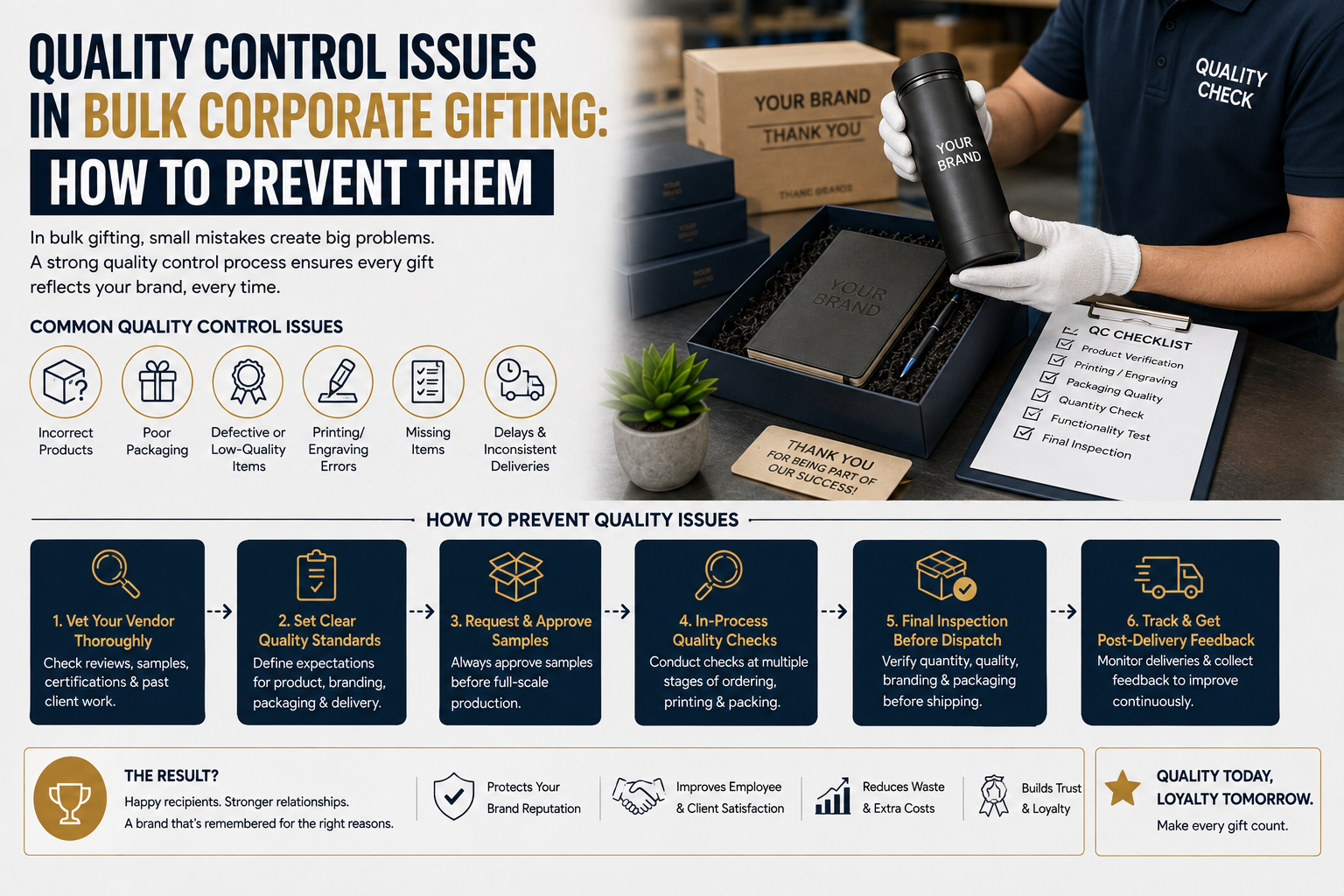
Quality Control Issues in Bulk Corporate Gifting: How to Prevent Them
Bulk corporate gifting can look easy on paper.
Select the products, approve the quotation, confirm the quantity, add the branding, and arrange delivery.
But when an organization is ordering 500, 2,000, or 10,000 gifts, even a small quality issue can become a significant problem.
A few defective products can turn into hundreds of replacements. A minor printing mistake can affect an entire production batch. Incorrect personalization can create employee complaints. Poor packaging can result in damaged gifts during transportation.
For Procurement and Admin teams, this makes quality control for corporate gifts an essential part of the gifting process—not something to check only when the final shipment arrives.
The objective is to prevent quality problems before they reach recipients.
That requires a structured system covering product selection, samples, customization, production, inspection, packaging, and delivery.
This guide explains the most common quality-control issues in bulk corporate gifting and the practical steps businesses can take to prevent them.

Why Quality Control Matters in Bulk Corporate Gifting
A corporate gift represents more than the physical product.
It represents the organization giving it.
When an employee receives a defective bottle, a client receives a poorly printed gift, or a personalized item contains a spelling mistake, the recipient usually doesn’t blame the manufacturer.
They associate the experience with the company that sent the gift.
Poor quality can therefore affect:
- Employee satisfaction
- Client relationships
- Brand perception
- Event experience
- Procurement credibility
- Internal workload
- Gifting budgets
Bulk orders also amplify mistakes.
If one product has a defect, replacing one unit may be manageable.
If a production problem affects 1,000 units, the cost and operational impact can be much higher.
That’s why quality needs to be built into the process from the beginning.
1. Define Quality Before Ordering
One of the biggest mistakes Procurement teams make is asking for “good quality” without defining what that means.
Quality should be measurable wherever possible.
Define requirements such as:
- Product material
- Dimensions
- Weight
- Finish
- Color
- Functionality
- Branding position
- Packaging specifications
- Personalization format
- Acceptable tolerances
For example, instead of saying:
“We need premium bottles.”
Specify:
“Stainless-steel bottle with approved finish, specified capacity, leak-resistant closure, and approved logo placement.”
The clearer the specification, the easier it becomes to inspect the final product.
2. Approve a Physical Sample
Product photographs should never be the only basis for approving a large gifting order.
Lighting and photography can make products appear different from what recipients eventually receive.
Before placing a major order, request a physical sample whenever practical.
Inspect:
- Material
- Finish
- Size
- Weight
- Functionality
- Color
- Branding
- Packaging
The approved sample should become the physical benchmark for mass production.
This gives both the buyer and vendor a common reference point.
3. Approve the Customized Sample Separately
A blank product sample isn’t enough if the final order involves printing or engraving.
For customized corporate gifts, approve:
Actual product + Actual logo + Actual personalization + Actual packaging
Check:
- Logo size
- Logo position
- Print clarity
- Engraving depth
- Font
- Name placement
- Color accuracy
- Alignment
- Packaging quality
A product can be excellent while its customization is poor.
Both need to be inspected.
4. Create a Detailed Product Specification Sheet
For large orders, create a simple quality specification document.
It can include:
Product
- Product name
- Model or SKU
- Material
- Size
- Color
- Quantity
Branding
- Logo
- Position
- Size
- Printing/engraving method
Packaging
- Box specification
- Inserts
- Labels
- Branding
Personalization
- Name format
- Font
- Maximum characters
- Position
Delivery
- Required dispatch date
- Delivery deadline
- Locations
This specification becomes the reference for Procurement, Admin, the vendor, and quality-control teams.
5. Verify Product Samples Against the Final Order
A common quality-control problem occurs when the approved sample differs from the mass-produced product.
For example:
Sample: Premium finish
Bulk production: Different coating or material
To prevent this, Procurement should confirm that the approved sample represents the actual production specification.
If the vendor needs to substitute a material, component, or product version, approval should be obtained before production.
6. Check Product Consistency Across the Batch
Bulk corporate gifts should have reasonable consistency.
Inspect for:
- Color variation
- Surface scratches
- Uneven finishing
- Size differences
- Logo variation
- Material inconsistencies
- Missing components
This is particularly important for premium gifting.
A group of employees opening their gifts should not see dramatically different quality levels between units.
7. Treat Customization as a Separate Quality-Control Stage
Printing and engraving create additional quality risks.
Common issues include:
- Misspelled names
- Incorrect logos
- Misaligned prints
- Uneven engraving
- Faded printing
- Incorrect colors
- Wrong font
- Incorrect personalization
Customization should therefore have its own inspection process.
The workflow should be:
Approved artwork → Production → Customization check → Final quality check
Don’t assume that checking the product automatically means the personalization has been checked.
8. Validate Personalization Data Before Production
When hundreds or thousands of employee names are involved, data accuracy becomes a quality issue.
Before sending the production file, verify:
- Employee names
- Employee IDs
- Product selection
- Department, if required
- Size, if applicable
- Special personalization
Avoid sending fragmented information through multiple emails or messaging channels.
Maintain one approved master file.
Once the information is verified, establish a clear data-freeze point.
9. Use Employee IDs for Large Personalized Orders
Names alone can create confusion.
For example, an organization may have several employees named:
Amit Kumar
An employee ID provides a more reliable reference.
A production record might contain:
EMP102 → Amit Kumar → Bottle → Personalized engraving
This helps connect the customized product with the correct recipient.
The ID doesn’t necessarily need to appear on the gift. It functions as an internal control.
10. Inspect Production Early
Don’t wait until all products are manufactured before checking quality.
For large orders, establish production checkpoints.
For example:
Sample approval
↓
Initial production check
↓
Mid-production inspection
↓
Final inspection
↓
Packaging inspection
This allows problems to be identified while there is still time to correct them.
Early detection is usually cheaper than large-scale rework.
11. Consider Batch-Based Quality Checks
For a large order, divide production into manageable batches where appropriate.
For example:
2,000 units
could be produced and inspected in several batches depending on the vendor’s production process.
If a defect is discovered early, the production team can investigate before the entire order is completed.
The exact inspection frequency should depend on:
- Order size
- Product type
- Customization complexity
- Vendor history
- Quality requirements
- Production method
12. Inspect Packaging as Carefully as the Product
Quality control shouldn’t stop with the gift itself.
Packaging can also create problems.
Check:
- Box quality
- Printing
- Inserts
- Protective materials
- Labels
- Product placement
- Sealing
- Presentation
Poor packaging can make an otherwise high-quality product feel inexpensive.
More importantly, inadequate protection can increase the risk of damage during shipping.
13. Test Packaging for Transportation
A beautifully packaged gift isn’t useful if it cannot survive transportation.
Depending on the product, assess whether the packaging provides sufficient protection against:
- Impact
- Pressure
- Movement
- Moisture
- Handling
Fragile or premium products may require additional protective material.
For large corporate gifting campaigns, packaging should be tested before the entire order is packed.
14. Inspect Quantity Before Dispatch
Quantity errors are surprisingly common in bulk orders.
Before dispatch, reconcile:
Ordered quantity
against:
Produced quantity
and:
Packed quantity
For example:
Purchase order: 2,000
Produced: 2,000
Packed: 1,980
The missing 20 units should be identified before shipment.
This simple reconciliation can prevent unnecessary delivery issues.
15. Match Customized Gifts With Recipients
Personalized gifting introduces another layer of quality control.
The question isn’t only:
Is the name correct?
It is also:
Is the correct personalized product assigned to the correct recipient?
For large employee gifting campaigns, use internal identifiers to connect:
Employee → Product → Personalization → Package → Shipment
This becomes especially important when employees receive different gift options.
16. Create a Defect Classification System
Not every defect has the same severity.
A simple classification system can help Procurement prioritize issues.
Critical Defect
A problem that makes the product unusable or seriously compromises the order.
Major Defect
A visible or functional issue that significantly affects product quality.
Minor Defect
A small cosmetic issue that may not affect usability.
The organization and vendor should agree on acceptable quality standards before production where appropriate.
17. Define the Acceptable Quality Level
For large orders, it may be unrealistic to assume every mass-produced item will be absolutely identical.
Procurement should discuss acceptable quality standards with the vendor before production.
Depending on the product, establish expectations around:
- Cosmetic variation
- Printing tolerance
- Color variation
- Minor finishing differences
- Defective-unit replacement
The key is to agree on standards before a dispute occurs.
18. Establish a Rejection and Replacement Process
Ask the vendor in advance:
What happens if products fail inspection?
Clarify:
- Who pays for replacements?
- How quickly are replacements produced?
- Who arranges pickup or disposal?
- Will the vendor cover additional shipping?
- What happens if the delivery deadline is approaching?
A clear replacement process protects Procurement from unexpected costs and delays.
19. Don’t Approve Production Based on Price Alone
Low-cost products can sometimes create higher total costs if quality problems lead to:
- Replacements
- Reprinting
- Rework
- Additional shipping
- Employee complaints
- Vendor follow-up
- Internal administrative work
Procurement should therefore evaluate:
Total Cost of Ownership
rather than simply:
Lowest Unit Price
A slightly higher-quality product with reliable production may ultimately be more economical.
20. Evaluate the Vendor’s Quality-Control Process
Before committing to a vendor, ask:
- Who performs quality checks?
- At what production stages?
- How are defects recorded?
- How are personalized products verified?
- How are replacements handled?
- Can the vendor provide production samples?
- What happens if the approved specification changes?
A reliable corporate gifting vendor should be able to explain its quality-control process clearly.
If the answer is simply:
“We check everything before shipping.”
ask for more detail.
What exactly is checked?
When?
By whom?
Against what specification?
21. Keep a Quality-Control Checklist
A simple checklist can prevent important details from being forgotten.
Product Quality
- Correct product
- Correct quantity
- Correct material
- Correct color
- Correct finish
- Functional components working
Branding
- Correct logo
- Correct placement
- Correct size
- Correct color
- Clear printing/engraving
Personalization
- Correct name
- Correct spelling
- Correct font
- Correct positioning
- Correct recipient assignment
Packaging
- Correct box
- Protective packaging
- Correct inserts
- Correct labels
- Presentation approved
Dispatch
- Quantity reconciled
- Addresses validated
- Shipment labels correct
- Tracking available
22. Keep Documentation Throughout the Project
Quality disputes are easier to resolve when documentation exists.
Maintain records of:
- Approved quotation
- Product specifications
- Artwork
- Physical sample approval
- Personalization file
- Production approval
- Quality inspection
- Quantity reconciliation
- Dispatch report
This creates a clear record of what was agreed.
It also helps if a quality issue appears after delivery.
23. Plan for a Final Pre-Dispatch Inspection
Before the order leaves the vendor, conduct a final inspection or obtain appropriate confirmation.
The final check should verify:
Product + Customization + Packaging + Quantity + Shipping
This is the final opportunity to identify problems before the gifts enter the logistics network.
For high-value or highly customized campaigns, a more rigorous pre-dispatch inspection may be worthwhile.
24. Monitor Quality After Delivery
Quality control doesn’t completely end at dispatch.
Track:
- Damaged gifts
- Incorrect gifts
- Customization complaints
- Missing items
- Packaging problems
- Replacement requests
If 30 recipients report the same issue, that’s valuable feedback.
It may indicate a systemic production or packaging problem rather than isolated incidents
25. Build Vendor Performance History
Procurement teams should maintain a record of vendor performance across campaigns.
Track indicators such as:
- On-time delivery
- Defect rate
- Replacement rate
- Customization accuracy
- Response time
- Packaging quality
- Complaint resolution
This helps future procurement decisions.
A vendor that consistently delivers high-quality products may deserve stronger consideration than a vendor that simply offers the lowest quotation.
Common Quality Control Issues in Corporate Gifting
The most frequent problems can be grouped into five areas:
Product Problems
- Defective products
- Scratches
- Poor finishing
- Material inconsistencies
Branding Problems
- Incorrect logo
- Poor print quality
- Misalignment
- Color differences
Personalization Problems
- Spelling mistakes
- Wrong recipient
- Incorrect font
- Inconsistent placement
Packaging Problems
- Damaged boxes
- Insufficient protection
- Incorrect inserts
- Poor presentation
Logistics Problems
- Missing items
- Wrong labels
- Damaged shipments
- Incorrect deliveries
Each category needs its own preventive control.
A Practical Quality-Control Workflow for Bulk Corporate Gifts
Procurement and Admin teams can use this simple process:
Step 1: Define Specifications
Document exactly what quality means.
Step 2: Select the Vendor
Evaluate experience, capability, and quality systems.
Step 3: Approve the Product Sample
Check the actual product.
Step 4: Approve the Customized Sample
Check branding and personalization.
Step 5: Validate Data
Confirm names, products, sizes, and other required information.
Step 6: Freeze Artwork and Data
Prevent uncontrolled production changes.
Step 7: Begin Production
Use appropriate production checkpoints.
Step 8: Conduct Quality Inspections
Inspect products, customization, and packaging.
Step 9: Reconcile Quantity
Confirm produced and packed quantities.
Step 10: Complete Final Inspection
Approve the shipment before dispatch.
Step 11: Track Delivery
Monitor shipments and exceptions.
Step 12: Review Performance
Record defects, complaints, replacements, and vendor performance.
How Procurement Can Reduce Quality Problems
The most effective approach is prevention.
Procurement teams can reduce risk by:
Choosing vendors based on capability—not price alone.
Approving physical samples before mass production.
Documenting specifications clearly.
Freezing artwork and personalization data.
Establishing quality standards before production.
Inspecting production before final dispatch.
Agreeing on replacement responsibilities in advance.
Tracking vendor performance after delivery.
These controls can significantly reduce the likelihood of costly surprises.
Final Thoughts
Quality control in corporate gifting isn’t simply about checking whether the products look good before shipment.
It is a complete process that starts when the gifting requirement is defined and continues through product selection, customization, production, packaging, dispatch, and delivery.
For Procurement and Admin teams, the most effective strategy is to build quality control for corporate gifts into every stage of the campaign.
Start with clear specifications. Approve physical and customized samples. Validate personalization data. Establish production checkpoints. Inspect packaging. Reconcile quantities. Define replacement procedures. Document approvals.
Most importantly, don’t wait until recipients report problems.
By the time a defective or incorrectly personalized gift reaches an employee or client, the organization is already dealing with the consequences.
The best quality-control strategy is not finding more defects at the end. It is preventing those defects from reaching the production line in the first place.
Leave a comment