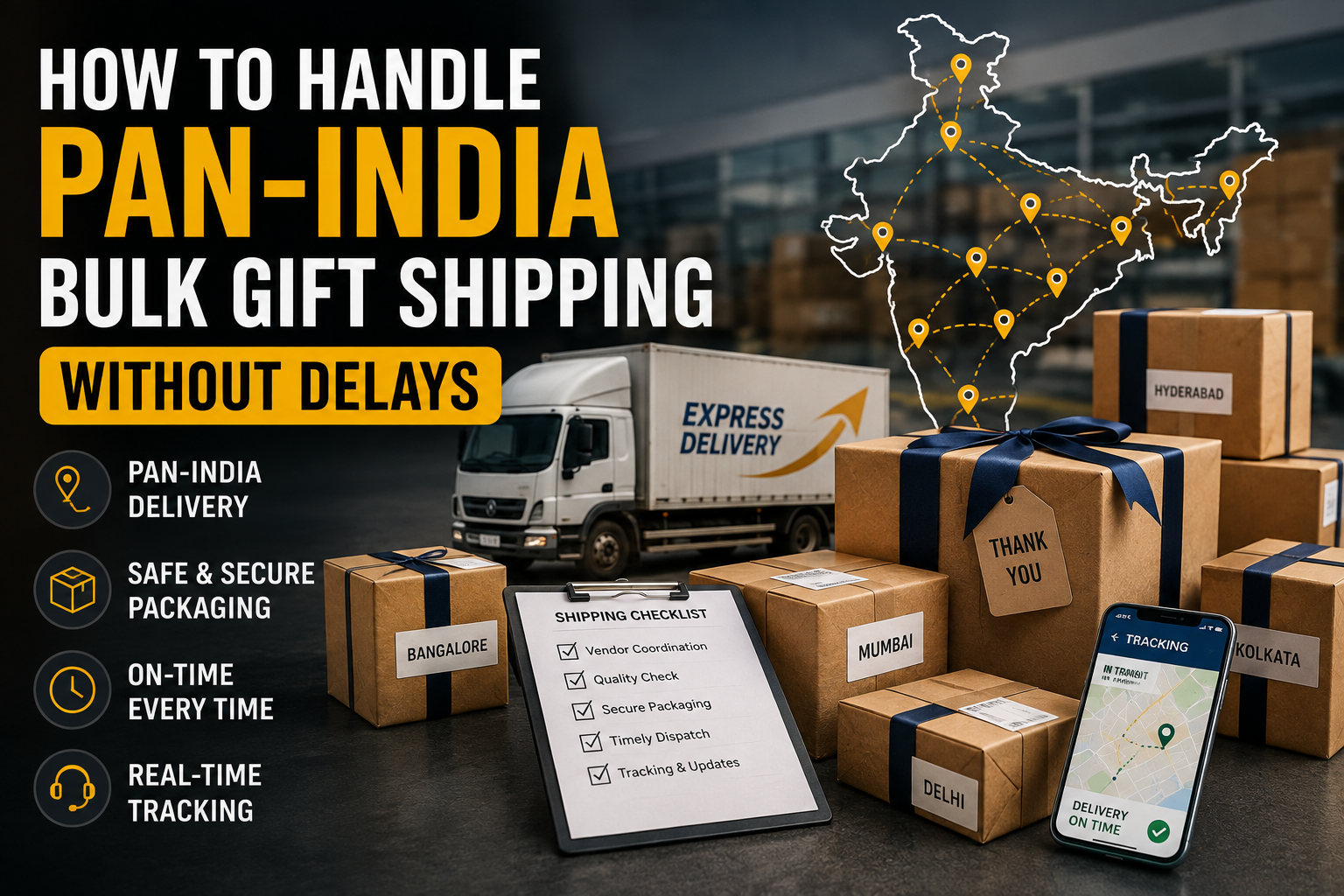
How to Handle Pan-India Bulk Gift Shipping Without Delays
Managing corporate gifting for employees, clients, partners, or event attendees across India is significantly more complex than delivering gifts to a single office. Different cities, delivery addresses, courier networks, packaging requirements, and recipient availability can all affect the final delivery timeline.
For Procurement and Admin teams, successful pan india corporate gift shipping requires more than selecting a reliable courier. It requires planning the entire fulfillment process—from inventory and packaging to address validation, dispatch coordination, tracking, and exception management.
A gifting order may contain 500, 2,000, or 10,000 packages going to recipients across multiple states. If even a small percentage of addresses fail, packages are returned, or deliveries miss the required date, the administrative workload can increase quickly.
The solution is to treat nationwide corporate gifting as a logistics project rather than a simple bulk shipment.
This guide explains how Procurement and Admin teams can plan, manage, and monitor Pan-India corporate gift shipments while reducing delays, failed deliveries, and unexpected logistics costs.

Why Pan-India Corporate Gift Shipping Is Challenging
A single-location corporate gift order is relatively straightforward.
For example:
1,000 gifts → One office → One delivery address
A Pan-India campaign could look very different:
1,000 gifts → 1,000 recipients → Multiple cities → Multiple delivery routes
The complexity increases further when recipients are spread across metro cities, Tier-2 cities, Tier-3 cities, and remote locations.
Common challenges include:
- Incorrect recipient addresses
- Incomplete postal codes
- Wrong mobile numbers
- Recipient unavailability
- Multiple delivery attempts
- Regional courier limitations
- Weather-related disruptions
- Peak-season logistics pressure
- Damaged packages
- Return-to-origin shipments
- Last-minute address changes
- Inconsistent tracking information
This is why nationwide gifting needs a structured process.
1. Start With a Complete Recipient Master File
The recipient database is the foundation of successful Pan-India shipping.
Before the gifts leave the warehouse, Procurement or Admin teams should maintain one verified master file containing the information required for fulfillment.
Depending on the shipping model, this may include:
- Recipient name
- Company name
- Complete address
- City
- State
- PIN code
- Mobile number
- Email address, where required
- Gift or product assigned
- Personalization details
- Special delivery instructions
The database should have one clearly designated owner.
Avoid allowing multiple departments to send different versions of the recipient list to the vendor. Conflicting files can create duplicate shipments, missing recipients, and incorrect personalization.
2. Validate Addresses Before Dispatch
Address errors are one of the most common causes of delivery failures.
A recipient may provide:
“Office, Noida”
when the courier actually needs a complete address, building name, locality, PIN code, and contact number.
Before dispatch, conduct an address-quality check.
Look for:
- Missing PIN codes
- Invalid PIN codes
- Incomplete street information
- Missing building or office details
- Duplicate recipients
- Incorrect phone numbers
- Mismatched cities and PIN codes
For large orders, cleaning the database before shipment can prevent a significant number of failed deliveries.
3. Segment the Shipment by Geography
Do not treat India as one delivery zone.
Divide recipients into practical geographical or operational categories.
For example:
Metro cities
Delhi NCR, Mumbai, Bengaluru, Hyderabad, Chennai, Kolkata, Pune, etc.
Tier-2 cities
Cities with established courier networks but potentially longer delivery windows.
Tier-3 and smaller locations
Areas where delivery may require additional transit time or have fewer service options.
Remote or difficult-to-service locations
Locations that may require special planning or alternative courier arrangements.
This segmentation helps Procurement teams estimate realistic delivery timelines instead of applying one standard assumption to every recipient.
4. Select the Courier Based on Coverage, Not Just Price
The cheapest shipping quote is not necessarily the best option for a nationwide corporate gifting campaign.
When evaluating logistics partners, consider:
- PIN-code coverage
- Average transit time
- Tracking quality
- Pickup capability
- Reverse logistics
- Customer support
- Delivery attempt policy
- Damage handling
- Cashless corporate processes
- Regional service reliability
A courier that performs well in major metropolitan areas may not provide the same service quality in remote locations.
For Pan-India corporate gift shipping, coverage and consistency should be evaluated alongside price.
5. Confirm Serviceability Before Packing
One of the most useful checks is to validate delivery serviceability before the packages are finalized.
Some PIN codes may have:
- Limited delivery coverage
- Extended delivery timelines
- Specific carrier restrictions
- Temporary service disruptions
- Special handling requirements
If a location has a serviceability issue, address it before dispatch rather than discovering the problem after the package enters the logistics network.
This is particularly important when the gifting campaign has a fixed delivery deadline.
6. Create a Realistic Shipping Timeline
Do not calculate the timeline as:
Production complete → Courier pickup → Delivery
There are several stages between these milestones.
A practical workflow may look like:
Product production
↓
Branding/customization
↓
Quality inspection
↓
Packaging
↓
Address and shipment-data validation
↓
Shipping-label generation
↓
Sorting
↓
Courier pickup
↓
Transit
↓
Last-mile delivery
↓
Delivery confirmation
Each stage requires time.
For a nationwide campaign, build a buffer for regional variation rather than promising every recipient the same delivery date.
7. Dispatch in Batches When Appropriate
Large gifting campaigns do not always need to be dispatched as one massive shipment.
Batch dispatching can make the process easier to control.
For example:
Batch 1: Metro locations
Batch 2: Tier-2 cities
Batch 3: Tier-3 and remote locations
This allows the team to identify problems in the first batch before completing the remaining shipments.
However, batch dispatching should be planned around the event or gifting deadline. It should not create unnecessary delays for recipients who could have received their gifts earlier.
8. Use Strong Packaging for Multi-City Shipping
A corporate gift may look perfect when it leaves the warehouse but still arrive damaged.
Nationwide transportation involves multiple handling points, loading and unloading, sorting facilities, and last-mile movement.
Packaging should therefore be selected according to the product and shipping conditions.
Consider:
- Product fragility
- Box strength
- Internal cushioning
- Moisture protection where appropriate
- Secure sealing
- Outer packaging
- Label placement
For premium corporate gifts, the packaging is part of the recipient experience.
A damaged gift box can reduce the perceived value of an otherwise excellent product.
9. Keep the Shipping Label Clear and Accurate
Every package should have clear shipping information.
The label should correspond exactly with the approved recipient database.
Avoid manually writing addresses wherever possible for large campaigns.
Automated or standardized label generation can reduce:
- Typographical errors
- Duplicate labels
- Missing information
- Incorrect recipient-product matching
If individual personalization is involved, conduct a final reconciliation between the personalization list and shipping list.
10. Separate Gift Assembly From Shipping Data
For large orders, don’t assume that the person assembling the gifts should also manage the shipping database.
These are different processes.
The fulfillment team needs to know:
What goes inside the package?
The logistics team needs to know:
Where does the package go?
A controlled process should connect both datasets.
For example:
Recipient ID → Gift ID → Package ID → Tracking ID
This makes it easier to identify a missing or delayed package without searching manually through hundreds or thousands of records.
11. Track Every Shipment
Tracking is essential for Pan-India corporate gifting.
Procurement and Admin teams should maintain a centralized tracking dashboard containing:
- Recipient name
- City
- PIN code
- Shipment ID
- Courier
- Dispatch date
- Current status
- Expected delivery
- Exception status
- Final delivery date
A simple status structure can include:
Not Dispatched
Picked Up
In Transit
Out for Delivery
Delivered
Exception
Returned
This gives the team visibility across the entire campaign.
12. Create an Exception Management Process
Tracking is useful only when someone acts on exceptions.
Common exceptions include:
- Incorrect address
- Recipient unavailable
- Phone unreachable
- Delivery attempt failed
- Shipment delayed
- Package damaged
- Shipment returned
- PIN code not serviceable
Create an escalation process.
For example:
Day 1: Exception identified
Day 1: Admin team validates recipient information
Day 2: Courier/vendor contacted
Day 2: Recipient contacted where appropriate
Day 3: Reattempt or corrective action initiated
The exact process can vary, but ownership should be clearly defined.
13. Don’t Wait Until the Final Delivery Date
One of the biggest mistakes in corporate gifting logistics is checking the tracking dashboard only when the delivery deadline is approaching.
By then, there may be very little time to fix a problem.
Instead, monitor shipments continuously.
For a time-sensitive campaign, establish checkpoints such as:
24 hours after dispatch: Confirm shipment movement
48–72 hours: Identify shipments with no meaningful movement
Before the delivery deadline: Escalate exceptions
After the expected delivery date: Investigate every undelivered shipment
Early intervention is much easier than emergency recovery.
14. Plan for Return-to-Origin Shipments
Not every package will reach the recipient on the first attempt.
Packages can be returned because of:
- Incorrect address
- Recipient refusal
- Unreachable phone number
- Multiple failed attempts
- Closed office
- Incomplete address
- Serviceability problems
Before the campaign starts, establish what happens to returned packages.
Decide:
- Who receives the returned shipment?
- Who verifies the address?
- Who approves re-dispatch?
- Who pays the second delivery charge?
- How will the recipient be contacted?
- Where will returned inventory be stored?
Having these answers in advance reduces confusion.
15. Keep a Small Replacement Buffer
For large corporate gifting campaigns, a small quantity of additional gifts can be useful.
The buffer can help with:
- Damaged products
- Missing shipments
- Lost packages
- Incorrect personalization
- Replacement requirements
- Last-minute recipients
The ideal quantity depends on order size, product type, value, and shipping complexity.
The goal is not to create excess inventory but to maintain enough flexibility to resolve exceptions quickly.
16. Communicate Delivery Expectations to Recipients
Recipients should know when to expect their corporate gift when the campaign is time-sensitive.
A simple communication can include:
- Gift shipment notification
- Expected delivery window
- Tracking information, where appropriate
- Contact instructions for delivery issues
This can reduce missed deliveries because recipients are more likely to recognize and respond to the shipment.
For employee gifting, internal communication can also improve the overall experience.
17. Plan Around Peak Seasons
Festivals and major corporate gifting periods can place significant pressure on manufacturing and logistics networks.
If a campaign is scheduled during a peak period, Procurement teams should begin earlier than they would for a normal shipment.
Don’t plan based on the fastest standard delivery time.
Plan around a realistic delivery window that includes:
Production + Packaging + Dispatch + Transit + Buffer
Early planning can also provide more flexibility if a preferred product becomes unavailable.
18. Calculate the True Shipping Cost
Shipping should not be treated as an afterthought.
The final logistics cost can include:
- Base shipping
- Packaging
- Remote-area charges
- Additional handling
- Reattempts
- Return shipping
- Re-dispatch
- Special delivery requirements
When comparing vendors, ask for a complete commercial structure rather than comparing only the headline per-package rate.
A slightly higher initial shipping cost may be preferable if it delivers better coverage and fewer failed deliveries.
19. Use One Point of Contact
Large corporate gifting campaigns can involve HR, Admin, Procurement, Events, vendors, packaging teams, and logistics providers.
Without clear ownership, communication can become fragmented.
Assign one primary project owner who can coordinate:
Internal teams ↔ Gift vendor ↔ Logistics partner
This reduces duplicated instructions and makes escalation faster.
A Practical Pan-India Corporate Gift Shipping Checklist
Before dispatch, Procurement and Admin teams should confirm:
Product
- Product quantity finalized
- Product quality approved
- Branding completed
- Packaging approved
Recipient Data
- Names verified
- Addresses validated
- PIN codes checked
- Mobile numbers confirmed
- Duplicate records removed
Logistics
- Courier selected
- Serviceability checked
- Pickup date confirmed
- Delivery window confirmed
- Tracking process established
Contingency
- Replacement stock available where necessary
- Exception process defined
- Return handling confirmed
- Escalation contacts available
- Delivery buffer included
This checklist can prevent many avoidable problems.
Final Thoughts
Successful pan india corporate gift shipping requires planning at every stage.
The biggest mistake is treating shipping as the final step after the gifts have already been produced. In reality, logistics should influence product selection, packaging, recipient-data management, procurement timelines, and even the gifting budget from the beginning.
For Procurement and Admin teams, the most effective approach is to build a structured process:
Validate recipients → Confirm product availability → Segment locations → Select the right logistics partner → Pack securely → Dispatch systematically → Track every shipment → Manage exceptions quickly.
Most importantly, don’t promise delivery based on the fastest possible scenario.
Build your timeline around realistic transit times and include a contingency buffer.
When Pan-India corporate gifting is managed as an end-to-end fulfillment project rather than simply a courier exercise, organizations can reduce delivery failures, control logistics costs, minimize administrative workload, and ensure that gifts reach recipients when they actually matter.
The goal is simple: the right gift, the right recipient, the right location, and the right time—across India.
Leave a comment