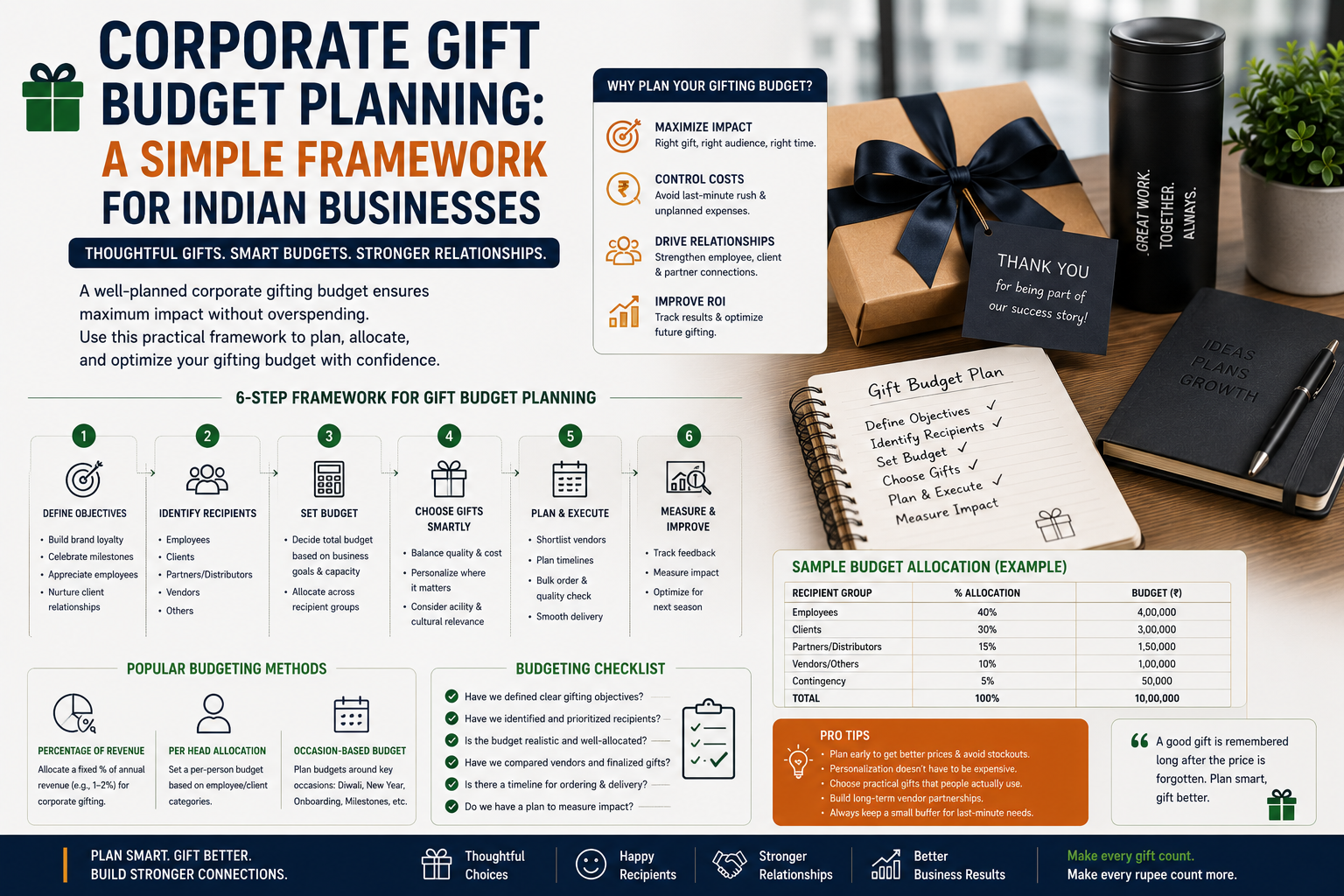
Corporate Gift Budget Planning: A Simple Framework for Indian Businesses
Corporate gifting can be an effective way to appreciate employees, strengthen client relationships, support business partnerships, and reinforce a company’s brand.
But without a clear budget, gifting can quickly become difficult to manage.
A few hundred gifts can turn into thousands of individual expenses across products, branding, packaging, personalization, shipping, taxes, and last-minute requirements. For Finance and HR decision-makers, the challenge is therefore not simply choosing attractive gifts. It is creating a corporate gifting budget planning framework that controls spending while still delivering a meaningful experience.
For Indian businesses, this becomes particularly important during high-volume gifting periods such as Diwali, employee appreciation campaigns, annual celebrations, onboarding programs, client gifting, and milestone events.
A structured budget helps decision-makers answer five important questions:
- How much should we spend?
- Who should receive gifts?
- What should each recipient receive?
- Which costs need to be included?
- How do we measure whether the spending was worthwhile?
This guide provides a practical framework Finance and HR teams can use to plan corporate gifting budgets without unnecessary overspending.

Why Corporate Gifting Needs a Defined Budget
Corporate gifting is often treated as a discretionary expense.
That can lead to inconsistent decisions.
One department may spend ₹800 per employee while another spends ₹1,500. One team may include shipping in its budget while another treats it as a separate expense.
Without a centralized framework, organizations can lose visibility into their actual gifting expenditure.
A defined budget provides:
Consistency + Cost Control + Better Procurement + Easier Approval + Measurable Outcomes
It also gives Finance teams a clear basis for evaluating vendor proposals and approving gifting campaigns.
1. Start With the Purpose of the Gift
The first step in corporate gifting budget planning is to identify the objective.
Different gifting objectives may justify different spending levels.
Employee Appreciation
The objective is recognition, morale, and employee experience.
Client Gifting
The objective may be relationship building, appreciation, and account management.
Festive Gifting
The focus may be celebration, goodwill, and brand visibility.
Employee Onboarding
The gift may form part of the employee’s first impression of the organization.
Business Milestones
Higher-value gifts may be appropriate for significant achievements or strategic relationships.
The purpose should determine the budget—not the other way around.
2. Divide Recipients Into Categories
A company rarely needs to give exactly the same gift to everyone.
Create recipient categories based on business importance and campaign objectives.
For example:
| Recipient Group | Example Budget |
|---|---|
| Employees | ₹500–₹1,000 |
| Managers | ₹750–₹1,500 |
| Key Clients | ₹1,500–₹5,000+ |
| VIP Clients/Partners | ₹5,000+ |
These are illustrative ranges rather than universal recommendations.
The appropriate amount depends on the company’s objectives, relationship value, employee population, occasion, and overall financial plan.
The benefit of segmentation is that it prevents the organization from using one expensive gift for every recipient simply because it wants a premium experience.
3. Calculate the Core Per-Recipient Budget
Once recipient groups are defined, establish a target cost per recipient.
For example:
1,000 employees × ₹750 = ₹7,50,000
This becomes the starting product budget.
But Finance teams should avoid assuming that ₹750 is the final delivered cost.
A better calculation is:
Product + Branding + Packaging + Personalization + Logistics + Applicable Taxes = Total Campaign Cost
This prevents budget surprises later.
4. Separate Product Cost From Total Gifting Cost
Suppose a vendor quotes a corporate gift at ₹600.
That does not necessarily mean your campaign costs ₹600 per recipient.
Additional charges may include:
- Branding
- Personalized printing
- Gift box
- Message card
- Assembly
- Shipping
- Individual delivery
- Replacement shipments
- Applicable taxes
For example:
| Component | Cost |
|---|---|
| Product | ₹550 |
| Branding | ₹30 |
| Packaging | ₹60 |
| Logistics | ₹50 |
| Pre-tax total | ₹690 |
The actual campaign cost is therefore considerably different from the original product price.
Always compare landed cost per recipient.
5. Build a Budget by Campaign, Not Just by Product
A common budgeting mistake is allocating money to individual products without considering the campaign.
Instead, create a campaign-level budget.
For example:
Employee Diwali Gifting
Recipients: 2,000
Target spend: ₹1,000 per employee
Total target: ₹20,00,000
Then divide the budget into:
- Products
- Packaging
- Branding
- Logistics
- Contingency
This gives Finance and HR a complete picture of expected expenditure.
6. Include a Contingency Budget
Large gifting campaigns rarely execute exactly as planned.
You may encounter:
- Additional employees
- Damaged products
- Address corrections
- Replacement shipments
- Packaging changes
- Last-minute orders
- Product availability problems
A contingency reserve can help manage these unexpected costs without requiring a complete budget revision.
The exact percentage should depend on campaign complexity and organizational risk tolerance.
The important principle is:
Don’t allocate 100% of the available budget before considering exceptions.
7. Use Tiered Budgets for Different Occasions
Not every corporate gifting event deserves the same spending level.
For example:
Routine Employee Appreciation
Lower-cost useful gifts.
Annual Festive Gifting
Moderate-value premium gifts.
Employee Milestones
More personalized gifts.
VIP Client Recognition
Higher-value executive gifts.
This approach allows Finance teams to allocate resources according to the importance of each occasion.
8. Set an Annual Corporate Gifting Budget
Instead of budgeting separately every time someone requests a gift, organizations can establish an annual gifting envelope.
For example:
Annual Corporate Gifting Budget: ₹50 lakh
Then allocate it across campaigns:
- Employee gifting: ₹20 lakh
- Diwali/client gifting: ₹15 lakh
- Employee milestones: ₹5 lakh
- Onboarding: ₹5 lakh
- Events: ₹3 lakh
- Contingency: ₹2 lakh
This creates much better visibility than approving individual gifting requests without an overall spending framework.
9. Analyze Previous Year’s Spending
Historical data is one of the most useful tools for budget planning.
Review:
- Number of recipients
- Average cost per gift
- Total annual gifting spend
- Shipping expenditure
- Packaging costs
- Vendor charges
- Replacement costs
- Unused inventory
Ask:
What did we actually spend last year?
Then ask:
What should change this year?
This creates a more realistic budget than simply increasing last year’s figure by a fixed percentage.
10. Measure Cost Per Recipient
Finance teams should track the average cost per recipient.
For example:
Total campaign spend ÷ Number of successful deliveries = Cost per recipient
This metric becomes useful when comparing campaigns.
If Campaign A costs ₹750 per recipient and Campaign B costs ₹1,100, Finance can investigate whether the additional ₹350 created meaningful additional value.
11. Negotiate Based on Total Volume
Large organizations should use their purchasing volume strategically.
Instead of negotiating individual orders separately, Procurement may consolidate demand.
For example:
300 gifts + 500 gifts + 700 gifts = 1,500 gifts
The combined requirement may create stronger negotiating leverage.
Ask vendors for pricing at multiple volume levels:
- 250 units
- 500 units
- 1,000 units
- 2,500 units
Then compare the price difference.
12. Compare Vendors on Total Value
The lowest unit price does not always mean the lowest campaign cost.
A vendor offering a ₹450 product may charge more for:
- Branding
- Packaging
- Assembly
- Shipping
Another vendor may offer a ₹500 product with more services included.
Compare:
Total delivered cost + Quality + Reliability + Service
rather than simply comparing catalogue prices.
13. Don’t Overspend on Branding
Corporate gifts should represent the company, but excessive branding can reduce perceived premium value.
Instead of placing a large logo everywhere, consider:
- Subtle logo placement
- Engraving
- Minimal printing
- Branded packaging
- A premium message card
This can create a more sophisticated result without increasing branding expenditure unnecessarily.
14. Control Personalization Costs
Personalization can improve employee experience, but it can also increase production complexity.
If the campaign involves thousands of employees, individual names may require additional:
- Production time
- Quality checks
- Packaging controls
- Data management
Consider where personalization adds meaningful value.
For example:
Employee name on product
or
Personalized message card
or
Standard product with premium branded packaging
The right choice depends on the campaign objective and budget.
15. Budget for Shipping From the Beginning
Shipping should never be treated as an afterthought.
A campaign involving one office may have very different logistics costs from a campaign involving employees across India.
Consider:
- Number of locations
- Individual home deliveries
- Package dimensions
- Package weight
- Remote locations
- Delivery timelines
- Reverse logistics
For large remote-workforce campaigns, shipping can represent a meaningful portion of the total budget.
Include it in the initial financial model.
16. Consider the Cost of Packaging
Packaging can dramatically affect the perceived value of a gift.
However, premium packaging doesn’t have to mean expensive packaging.
Finance and HR teams can compare:
Standard box
vs.
Premium rigid box
vs.
Branded sleeve + standard box
vs.
Curated gift hamper
Choose the packaging approach that creates the right recipient experience without consuming a disproportionate amount of the budget.
17. Use Budget Bands Instead of One Fixed Product
Instead of saying:
“We need a gift worth exactly ₹1,000.”
create a budget band:
₹800–₹1,000
This gives Procurement flexibility to find products with better quality, availability, and bulk pricing.
A vendor may have an excellent ₹850 product that creates more value than a mediocre ₹1,000 product.
18. Create Approval Thresholds
Large organizations can simplify internal approvals by establishing spending thresholds.
For example:
Under ₹500 per recipient → Standard approval
₹500–₹2,000 → Department/Finance approval
Above ₹2,000 → Senior leadership approval
The exact thresholds should match the company’s internal procurement policy.
The principle is to create clear approval rules before the campaign begins.
19. Track Budget vs Actual Spending
Budgeting is only useful if actual spending is monitored.
Maintain a simple tracker:
| Category | Budget | Actual | Variance |
|---|---|---|---|
| Products | ₹10,00,000 | ₹9,60,000 | ₹40,000 |
| Packaging | ₹1,50,000 | ₹1,65,000 | -₹15,000 |
| Shipping | ₹1,00,000 | ₹1,10,000 | -₹10,000 |
| Contingency | ₹50,000 | ₹20,000 | ₹30,000 |
This helps Finance identify where costs are exceeding expectations.
20. Evaluate the Outcome
Corporate gifting should not be evaluated only on whether the budget was spent.
Consider:
- Employee feedback
- Client response
- Gift utilization
- Delivery success
- Quality issues
- Vendor performance
- Repeat-order potential
- Cost per successful delivery
The objective is to understand whether the campaign produced the intended business or employee value.
A Simple Corporate Gifting Budget Formula
Finance and HR teams can use this basic framework:
Step 1
Recipients × Target Gift Value = Core Gift Budget
Step 2
Add:
Branding + Packaging + Personalization + Logistics
Step 3
Add an appropriate:
Contingency Reserve
Step 4
Subtract any:
Vendor Discounts or Volume Savings
Step 5
Calculate:
Final Budget ÷ Expected Successful Deliveries = Expected Cost Per Recipient
This provides a practical starting point for most corporate gifting campaigns.
Example: Planning a ₹10 Lakh Employee Gifting Campaign
Suppose a company wants to gift:
1,000 employees
with a total planned budget of:
₹10,00,000
A possible allocation could be:
| Category | Planned Budget |
|---|---|
| Products | ₹7,00,000 |
| Branding | ₹50,000 |
| Packaging | ₹1,00,000 |
| Logistics | ₹1,00,000 |
| Contingency | ₹50,000 |
| Total | ₹10,00,000 |
This is only an illustrative framework. Actual allocations should be based on the product, recipient locations, customization requirements, vendor pricing, and tax treatment.
The key point is that the budget is divided into cost drivers, rather than assuming the entire ₹10 lakh can be spent on products.
Corporate Gifting Budget Planning Checklist
Before approving a gifting campaign, Finance and HR should answer:
Recipients
- How many people will receive gifts?
- Are there different recipient categories?
- Are any employees or clients excluded?
Product
- What is the target per-recipient value?
- Is the product useful and appropriate?
- Is the quantity available?
Customization
- Is branding required?
- Is personalization required?
- What is the additional cost?
Packaging
- What type of packaging is appropriate?
- Is premium packaging necessary?
Logistics
- Are gifts delivered centrally or individually?
- What are the estimated shipping costs?
- Are remote locations included?
Finance
- What is the total landed cost?
- Is contingency included?
- What is the expected cost per recipient?
- Does the campaign require additional approval?
Vendor
- Is bulk pricing available?
- What is the production timeline?
- What happens if products are damaged or unavailable?
Common Corporate Gifting Budget Mistakes
Budgeting Only for the Product
Branding, packaging, logistics, and taxes can significantly change the final cost.
Choosing the Cheapest Product
Low price does not always mean high value.
Ignoring Recipient Segmentation
Different audiences may justify different gifting levels.
No Contingency
Unexpected expenses can quickly exceed the approved budget.
No Annual Plan
Repeated small purchases can become a significant annual expense.
Not Tracking Actual Costs
Without actual-versus-budget reporting, organizations cannot improve future campaigns.
Focusing Only on Price
The real objective should be value, experience, and business impact within a controlled budget.
Final Thoughts
Effective corporate gifting budget planning is not about finding the lowest possible price.
It is about creating a financial framework that allows HR and Finance teams to deliver the right gifting experience to the right audience without losing control of costs.
Start with the purpose of the campaign, segment recipients, establish a per-recipient budget, calculate the complete landed cost, negotiate using volume, account for packaging and logistics, maintain a contingency reserve, and measure actual spending against the approved plan.
For Indian businesses, this approach is particularly valuable when gifting programs involve large employee populations, multiple offices, remote employees, or nationwide delivery.
The strongest corporate gifting budget is one that Finance can defend, HR can execute, Procurement can negotiate, and recipients can genuinely appreciate.
1 Comment