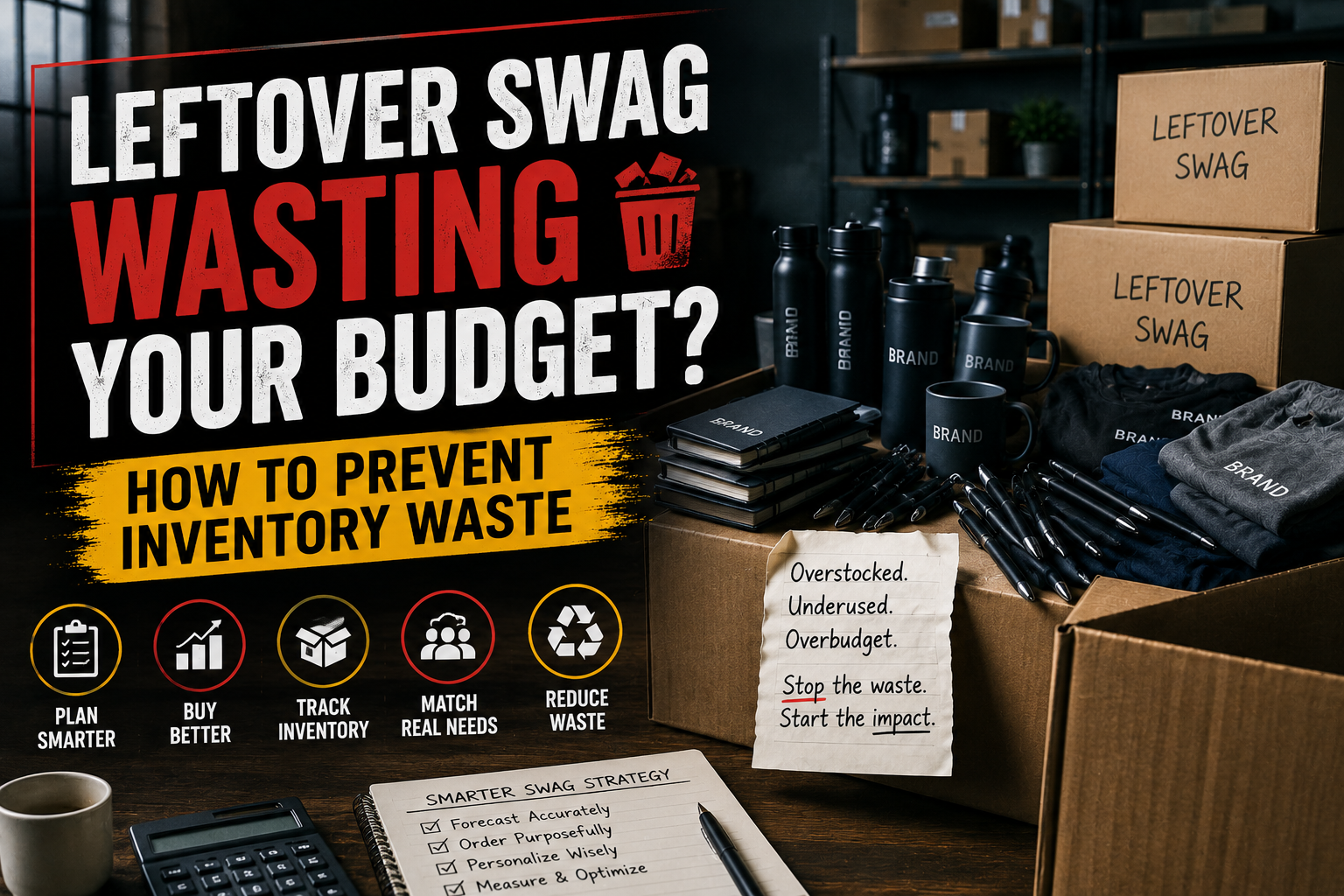
Leftover Swag Wasting Your Budget? How to Prevent Inventory Waste
Corporate swag can be an effective way to increase brand visibility, support employee engagement, and create memorable experiences at conferences and business events. But when organizations order more merchandise than they can realistically distribute, the same swag can quickly become a hidden budget problem.
Boxes of unused notebooks, outdated T-shirts, branded bottles, event giveaways, promotional bags, and other merchandise can occupy storage space for months. Some items eventually become irrelevant because campaigns end, logos change, employees leave, or the products simply no longer fit the organization’s current brand strategy.
For HR, Admin, and Events teams, managing leftover corporate swag waste is therefore more than an inventory issue. It is a procurement, budgeting, sustainability, and planning challenge.
The good news is that most swag waste can be reduced before the purchase order is even created.
The solution is not necessarily to stop ordering branded merchandise. Instead, organizations need a smarter approach to forecasting demand, selecting products, controlling quantities, managing inventory, and planning how unused items will be used.

What Is Leftover Corporate Swag Waste?
Leftover corporate swag waste refers to branded merchandise that remains unused after an event, campaign, employee initiative, conference, or promotional activity.
Common examples include:
- Branded T-shirts
- Caps
- Water bottles
- Notebooks
- Pens
- Tote bags
- Mugs
- Event merchandise
- Promotional accessories
- Employee welcome-kit items
- Festival merchandise
Not all leftover inventory is necessarily waste. Some products can be stored and reused.
The problem occurs when inventory becomes difficult or impossible to use because of excess quantities, outdated branding, seasonal relevance, poor forecasting, or unsuitable product selection.
That is when a useful marketing or employee-engagement investment turns into avoidable expenditure.
Why Corporate Swag Inventory Gets Left Behind
Several factors can contribute to excess corporate merchandise.
Overestimating Attendance
Events teams may order based on expected attendance rather than realistic confirmed registrations.
If a conference expects 1,000 attendees but only 700 arrive, 300 giveaways may remain unused.
Ordering Too Early
Early ordering can help avoid rush charges, but excessive quantities purchased months in advance can create unnecessary inventory risk.
Fixed-Quantity Packaging
Some vendors offer better pricing at larger quantities, encouraging teams to order more merchandise than they actually need.
Campaign-Specific Branding
Products carrying event dates, campaign slogans, or limited-time messaging can become difficult to reuse after the campaign ends.
Poor Inventory Tracking
If different departments independently order and store merchandise, teams may not know that suitable products already exist within the organization.
1. Forecast Demand Using Real Data
The first step in preventing leftover corporate swag waste is improving demand forecasting.
Instead of automatically adding a large percentage to the expected quantity, analyze historical information.
Review:
- Previous event attendance
- Registration-to-attendance ratios
- Employee headcount
- Historical giveaway distribution
- Campaign participation
- Previous leftover inventory
- Expected growth
- Confirmed versus estimated recipients
For example, if an event historically receives 800 attendees from 1,000 registrations, ordering 1,500 gifts may not be necessary.
The objective should be to establish a reasonable inventory buffer rather than an excessive surplus.
2. Separate Confirmed Demand From Contingency Stock
Events teams often need a buffer because attendance and participation can change.
Instead of treating the entire forecast as confirmed demand, divide it into two categories:
Confirmed requirement: Expected recipients based on reliable data.
Contingency stock: Additional units reserved for unexpected demand.
This makes the buffer visible.
For example:
Expected attendees: 1,000
Contingency: 5–10%
Planned order: 1,050–1,100
The appropriate buffer will vary by event type, product cost, lead time, and the consequences of running out.
A high-cost, highly customized item may require a smaller buffer than an inexpensive, reusable item.
3. Choose Reusable Swag Over Event-Specific Merchandise
One of the easiest ways to reduce future waste is to select products that remain useful after the event.
Compare:
Event-specific:
“Annual Sales Summit 2026” printed prominently on a T-shirt.
with:
Reusable:
A clean company-branded T-shirt or cap without a specific event date.
The second option has a much longer useful life.
If inventory remains after the event, it can potentially be used for:
- New employees
- Future events
- Internal recognition
- Customer meetings
- Employee campaigns
- Recruitment events
The less time-sensitive the branding, the greater the opportunity for reuse.
4. Avoid Over-Customization
Customization can make swag memorable, but excessive customization increases inventory risk.
A product carrying a company logo can often be reused.
A product carrying a specific event name, year, location, or campaign message has a much shorter lifespan.
For recurring events, consider using a standardized corporate identity and changing only small elements such as inserts, stickers, cards, or packaging.
This approach can reduce the amount of merchandise that becomes obsolete after a single campaign.
5. Maintain a Central Swag Inventory
HR, Admin, and Events teams should know what merchandise the organization already owns.
Create a central inventory system that records:
- Product name
- Quantity
- Department
- Storage location
- Purchase date
- Unit cost
- Branding
- Intended use
- Condition
- Recommended use-by date
- Reorder status
Even a simple spreadsheet or inventory management system can improve visibility.
Before placing a new order, teams should check:
“Do we already have something suitable?”
This single question can prevent duplicate purchases.
6. Use an Inventory Aging System
Not all leftover inventory should be treated equally.
Create categories such as:
0–3 months: Current stock
3–6 months: Review for upcoming use
6–12 months: Prioritize for redistribution
12+ months: Evaluate for repurposing, donation, or disposal
The exact timeframes can vary depending on the product.
The important principle is to prevent merchandise from sitting indefinitely.
Inventory that is ignored for a year is much more likely to become unusable.
7. Design Merchandise for Multiple Audiences
A product becomes more valuable when it can serve different groups.
For example, a neutral branded notebook could be used for:
- Employees
- New hires
- Clients
- Conferences
- Recruitment events
- Training sessions
By contrast, a product designed exclusively for one event may have very limited reuse potential.
When choosing swag, ask:
“If this event ends tomorrow, where else could we use this product?”
If the answer is “nowhere,” the organization should reconsider the quantity and customization strategy.
8. Use On-Demand or Phased Ordering Where Possible
Large events sometimes create pressure to purchase the entire quantity at once.
However, organizations with flexible suppliers may be able to use phased procurement.
For example:
Phase 1: Initial quantity for confirmed participants
Phase 2: Additional quantity based on registration or actual attendance
This approach can reduce excess stock.
It may not work for every product because custom manufacturing requires lead time. But for suitable merchandise categories, staged procurement can be an effective inventory-control strategy.
9. Avoid Buying Excess Inventory Just for a Bulk Discount
A lower unit price does not automatically mean a lower total cost.
Suppose:
500 units = ₹200 each
1,000 units = ₹150 each
The second option appears much cheaper per unit.
But if the organization only needs 600 units, purchasing 1,000 means 400 additional units must be stored, redistributed, or potentially discarded.
The correct question is:
“What is the total cost of the inventory we can actually use?”
A slightly higher unit price may be financially better if it prevents hundreds of unnecessary products from sitting in storage.
10. Create a Post-Event Inventory Plan Before Ordering
Don’t wait until the event ends to decide what happens to leftover swag.
Before purchasing, establish:
- Expected distribution
- Storage location
- Future events
- Internal reuse opportunities
- Employee distribution options
- Donation possibilities
- End-of-life process
This changes the mindset from:
“What will we do with leftovers?”
to:
“How will every unit be used?”
That is a much stronger inventory-management approach.
What to Do With Existing Leftover Corporate Swag
If your organization already has excess merchandise, don’t automatically throw it away.
Several options may exist.
Redistribute Internally
Use leftover merchandise for employee recognition, onboarding, internal meetings, or team activities.
Use It at Future Events
If the branding remains relevant, store suitable products for future conferences and campaigns.
Include It in Employee Kits
Unused notebooks, bottles, bags, and desk accessories can potentially become components of future onboarding or appreciation kits.
Create Small Gift Bundles
Several leftover products can be combined into curated internal or promotional gift sets.
For example:
Notebook + Pen + Tote Bag
may become a useful employee or event bundle.
Donate Appropriate Items
Where suitable and legally/operationally feasible, organizations can consider donating unused merchandise to community organizations or educational initiatives.
This can be preferable to disposing of perfectly usable products.
How HR, Admin, and Events Teams Can Work Together
Swag waste often occurs because different teams manage merchandise independently.
A better process creates shared responsibility.
HR
HR can identify employee gifting, onboarding, recognition, and internal-event requirements.
Admin
Admin can coordinate storage, procurement support, inventory records, and distribution logistics.
Events
Events teams can provide attendance forecasts, campaign requirements, and event-specific distribution data.
Procurement/Finance
Procurement and Finance can monitor purchasing quantities, costs, vendor terms, and inventory value.
When these teams share information, the organization is less likely to purchase products that already exist elsewhere.
Measure Swag Waste With Simple KPIs
What gets measured can be improved.
Organizations can track:
Inventory Utilization Rate
Used units ÷ Purchased units × 100
Leftover Rate
Unused units ÷ Purchased units × 100
Inventory Value
Unused units × Unit Cost
Obsolescence Rate
Obsolete units ÷ Total leftover units × 100
For example, if a company purchases 2,000 branded items and distributes 1,700:
Leftover Rate = 300 ÷ 2,000 × 100 = 15%
If each item costs ₹300, the unused inventory represents ₹90,000 in product value.
That number makes the financial impact much easier for leadership to understand.
A Simple Corporate Swag Waste Prevention Framework
Organizations can use a five-step process:
1. Forecast
Use historical attendance and recipient data to estimate realistic demand.
2. Buffer
Maintain a reasonable contingency quantity rather than automatically over-ordering.
3. Standardize
Use reusable products and evergreen branding wherever possible.
4. Track
Maintain centralized inventory records and monitor aging stock.
5. Reuse
Create a defined plan for redistributing leftover merchandise before considering disposal.
This framework can significantly reduce unnecessary inventory without compromising event quality.
Final Thoughts
Leftover corporate swag waste is often treated as a minor operational problem, but across multiple events and campaigns, the financial impact can become substantial.
The solution starts before the purchase order is created.
Forecast demand carefully. Separate confirmed requirements from contingency stock. Select reusable merchandise. Avoid unnecessary event-specific customization. Maintain centralized inventory visibility and establish a plan for leftover products.
Most importantly, don’t evaluate corporate swag only by its unit price.
A ₹150 product that becomes obsolete after one event may be more expensive in practical terms than a ₹200 product that can be reused across several campaigns.
For HR, Admin, and Events teams, the goal should be simple:
Buy what you can reasonably use, design what you can reuse, and track what you already own.
When corporate swag is managed as an inventory category rather than a one-time event expense, organizations can reduce waste, protect their budgets, improve procurement efficiency, and get significantly more value from every branded item they purchase.
Leave a comment