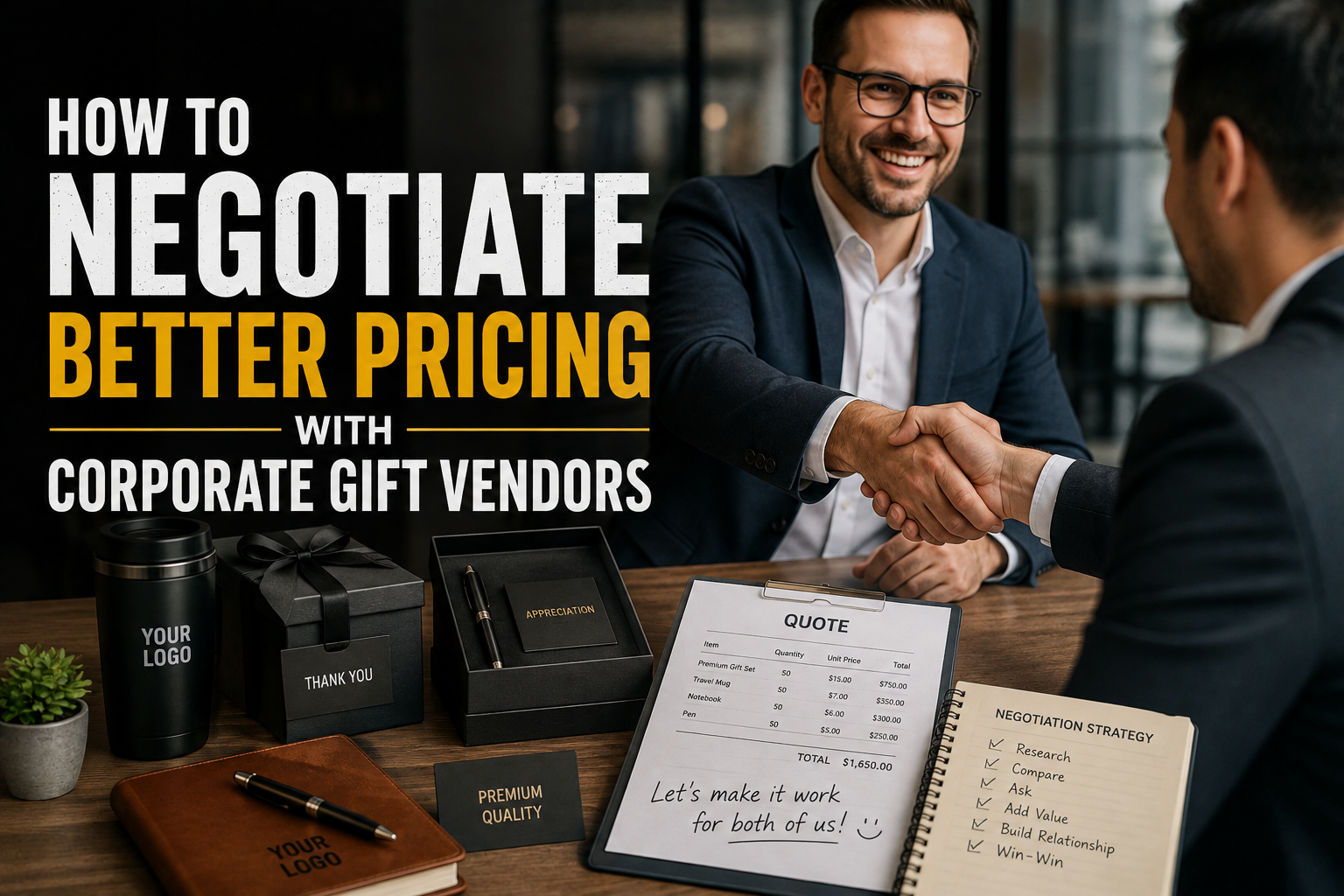
How to Negotiate Better Pricing with Corporate Gift Vendors
Corporate gifting can quickly become a significant business expense when an organization is purchasing gifts for hundreds or thousands of employees, clients, partners, or event attendees. Even a small difference in the per-unit price can have a noticeable impact on the final procurement budget.
However, negotiating better corporate gift pricing is not simply about asking a vendor to “give the best rate.” Effective negotiation involves understanding the complete cost structure, knowing your purchasing requirements, comparing vendors correctly, and creating a commercial relationship that benefits both sides.
For Procurement and Finance teams, the strongest negotiation strategy is to look beyond the headline product price and negotiate the total value of the corporate gifting program.
Whether you are planning festive gifting, employee rewards, client appreciation gifts, onboarding kits, or event merchandise, these strategies can help you secure better pricing without compromising product quality or recipient experience.

Why Corporate Gift Pricing Is Negotiable
Corporate gift vendors typically work with multiple cost components.
The final price may include:
- Product cost
- Branding
- Packaging
- Personalization
- Assembly
- Shipping
- Taxes
- Warehousing
- Customization setup
- Minimum-order requirements
- Delivery timelines
This means there may be several areas where commercial terms can be improved.
For example, a vendor may not be able to reduce the product price substantially but may offer better packaging rates, free branding, reduced shipping charges, or improved payment terms.
That is why successful negotiation should focus on the overall commercial package, rather than only negotiating the unit price.
1. Know Your Exact Requirement Before Negotiating
Vague requirements weaken your negotiating position.
Before approaching vendors, prepare a clear procurement brief covering:
- Number of recipients
- Gift category
- Target price range
- Required delivery date
- Delivery locations
- Branding requirements
- Packaging requirements
- Personalization
- Expected reorder potential
- Payment preferences
For example, saying:
“We need corporate gifts around ₹1,000.”
is less useful than:
“We require 1,000 employee gifts with branded packaging, delivery to five cities, individual recipient labels, and delivery completed by October 15.”
The second requirement gives the vendor enough information to prepare a realistic commercial proposal.
It also makes vendor-to-vendor comparison much easier.
2. Ask for a Complete Cost Breakdown
Never negotiate a corporate gift based only on the product’s advertised price.
Ask the vendor to separate the quotation into relevant components.
A useful quotation structure could include:
Product + Branding + Packaging + Personalization + Logistics + Taxes + Other Charges
This helps identify where the actual cost is coming from.
For example, Vendor A may quote a product at ₹850 while Vendor B quotes ₹900.
At first glance, Vendor A appears cheaper.
But after adding branding and delivery, the final prices could become:
Vendor A: ₹1,080 delivered
Vendor B: ₹1,020 delivered
The cheaper product was not necessarily the cheaper procurement option.
A complete cost breakdown gives Finance and Procurement teams a stronger negotiating position because they can identify the areas where savings are possible.
3. Use Volume as a Negotiating Lever
Quantity is one of the strongest advantages a corporate buyer has.
If you are ordering 500, 1,000, 5,000, or more units, the vendor may have greater flexibility because production, sourcing, and setup costs can be distributed across a larger order.
However, don’t simply ask:
“What discount can you give us?”
Instead, request structured volume pricing.
For example:
| Quantity | Quoted Unit Price |
|---|---|
| 500 units | ₹1,050 |
| 1,000 units | ₹990 |
| 2,500 units | ₹930 |
| 5,000 units | ₹890 |
This gives your team visibility into the vendor’s pricing curve.
You can then decide whether increasing quantity genuinely creates enough savings to justify the additional inventory.
4. Combine Multiple Gifting Requirements
One of the most effective ways to negotiate better corporate gift pricing is to look at your organization’s total annual requirement.
Instead of treating every occasion as a separate purchase, consider whether requirements can be consolidated.
For example:
- Diwali gifts
- Employee joining kits
- Anniversary gifts
- Client appreciation gifts
- Annual conference merchandise
- Recognition gifts
may all be purchased independently throughout the year.
If the organization can give a vendor visibility into recurring requirements, it may be able to negotiate better annual commercial terms.
The important point is that you should not promise volumes that are uncertain.
Instead, communicate realistic expected purchasing potential.
5. Negotiate the Package, Not Just the Product
Sometimes the product price has very little room for negotiation.
That doesn’t mean the commercial discussion is over.
Look at other cost components.
You may be able to negotiate:
- Free logo branding
- Better packaging
- Reduced setup charges
- Complimentary message cards
- Lower shipping rates
- Free samples
- Extended payment terms
- Reduced minimum quantities
- Replacement guarantees
- Storage support
- Phased delivery
For example, a vendor may refuse to reduce a ₹1,000 product to ₹900 but may agree to include ₹80 worth of branding and packaging.
Your actual saving is still meaningful even though the product’s list price remains unchanged.
6. Compare Vendors on the Same Specification
Competitive quotations are useful only when vendors are quoting for comparable requirements.
When requesting quotations, provide the same specification to each vendor.
Include:
- Product specification
- Quantity
- Branding method
- Packaging
- Personalization
- Delivery locations
- Delivery deadline
- Quality expectations
- Payment terms
Then compare the fully loaded price.
Otherwise, one vendor may appear cheaper simply because their quotation excludes packaging or shipping.
A standardized Request for Quotation (RFQ) can make this process much more effective.
7. Don’t Reveal Your Maximum Budget Too Early
If you tell a vendor:
“Our budget is ₹1,500 per gift.”
you may unintentionally anchor the negotiation around that number.
Instead, provide the required product specifications and ask vendors for their most competitive commercial proposal.
Once you receive multiple quotations, you can assess market pricing.
If a target budget must be communicated, it is often better to frame it as a commercial objective rather than an absolute maximum.
For example:
“We are evaluating options around the ₹1,200 range and would like your most competitive proposal for the complete delivered package.”
This leaves room for discussion.
8. Ask for Better Pricing in Exchange for Predictability
Vendors value predictable business.
If you can provide confirmed quantities, clear deadlines, early approvals, and a streamlined procurement process, you may have more leverage to negotiate.
For example:
“We can finalize the design this week and confirm the complete quantity immediately if you can improve the delivered commercial price.”
This turns negotiation into an exchange of value.
Instead of simply asking the vendor to reduce their margin, you are offering something that can reduce their operational uncertainty.
9. Negotiate Payment Terms
Price is not the only commercial variable.
Payment terms can have a significant impact on working capital and procurement flexibility.
Depending on the vendor relationship, you may negotiate:
- Partial advance
- Milestone-based payments
- Credit period
- Payment after delivery
- Payment after quality verification
A slightly higher unit price with favorable payment terms may sometimes be commercially preferable to a lower price requiring a large advance.
Finance should therefore evaluate the complete commercial arrangement rather than focusing exclusively on unit price.
10. Negotiate Delivery and Logistics
Shipping can become a major expense for corporate gifting programs distributed across multiple cities.
Ask whether the vendor can offer:
- Free or reduced shipping
- Consolidated shipping
- Multiple delivery locations
- Scheduled dispatch
- Vendor-managed inventory
- Phased delivery
- Reduced remote-area charges
If the organization has a large number of recipients in a few locations, consolidated delivery may be more economical than individual dispatch.
For employee gifting across India, however, direct-to-recipient delivery may be necessary. In that case, negotiate logistics pricing as part of the overall contract rather than accepting standard courier rates.
11. Request Samples Before Confirming a Large Order
A low price is meaningless if the final product does not meet expectations.
Before placing a large order, evaluate:
- Product quality
- Material
- Finish
- Branding quality
- Packaging
- Color accuracy
- Personalization
- Functionality
A sample can help prevent expensive mistakes.
For customized corporate gifts, also confirm whether the approved sample represents the exact production specification.
This is particularly important for large orders because correcting a quality problem after production can be significantly more expensive than identifying it before production starts.
12. Negotiate Minimum Order Quantities
Minimum order quantity (MOQ) can have a major impact on corporate gifting costs.
A vendor may offer an attractive unit price only when you purchase 1,000 units, even though you require only 700.
Before accepting the MOQ, calculate the cost of the excess inventory.
Ask whether the vendor can:
- Reduce the MOQ
- Combine multiple colors or variants
- Hold excess inventory
- Split delivery
- Apply the quantity toward a future order
A slightly higher unit price for the exact quantity you need may be more economical than purchasing hundreds of unnecessary units.
13. Use Annual Vendor Relationships Strategically
If your organization purchases corporate gifts regularly, avoid renegotiating everything from zero every time.
Instead, consider establishing preferred vendor relationships.
An annual commercial arrangement can cover:
- Agreed pricing bands
- Product categories
- Branding rates
- Packaging rates
- Logistics terms
- Service levels
- Replacement policies
- Payment terms
This can reduce procurement time and provide greater pricing predictability.
However, continue benchmarking the market periodically to ensure that the relationship remains commercially competitive.
14. Negotiate Based on Total Cost of Ownership
The cheapest quotation is not always the lowest-cost option.
Consider a simple example:
Vendor A
Product: ₹900
Packaging: ₹100
Branding: ₹50
Shipping: ₹100
Total: ₹1,150
Vendor B
Product: ₹950
Packaging: ₹50
Branding: Included
Shipping: ₹50
Total: ₹1,050
Vendor B has the higher product price but the lower total cost.
This is why Procurement teams should compare total cost of ownership, not simply the headline product price.
15. Create a Competitive but Professional Negotiation
Corporate gifting works best as a long-term vendor relationship.
Aggressive price pressure may produce a short-term saving but create problems later through reduced service quality, missed deadlines, or lower product quality.
A better negotiation approach is collaborative.
Explain your requirements clearly, share realistic volume expectations, ask for transparency, and identify areas where both sides can create efficiencies.
The objective should be:
Better commercial value + reliable quality + predictable delivery.
Not simply:
Lowest possible price.
A Corporate Gift Vendor Negotiation Checklist
Before finalizing a vendor, Procurement teams can review:
- Product specification confirmed
- Quantity confirmed
- Volume discount negotiated
- Branding charges confirmed
- Packaging charges confirmed
- Personalization charges confirmed
- Shipping costs confirmed
- Applicable taxes confirmed
- Minimum order quantity confirmed
- Sample approved
- Delivery timeline confirmed
- Replacement policy documented
- Payment terms negotiated
- Cancellation terms confirmed
- Final delivered cost calculated
This checklist helps prevent a low initial quotation from turning into a high final invoice.
Final Thoughts
Negotiating better pricing with corporate gift vendors is not about forcing suppliers to offer the lowest possible number.
The strongest Procurement teams negotiate the complete value proposition.
Start with clear requirements. Use realistic volume to create leverage. Request transparent quotations. Compare vendors using the same specifications. Negotiate packaging, branding, logistics, payment terms, and replacement policies alongside the product price.
Most importantly, evaluate the fully loaded cost per recipient.
A vendor offering a slightly higher product price may ultimately provide better value if packaging, branding, delivery, and service are included.
For organizations purchasing corporate gifts regularly, the biggest savings often come from better planning and stronger commercial processes rather than simply asking for a bigger discount.
When Procurement treats corporate gifting as a structured purchasing category, vendor negotiations become more predictable, budgets become easier to control, and the organization can secure better quality and value without compromising the recipient experience.
Leave a comment